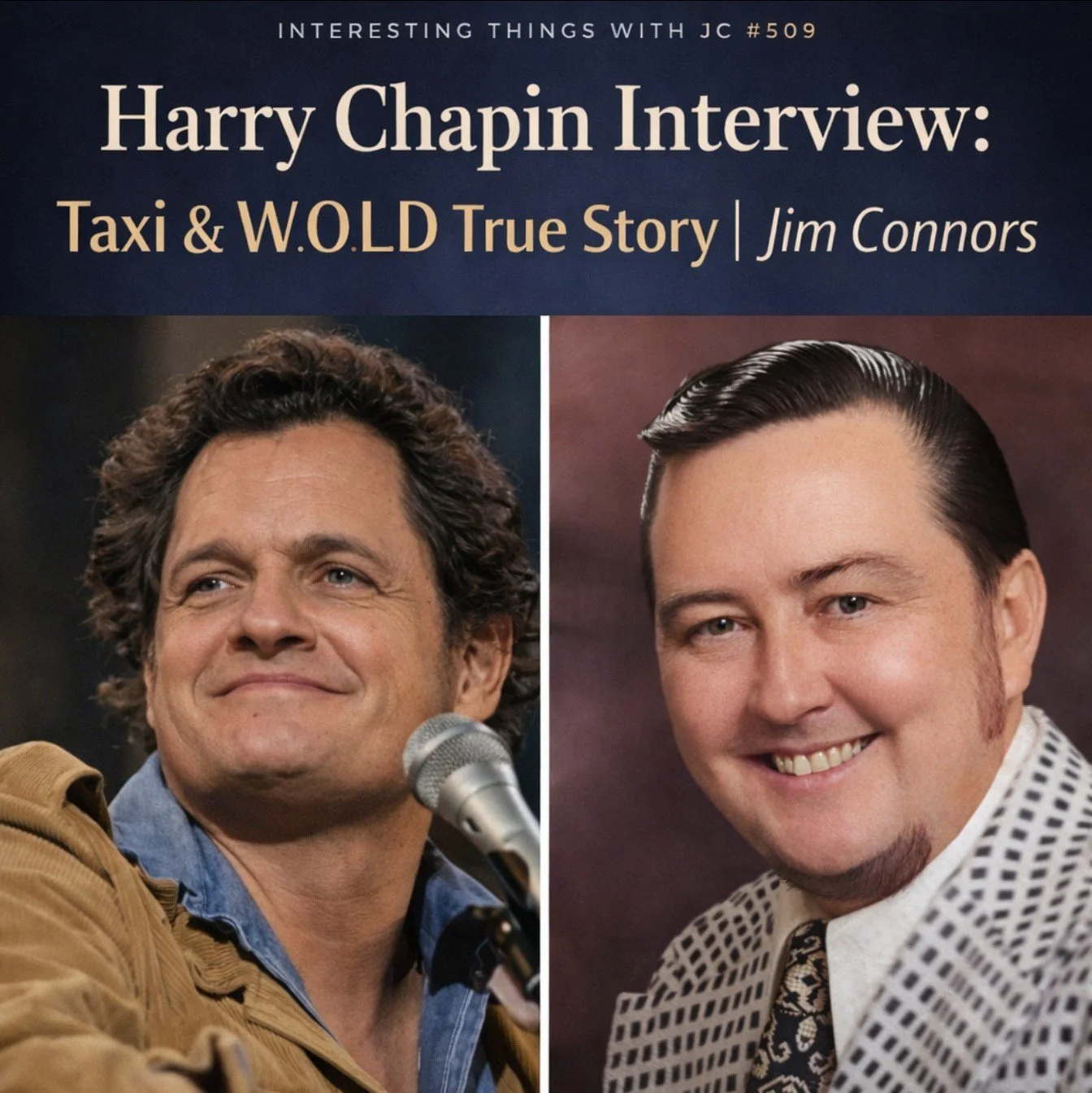
509: "Harry Chapin and Jim Connors"
Harry Chapin Interview:
Taxi & WOLD True Story | Jim Connors
Interesting Things with JC #509: "Harry Chapin and Jim Connors" - This rare Harry Chapin interview captures a never-before-heard conversation with radio pioneer Jim Connors, offering firsthand insight into the true stories behind Taxi and W.O.L.D.. In their own words, Chapin explains how his time in Boston and his relationship with Connors shaped his understanding of radio and inspired the ideas that led to W.O.L.D., while Connors reflects on how the song connected to his own life and career.
The interview also reveals the realities of Top 40 radio in the 1970s, including gatekeeping, competition between stations, and the commercial risk of airing a nearly seven-minute single like Taxi. As a primary source, this recording helps clarify and correct years of retelling surrounding these songs, preserving the perspective of the people who lived it.
Curriculum - Episode Anchor
Episode Title: Harry Chapin & Jim Connors
Episode Number: 509
Host: JC
Audience: Grades 9–12, Introductory College, Homeschool, Lifelong Learners
Subject Area: Music History / Media Studies / Communication
This transcript preserves the original tone, period language, and conversational character of the recording as part of the historical record, while speaker attributions and punctuation have been clarified for readability. For a fully accurate forensic verbatim reference, please consult the original attached audio. Special thanks to Ron Santora for transferring this reel to reel recording to digital format for legacy preservation.
Lesson Overview
Students analyze a primary source interview featuring Harry Chapin and Jim Connors to examine how storytelling, media gatekeeping, and professional relationships shape cultural impact. The lesson centers on two works, Taxi and W.O.L.D., exploring how personal experience, observed experience, and real-world impact intersect in narrative songwriting and media exposure.
Objectives:
Analyze how Taxi and W.O.L.D. emerge from different types of real-world experience
Evaluate the role of Top 40 radio gatekeeping and commercial risk in shaping success
Examine how artist-radio relationships influence public exposure
Interpret how storytelling can impact the lives of those represented
Essential Question: How do personal experience, observation, and media systems interact to shape storytelling and success?
Success Criteria:
Students cite transcript evidence explaining the origins of both songs
Students identify how radio gatekeeping influenced airplay decisions
Students explain the difference between literal truth and emotional truth
Students evaluate how storytelling affected Jim Connors’ life
Student Relevance Statement: Students connect storytelling, media influence, and career realities to their own future paths in communication, business, and creative industries.
Real-World Connection: Media exposure, professional relationships, and risk-taking decisions directly influence what reaches public audiences.
Workforce Reality: Creative and media careers require persistence, relationship-building, and the ability to navigate gatekeepers and industry constraints.
Key Vocabulary
Narrative (NAIR-uh-tiv): A structured account or story conveying meaning
Authenticity (aw-then-TIS-uh-tee): Genuine and truthful representation
Persona (per-SOH-nuh): The voice or character presented publicly
Transience (TRAN-zee-uhns): Temporary or short-lived nature
Limelight (LIME-light): Public attention or fame
Promotion (pruh-MOH-shun): Strategic communication to gain exposure
Audience Perception (AW-dee-uhns per-SEP-shun): How listeners interpret content
Industry Dynamics (IN-duh-stree dye-NAM-iks): Forces shaping a professional field
Resilience (ri-ZIL-yuhns): Ability to recover from setbacks
Narrative Core
Open: A rare recording captures the intersection of lived experience, observation, and real-world impact through two defining songs, Taxi and W.O.L.D.
Info: In this conversation, Harry Chapin and Jim Connors explain how both songs emerged from real experiences, including Chapin’s own life and his time spent with Connors in Boston.
Details: Taxi reflects Chapin’s personal experiences, shaped into a story that is not entirely literal but emotionally true. W.O.L.D. grew out of his exposure to the radio world during his time in Boston, where extended conversations with Jim Connors led him to recognize parallels between performers and disc jockeys. The interview also reveals the realities of Top 40 radio gatekeeping, including hesitation to air a nearly seven-minute single and competition between major stations. Connors further explains how the themes of W.O.L.D. intersected with his own life, showing how storytelling can return to affect the individuals who inspired it.
Reflection: This conversation demonstrates that storytelling is not one-directional. It originates from real lives, is shaped by artists, and can return to influence those same lives within professional and personal contexts.
Closing: These are interesting things, with JC.
Transcript
Interesting Things with JC #509:
"Harry Chapin & Jim Connors"
[Interesting Things with JC Narration]
This recording that you’re about to hear is being released today as a special Interesting Thing. This is going to be much longer than the typical 3 to 7 minute Interesting Thing that you’re used to hearing. However, this is an untold story that no one has heard outside of myself, my father, the gentleman who transferred the tape initially, and my uncle Brian, who provided me with this specific recording.
For years, my father was trying to take this recording and turn this into something more. There were also attempts to reach out to the Harry Chapin Foundation, as well as others, to share this forward.
So if you could sit back, grab yourself a drink, and prepare to be entertained, enjoy this conversation between Jim Connors and Harry Chapin.
[JC]
Hello, this is Jim Connors, Music Director, WYSL, Buffalo, and we’re going to have a little conversation with Harry Chapin. Artist, gentleman, Harry, welcome to Buffalo, New York.
I met Harry Chapin in Boston, Massachusetts, while working at WMEX Radio, and Harry was working at the time on a record called “Taxi,” which did, according to Elektra Records, roughly 850,000, not getting the city of Chicago and Miami, unfortunately. But it was enough to bring Harry Chapin into the limelight and make people think about themselves, because Harry writes very openly, very honestly, about situations. I think I would let Harry explain “Taxi,” if he cares to, what that was about.
[Harry Chapin]
Yeah, well, it’s a song about broken dreams. I try, as much as I can, to get all my songs to be grounded where the persona, the person in the song, speaks about something he knows about. Not so much literal realities of reflecting oneself, but the emotional realities. I base a lot of my songs on myself, but I don’t necessarily make every detail accurate. The important thing is to have it emotionally ring true.
So “Taxi” is about 60 to 70 percent literally true and 100 percent emotionally true in terms of me. I had to get a hack license because the film business, which I was in for 7 years, between 1965 and 1971, sort of fell apart. At that time, the recession hit and I couldn’t get much work, so I got myself a hack license. During that time, while I was waiting for it to come through, I’d heard an old girlfriend of mine had married a rich guy instead of becoming an actress, and here I was, who at one time went to the Air Force Academy and wanted to be a pilot, about to be flying in my taxi.
So I wrote the song about flashing on the fact of what it would be like one night if she got into the cab.
[JC]
She never actually did?
[Harry Chapin]
Oh, come on.
[JC]
No?
[Harry Chapin]
No. But I wrote the song and couldn’t find anybody dumb enough to sing it, so I had to put the group together to do some of my story songs myself. We couldn’t find anybody dumb enough to hire the group, so we rented the Village Gate in New York City for $400 a week and ran our own club, wives and girlfriends to handle the tickets and serve drinks. Whenever we heard that a record company or a reviewer was coming, we’d stack the audience with friends and relatives and get standing ovations after every number. Finally, we got things going, and about 8 record companies got interested in us.
We ended up by signing with Elektra Records because of, basically, Jac Holzman, who produced the first record. He’s the president of the company, or was. He’s since retired. “Taxi” was the first single, although I didn’t write it to be a single. As I say, I try to write as accurately as I can and let the chips fall where they may.
[JC]
To be very honest with you, as I recall “Taxi,” the discussion I had with the program director, as music director there at the time, was the fact that it was so doggone long and whether or not we could get away with playing a 7 minute record. Probably, was it over 7 minutes?
[Harry Chapin]
No, it was 6:55 on the air.
[JC]
And I said, well, you know, there was a time I did a concert in Cleveland for The Association, and at the time one of the guys, Jim Yester from the group, we were discussing length of music, lyrics, and so forth, and he says, “Jim, if it was 25 minutes long and it was the right kind of lyric, I would do it.”
So this is exactly what I told the PD, and I said, “I think we should give this record a shot.”
[Harry Chapin]
Well, you guys were the first regular Top 40 station playing that in the cuts, right? So that started it for you.
[JC]
Yeah. Unfortunately, Chicago, can you tell me why? Do you think it might be? I’ve tried to analyze this situation as to why not Chicago, because I had Jim Smith from WLS on the line and he wouldn’t get into it. Now, if all the FM stations in Chicago are playing a particular record, it seems to me that WLS or WCFL should be interested in Harry Chapin. I’m trying to pick at him mentally why he’s not playing the record.
[Harry Chapin]
Well, I can’t figure out why they won’t get into it. I don’t know. Sometimes it may be a competitive situation with WCFL and WLS, where both, I remember in terms of “Taxi,” both the fact that the record was long and if one went on the other would have to go on. I think they were both waiting for the other one to go on.
Also there was a slight controversy over the word “stoned” in the song, “flying so high when I’m stoned,” at the end of the record. I remember ABC in New York had to have a corporate meeting to decide whether it was a pro or anti drug record. The fact that we’d been on the Cavett show and the Carson show singing it sort of took away that whole problem, so they ended up playing it.
But it is ironic that both Chicago and Miami, on both these records, are the only 2 major markets that have not played them.
[JC]
I don’t know. It was Jim Dunlap I met a couple times, real nice guy. Was he in Miami back then, 2 years ago?
[Harry Chapin]
Sure. PD, WQAM, right?
[JC]
Yeah, absolutely. I don’t know whether Elektra Records had something to do with it because there was a problem down there with Jim Morrison and The Doors.
[Harry Chapin]
Oh yeah, we all know that situation.
[JC]
It can’t be anything else. I can’t think of anything else unless it’s something against Jim Eisen, the original streaker, I guess.
[Harry Chapin]
He sure as hell did. I met the guy who was the DJ that introduced that show.
[JC]
Really?
[Harry Chapin]
And he said that there was no doubt about that, that he not only exposed himself but was quite obscene.
[JC]
That particularly you could get away with that in Buffalo.
[Harry Chapin]
No, they’re streaking here.
[JC]
Really? Do you think you might do it at a concert in Buffalo?
[Harry Chapin]
I tell you, we went down South 2 weeks ago and did it. We turned on Don Burns, I’ll tell you that. Miami, Mississippi, Alabama, and Florida, boy, streaking is the biggest thing, as big as the Beatles. It’s incredible.
We did a concert there. There were about 2,800 people in the concert, and then supposedly 10,000 people on campus. We went outside and the other 7,200 people were all out there watching the streakers. Really incredible.
[JC]
After Harry left with “Taxi,” anyway, I think we got to number 1 with the record, 1 or 2, I forgot. I forgot about Harry Chapin, as a matter of fact, to be very honest with you, until he walked into the studios of WYSL, I don’t know what it was, January, somewhere in there, and came in with an album. Fred Horton, looks like “the son of a horse going west,” which is the local commercial records, he speaks very well of you. They come downstairs and maybe listened to a record, and Fred says, “It’s got something to do with you.”
Well, since that remark, and the way the record’s gone and everything else that’s happened with it, the article is in the Buffalo and Chicago paper, I had to sit down and analyze a certain meeting that we had had in Boston. I can remember Harry with his hands across a console, something similar to the one we’re speaking on here today, and looking at me when I said a couple of things about, oh, the Osmonds, I think it was, the Osmonds concert, where there were some kids who managed to walk over bodies trying to get to Donny Osmond. What the hell they wanted to do that for, I don’t know.
[Harry Chapin]
Probably learning how to suck salt, which is all they do in Salt Lake City.
[JC]
Is that where they’re from? Salt Lake City?
[Harry Chapin]
I don’t know. They’re Mormons. They’re flakies.
[JC]
But anyhow, we were talking about the young kids and hops and some of the different things that are related to youth. There were about 4 people in that room, Harry. There was somebody else. I’ve got Tom Allen in my head. Tom, it was yourself, you, and I’m not sure if it was a guy from Elektra, Greg Kimmelman, or somebody.
[Harry Chapin]
I think it was Greg.
[JC]
I related to that. I can relate to that. I can relate to my hairdo at the time, thanks to the girl I’m going to marry from South Buffalo. She changed my hairdo because at the time it was a greaser, and you could see all kinds of little problems on my head, fortunately not at the other end of my body. She got the part that talks.
What else can I relate to? One of the other problems, personal problems, that come out on a record. Harry likes to sing about people. I will have to relate to another artist on this particular note, Paul Williams, who I spent a couple of hours with. Paul went through a bad marriage, and we sat and talked about the honesty in lyrics and the fact that that’s what people accept.
If you want to fool around with some gimmicks and sounds, okay, it may hurt you when you get on stage and you can’t do the same damn thing you did on a record. But if you’re very open and honest with people, like Nilsson’s “Without You,” or in the case of Paul Williams, “Waking Up Alone,” “I Won’t Last a Day Without You,” I mean that’s honesty in writing, and that’s what Harry does.
As a matter of fact, I might be able to corner Harry a little bit on one subject. Over the holidays, they weren’t the greatest holidays in the world because, Harry, one part of this record caused the young lady I was going to marry to forget about getting married. Would you come over here for just a minute? Just tell everybody we are going to get married anyhow.
She came back, and I was very pleased about that, but at the time it was a horror movie over the holidays. I ran into King Arthur Knight from WMEX, as a matter of fact. I brought him to that station, and he was telling me that you’re contemplating something along the lines of him next.
[Harry Chapin]
I knew it. I knew it.
No, I mean the song really grew out of that initial exposure to the jock world that I got that first weekend up in Boston. We did a concert with Carly Simon. I opened for Carly at Symphony Hall. I met you, and I spent most of the weekend, I talked far more with you than anybody else that weekend. Then I sort of forgot about the whole thing for about a year and a half. Then it started hitting me that there were so many analogies between being a performer and being a disc jockey, the transitoriness of the life, in terms of both the business you’re in, the longevity in terms of your success, the heavies it takes on your personal life, some of the less glamorous aspects of the business that occur behind the scenes.
I think most people don’t understand that the average DJ, as big as you can get or the smallest guy, usually operates out of a room no bigger than 10 by 10, and there’s a single microphone. Maybe there’s an engineer. Maybe you’re doing your own engineering, and you’re really having to create your own excitement. It’s like any other business. It has some of its more real, down to earth, and less glamorous aspects.
But there’s a special demand in this business, and that is in terms of public acceptance and relating to an audience. Depending upon what station you’re at, often the thing that hit me, I’m 31 years old now, and my audience varies or ranges basically from about 18 to 35, but singles are bought by people who are usually 10 to 15.
[JC]
Right.
[Harry Chapin]
It creates a kind of pressure on an artist. Now I still try to write as good songs as I can and don’t write for that audience, but in terms of radio, that was the irony of the line, the 45 was an arbitrary age, but “45 going on 15.” I was even relating to myself in that whole thing of saying, you know, the irony of it. Most of the people in pop music now are maybe 10 years older than the people they’re singing to, at least 10.
I’ve listened to Cousin Brucie on WABC. He’s a guy I listened to when I was a kid. It’s 15 years later and there he is, saying his thing to all the little girls out there, and he’s old enough to be their father. He’s a great jock, but there’s an irony there, trying to be in a youth related industry and yet finding yourself getting older and having to do some assessments about what you’re really about.
So all these things came into play about the record, and then, as I do in most of my songs, I start out with an emotional reality, which came from the exposure in Boston, moved on and sort of put myself into it too, and then let the song take its own head and go where it seemed to be the right places to go. So I tried to distill as much as I could of that feeling into the song, and from the reactions around the country, it seems to have hit a chord on the inside.
[JC]
I would like to think that on the inside, and believe me, you don’t even have to buy me a cup of coffee for it, because the most important thing to me is creating and discovering people on the inside. It’s a thrill to be able to talk to all the Top 40 program directors and music directors around the country, which I do. I explain to them different things like I did about Chai Coltrane. The record got to 11 in the country, did close to a million, and she’s my claim to fame. Clint Holmes is my claim to fame. Chuck Berry, which is a tremendous thrill, rediscovering Chuck Berry, who I grew up with, all his music, I should say, and telling these program directors that Harry Chapin is a hit.
Please give him a chance in your city because I think he’s open, honest, and sincere, and that’s what the people need now. Like I said at the Billboard Convention as a speaker in 1972, if it’s good enough for these other Top 40 major market program directors and their people in their city, it’s good enough for you.
And it’s a thrill to have it accepted, except, like I say, in these 2 cities. To me, Harry, face to face, that’s what I want to say to you. It’s a thrill.
[Harry Chapin]
Well, I appreciate the things you’ve done, and I also appreciate your reaction to the whole thing. I am going to continue writing about real things. Some of my songs are probably too long for commercial radio, be it “Sniper.” I’ve got a new song now, it’s called “What Made America Famous.” That’s going to be a little shorter than “Taxi,” but so far the reactions to it from some radio people, you’ll hear it tonight...
[JC]
Give us a taste.
[Harry Chapin]
I haven’t got a guitar, so I won’t. But Johnny Mathis...
[JC]
I got some guy calling up here in the morning, Harry, and he makes the whole day because he’s kind of flaky. He says, “Would you play Johnny Mathis?” I said, “Look, it’s Johnny Mathis. Mathis, Mathis, Mathis, for God’s sake.”
[Harry Chapin]
Yeah. So the key is, see, I’m always pleasantly surprised when one of my songs really does do well on Top 40 radio because, as I say, I’m not writing for that audience. But what I feel is that I will get my shots as long as I qualitatively keep coming up with good records and good songs, real songs, that talk about real problems, real people, and I’m building for a long range career, not a flash 2 year...
[JC]
What are your goals?
[Harry Chapin]
Well, I’d put it very simply. I’d like to be to American music and thought what Jacques Brel is to France, in the sense that Jacques Brel sort of stands for something. He seems to capture the tonality of some of the real beautiful and less beautiful aspects of what France is. I’d like to be the songwriter that talks about the common people and the common goals and the common problems and the common denominators of this country.
So yeah, you’ve got to keep working. It’s not a commercial goal. It means creating a tonality, a life work, a body of music that seems to relate in the long run to an awful lot of the good sides of people.
People can be approached in 2 ways. An audience can be either a mob or a collection of people who can function in a positive way. There are a lot of artists, and it’s just as valid, obviously, because you get a lot of reactions, who do approach audiences in a sense as a mob, trying to get a mob reaction, almost a mindless one. I approach it in a different way. I try to get people reacting from their hearts, from their minds, to the things in themselves. Hopefully my music can be bigger than I am and reach and add to an awful lot of people.
[JC]
That way if somebody else records it, you get a little check from Japan for $6 every month, you mean?
[Harry Chapin]
No, I don’t have to worry about that, thank God. A couple of people have just recorded “Taxi.” It’s really funny. A friend of mine sent me a copy of the “Heads and Tales” album that had been bootlegged on Taiwan.
[JC]
Oh wow.
[Harry Chapin]
And it was selling for 89 cents. It looked like it had been printed on cardboard. The disc and the cover seemed like they were made out of newspaper. It was really incredible.
[JC]
I’ve got one question. What was going on inside your mind the first time you played the record for JC?
[Harry Chapin]
I don’t know. My reaction? Well, he had 5 one dollar bills. I said, “No, no, that’s all right.”
My reaction is that I was proud of the song, and since Jim was one of the first people to be aware of me, I figured that he would give it an open hearing. That’s what he did.
[JC]
And I want to tell you why I gave him an open hearing. I’ll have to think about that for a second. I got the thought. I don’t get into artists that much. I’ll emcee your show. I’ll be a part of you, go to dinner with you, but I won’t open up to you unless something makes that happen.
In the case, I have to relate quickly to Chai Coltrane, explaining the fact that she wrote this, blah blah blah, and started explaining something personal about herself. Harry got into something about, maybe Harry could explain this more than I could, but it just floored me. I had to sit down when he started into this thing about his uncle, I think it was, who was hanged first of all. Right away I thought, I’ve got to find out about this guy.
[Harry Chapin]
No, it’s back... up in Boston, the only 2 famous members of my family from the past were from around that area. One guy was Deacon Samuel Chapin, who founded Springfield, Massachusetts, around 1640, and the other guy was the first guy to be executed for incest in Massachusetts history. I was just telling him this. He was asking me if I’d ever been up around Boston, and I was saying, you know, my whole family’s from up around that area, even though I grew up in New York City.
Then I started telling him about this song I had on my first album called “Dogtown,” which sort of subtly intimates a relationship of animal husbandry. Anyway, we just got kidding around, things like that.
[JC]
When I heard they were mixing pills with cost of salt, I said I’m going home. All right, something better. I got him off the track. Take it where it goes.
Oh boy.
What was your reaction the first time you heard “W.O.L.D.”?
First reaction? That’s a business. The record store, that’s part of it again. I’ve always wanted to have a record store. Matter of fact, Harry, when we get old, we make that a goal. Start a record store, man. I can really hustle them damn things, especially the ones that say “Not for Sale.” Are you kidding me? Are you serious? Are you kidding me? I got one going in South Buffalo right now.
But some somber thoughts at the moment. The people down in the area that I worked at for 9 years took some cracks on the air, and I couldn’t do anything about it.
[Harry Chapin]
Where was this, in Buffalo?
[JC]
No, down in Erie. They wanted to get the record off the air, and I couldn’t do anything about that. I said, “Hey, listen, the jocks down there were playing it, saying smart remarks.”
So that’s the only thing I can relate to as an effect of it. Having Harry Chapin discovered is an accomplishment, and that’s been a goal. If whatever he does from here makes him a million seller, I’ll be the happiest man in the whole world because I’ll have had something to do with it.
Like I said, Chuck Berry, it’s a tremendous thrill. Imagine growing up with rock and roll music, “Johnny B. Goode,” “Sweet Little Sixteen,” the guy fades out, went to jail as a matter of fact, took a girl across the border, what have you, came back again in the 1960s, 1964, 1965, faded out again, came back with a record called “My Ding-a-Ling,” and I wound up the first music director in the world to play the goddamn song, to expose the record in market 6 around the country. I got gold for that.
If I wasn’t a music director, as a matter of fact, I could have gone to England and shared the joy with the company, but of course that’d be a conflict. But no, really, it was a tremendous thrill to rediscover a great star like Chuck Berry. It’s a thrill to me now.
With your other goals, as far as I’m concerned, I hope, Harry, that you sincerely, sincerely make it.
[Harry Chapin]
Well, I’m just chugging, writing as good as I can. We’ll see where it goes.
[JC]
How many other jocks around the country were as open to the music as JC was?
[Harry Chapin]
Well, on “W.O.L.D.,” I think almost all jocks reacted favorably to it. There was only one area where there was... I mean I don’t know what happened in Chicago and Miami, but I know one major guy in Milwaukee felt that it was denigrating to jocks. But no other jock ever felt that. He was the only guy. So that was the exception to prove the rule.
Most of them felt it was a serious treatment, and they saw a lot of themselves in it. Gavin and a lot of the sheets made editorials about it. Jim did some stuff in his thing. It gave everybody a chance to start talking about long range goals, assessing what the disc jockey life is like.
And so I’ve got to correct you on one note. We do not ride horses with records in our hands. We are not just jocks. We are radio personalities. Thank you.
So I would say in general the reaction has been very good. As a matter of fact, it almost worked as a counter problem because they felt that it was too much of, at first, too much of an in industry record, that it was something that would only appeal to jocks and music directors and program directors. But then, when they found out the places that did play it at the beginning, that there was a strong reaction, strong phones, it had the same sort of pattern as “Taxi,” where if it was played, since it sounded different from anything else on the radio at the time, there was a fair amount of interest in terms of people calling up and asking about it.
[JC]
Harry, there’s an epilogue, just one epilogue I’d like to touch on shortly. That is that Buffalo, New York, it’s been a horror movie. As a matter of fact, the only reason I’m back here, or came back here, was to take care of ex problems. They’re taken care of.
In the interim period, I ran into a girl and we got to know each other, and we split 2 or 3 times, as a matter of fact. There were a number of different times where I wanted to get out of this damn city and go back home so bad, you know. Again, the people of Buffalo have started to accept me and change my thoughts on that, and this young lady, Kathy Marinacho, has decided this time that we’re going to be husband and wife.
The epilogue to the whole thing is that I am very, very happy, and I have not been very happy. It’s been a goddamn horror movie, let me tell you, this whole business in the last 3 years between Boston and here. But there ain’t going to be no more freaking horror movies.
[Harry Chapin]
Well, that’s the thing about life. It keeps shoving you in interesting places. A lot of my songs are about having a positive reaction to negative stimuli. I don’t write that many happy songs per se because it’s not the most interesting times in life. The most interesting times in life are, to say it a different way, when things are going great, you don’t really need other people, but when things are going badly, it’s the time you do need other people. Those are the times when hopefully you can change negative momentum into positive momentum.
It’s happened to me a lot of times in my life, and it’s nice to know that happens in other people’s lives.
[JC]
To show you how bad it is now, how much I love this girl who’s in this very room, she’s afraid to say something, is the fact that last night you’re performing in Buffalo at a place called Bishop Neumann High School. While you’re here, last night we had a basketball game at a place called Lancaster High School against some people out there, and I had to come on the air this morning and apologize because I led the entire WYSL staff to Bishop Neumann High School last night instead of Lancaster.
[Harry Chapin]
No.
[JC]
I swear to God I did.
[Harry Chapin]
Wow.
[JC]
Everybody says, “I don’t know where he’s going.” That’s right. We got into 5 fights because of it. I said, “Cathy, I can’t figure out how come you’re almost 21 years old and you don’t know your way around Buffalo.” She says to me, “Can you figure out why you don’t have any direction?”
Well, so what? Did you win or lose last night? The game came out a tie, and I got there a minute and a half before the game ended and shot my weapon. I have a little gimmick and I shot my gun off.
So it was a tie. But anyhow, I went to Bishop Neumann. That’s funny. Ain’t nobody there. Ain’t no game going on. So you know where my head’s at.
[Interviewer / Off mic question]
Does it make it more difficult for you if you write about things that are much closer to being real, that touch on people’s lives, like the thing that happened with JC, just as a performer? Does it make it...
[Harry Chapin]
Well, in a sense, I work very hard, and I’m working very hard in my own personal life, to constantly get myself back in touch with reality. I mean the radio industry, the record industry, performing, there’s a tremendous temptation to get into unrealities. First of all, you’re dealing with a non real concept, i.e., an audience.
An audience, what it really comes down to often for a performer, is a whole bunch of applause sounds that tickle your eardrums. But you don’t really relate to any individuals. This thing can start happening, especially... I’ve known performers, big name performers, who have gone out and done horrible shows and gotten standing ovations and everybody’s going hog wild, and they know they did a bad job. It’s almost like knee jerk reaction time, and it becomes terribly freaky feeling to find that the personal inputs you put in don’t create the same reaction back.
I know also people who have no names at all who will put on a fantastic show in front of an audience who, if they were at least open minded, would react fantastically back to them, and nothing happens.
So okay, but the thing is, for a performer, as he starts becoming successful, or a radio personality, or whatever, is to work very hard constantly to get into touch with himself and with real relationships, with real people, and in a sense defuse that gradual sense of dealing with a non concrete concept such as audience reaction.
The most important thing that happens for me is between my head and my guitar, my head and a piece of paper as I’m writing. I don’t just write music. I read a lot of other things. If I don’t keep that being the major message to me, the major important thing, then I’m going to lose whatever I have.
I’ve met so many guys whose first and second albums have been monsters, not necessarily just in terms of public acceptance but in terms of quality work, and then because of increasing success end up losing the very things that gave them that success because they start relating to the reaction to what they’re doing rather than what they’re doing.
So you’ve got to constantly, over and over and over again, keep going back and doing your homework, going back to the basics of what you’re about. To me, that is writing about real things, real people, real feelings.
[JC]
And there’s my vibration. When that curtain comes down, who’s there? Who have you got there? There’s somebody waiting, huh, to share that with.
A wife, some kids. Yeah, yeah, all that matters. And even more than that, on the most basic sense, when the curtain comes down, who’ve you got that faces yourself? If you haven’t done a good job in terms of yourself, even if you’ve convinced the wife and kids and the audience, of course, that everything’s been hunky dory, and you can’t look at yourself in the mirror, that’s even worse.
So it starts as close as you can get to home and spreads out from there.
[Harry Chapin]
The constant job of any human being is, it’s a simplistic truism, but to be as much in touch with what you are as possible and try to have an open communication with yourself before you can even hope to have it with other people.
[JC]
I have an Irish wish for you before I close out my end of it, because I don’t have anything more to say. Harry Chapin, may the wind always be at your back, and the road rise before you. The dust from your carriage continue to blind your enemies, and may you be in heaven 5 minutes before the devil finds out you were dead.
[Harry Chapin]
Thank you, JC.
[Interesting Things with JC Narration]
These are interesting things, with JC.
Student Worksheet
Respond in complete sentences using evidence from the transcript.
Comprehension: What does Chapin mean by “emotionally true”?
Comprehension: What real-life experience influenced Taxi?
Analysis: How did Chapin’s time in Boston influence the creation of W.O.L.D.?
Analysis: How did Top 40 radio gatekeeping affect whether Taxi was played?
Analysis: How did W.O.L.D. connect to Jim Connors’ life?
Reflection: How can storytelling impact both audiences and the people it represents?
Difficulty Scaling:
Basic: Questions 1–2
Intermediate: Questions 1–4
Advanced: All questions + extended reflection (8–10 sentences)
Student Output: 6–10 sentence analytical response comparing Taxi and W.O.L.D.
Academic Integrity Guidance: Use transcript-based evidence; paraphrase rather than copy
Teacher Guide
Quick Start: Play opening segment of audio, then distribute transcript
Pacing Guide (Audio-First):
Audio listen (33 min)
Guided discussion (10 min)
Worksheet completion (15–20 min)
Bell Ringer: What makes a story feel real even if details are not exact?
Audio Guidance: Focus on tone, humor, and conversational authenticity
Audio Fallback: Instructor-led reading of transcript excerpts
Materials: Transcript, worksheet, audio
Misconceptions:
Songs must be factually exact to be meaningful
Success depends only on talent
Discussion Prompts:
Why was a 6:55 song a commercial risk?
What role did Jim Connors play in Chapin’s success?
How did Boston influence W.O.L.D.?
What is the difference between personal and observational storytelling?
Formative Checkpoints: Monitor responses and discussion
Differentiation:
Provide guided notes
Offer verbal response options
Assessment Differentiation: Oral vs written responses
Time Flexibility: Expand into research project
Substitute Readiness: Fully transcript-based option
Engagement Strategy: Compare with modern streaming vs radio
Extensions: Research another artist influenced by real individuals
Cross-Curricular: Economics, psychology, media studies
SEL: Identity, resilience, self-awareness
Answer Key:
Emotional honesty over factual detail
Economic hardship, lack of opportunities, industry barriers
Radio exposure enabled national recognition
Performers must balance authenticity with audience expectations
Personal response (varies)
Quiz
What does Chapin prioritize in songwriting?
A. Popular trends
B. Emotional truth
C. Short length
D. InstrumentationWhat inspired W.O.L.D.?
A. A movie
B. Radio experience in Boston
C. A book
D. A concertWhy was Taxi risky for radio?
A. Language
B. Length
C. Genre
D. CostWhat role did Connors play?
A. Producer
B. Songwriter
C. Radio advocate
D. ManagerWhat theme is central to both songs?
A. Wealth
B. Fame
C. Real-life experience
D. Fantasy
Assessment
Open-Ended Questions:
Compare how Taxi and W.O.L.D. were created from different types of experience.
Evaluate how media gatekeeping influenced the success of Taxi.
Rubric:
3: Strong analysis, clear evidence, real-world connection
2: Partial analysis, some evidence
1: Minimal or unclear
Exit Ticket: One sentence explaining how storytelling can affect real people
Standards Alignment
CCSS.ELA-LITERACY.RI.11-12.1: Cite strong and thorough textual evidence to support analysis of what the text says explicitly and implicitly, demonstrated through transcript-based responses and written analysis.
CCSS.ELA-LITERACY.RI.11-12.6: Determine an author’s point of view and analyze how style and content contribute to the power and persuasiveness of the text, applied through evaluation of Chapin’s storytelling philosophy.
CCSS.ELA-LITERACY.SL.11-12.3: Evaluate a speaker’s point of view, reasoning, and use of evidence and rhetoric, measured through discussion and listening analysis of the interview.
CCSS.ELA-LITERACY.W.11-12.2: Write informative/explanatory texts to examine and convey complex ideas clearly, demonstrated through structured student responses on authenticity and media influence.
C3.D2.Eco.2.9-12: Use economic reasoning to analyze the role of incentives, competition, and market constraints in career pathways, applied to radio gatekeeping and music distribution challenges.
C3.D2.His.16.9-12: Integrate evidence from multiple sources to develop claims about historical and cultural developments, demonstrated through analysis of 1970s music industry context.
ISTE 1.1 Empowered Learner: Students build strategies to leverage media and learning tools to deepen understanding of real-world systems, demonstrated through analysis of radio as a communication platform.
ISTE 1.3 Knowledge Constructor: Students critically evaluate information from primary sources to construct meaningful understanding, applied through transcript interpretation.
Career Readiness (CTE Arts, A/V Technology & Communications):
Demonstrate understanding of media production, distribution, and audience engagement
Apply communication skills to analyze professional interviews and industry dynamics
Evaluate persistence, adaptability, and self-promotion as career competencies
Career Readiness (Employability Skills Framework):
Critical Thinking: Analyze authenticity and audience impact
Communication: Interpret and respond to spoken and written narratives
Self-Management: Reflect on persistence and long-term goal setting
NGSS Science & Engineering Practice (Cross-Disciplinary Application):
Analyzing and Interpreting Data: Evaluate qualitative information from real-world narratives to identify patterns in human behavior and decision-making
Lifelong Learning / Homeschool Alignment:
Apply real-world narratives to personal development and career exploration
Develop independent analysis skills through primary source interpretation
Connect historical media practices to modern communication environments
Show Notes
This episode presents a rare and historically significant primary source conversation between Harry Chapin and Jim Connors, centered on two defining works, Taxi and W.O.L.D., and the real-life experiences that shaped and were shaped by them. While Taxi reflects Chapin’s own life and his approach to emotional truth in storytelling, W.O.L.D. grew out of his direct exposure to the world of radio during his time in Boston, where extended conversations with Jim Connors gave him insight into the realities of the profession.
In his own words, Chapin explains that this early exposure to Connors and the radio environment led him to recognize parallels between performers and disc jockeys, which became the conceptual foundation for W.O.L.D.. This establishes a clear and documented connection between lived experience, observation, and the creation of narrative songwriting.
Over the years, elements of these stories, particularly surrounding W.O.L.D., have been retold, reinterpreted, and in some cases inaccurately represented in books, articles, and secondhand accounts. This recording stands apart by preserving the voices of those directly involved. Here, Chapin and Connors clarify the origins, intent, and meaning behind the work, offering a level of accuracy and context that later narratives cannot replicate.
What makes this conversation especially unique is that it goes beyond origin. Connors openly discusses how the themes reflected in the music intersected with his own life, including personal and professional challenges. This creates a rare documented moment where an artist, the observed subject, and the real-world impact of that work are all present together.
The interview also reveals the structural realities of the music industry at the time, including Top 40 radio gatekeeping, competition between stations, and the commercial risk of airing a nearly seven-minute single. These factors demonstrate how success depended not only on artistic quality, but on relationships, timing, and the willingness of individuals within the system to take risks.
Both men have since passed, and this recording stands as an enduring record of their insight, professionalism, and mutual respect. More importantly, it serves as a primary source that helps set the record straight, preserving the truth of these stories as told by the people who lived them.
References
Library of Congress. (n.d.). Popular music and storytelling traditions. Harry Chapin Collection Identifier: 2014572485. https://findingaids.loc.gov/repositories/15/resources/1757
Harry’s Story. (2026). Harry Chapin Music. https://harrychapinmusic.com/pages/harrys-story
Binghamton University. (n.d.). Remembering the goodness of Harry Chapin. https://www.binghamton.edu/news/story/3068/remembering-the-goodness-of-harry-chapin