1770: "When a Parasite Rewires Behavior to Spread Itself"
Interesting Things with JC #1770: "When a Parasite Rewires Behavior to Spread Itself"
Infected Texas field crickets were sterile or producing barely moving sperm, but they kept mating, and infected males courted females sooner than healthy males. The virus was disrupting the immune signals that normally slow courtship during illness while still spreading through sexual contact.
Curriculum - Episode Anchor
Episode Title: When a Parasite Rewires Behavior to Spread Itself
Episode Number: 1770
Host: JC
Audience: Grades 9–12, introductory college, homeschool, lifelong learners
Subject Area: Biology, animal behavior, immunology, ecology, evolution, scientific reasoning
Lesson Overview
Learning Objectives
Explain how IIV-6/CrIV infection affected reproduction, immune function, and mating behavior in Texas field crickets (Gryllus texensis).
Analyze how the heat-killed-bacteria challenge helped researchers investigate sickness behavior.
Distinguish direct observations from proposed biological mechanisms and evolutionary explanations.
Construct an evidence-based causal model connecting infection, immune disruption, sickness behavior, mating, and viral transmission.
Essential Question: How can disrupting a host's normal response to illness create additional opportunities for a pathogen to spread?
Success Criteria
Identify at least four observations from the cricket study.
Explain the purpose and result of the immune-challenge experiment.
Distinguish "creating a behavior" from preventing the normal suppression of an existing behavior.
Explain natural selection without attributing intention, planning, or purpose to the virus.
Support a causal explanation with specific evidence.
Student Relevance Statement: Behavior is influenced by processes occurring throughout the body. This case provides a concrete example of how immune activity, physiology, nervous-system communication, and behavior can interact—and how experiments allow scientists to investigate those connections.
Real-World Connection: Understanding host-pathogen relationships is important in ecology, epidemiology, veterinary science, neuroscience, and infectious-disease research. The same scientific habits used in this case—isolating variables, using controls, testing mechanisms, and separating evidence from inference—apply throughout science.
Workforce Reality: Biologists, epidemiologists, laboratory scientists, veterinarians, entomologists, neuroscientists, and public-health researchers routinely interpret experiments in which several competing explanations could fit an initial observation. Their work depends on recognizing what an experiment actually demonstrates and what remains a hypothesis.
Key Vocabulary
Terms
Host(HOHST) — An organism in or on which a parasite or pathogen lives.
Pathogen(PATH-uh-jən) — A biological agent capable of causing disease.
Iridovirus(ih-RID-oh-vy-rus) — A member of a family of DNA viruses infecting various animals; the cricket research examined IIV-6/CrIV.
Sickness behavior(SIK-niss bih-HAYV-yer) — Changes in behavior associated with immune activation; depending on the animal and circumstances, these can include changes in feeding, activity, and reproductive behavior.
Immune signaling(ih-MYOON SIG-nuh-ling) — Chemical communication involved in coordinating immune responses and their effects elsewhere in an organism.
Phenoloxidase(fee-nol-OK-si-days) — An enzyme involved in insect immune defense.
Fat body(FAT BAH-dee) — An insect organ involved in nutrient storage, metabolism, protein production, and immune function.
Sperm motility(SPURM moh-TIL-ih-tee) — The capacity of sperm cells to move.
Sexual transmission(SEK-shoo-ul tranz-MISH-un) — Transfer of an infectious agent through sexual contact.
Natural selection(NATCH-er-ul suh-LEK-shun) — A process in which heritable variants associated with greater reproductive or transmission success can become more common over generations.
Narrative Core
Open: The biological puzzle begins with an apparent contradiction. Infected female Texas field crickets were effectively sterile. Sperm from infected males showed little or no motility. Yet infected males and females continued mating. More surprisingly, infected males began courting females sooner than uninfected controls.
Info: Illness can alter animal behavior through communication between physiological systems. Immune activation can produce sickness behavior, a collection of behavioral changes associated with infection or immune challenge. Researchers therefore had reason to expect serious infection to affect the crickets' normal behavior as well as their physiology.
Details: Adamo and colleagues investigated crickets infected with IIV-6/CrIV. Electron microscopy showed extensive viral infection of the fat body, an organ important for protein production, lipid storage, and immune function. Infected females had severely reduced egg production, while sperm obtained from infected males showed little or no motility. Yet sexual behavior persisted. Researchers also reported reduced total hemolymph protein and phenoloxidase activity. To investigate sickness behavior, they challenged infected and uninfected crickets with heat-killed bacteria. The immune challenge produced sickness behavior in healthy animals, but infected animals failed to express the expected response. Together, these observations supported the interpretation that immune signals normally involved in inducing sickness behavior were absent or impaired during viral infection.
Reflection: This distinction is central to the science. The evidence did not require the virus to manufacture a new mating behavior. Courtship was already part of the cricket's behavioral repertoire. Instead, infection appeared to interfere with a system capable of reducing behavior during illness. That difference changes the causal explanation from "the virus creates desire" to "infection prevents a normal behavioral brake from functioning."
Closing: These are interesting things, with JC.
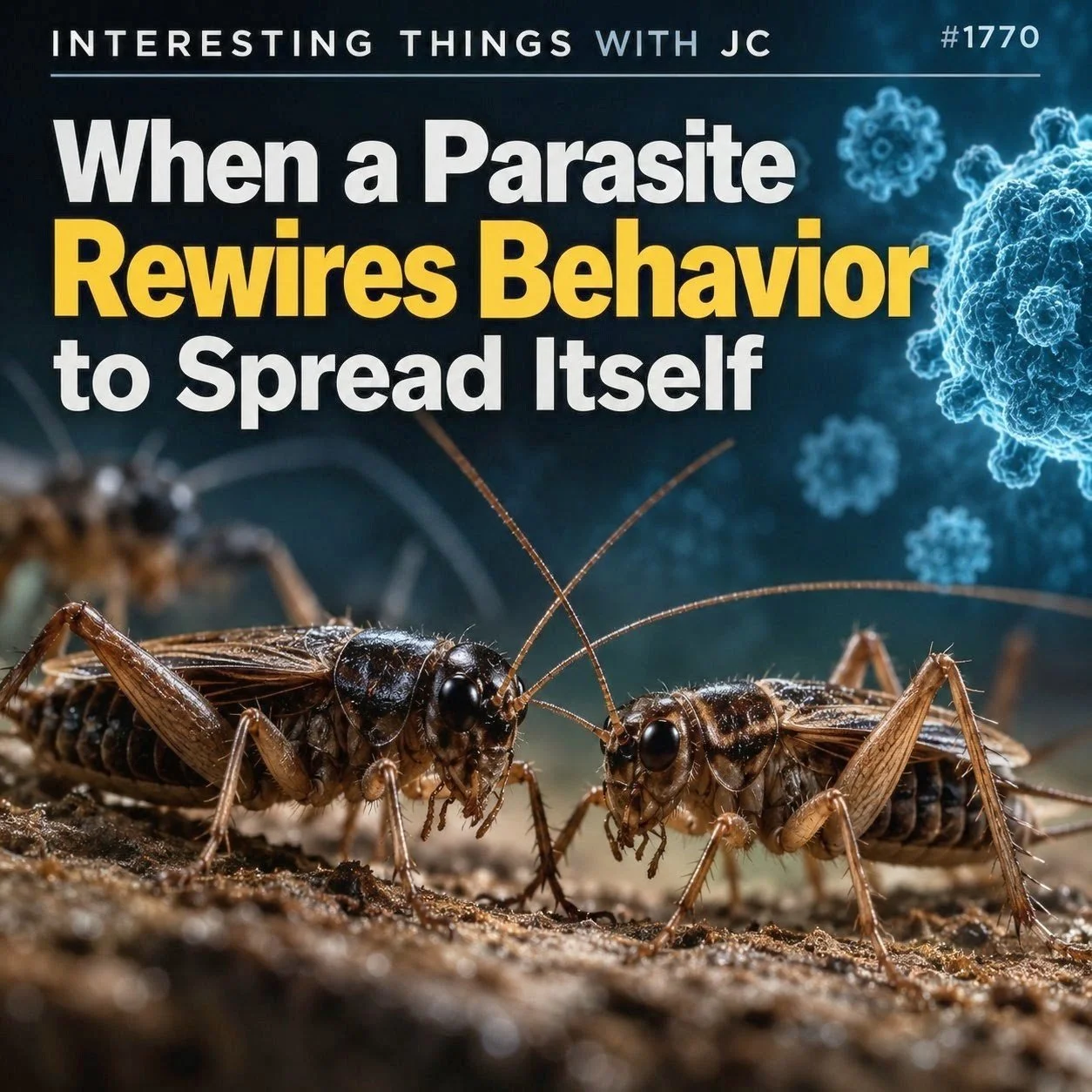
Two brown field crickets face each other on a dark, earthy surface beneath a large headline reading, “When a Parasite Rewires Behavior to Spread Itself.” Blue, virus-like microscopic forms appear in the background, suggesting infection and transmission. The top of the image reads “Interesting Things with JC” and “#1770.”
Transcript
Interesting Things with JC #1770:
"When a Parasite Rewires Behavior to Spread Itself"
Imagine getting so sick that your body should be telling you to stop eating, stop moving around, and stop looking for a mate.
Now imagine the infection interfering with that warning system.
That's what researchers found in Texas field crickets infected with a virus known as cricket iridovirus.
The infection was doing serious damage. Females stopped producing eggs. Males still produced sperm, but much of it had little or no movement.
Yet their sexual behavior didn't shut down.
Infected males actually began courting females sooner than healthy males.
That's where this becomes much more than a story about sick crickets mating.
Animals have something called sickness behavior. When the immune system detects an infection, chemical signals help coordinate the body's defenses, but they also communicate with the nervous system. An animal may become sluggish, eat less, withdraw, and reduce activities like courtship.
That isn't just weakness. It's part of the body's response to infection.
Biologist Shelley Adamo and her colleagues wanted to know why these infected crickets weren't doing it.
So they gave healthy and virus-infected crickets heat-killed bacteria. The bacteria couldn't reproduce or cause another infection, but the immune system could still recognize them.
The healthy crickets reacted.
The infected crickets largely didn't.
Researchers found another clue inside their immune systems. Activity of phenoloxidase, an enzyme involved in insect defense, was reduced. The virus was also attacking the fat body, an organ that stores nutrients, regulates metabolism, and produces important components of the insect immune response.
Something in the normal connection between infection, immunity, and behavior had been disrupted.
And then comes the reason that matters.
This virus can spread through sexual contact.
A female may no longer be capable of producing eggs, but she can still mate. A male may have badly impaired sperm, but he can still court females.
For the cricket, reproduction is breaking down.
For the virus, the route into another cricket remains open.
Researchers weren't claiming that the virus gave crickets a new sexual urge. The evidence pointed toward something subtler: infection appeared to interfere with the normal system that suppresses courtship when an animal becomes sick.
Instead of pressing the accelerator, think of it as disabling the brake.
And nature has produced far more dramatic versions of this.
The fungus Ophiocordyceps infects ants and alters their behavior before killing them in locations favorable for fungal reproduction. Hairworms develop inside insects such as crickets and can alter their behavior in ways that bring them toward water, where the adult worm needs to reproduce. Toxoplasma gondii can alter responses to cat odors in infected rodents, potentially increasing the chance that a rodent is eaten by a cat, where the parasite completes the sexual stage of its life cycle.
Different parasite. Different host. Different mechanism.
But the evolutionary principle is similar.
A parasite lives inside a biological machine that already knows how to walk, eat, mate, hide, hunt, and react to danger. Evolution doesn't necessarily have to build new behaviors from scratch.
It can exploit the machinery that's already there.
Turn down fear. Change where the animal travels. Interrupt the signal that says you're sick. Keep a host active when it would normally withdraw.
None of this requires the parasite to think or plan. Mutations that happen to increase transmission can leave more descendants, and over generations natural selection can preserve those traits.
That's the disturbing brilliance of host manipulation.
Sometimes the most useful thing a parasite can change isn't the host's body.
It's what the host does next.
These are interesting things, with JC.
Student Worksheet
Comprehension
What happened to egg production in infected female crickets?
What happened to sperm motility in infected males?
What unusual difference did researchers observe in the timing of male courtship?
Define sickness behavior in your own words.
Why did researchers use heat-killed bacteria rather than introducing another active infection?
How did healthy and virus-infected crickets differ after the immune challenge?
Evidence Analysis
Researchers observed reduced phenoloxidase activity. Why was this finding relevant?
Why was infection of the fat body important to the researchers' proposed explanation?
Sort each statement into Observation, Interpretation, or Evolutionary Explanation:
Infected males courted females sooner.
Sperm from infected males showed little or no motility.
Immune signals responsible for sickness behavior appeared to be impaired.
Continued mating could increase opportunities for viral transmission.
Infected females were effectively sterile.
Causal Reasoning
Complete this model and explain each connection: Viral infection → ______ → altered immune signaling → ______ → continued mating → increased transmission opportunity.
Why is "the virus makes the cricket want to mate" a weaker scientific explanation than the interpretation presented in the episode?
Which single experiment or observation from the episode provides the strongest evidence for disrupted sickness behavior? Defend your choice.
Experimental Design
Identify the independent variable, one dependent variable, and an important comparison in the heat-killed-bacteria experiment.
Why is a comparison group necessary for interpreting the infected crickets' response?
Design one follow-up experiment that could test a step in the proposed infection-to-behavior mechanism. State:
hypothesis
manipulated or compared variable
measured outcome
control or comparison group
result that would support the hypothesis
Reflection
Explain why an evolutionary advantage to a virus does not mean the virus consciously caused that outcome.
What does this study demonstrate about the difficulty of moving from correlation to a mechanistic explanation?
Difficulty Scaling
Level 1 — Describe: Identify what happened to infected crickets.
Level 2 — Explain: Connect experimental evidence with immune function and behavior.
Level 3 — Analyze: Separate observation, mechanism, and evolutionary explanation.
Level 4 — Investigate: Design an experiment capable of testing part of the proposed mechanism.
Student Output: Complete Questions 1–14. Choose either Question 15, 16, or 17 for a 200–300-word evidence-based response.
Academic Integrity Guidance: Build explanations from the evidence presented rather than simply repeating the episode's conclusion. When proposing a mechanism, identify it as an interpretation unless the experiment directly demonstrates it. For the extended response, explain why the evidence supports your conclusion.
Teacher Guide
Quick Start: Treat the episode as a biological mystery rather than beginning with the explanation. Present the opening observations—sterility, poor sperm motility, continued mating, and earlier courtship—and ask students to generate possible explanations before hearing how the researchers investigated them.
Pacing Guide — Audio First
0–5 minutes: Bell Ringer and initial hypothesis.
5–10 minutes: Introduce essential vocabulary without revealing the proposed mechanism.
10–15 minutes: First listen/read for the central biological puzzle.
15–22 minutes: Students record observations versus explanations.
22–30 minutes: Replay/read the experimental portion and analyze the heat-killed-bacteria challenge.
30–38 minutes: Build the class causal model.
38–45 minutes: Discuss natural selection versus intentional explanations.
45–50 minutes: Complete Exit Ticket.
Bell Ringer: An animal is seriously infected but continues performing an energetically costly behavior normally reduced during illness. Generate two biologically different explanations for that observation. What evidence would help distinguish between them?
Audio Guidance: During the first listen, students should identify the mystery without taking detailed notes. During the second listen, have students use three labels: O for observation, E for experimental evidence, and I for interpretation.
Audio Fallback: Read the transcript aloud through "The infected crickets didn't." Pause and have students predict the researchers' interpretation before completing the transcript.
Time on Task: Core lesson: 45–50 minutes. Full evidence-and-experimental-design lesson: 70–90 minutes.
Materials
Episode audio or verbatim transcript
Student worksheet
Board or shared digital workspace
Three-column Observation–Evidence–Interpretation organizer
Optional index cards for causal-model activity
Vocabulary Prep
Introduce host, sickness behavior, fat body, and phenoloxidase before listening.
Introduce natural selection after students have analyzed the immediate mechanism so mechanism and evolutionary explanation remain conceptually separate.
Misconceptions
"The virus gives the cricket an increased sex drive." The research supports disruption of sickness behavior; it does not establish a newly created motivational state.
"Earlier courtship proves manipulation." Earlier courtship is an observation. Explaining why it occurs requires additional evidence.
"The virus knows mating will spread it." Natural selection requires no foresight.
"Sterility should automatically stop mating." Reproductive physiology and mating behavior are related but distinct biological systems.
"Heat-killed bacteria cannot affect the cricket." They cannot produce the same active bacterial infection, but immune recognition can still provoke a response.
"One immune measurement proves the entire pathway." Phenoloxidase contributes evidence of altered immune function but does not by itself establish the full mechanism.
"All sickness behavior is identical across animals." Sickness behaviors vary among species and circumstances.
Discussion Prompts
What is the central contradiction that made these crickets scientifically interesting?
Which findings are direct measurements and which are explanations constructed from those measurements?
What question does the heat-killed-bacteria experiment address that observations of mating alone cannot?
Why does infection of an immune-related organ strengthen the proposed mechanism?
Does showing that continued mating helps transmission prove that the virus evolved specifically to manipulate mating? Why or why not?
What additional experiment would make the causal explanation stronger?
Formative Checkpoints
Checkpoint 1: Student can state the puzzle without explaining it.
Checkpoint 2: Student can explain why heat-killed bacteria function as an immune challenge.
Checkpoint 3: Student identifies differences between healthy and infected responses.
Checkpoint 4: Student connects fat-body infection and reduced immune measures to the proposed mechanism without claiming they independently prove it.
Checkpoint 5: Student separates proximate mechanism ("How might behavior remain active?") from evolutionary consequence ("How might that affect transmission?").
Causal Model Activity
Give students six concepts: IIV-6/CrIV infection, fat-body/immune disruption, altered immune signaling, reduced sickness behavior, continued sexual behavior, and transmission opportunity.
Students arrange the concepts into a proposed causal sequence.
Require an evidence statement beneath each connection.
Mark each connection strongly supported, suggested, or not directly tested.
Compare models and identify where another experiment would strengthen causal confidence.
Differentiation
Additional Support: Provide the causal concepts already arranged and ask students to add evidence beneath each arrow.
Advanced Learners: Require students to develop at least two competing hypotheses and design an experiment distinguishing them.
English Learners: Pair each technical term with a plain-language equivalent and allow diagram construction before written explanation.
Visual Learners: Color-code physiological effects, behavioral observations, experiments, and evolutionary consequences.
Auditory Learners: Replay the experimental passage and have students verbally identify each claim and supporting observation.
Assessment Differentiation: Students may produce a written causal explanation, an annotated scientific model, or a short oral defense. Every format must include evidence, mechanism, uncertainty, and evolutionary reasoning.
Time Flexibility: For 30 minutes, use Questions 1–12 and the Exit Ticket. For 50 minutes, complete the core worksheet. For 90 minutes, include experimental design and causal-model critique.
Substitute Readiness: Provide the transcript and worksheet with this direction: "Read once for the story, read again for evidence, complete Questions 1–14, then complete the Exit Ticket."
Engagement Strategy: Delay revealing sexual transmission until students have explained the immune-behavior evidence. Then ask: "If the behavior remains active, what consequence might that have for a pathogen transmitted during mating?"
Extensions
Create an evidence map linking each conclusion to the observation supporting it.
Compare the cricket case with another host-pathogen interaction and identify similarities and differences in evidence.
Investigate how scientists distinguish adaptive pathogen manipulation from incidental consequences of infection.
Develop a hypothetical experiment measuring whether restoring an immune signal changes behavior.
Evaluate how anthropomorphic language can distort explanations of natural selection.
Cross-Curricular Connections
Biology: Immunology, evolution, reproductive biology, host-pathogen interactions.
Neuroscience/Psychology: Immune-to-neural communication and behavioral regulation.
Statistics: Controls, variation, comparison groups, and strength of evidence.
ELA: Claims, evidence, reasoning, and precise scientific language.
Philosophy of Science: Causation, inference, competing hypotheses, and limits of evidence.
SEL Connection: Scientific reasoning rewards willingness to revise an explanation when evidence does not support the first assumption. Students practice intellectual flexibility and evidence-based disagreement.
Skill Value Emphasis: The highest-value skill in this lesson is not memorizing cricket biology. It is learning to ask: What was observed? What was experimentally tested? What mechanism is being proposed? What conclusion is justified?
Answer Key
Egg production severely declined; infected females were effectively sterile.
Sperm obtained from infected males showed little or no motility.
Infected males began courting sooner than uninfected controls.
Sickness behavior consists of behavioral changes associated with immune activation.
Heat-killed bacteria could provide an immune challenge without establishing another active bacterial infection.
Healthy crickets displayed sickness behavior; infected crickets failed to show the expected response.
Reduced phenoloxidase activity provided evidence that infection was associated with altered immune function.
The fat body performs important immune and protein-production functions, so viral attack there provides a plausible connection to impaired immune signaling.
Observation: earlier courtship, poor sperm motility, effective female sterility. Interpretation: impaired immune signals underlying sickness behavior. Evolutionary Explanation: continued mating may increase transmission opportunities.
A defensible model is: viral infection → fat-body/immune disruption → altered immune signaling → reduced sickness behavior → continued mating → increased transmission opportunity. Students should recognize that the complete chain contains interpreted causal links rather than only directly observed events.
Courtship already existed. The evidence supports failure of normal illness-associated behavioral suppression rather than demonstration of a newly manufactured mating drive.
Strong answers will usually select the immune-challenge comparison because healthy crickets responded while infected crickets did not, directly testing their capacity to express sickness behavior under challenge.
A defensible answer identifies infection status/immune challenge as an experimental comparison and behavioral response as a dependent measure.
Comparison allows researchers to determine whether the absence of sickness behavior is specifically associated with infected animals rather than being the normal response under those conditions.
Answers vary. Require a testable hypothesis, defined comparison, measurable outcome, and appropriate control.
Selection operates through differential success among variants; conscious foresight is unnecessary.
Strong answers note that correlated changes can suggest mechanisms, but establishing causal pathways generally requires interventions capable of isolating individual links.
Quiz
Questions
Which combination best describes the reproductive effects reported in infected crickets?
A. Increased egg production and increased sperm motility
B. Reduced egg production and little or no sperm motility
C. Reduced egg production but completely normal male reproduction
D. Normal egg production and reduced courtshipWhat made the infected males' courtship behavior especially noteworthy?
A. They stopped courting entirely
B. They courted only infected females
C. They began courting sooner than uninfected controls
D. They regained fertility after courtshipWhy did the researchers challenge crickets with heat-killed bacteria?
A. To transmit IIV-6/CrIV between animals
B. To stimulate an immune response without causing another active bacterial infection
C. To restore sperm motility
D. To destroy the cricket's fat bodyWhich conclusion most accurately represents the evidence?
A. The virus consciously caused mating to increase its spread
B. Infection appeared to interfere with normal mechanisms associated with sickness behavior
C. The virus created an entirely new courtship behavior
D. Phenoloxidase alone controls all cricket mating behaviorWhy can continued mating matter evolutionarily to a sexually transmitted pathogen?
A. It guarantees that every mating event produces infection
B. It allows the pathogen to predict host behavior
C. It can create additional opportunities for transmission to another host
D. It restores the reproductive health of infected animals
Assessment
Open-Ended Questions
Construct an evidence-based explanation for why infected crickets continued mating despite serious reproductive effects. Your response must incorporate the fat body, phenoloxidase, immune challenge, sickness behavior, and sexual transmission. Label at least one statement as direct evidence and one as scientific interpretation.
Evaluate this statement: "The virus evolved to make crickets want to mate." Explain what is scientifically problematic about the statement and rewrite it as a more precise evolutionary explanation.
3–2–1 Rubric
3 — Evidence-Based Mastery: Accurately integrates multiple observations; explains the experimental logic; distinguishes observation, mechanism, and evolutionary consequence; acknowledges uncertainty; and explains natural selection without intentional language.
2 — Developing Understanding: Correctly identifies the main relationship and uses evidence but incompletely distinguishes direct evidence from interpretation or provides an incomplete causal pathway.
1 — Emerging Understanding: Identifies isolated facts but does not construct an evidence-supported causal explanation or substantially misrepresents natural selection or the experiment.
Exit Ticket: Complete these three statements: The researchers observed… / The experiment suggested… / Natural selection could favor… Each response must refer to a different level of the scientific explanation.
Standards Alignment
NGSS — Life Science
HS-LS4-4 — Construct an explanation based on evidence for how natural selection leads to adaptation of populations — Students explain how pathogen variants associated with increased transmission opportunities could be favored over generations; measurable outcome: construct a non-intentional evolutionary explanation supported by evidence.
HS-LS4-2 — Construct an explanation based on evidence that the process of evolution primarily results from four factors — Students connect differential success to selection while avoiding purpose-driven explanations; measurable outcome: distinguish evolutionary process from conscious agency.
NGSS — Science & Engineering Practices
Analyzing and Interpreting Data — Students organize reproductive, immune, and behavioral observations into an evidence model and determine which conclusions they support.
Constructing Explanations and Designing Solutions — Students construct a causal explanation and design a follow-up experiment capable of testing one proposed mechanistic link.
Engaging in Argument from Evidence — Students defend which result provides the strongest evidence for disrupted sickness behavior.
CCSS Reading
CCSS.ELA-LITERACY.RST.11-12.1 — Cite specific textual evidence to support analysis of science and technical texts — Students use specific experimental observations when defending biological conclusions.
CCSS.ELA-LITERACY.RST.11-12.8 — Evaluate the hypotheses, data, analysis, and conclusions in a science or technical text — Students distinguish direct observations from proposed mechanisms and evolutionary explanations.
CCSS.ELA-LITERACY.RST.11-12.9 — Synthesize information from a range of sources into a coherent understanding — Extension learners compare the episode narrative with the underlying scientific literature.
CCSS Writing
CCSS.ELA-LITERACY.WHST.11-12.1 — Write arguments focused on discipline-specific content — Students defend an interpretation using relevant experimental evidence.
CCSS.ELA-LITERACY.WHST.11-12.2 — Write informative/explanatory texts — Students communicate the proposed infection-to-transmission mechanism accurately and sequentially.
CCSS.ELA-LITERACY.WHST.11-12.9 — Draw evidence from informational texts to support analysis, reflection, and research — Students support assessment responses with evidence rather than unsupported assertions.
C3 Framework
D4.1.9-12 — Construct arguments using precise and knowledgeable claims with evidence from multiple sources — Students develop claims that distinguish evidence from inference and defend those claims through scientific reasoning.
D4.2.9-12 — Construct explanations using sound reasoning, correct sequence, examples, and details — Students create a coherent causal explanation from infection through behavioral and transmission consequences.
Career Readiness Competencies
Critical Thinking: Separate measurement from interpretation.
Systems Thinking: Model interactions among viral infection, immune function, behavior, and transmission.
Experimental Reasoning: Identify variables, comparisons, controls, and testable outcomes.
Evidence Communication: Defend conclusions without overstating certainty.
Scientific Literacy: Recognize anthropomorphic language and replace it with mechanistic or evolutionary explanations.
Homeschool/Lifelong Learning
Learners can complete the lesson independently by reading the transcript twice, constructing the causal model, answering Questions 1–14, and completing one advanced response.
Mastery is demonstrated when the learner can explain the case without relying on intentional language and can distinguish what researchers observed from what the evidence suggests.
Show Notes
A virus infecting Texas field crickets creates an unusually powerful case study in scientific reasoning. Infected females became effectively sterile, sperm from infected males showed little or no motility, yet sexual behavior continued—and infected males courted sooner than uninfected controls. Researchers investigating this contradiction found evidence of altered immune function and an inability of infected crickets to produce expected sickness behavior following an immune challenge. Because the virus can spread through sexual contact, continued mating also creates transmission opportunities. For students, the deeper lesson extends beyond parasites: this episode demonstrates how scientists move from surprising observations to experiments, mechanisms, causal models, and evolutionary explanations while carefully separating what the evidence demonstrates from what it merely suggests.
References
Adamo, S. A., Kovalko, I., Easy, R. H., & Stoltz, D. (2014). A viral aphrodisiac in the cricket Gryllus texensis. The Journal of Experimental Biology, 217(11), 1970–1976. https://doi.org/10.1242/jeb.103408
Adamo, S. A. (2014). Parasitic aphrodisiacs: Manipulation of the hosts' behavioral defenses by sexually transmitted parasites. Integrative and Comparative Biology, 54(2), 159–165. https://doi.org/10.1093/icb/icu036
Sullivan, K., Fairn, E., & Adamo, S. A. (2016). Sickness behaviour in the cricket Gryllus texensis: Comparison with animals across phyla. Behavioural Processes, 128, 134–143. https://doi.org/10.1016/j.beproc.2016.05.004