1771: "Debut of the Fresh Prince of Bel-Air"
Interesting Things with JC #1771: "Debut of the Fresh Prince of Bel-Air"
The original Fresh Prince theme was much longer. In the video for the opening, Will packed and then flew first class, landed in LA and met his ride before there was ever a famous cab. Most of that trip was left on the cutting room floor!
Curriculum - Episode Anchor
Episode Title: Debut of the Fresh Prince of Bel-Air
Episode Number: 1771
Host: JC
Audience: Grades 9–12, introductory college, homeschool, lifelong learners
Subject Area: Media studies, English Language Arts, popular culture, television history, music and narrative
Lesson Overview
Learning Objectives
Explain how The Fresh Prince of Bel-Air used its opening theme to communicate the series premise.
Identify how exposition can be compressed into a short narrative.
Compare the extended and shortened opening sequences as examples of editorial decision-making.
Analyze how music, characterization, setting, and conflict can work together to establish a television narrative.
Essential Question: How can a short piece of music tell enough of a story to establish characters, conflict, setting, and premise?
Success Criteria: Students can identify major elements of exposition in the episode's account, explain why the opening theme functions as narrative rather than simply introductory music, and support an interpretation with specific evidence.
Student Relevance Statement: Modern audiences encounter compressed storytelling constantly in trailers, social-media videos, advertisements, podcasts, title sequences, and music. Understanding how information is selected and compressed strengthens media literacy and communication skills.
Real-World Connection: Writers, editors, producers, marketers, journalists, and content creators regularly decide which details audiences need immediately and which can be omitted, delayed, or expanded.
Workforce Reality: Effective communication often requires turning a complicated subject into a concise narrative without losing the information necessary for an audience to understand it.
Key Vocabulary
Terms
Exposition(ek-spuh-ZISH-un) — Background information that establishes characters, setting, circumstances, or conflict.
Premise(PREM-iss) — The central situation or foundational idea on which a story is built.
Sitcom(SIT-kom) — Short for situational comedy; a television format centered on recurring characters and situations.
Narrative(NAIR-uh-tiv) — A structured account of connected events forming a story.
Characterization(kar-ik-ter-ih-ZAY-shun) — The methods used to establish a character's personality, identity, motivations, or traits.
Theme Song(THEEM song) — Music associated with a program that can establish identity, mood, characters, or narrative information.
Compression(kum-PRESH-un) — Reducing information while preserving its most important meaning.
Editing(ED-it-ing) — Selecting, arranging, shortening, or modifying material to shape how an audience receives it.
Cultural Reference(KUL-chur-ul REF-er-ens) — A recognizable element of popular culture that carries meaning for an audience.
Narrative Core
Open: On September 10, 1990, NBC premiered The Fresh Prince of Bel-Air. Its opening sequence immediately distinguished the program by explaining the central situation through rap rather than leaving the pilot to provide all of the exposition.
Info: Will Smith portrayed a fictionalized version of himself: a teenager from West Philadelphia sent to live with affluent relatives in Bel-Air. The series ultimately ran six seasons and 148 episodes. Its principal cast included Smith, James Avery, Janet Hubert, Alfonso Ribeiro, Karyn Parsons, Tatyana Ali, and Joseph Marcell.
Details: The theme, commonly associated with the title Yo Home to Bel-Air, credits Will Smith and Jeffrey Townes as writers, with Townes—DJ Jazzy Jeff—associated with its production. An extended version contains considerably more of Will's journey than the shortened opening familiar from later broadcasts. The longer narrative covers additional stages between leaving Philadelphia and arriving at the Banks residence.
Reflection: The difference between the versions provides a useful lesson in narrative compression. The shorter opening retains the essential causal chain: Will's original environment, a conflict, his mother's decision, transportation to California, and his arrival in Bel-Air. Removing intermediate events shortens the sequence without eliminating the information audiences need to understand the premise.
Closing: These are interesting things, with JC.
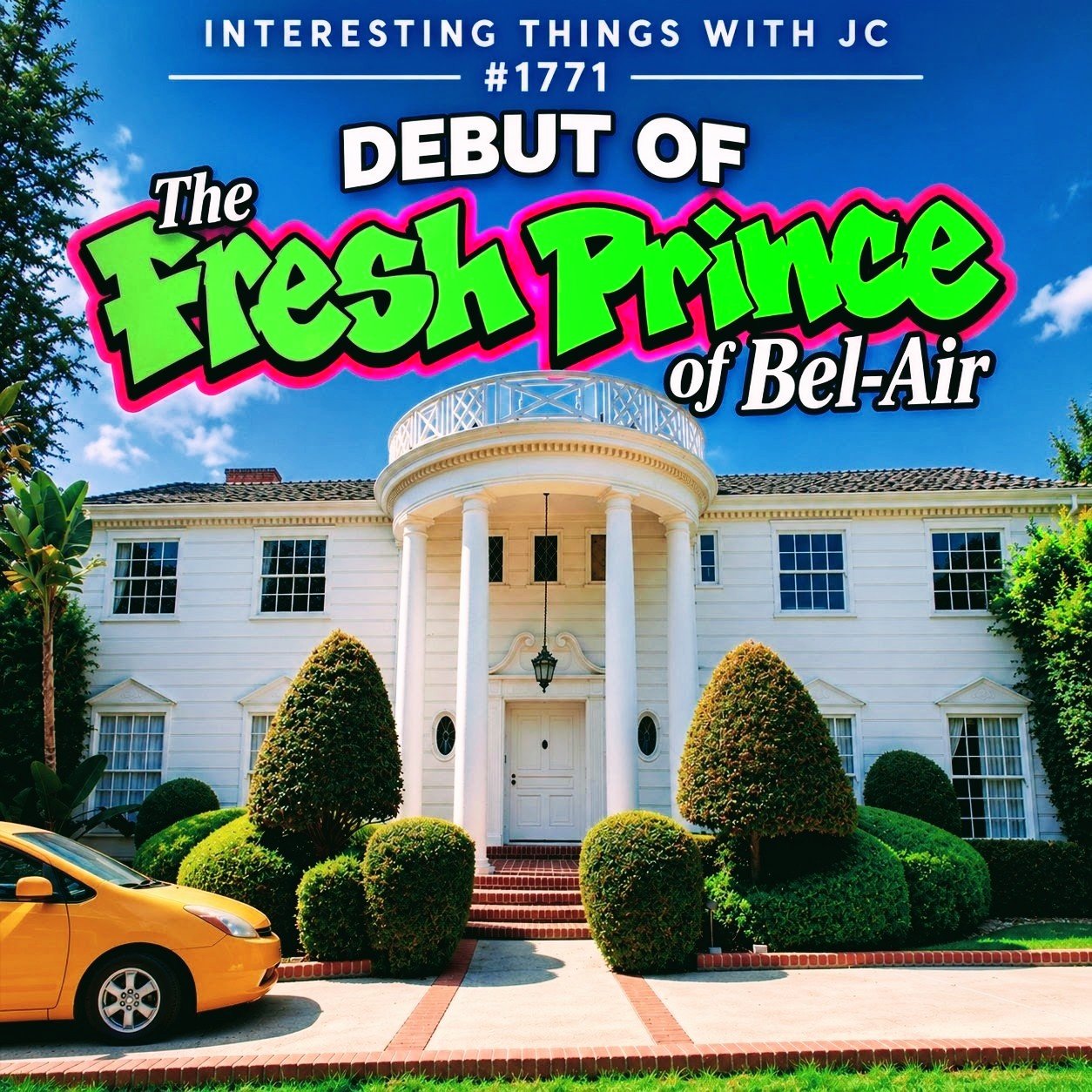
Square podcast cover for Interesting Things with JC #1771, “Debut of The Fresh Prince of Bel-Air.” A bright white, two-story Bel-Air mansion with tall columns, manicured shrubs, and a circular balcony fills the background beneath a vivid blue sky. A yellow taxi is partially visible at the lower left, referencing Will’s arrival in Bel-Air. Large green, black, and hot-pink graffiti-style lettering across the upper half reads “The Fresh Prince,” with “Debut of” above and “of Bel-Air” below. The series name and episode number appear in white at the top.
Educational commentary and criticism. Certain referenced material is used pursuant to the fair-use principles of 17 U.S.C. § 107. All underlying copyrights and trademarks remain the property of their respective owners. No affiliation or endorsement is implied.
Transcript
Interesting Things with JC #1771:
"Debut of the Fresh Prince of Bel-Air"
On September 10th, 1990, NBC introduced a new sitcom with an unusual opening. Before the first scene really had to explain anything, its star rapped the entire setup: a teenager from West Philadelphia gets into trouble, his mother sends him across the country, and he arrives at the home of his wealthy aunt and uncle in Bel-Air. By the time Will Smith knocked on the Banks family's door, you already knew how he got there.
The show was The Fresh Prince of Bel-Air, and Smith was essentially playing a fictional version of himself. He was already known as the Fresh Prince from his recording career with DJ Jazzy Jeff, but television was new territory. The series surrounded him with James Avery as Uncle Phil, Janet Hubert as Aunt Vivian, Alfonso Ribeiro as Carlton, Karyn Parsons as Hilary, Tatyana Ali as Ashley, and Joseph Marcell as Geoffrey. It would eventually run for six seasons and 148 episodes.
And that opening theme wasn't just attached to the show. It was the show's premise compressed into a rap.
Will Smith wrote the lyrics after reading material from the pilot, while his longtime musical partner Jeffrey Townes, DJ Jazzy Jeff, produced the song. The result was "Yo Home to Bel-Air," better known simply as the Fresh Prince theme.
But there's something people who grew up watching the show in reruns may not remember.
The original opening was longer.
The familiar version gets Will from West Philadelphia to Bel-Air pretty quickly. The extended version keeps going. His mother packs his suitcase. He gets his ticket, puts on his Walkman, flies first class, wonders what the people in Bel-Air will be like, encounters a man waiting for him at the airport, and only then gets into that famous cab. The extended sequence appeared at the beginning of the series before the opening was cut down for television time.
That's why some people can sing every word of the Fresh Prince theme and still discover that there are entire verses they've barely heard.
The version most of us remember preserved the pieces that mattered most: "West Philadelphia born and raised," the fight, his mother's decision, the cab with the "Fresh" license plate, and finally the arrival in Bel-Air. What disappeared was most of the journey between those places.
And the song did something television themes rarely attempt. It didn't merely introduce the characters or establish a mood. It handled the exposition. The premise of the pilot and the premise described in the opening credits are essentially the same story, which meant the series could begin with Will arriving at the Banks home and get on with what happened next.
That mattered because what followed became much larger than the original joke about a streetwise Philadelphia kid living with his rich relatives.
The series could be broad and ridiculous, but over six seasons it also dealt with family, class, race, absent parents, relationships and growing up. Smith arrived as a successful rapper learning how to act on television and left the series in 1996 as a performer whose next chapter was already becoming a major film career.
But every week, audiences were taken back to the beginning.
A playground. One little fight. A frightened mother. A trip across the country. A cab pulling up to a house around seven or eight.
More than three decades later, you can say the first few words "Now this is a story all about how My life got flipped, turned upside down And I'd like to take a minute, just sit right there, I'll tell you how I became the prince of a town..." and millions of people already know what comes next.
The funny part is that some of them still haven't heard the whole story.
These are interesting things, with JC.
Student Worksheet
Comprehension
On what date did The Fresh Prince of Bel-Air premiere?
What circumstances cause fictional Will to move from Philadelphia to Bel-Air?
How does the opening theme communicate the basic premise of the television series?
What additional parts of Will's journey are described in the extended version?
How many seasons and episodes did the series ultimately have?
Analysis
Why can the theme song be considered exposition rather than simply entertainment?
Identify three pieces of information that the shortened opening needs to retain for the story to remain understandable.
What does the comparison between the extended and shortened openings demonstrate about editing?
How does geographic movement from West Philadelphia to Bel-Air help establish the central conflict or contrast of the series?
Explain how the opening uses cause and effect to construct a complete miniature narrative.
Reflection
Think of a contemporary television series, film trailer, podcast introduction, social-media video, or advertisement that quickly establishes a story. What techniques does it use to communicate efficiently?
If you had only 30 seconds to explain the premise of a story you know well, what information would you keep, and what would you remove?
Difficulty Scaling
Level 1 — Identify: Locate explicit facts and narrative elements.
Level 2 — Analyze: Explain relationships among conflict, setting, characterization, music, and exposition.
Level 3 — Evaluate/Create: Judge editorial choices or construct a compressed narrative using similar principles.
Student Output: Complete Questions 1–10 using complete sentences and textual evidence where appropriate. Complete either Question 11 or 12 in a developed paragraph.
Academic Integrity Guidance: Responses should demonstrate the student's own reasoning. Outside research should be identified when used. Students should distinguish factual evidence from personal interpretation.
Teacher Guide
Quick Start: Introduce the essential question, conduct the Bell Ringer, play or read the JC episode, and use the worksheet to move students from factual recall to analysis of narrative compression.
Pacing Guide — Audio First
0–5 minutes: Bell Ringer and prior-knowledge activation.
5–10 minutes: Introduce vocabulary and essential question.
10–15 minutes: Listen to the JC episode.
15–25 minutes: Complete comprehension questions.
25–38 minutes: Analyze exposition and narrative compression.
38–47 minutes: Discussion and reflection.
47–50 minutes: Exit Ticket.
Bell Ringer: Ask students to describe the premise of a favorite television program or film in no more than three sentences. Then ask what information they deliberately omitted.
Audio Guidance: Play the complete JC episode once without interruption. On a second listen, students may record details related to setting, conflict, character, and sequence.
Audio Fallback: If audio is unavailable, use the complete transcript once it has been inserted into the designated Transcript placeholder.
Time on Task: Approximately 45–50 minutes for a standard lesson; 70–90 minutes with extension activities.
Materials
JC episode audio
Completed transcript when available
Student worksheet
Writing materials or digital document
Optional access to legally available examples of television opening sequences
Vocabulary Strategy: Before listening, introduce exposition, premise, narrative, and compression. Ask students to listen for examples rather than memorize definitions in isolation.
Misconceptions
A theme song does not necessarily function only as background music.
Shortening a narrative does not automatically change its central meaning.
The television character Will Smith should not be treated as identical to the real performer simply because they share a name and aspects of identity.
Popular entertainment can be analyzed using the same narrative concepts applied to literature and other media.
Discussion Prompts
What is the minimum information necessary to understand the show's premise?
What does the extended version contribute that the shorter version does not?
Why might television producers shorten an opening even when audiences enjoy it?
Does knowing more about Will's journey substantially change the premise? Why or why not?
Formative Checkpoints
Students correctly distinguish premise from individual plot events.
Students identify the opening theme as a form of exposition.
Students can separate essential information from supplementary detail.
Students support analytical claims with evidence from the episode.
Differentiation
Additional Support: Provide a five-part organizer labeled character, setting, conflict, change, and destination.
Advanced Learners: Ask students to examine what is gained and lost through narrative compression.
English Learners: Preview vocabulary and permit a visual sequence or timeline before requiring written analysis.
Assessment Differentiation: Students may demonstrate analysis through a written paragraph, annotated sequence, short presentation, or teacher-approved audio response while maintaining the same evidence requirements.
Time Flexibility: For a 30-minute lesson, complete Questions 1–8 and the Exit Ticket. For an extended block, add the narrative-compression activity.
Substitute Readiness: Students can complete the lesson independently using the audio or inserted transcript, vocabulary list, worksheet, and assessment instructions.
Engagement Strategy: Challenge students to reduce a familiar movie or television series to four essential events, then remove one event at a time until the premise becomes unclear.
Extensions
Create a 30-second spoken introduction to a familiar story.
Compare a long-form synopsis with a trailer or title sequence.
Rewrite a familiar narrative using only five sentences.
Investigate another television opening that communicates substantial story information.
Cross-Curricular Connections
English Language Arts: Exposition, characterization, narrative structure, concision.
Media Studies: Television conventions, editing, audience expectations.
Music: Rhythm and lyrics as storytelling mechanisms.
History: American television and popular culture in the early 1990s.
Communication: Selecting information for a specific audience and time constraint.
SEL Connection: Students can consider how relocation, unfamiliar environments, family expectations, and adaptation can influence identity and interpersonal relationships without requiring personal disclosure.
Skill Value Emphasis: The central transferable skill is concise communication: deciding what an audience must know, what can wait, and what can be removed.
Answer Key
September 10, 1990.
After Will gets into trouble following a fight, his mother sends him to live with his aunt and uncle in Bel-Air.
It narrates the circumstances that move Will from West Philadelphia to the Banks family's home.
The extended narrative includes additional stages such as packing, receiving his ticket, traveling by plane, arriving at the airport, and events preceding the cab ride.
Six seasons and 148 episodes.
It supplies background circumstances, setting, conflict, and the events required to understand the premise.
Answers may vary but should identify essential elements such as Philadelphia, the conflict/fight, his mother's decision, travel to Bel-Air, and arrival.
Editing can remove secondary details while preserving the central causal structure and meaning.
The move establishes a contrast between Will's familiar Philadelphia environment and the affluent Bel-Air household, creating conditions for later character and social conflicts.
Strong responses should trace the sequence from conflict to parental decision, relocation, and arrival.
11–12. Answers vary; evaluate clarity, reasoning, and appropriate supporting examples.
Quiz
Multiple Choice
The Fresh Prince of Bel-Air premiered on:
A. September 10, 1988
B. September 10, 1990
C. May 20, 1990
D. September 17, 1991The opening theme is particularly important because it:
A. summarizes every episode in the series
B. introduces only the actors' names
C. communicates the show's central premise through narrative
D. replaces all dialogue in the pilotThe extended opening differs from the familiar shorter version primarily because it:
A. introduces a different protagonist
B. contains additional stages of Will's journey
C. changes Will's destination
D. removes the Philadelphia settingWhich term best describes background information establishing a story's circumstances?
A. Exposition
B. Resolution
C. Citation
D. RefrainComparing the long and short openings provides the clearest example of:
A. narrative compression
B. chronological error
C. unreliable narration
D. dramatic irony
Assessment
Open-Ended Questions
Explain how the opening theme of The Fresh Prince of Bel-Air functions as a miniature narrative. Address setting, character, conflict, cause and effect, and resolution or destination.
Evaluate the shortened opening as an editorial decision. What information is preserved, what information is removed, and why can audiences still understand the premise?
3–2–1 Rubric
3 — Proficient: Presents a clear claim, accurately uses multiple pieces of evidence, applies relevant vocabulary, and explains how the evidence supports the interpretation.
2 — Developing: Presents a reasonable claim and some accurate evidence but provides limited explanation or incomplete use of vocabulary.
1 — Beginning: Provides minimal evidence, contains significant misunderstanding, or does not adequately connect evidence to the response.
Exit Ticket: In two or three sentences, identify one detail that is essential to understanding the show's premise and one detail that could be removed without making the premise unclear. Explain your choices.
Standards Alignment
NGSS — Science & Engineering Practices
Obtaining, Evaluating, and Communicating Information — Students evaluate which information is necessary to communicate an explanation clearly and concisely; measurable through their narrative-compression analysis.
CCSS Reading
CCSS.ELA-LITERACY.RI.9-10.2 — Determine a central idea of a text and analyze its development — Students determine the episode's central explanation of how the opening communicates the television premise.
CCSS.ELA-LITERACY.RI.11-12.3 — Analyze a complex set of ideas or sequence of events — Students trace the causal sequence connecting conflict, relocation, and arrival.
CCSS Writing
CCSS.ELA-LITERACY.W.9-10.9 — Draw evidence from informational texts to support analysis, reflection, and research — Students support worksheet and assessment responses with evidence from the episode.
C3 Framework — Inquiry
D2.His.14.9-12 — Analyze multiple and complex causes and effects of events in the past — Students examine the sequence of decisions and events represented within a historical popular-culture artifact while distinguishing narrative construction from broader historical causation.
ISTE / CTE — Applied Communication
Creative Communicator — Students analyze how format, length, language, and medium influence the communication of a message and demonstrate the principle by producing a compressed narrative.
Career Readiness Competencies
Communication: Select and organize information appropriate to purpose and audience.
Critical Thinking: Distinguish essential evidence from supplementary detail.
Media Literacy: Analyze how editing and format shape audience understanding.
Creative Production: Transform a longer narrative into a concise version while preserving meaning.
Homeschool/Lifelong Learning
Learners practice close listening, media analysis, evidence-based interpretation, concise writing, and critical consumption of popular media through a familiar cultural example.
Show Notes
Interesting Things with JC #1771 examines the September 10, 1990 debut of The Fresh Prince of Bel-Air and the unusual storytelling function of its famous opening theme. The lesson uses the difference between the extended and shortened versions of Will's journey to explore exposition, narrative structure, editing, and information compression. For students, the episode offers an accessible example of a sophisticated communication problem: how to tell an audience everything it needs to know in very little time. That skill extends well beyond television into writing, journalism, marketing, media production, presentations, and everyday communication.
References
Hulu. (n.d.). The Fresh Prince of Bel-Air. https://www.hulu.com/series/the-fresh-prince-of-bel-air-ab545e77-7614-40e7-901f-96a1fcdb86e3
IMDb. (n.d.). The Fresh Prince of Bel-Air: Episode list. https://www.imdb.com/title/tt0098800/episodes/
Apple Music. (1991). Yo Home to Bel-Air (Extended Version) — DJ Jazzy Jeff & The Fresh Prince. https://music.apple.com/us/song/1192857971
Shazam. (n.d.). Yo Home to Bel-Air (Extended Version) — DJ Jazzy Jeff & The Fresh Prince. https://www.shazam.com/en-us/song/1192857971/yo-home-to-bel-air-extended-version