1374: "Dragon Man - A Face from the Human Past"
Interesting Things with JC #1374: "Dragon Man - A Face from the Human Past" – Buried through war and secrecy, a massive human skull waited 85 years in a well before revealing the face of a lost people…survivors whose story still runs in our blood.
Curriculum - Episode Anchor
Episode Title: Dragon Man - A Face from the Human Past
Episode Number: 1374
Host: JC
Audience: Grades 9–12, college intro, homeschool, lifelong learners
Subject Area: Anthropology, Human Evolution, History of Science
Lesson Overview
Learning Objectives:
Define the term "Denisovans" and describe their significance in human evolution.
Compare the physical traits of the Harbin skull to those of Neanderthals and modern humans.
Analyze the historical context of the Harbin skull’s discovery and delayed scientific study.
Explain how DNA and protein analysis contributed to identifying the Harbin skull as Denisovan.
Key Vocabulary
Denisovans (Deh-NEE-so-vuhns) — An extinct group of ancient humans identified from genetic material and fossils, known for contributing DNA to modern populations in Asia and Oceania.
Homo longi (HOH-moh LONG-ee) — Proposed species name meaning “Dragon River Man,” linked to the Harbin skull before being reclassified as Denisovan.
Brow ridge (BROW rij) — The bony ridge located above the eye sockets; the Harbin skull had thick brow ridges.
Proteomics (proh-TEE-oh-miks) — The large-scale study of proteins, used in analyzing ancient remains to extract evolutionary information.
Occupation (ahk-yoo-PAY-shun) — Military control of a region by a foreign power; the Harbin skull was hidden during Japanese occupation of northeast China.
Narrative Core
Open: A cold day in 1933 Harbin, China—construction workers on the Songhua River uncover a massive, ancient skull.
Info: The skull is hidden in an abandoned well for over 80 years due to fears during Japanese occupation.
Details: In 2018, scientists examine the skull, first calling it Homo longi, but later, DNA and protein analysis reveal it’s Denisovan.
Reflection: The skull provides a physical face to a once “invisible” branch of human evolution, connecting modern humans genetically to this extinct group.
Closing: These are interesting things, with JC.
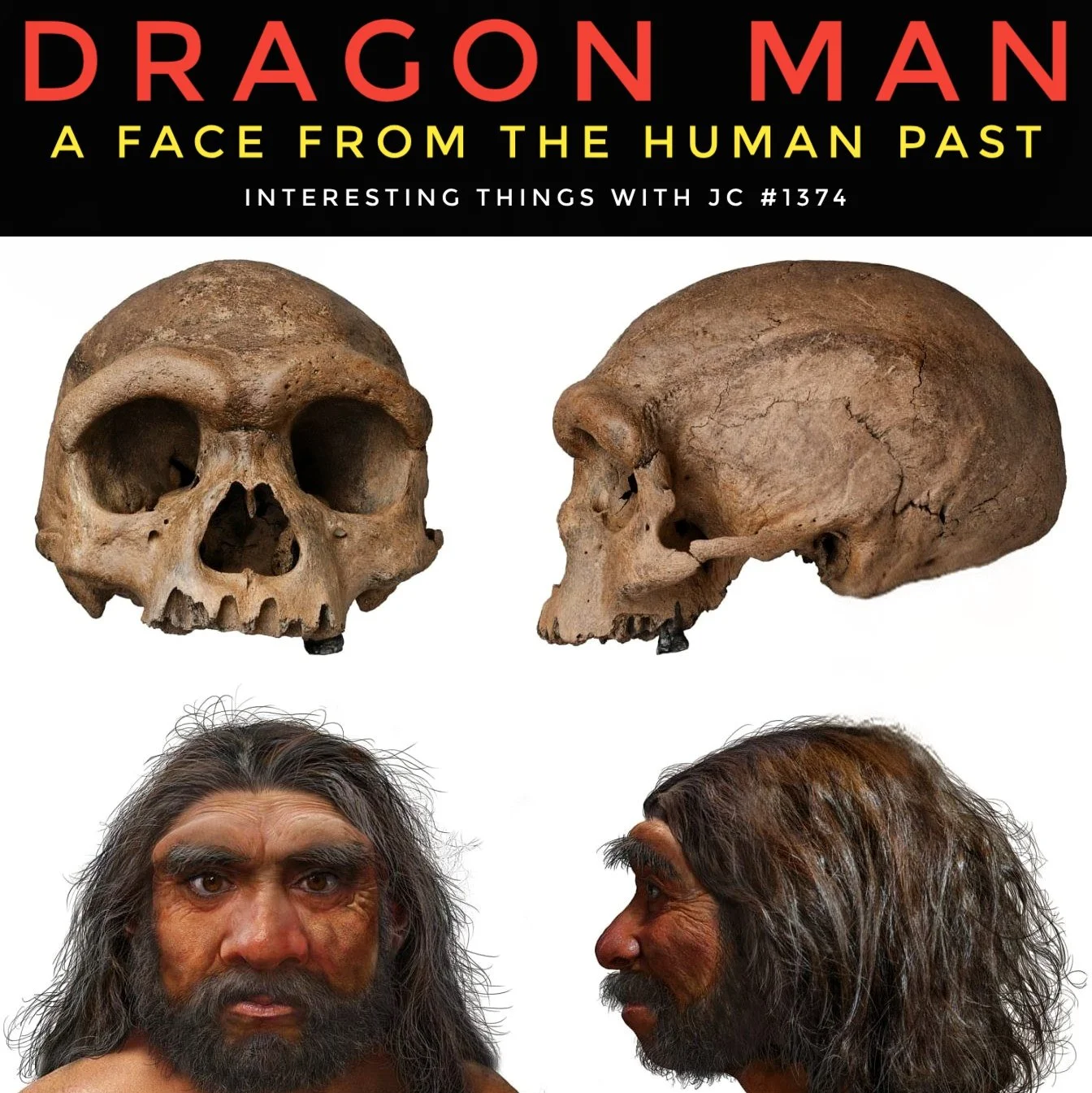
Composite image showing the Harbin 'Dragon Man' skull from front and side views, alongside scientific reconstructions of the Denisovan male face from the same fossil, featured in Interesting Things with JC episode 1374.
Transcript
In 1933, in the city of Harbin (Har bin) in China’s far northeast, the air was biting cold, the river wind carrying the smell of wet earth and iron.
A bridge crew was working along the Songhua (Song hwah) River when one worker’s shovel struck something unusual.
Brushing away the dirt, he found a human skull, big, heavy, and old. It measured more than 9 inches (23 centimeters) long. The brow ridges were thick, the face wide and flat, the eye sockets large and square.
The region was under Japanese occupation, and he feared what might happen if he handed it over.
So he lowered it into an abandoned well and kept the secret.
For more than eight decades, the skull sat in darkness, until his family finally passed it to scientists in 2018.
When experts first examined it, they thought it might belong to a new human species, Homo longi, or “Dragon River Man.” Its mix of traits did not match any known group.
But newer tools told a different story.
From hardened tooth plaque, researchers pulled ancient proteins and traces of DNA. They also studied dense bone from the inner ear.
The results matched a mysterious group known as the Denisovans, first identified in 2010 from a single finger bone in a cave in Siberia’s Altai Mountains.
Before this, Denisovans were almost invisible, just a handful of teeth and bone fragments, plus genetic clues found in people today from Tibet to Papua New Guinea.
The Harbin skull, at least 146,000 years old, gave them a face for the first time.
Its features suggest a body built for cold northern winters, yet their DNA shows they ranged widely, surviving from icebound plains to tropical forests.
They lived alongside Neanderthals and early modern humans, sometimes raising families together.
Some of their genes still help people today, like the one that lets Tibetans thrive in thin mountain air.
A skull pulled from the frozen soil of 1930s China now stands as proof of a lost branch of our family, survivors whose story runs through our bones, and through time itself.
These are interesting things, with JC.
Student Worksheet
Where and when was the Harbin skull discovered?
Why did the worker who found the skull hide it, and for how long?
What modern technologies were used to identify the Harbin skull as Denisovan?
How did Denisovans adapt to different environments?
Name one genetic trait passed down from Denisovans that benefits people today.
Teacher Guide
Estimated Time: 45–60 minutes
Pre-Teaching Vocabulary Strategy: Introduce and define key anthropology and archaeology terms using images and fossil examples.
Anticipated Misconceptions:
Students may think Denisovans and Neanderthals are the same group; clarify differences.
Some may assume all human ancestors were adapted to only one climate.
Discussion Prompts:
Why might the finder of the Harbin skull have feared handing it over?
How do scientific classifications change with new evidence?
Differentiation Strategies:
ESL: Use visual vocabulary cards with fossil images.
IEP: Provide guided notes with sentence starters.
Gifted: Assign a short research project comparing Denisovans to other ancient human species.
Extension Activities:
Create a museum-style exhibit panel about the Harbin skull.
Compare Denisovan genetic contributions to modern human populations in different regions.
Cross-Curricular Connections:
Biology: DNA analysis and proteomics.
History: Japanese occupation of northeast China in the 1930s.
Geography: Mapping Denisovan migration patterns.
Quiz
In what year was the Harbin skull discovered?
A. 1910
B. 1933
C. 1945
D. 2010
Answer: BWhich name was first proposed for the Harbin skull before it was linked to Denisovans?
A. Homo sapiens
B. Homo longi
C. Homo erectus
D. Homo neanderthalensis
Answer: BWhich modern tool helped confirm the Harbin skull’s Denisovan identity?
A. Carbon dating
B. Ancient DNA analysis
C. Radiocarbon fluorescence
D. Magnetometer scanning
Answer: BDenisovan genes still help modern Tibetans with what adaptation?
A. Cold resistance
B. Thin air at high altitude
C. Disease immunity
D. Enhanced vision
Answer: BWhere were Denisovans first identified?
A. Harbin, China
B. Altai Mountains, Siberia
C. Tibet Plateau
D. Papua New Guinea
Answer: B
Assessment
Explain how the Harbin skull has changed our understanding of Denisovans.
Discuss the historical and scientific journey of the Harbin skull from its discovery to modern analysis.
3–2–1 Rubric:
3: Accurate, complete, and thoughtful explanation with specific examples.
2: Partial explanation or missing some detail.
1: Inaccurate or vague response.
Standards Alignment
NGSS HS-LS4-1: Analyze and interpret scientific evidence (fossil and genetic) that documents the diversity of life and human evolution.
CCSS.ELA-LITERACY.RST.9-10.2: Determine central ideas of a scientific text and summarize key details.
C3 Framework D2.His.1.9-12: Evaluate how historical context influences interpretation of artifacts.
ISTE 3a: Plan and employ strategies to use technology for research and analysis.
AQA A-level Biology 3.4.4: Genetic diversity within and between species can be measured using DNA.
IB Biology SL/HL Topic 5: Evolution and biodiversity—fossil record and genetic evidence.
Show Notes
This episode of Interesting Things with JC explores the Harbin skull, an extraordinary fossil found in 1933 in northeast China and hidden for decades. Once believed to be a new species, Homo longi, recent DNA and protein analysis revealed it as Denisovan—the first time scientists could visualize the face of this elusive human relative. The story bridges anthropology, history, and genetics, illustrating how evidence hidden for decades can transform our understanding of the human past. It is an engaging resource for classrooms exploring human evolution, scientific discovery, and the interplay between historical events and research breakthroughs.
References:
Ji, Q., et al. (2021). Late Middle Pleistocene Harbin cranium represents a new Homo species. The Innovation, 2(3), 100130. https://doi.org/10.1016/j.xinn.2021.100130
Douka, K., et al. (2019). Age estimates for hominin fossils and the onset of the Upper Palaeolithic at Denisova Cave. Nature, 565, 640–644. https://doi.org/10.1038/s41586-018-0870-z
Huerta-Sánchez, E., et al. (2014). Altitude adaptation in Tibetans caused by introgression of Denisovan-like DNA. Nature, 512, 194–197. https://doi.org/10.1038/nature13408