1541: "Taipei 101"
Interesting Things with JC #1541: "Taipei 101" – It rises straight up, built to sway, not resist. In a city shaped by wind and earthquakes, this tower was designed to move, bend, and endure. A story about strength that comes from knowing when to yield.
Curriculum - Episode Anchor
Episode Title: Taipei 101
Episode Number: #1541
Host: JC
Audience: Grades 9–12, college intro, homeschool, lifelong learners
Subject Area: Engineering, Architecture, Environmental Science, Asian Studies
Lesson Overview
By the end of this lesson, students will be able to:
Define structural and environmental engineering terms such as "tuned mass damper" within the context of skyscraper design.
Compare Taipei 101 to other record-breaking skyscrapers, evaluating engineering, cultural, and environmental elements.
Analyze how Taipei 101’s design adapts to natural hazards like earthquakes and typhoons using specific engineering techniques.
Explain the symbolic and architectural significance of Taipei 101 in terms of Taiwanese identity and global influence.
Pre-Teaching Vocabulary Strategy:
Introduce key terms through images and video clips showing tuned mass dampers, and typhoon impacts on buildings. Use Frayer Model or visual dictionary cards.
Key Vocabulary
Tuned Mass Damper (toon’d mass DAM-per): A 660-ton pendulum system in Taipei 101 that counteracts building sway caused by wind or seismic activity.
Pagoda (puh-GOH-duh): A tiered architectural structure found in traditional Asian architecture, influencing Taipei 101’s design.
Typhoon (tie-FOON): A type of tropical storm common in East Asia; Taipei 101 is built to withstand typhoon-level winds.
Prosperity Symbolism (pro-SPAIR-i-tee SIM-buh-liz-uhm): Cultural use of numerology and form, such as the number 8 and bamboo shapes, in Taipei 101’s design to reflect good fortune.
Narrative Core
Open: The episode opens by placing the listener in the streets of Taipei, looking up at an awe-inspiring tower that refuses to taper off gently—Taipei 101.
Info: JC explains the background of Taipei 101’s conception in the late 1990s, positioning it as a symbol of Taiwan’s economic ambition.
Details: Detailed construction history and technical feats—including height, elevators, and engineering against natural forces—are revealed.
Reflection: JC explores the symbolism in Taipei 101’s shape and number, showing how architecture can embody cultural identity and resilience.
Closing: “These are interesting things, with JC.”
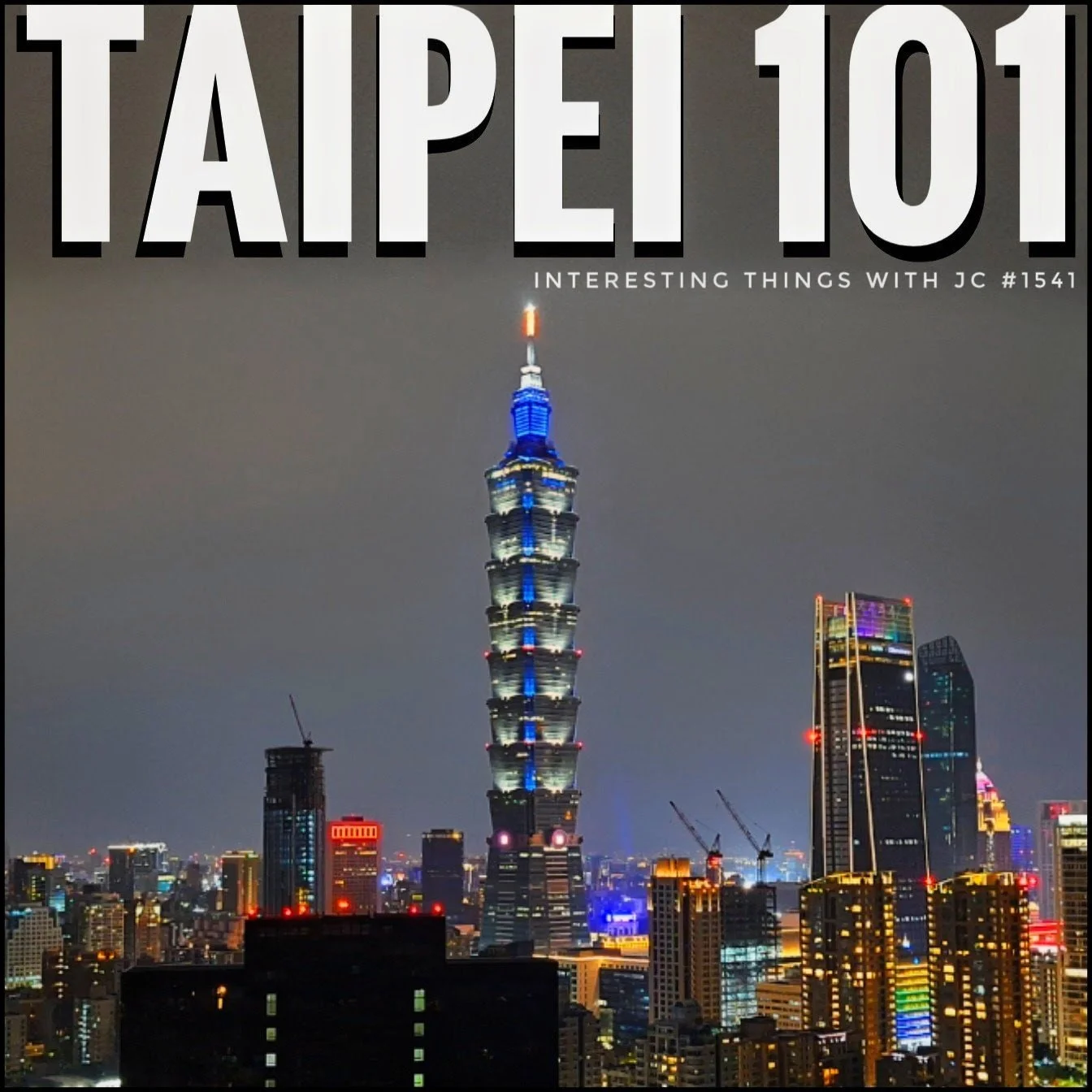
A nighttime cityscape featuring the illuminated Taipei 101 skyscraper standing prominently in the center. The building's stacked, pagoda-like structure glows with blue and white lights, topped with an orange-lit spire. Surrounding Taipei 101 are modern high-rise buildings with varied lighting and construction cranes, all set against a dark, overcast sky. Large white bold text at the top reads “TAIPEI 101,” with smaller text below stating “Interesting Things with JC #1541.”
Transcript
Interesting Things with JC #1541: "Taipei 101"
If you ever find yourself in Taipei (tie-PAY), Taiwan (tie-WAHN), you notice it right away. You are walking down the street, you look up, and the building just keeps going. It does not taper gently. It rises in stacked sections, steady and intentional. For several years, that building stood taller than any other on Earth.
The plan for the tower began in July of 1997, as Taiwan pushed to show it could compete on a global economic stage. The project moved forward under Taipei mayor Chen Shui-bian (CHEN shway-bee-EN) using a build operate transfer model. Groundbreaking came in January 1998. Full construction began in 1999, making it the largest engineering project Taiwan had ever attempted. The structure reached full height in 2003 and officially opened on New Year’s Eve, 2004.
When it opened, Taipei 101 rose to about 1,671 feet, or 509 meters, including its pinnacle. That is 101 floors above ground and five below. It surpassed Malaysia’s Petronas Towers to become the world’s tallest building, a title it held until 2010, when Dubai’s Burj Khalifa took over. Height, though, was not the hardest part of the job.
Taipei sits in a region known for earthquakes and powerful typhoons. Winds can exceed 130 miles per hour, about 209 kilometers per hour. Engineers knew from the beginning that the building would move, so they designed it with that reality in mind.
Inside the tower, between the 87th and 92nd floors, hangs a tuned mass damper, a steel sphere weighing 660 tons, about 600 metric tons, and measuring roughly 18 feet across, or 5.5 meters. Suspended like a pendulum, it moves opposite the building’s sway, cutting motion by as much as 40 percent. In extreme conditions, it is capable of swinging up to nearly 5 feet, about 1.5 meters. Visitors can see it in action, a rare example of critical safety engineering left out in the open.
The building’s shape carries meaning. Its stacked form resembles a bamboo stalk, a symbol of strength and flexibility, and it echoes traditional Chinese pagodas. The number eight, long associated with prosperity, appears throughout the design. Even the number 101 signals renewal, moving past a milestone and starting again.
The tower also set records during construction for concrete pumping height. Its elevators once held the world speed record, traveling 37.7 miles per hour, or 60.6 kilometers per hour, whisking visitors to the 89th-floor observatory in about 37 seconds.
More than twenty years later, Taipei 101 remains at the center of city life. Each New Year’s Eve, it becomes the focal point of a massive fireworks display, drawing hundreds of thousands in person and millions more worldwide.
The building does not fight nature. It adjusts to it. It bends when it needs to and stands firm when it matters.
These are interesting things, with JC.
Student Worksheet
What engineering challenges did Taipei 101 face due to its location?
Describe how the tuned mass damper helps stabilize the building.
What cultural symbols are embedded in Taipei 101’s design and why?
How did Taipei 101 break global records during and after its construction?
In your own words, what does the number “101” symbolize in this context?
Student Handout
Name: __________________________________ Date: ________________
A. Number Hunt (circle in the transcript)
List 6 numbers you found and what each means:
________ = __________________________
________ = __________________________
________ = __________________________
________ = __________________________
________ = __________________________
________ = __________________________
B. Quick Math (choose 3)
Convert 509 meters to feet (estimate).
If wind gusts reach 60 m/s, about how many mph is that?
The damper can swing 150 cm. How many meters is that?
The elevator goes from 5F to 89F in ~37 seconds. What’s one reason comfort systems matter?
C. CER (Claim–Evidence–Reasoning)
Claim: __________________________________________
Evidence (quote or paraphrase + number):
Reasoning (how the evidence supports the claim):
5-Question Quiz
What is the main job of the tuned mass damper?
Where is the damper located (roughly which floors)?
Give one hazard Taipei engineers designed for.
Name one way the elevator system is described as extreme/high-performance.
What is one cultural design inspiration mentioned (bamboo/pagoda/number symbolism)?
Answer Key (Teacher Use)
Reduce sway/motion by counteracting building movement.
Between the 87th–92nd floors (center of the tower).
Earthquakes; typhoon winds.
~1,010 m/min; ~37 seconds from 5th to 89th floor; specialized comfort/safety systems.
Bamboo/pagoda-inspired form; repeated “8” modules; symbolism in “101.”
Teacher Guide
Estimated Time:
1–2 class periods (45–60 minutes each)
Two-day mini-unit (2 × 45–60 minutes)
Project extension (1–2 weeks)
Anticipated Misconceptions:
Students may think the tallest building is always the most modern or advanced.
Students may not realize that taller does not always mean stronger in engineering terms.
Discussion Prompts:
How do you balance height and safety in skyscraper design?
What role does symbolism play in national architecture?
Should more buildings adapt to nature like Taipei 101?
Extension Activities:
Design a model skyscraper using principles from Taipei 101.
Compare Taipei 101 to other symbolic buildings (e.g., Eiffel Tower, Burj Khalifa).
Cross-Curricular Connections:
Physics: Concepts of pendulums, mass damping, and force.
Environmental Science: Green building technologies.
Cultural Studies: Architecture as national symbolism.
Engineering: Structural design under natural stress.
Big Idea
Great engineering doesn’t “defeat” nature—it designs for real forces and predictable motion.
Essential Questions
How do engineers design tall buildings to stay safe during earthquakes and extreme winds?
How can a building’s shape communicate meaning while also improving performance?
Materials
Transcript (provided)
Projector/board
Student handout (included)
Simple building model supplies (choose one):
Paper tower + coins/washers + string (for “damper”)
Jenga blocks or index cards
Optional: phone slow-motion video
Lesson Sequence (45–60 Minutes)
1) Hook (5 minutes)
Show a short clip/image of Taipei 101 and ask: “What problems do you think engineers had to solve here?”
(Prompt: wind, earthquakes, elevator speed, weight.)
2) Listen/Read (8–10 minutes)
Use the transcript as a read-aloud or paired reading.
3) Make the Data Real (10 minutes)
Students highlight all numbers in the transcript (height, floors, wind speed, damper size/weight, elevator speed/time).
Then complete 3 quick conversions or comparisons on the handout.
Key data points supported by sources:
Wind damper ball: ~5.5 m diameter, 660 metric tons, 92 cables, max swing ~150 cm.
Design wind gust criteria: up to 60 m/s.
Elevator: 1,010 m/min; ~37 seconds from 5th to 89th floor.
Height: 508 m / about 1,671 ft.
4) Mini-Lab: “Damper Demo” (15 minutes)
Teams build a quick paper/card tower. First, shake the desk lightly and observe sway.
Then add a “damper”: a coin stack (mass) on a string near the top inside/alongside the tower.
Students test again and record: Does sway amplitude decrease? Does it feel “smoother”?
Connect to the real tuned mass damper reducing building motion (reported up to ~40% reduction).
5) Explain (10 minutes)
CER writing (Claim–Evidence–Reasoning):
Claim: Taipei 101 is safer/more comfortable because it is designed to move safely, not remain perfectly still.
Evidence: cite transcript + at least 2 numeric facts.
Reasoning: explain how opposing motion + damping reduces sway.
6) Exit Ticket (3 minutes)
“One sentence: What is a tuned mass damper doing during a typhoon?”
“One number: Choose a data point and say what it represents.”
Differentiation Strategies:
ESL: Provide vocabulary with translated definitions and visuals.
IEP: Offer sentence starters and scaffolding in written responses.
Gifted: Encourage deeper research into other skyscrapers or earthquake engineering.
Differentiation (UDL)
Multiple means of engagement: choice of model materials; role cards (builder, recorder, tester).
Multiple means of representation: diagram + short explanation; vocabulary picture cards (sway, amplitude, damper).
Multiple means of action/expression: written CER, audio response, or labeled diagram.
Assessment
Formative:
Highlighted transcript evidence
Lab observation notes
Exit ticket
Summative (pick one):
One-page explanation with diagram (TMD + forces)
Short presentation: “Three engineering solutions Taipei 101 uses for hazards”
Quiz (included below)
Extension Options
High School physics extension: relate damping to resonance and why matching/offsetting frequency matters.
Architecture extension: analyze how “form” can serve both culture and wind performance.
Civics/econ extension: research how major infrastructure projects are financed (including BOT models).
Standards Alignment (U.S.)
NGSS
3-5-ETS1-2, 3-5-ETS1-3 (compare solutions; plan and carry out fair tests)
MS-ETS1-1, MS-ETS1-2, MS-ETS1-3, MS-ETS1-4 (define criteria/constraints; evaluate and optimize)
HS-ETS1-2, HS-ETS1-3, HS-ETS1-4 (evaluate complex solutions; model; refine)
CCSS ELA/Literacy (Science/Tech & History/Social Studies)
RI.4–12.1 (cite textual evidence)
RI.4–12.7 (integrate quantitative/visual information with text)
WHST.6–12.2 (informative/explanatory writing)
SL.4–12.1 (collaborative discussion)
CCSS Math
4–7.RP (ratio/proportional reasoning for unit conversion)
6–8.EE (expressions/equations for modeling)
HSS.ID, HSN.Q (quantities, units, interpreting data)
C3 Framework (Social Studies)
D2.Geo.4.6-8 (spatial patterns; environment and human design)
D2.Eco.1.6-8 / D2.Eco.1.9-12 (economic decisions and tradeoffs; development projects)
ISTE Standards (Students)
1.4 Innovative Designer (prototype, test, refine)
1.5 Computational Thinker (use data/measurements to support conclusions)
1.6 Creative Communicator (present findings clearly for an audience)
International Equivalencies (Content-Based)
UK National Curriculum
Science (Forces; Earth and physical processes where relevant)
Design & Technology (design, make, evaluate; technical knowledge)
Cambridge IGCSE / O Level
Physics: forces, motion, oscillations (as age-appropriate)
Design & Technology: iterative design, testing, evaluation
IB (MYP/DP)
MYP Sciences (forces, energy, systems)
DP Physics (oscillations, damping—extension)
DP Design Technology (design cycle; evaluation)
Show Notes
Taipei 101 is more than a tall building—it’s a real-world case study in designing for powerful natural forces. Completed in 2004 and rising about 508 meters (about 1,671 feet), it became internationally famous not only for its height but for how it stays steady and comfortable in a region known for earthquakes and typhoon winds.
The episode highlights one of the tower’s most visible engineering features: a tuned mass damper (TMD). In Taipei 101, this system is a massive steel sphere, about 5.5 meters across and weighing about 660 metric tons, hung on cables high inside the building so it can move opposite the tower’s sway. In extreme conditions, Taipei 101 describes a maximum swing of about 150 cm, and multiple sources discuss how the device can reduce building motion substantially (often described around a 40% reduction, depending on conditions and measurement).
The tower also demonstrates how performance and meaning can share the same design. Engineers and designers worked in an environment where typhoon gust criteria can reach about 60 m/s, so shape, structure, and damping strategies all contribute to a safer, more usable building—without hiding the science.
Finally, the episode connects Taipei 101 to broader ideas: how cities signal economic ambition through landmark projects, how high-speed elevators become their own engineering challenge.
References
Thornton Tomasetti. (n.d.). Taipei 101. https://www.thorntontomasetti.com/project/taipei-101
Council on Tall Buildings and Urban Habitat. (2004). Structural design of Taipei 101, the world's tallest building. https://global.ctbuh.org/resources/papers/download/1650-structural-design-of-taipei-101-the-worlds-tallest-building.pdf
Engineering News-Record. (2003, November 24). Megastructure supports Taipei's 508-meter 'megatower'. https://www.enr.com/articles/37144-megastructure-supports-taipei-s-508-meter-megatower
CNN. (2024, April 4). Taipei 101: How Taiwan's tallest skyscraper withstands earthquakes. https://www.cnn.com/2024/04/04/style/taipei-101-earthquake-design-intl-hnk
The Builders Report. (n.d.). TAIPEI 101. https://thebuildersreport.com/building/taipei-101