Interesting Things with JC #1796: “Free Fall Kinematics”
Drop a baseball and gravity increases its downward velocity every second, but throw it upward and something unexpected happens at the top: its velocity reaches zero while its acceleration does not.
Curriculum - Episode Anchor
Episode Title: Free Fall Kinematics
Episode Number: 1796
Series: Interesting Things with JC
Host: JC
Audience: Grades 9–12, introductory college, homeschool, lifelong learners
Subject Area: Physics, physical science, mathematics
Estimated Lesson Time: 35–50 minutes
Episode Length: Under 3 minutes
Central Question: How can position, velocity, acceleration, and time be used to predict the motion of an object in free fall?
Essential Understanding: Near Earth’s surface and with air resistance neglected, freely falling objects experience approximately constant downward acceleration of 9.8 m/s², or 32.2 ft/s². This makes free fall a clear application of constant-acceleration kinematics.
Learning Objectives
Students will be able to:
Define kinematics, free fall, velocity, acceleration, displacement, and gravitational acceleration.
Explain what 9.8 m/s² means physically.
Distinguish velocity from acceleration.
Calculate velocity and displacement for an object dropped from rest.
Explain why an upward-moving object remains accelerated downward.
Explain why velocity is zero but acceleration is not zero at the highest point of a vertical trajectory.
Describe why objects of different masses have the same free-fall acceleration when air resistance is negligible.
Identify the assumptions behind elementary free-fall calculations.
Lesson Overview
Free fall provides one of the clearest introductions to kinematics because the acceleration is approximately constant near Earth’s surface. Students begin with an ordinary dropped baseball and follow its motion mathematically. They examine how velocity changes each second, why distance does not increase at a constant rate, and what happens when an object is thrown upward.
The lesson then addresses a common conceptual difficulty: at the highest point of an upward throw, instantaneous velocity is zero, but acceleration remains approximately 9.8 m/s² downward. OpenStax specifically identifies this behavior in its treatment of one-dimensional free fall. OpenStax
Core Equations
For an object dropped from rest, using downward as positive:
\(v=gt\)
\(d=\frac{1}{2}gt^2\)
\(g\approx9.8\text{ m/s}^2\approx32.2\text{ ft/s}^2\)
For general constant-acceleration motion:
\(v=v_0+at\)
\(\Delta y=v_0t+\frac{1}{2}at^2\)
\(v^2=v_0^2+2a\Delta y\)
Important Assumption: These simplified free-fall equations treat gravity as the dominant acceleration and neglect air resistance. Real objects falling through Earth’s atmosphere also experience aerodynamic drag.
Key Vocabulary
Kinematics (kin-uh-MAT-iks) — The description of motion through quantities such as position, displacement, velocity, acceleration, and time, without requiring an analysis of the forces producing the motion.
Free fall — Motion in which gravity is the only significant force acting on an object.
Position — An object’s location relative to a chosen reference point.
Displacement — Change in position, including direction.
Velocity — Rate at which position changes with time, including direction.
Acceleration — Rate at which velocity changes with time.
Gravitational acceleration, g — Near Earth’s surface, approximately 9.8 m/s² or 32.2 ft/s² downward. NASA
Initial velocity, \(v_0\) — Velocity at the beginning of the time interval being studied.
Instantaneous velocity — Velocity at a particular instant.
Air resistance/drag — Aerodynamic force opposing motion through air.
Constant acceleration — Motion in which velocity changes by the same amount during equal intervals of time.
Narrative Core
A dropped object does not simply move downward. Its velocity changes continuously.
Near Earth’s surface, an ideal freely falling object gains approximately 9.8 meters per second of downward velocity during every second of fall. In U.S. customary units, that change is about 32.2 feet per second each second.
This produces two different mathematical patterns.
Velocity changes linearly with time:
\(v=gt\)
Distance changes with the square of time:
\(d=\frac{1}{2}gt^2\)
NASA's calculated free-fall values demonstrate the distinction clearly: after 1 second an object dropped from rest has fallen approximately 4.9 m (16 ft); after 2 seconds, 19.6 m (64 ft); and after 3 seconds, 44.1 m (145 ft).
The same gravitational acceleration applies when an object is traveling upward. If upward is defined as positive, gravitational acceleration is approximately −9.8 m/s². The object's upward velocity therefore decreases until reaching zero at the highest point. Gravity has not stopped. Acceleration remains downward, causing the object to reverse direction.
In ideal free fall, mass does not determine gravitational acceleration. Without air resistance, objects with different masses accelerate equally. NASA notes that even objects as different as a beach ball and an airliner have the same gravitational acceleration in a vacuum.
This is why free fall is so useful for studying kinematics: when acceleration is known, position and velocity can be predicted as functions of time.
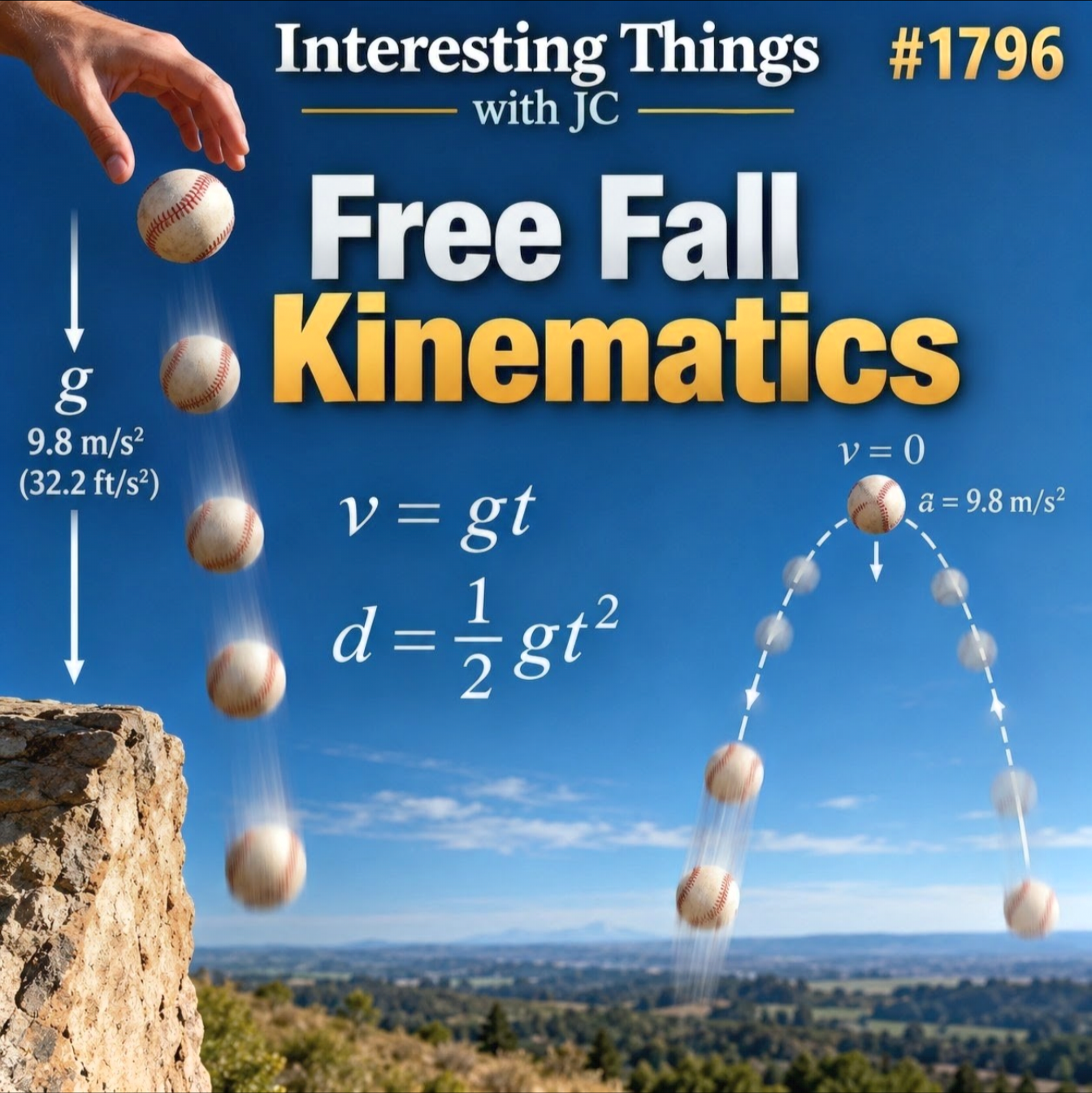
Square educational podcast cover for Interesting Things with JC #1796, “Free Fall Kinematics.” Against a bright blue sky, a hand releases a baseball beside a sequence of falling baseballs that illustrates increasing downward motion under gravity. Labels show gravitational acceleration as g = 9.8 m/s² (32.2 ft/s²), along with the equations v = gt and d = ½gt². On the right, another sequence shows a baseball traveling upward and downward along a curved path, with velocity marked as zero at the highest point while acceleration remains 9.8 m/s² downward. A rocky ledge and distant landscape appear along the bottom.
Transcript
Interesting Things with JC #1796:
“Free Fall Kinematics”
Drop a baseball from your hand, and the moment you let go, its motion begins changing in a predictable way. It doesn’t simply fall. It accelerates.
Near Earth’s surface, an object in free fall accelerates downward at about 32.2 feet per second squared, or 9.8 meters per second squared. That number is called g, the acceleration due to gravity.
The “per second squared” part sounds complicated, but it describes something simple. Ignoring air resistance, every second the object falls, its downward velocity increases by about 32.2 feet per second, or 9.8 meters per second.
Release an object from rest, and after 1 second it’s moving about 22 miles per hour, or 35 kilometers per hour. After 2 seconds, about 44 miles per hour, or 71 kilometers per hour. After 3 seconds, roughly 66 miles per hour, or 106 kilometers per hour.
But it isn’t covering equal distances during those seconds. Because it keeps getting faster, each second carries it farther than the second before.
For an object dropped from rest, the distance traveled is one-half times g times time squared. After 1 second, it has fallen about 16 feet, or 4.9 meters. After 2 seconds, about 64 feet, or 19.6 meters. After 3 seconds, about 145 feet, or 44.1 meters.
Free fall also exposes an important difference between velocity and acceleration.
Throw a ball straight upward. The ball rises while gravity continuously accelerates it downward. Its upward velocity gets smaller and smaller until the ball reaches its highest point.
For one instant, its velocity is zero.
Its acceleration is not.
Gravity is still accelerating it downward at 32.2 feet per second squared, or 9.8 meters per second squared. The ball reverses direction and begins gaining downward velocity.
And without air resistance, a bowling ball and a baseball dropped together would accelerate at the same rate. Their masses are very different, but their free-fall acceleration is the same.
So why do we call this kinematics?
Kinematics is how physics describes motion without needing to explain the force causing it. It tracks where an object is, how fast it’s moving, which direction it’s moving, how its velocity changes, and how much time passes.
In free fall, gravity provides a nearly constant acceleration, so those relationships become especially clear. If you know the starting position, starting velocity, acceleration, and time, the equations of kinematics can predict where the object will be and how fast it will be moving.
Free fall isn’t just something dropping. It’s motion that can be described mathematically, second by second.
These are interesting things, with JC.
Student Worksheet
Comprehension
What is meant by free fall?
What is the approximate value of gravitational acceleration near Earth’s surface in both SI and U.S. customary units?
In your own words, explain what “9.8 meters per second squared” means.
Approximately how fast is an object dropped from rest traveling after 3 seconds if air resistance is ignored?
Why does an object fall farther during its third second than during its first second?
What happens to the velocity of a ball as it travels upward?
What is the ball’s instantaneous velocity at its highest point?
What is its acceleration at that same point?
Why would a bowling ball and baseball accelerate equally in ideal free fall?
What does kinematics describe?
Calculations
Use \(g=9.8\text{ m/s}^2\) and neglect air resistance.
A ball is dropped from rest. Calculate its velocity after 2.5 seconds using \(v=gt\).
Calculate how far that ball falls during the same 2.5 seconds using \(d=\frac12gt^2\).
A rock is dropped from rest for 4 seconds. Calculate its final velocity.
Calculate its displacement after 4 seconds.
If downward is defined as positive, what sign should \(g\) have? What if upward is defined as positive?
Analysis
A student says, “At the top of its flight, the ball has stopped, so gravity must temporarily be zero.” Identify the error.
Explain the difference between velocity and acceleration using an upward-thrown ball.
A bowling ball and a sheet of paper are dropped in a classroom. The bowling ball reaches the floor first. Does this disprove equal free-fall acceleration? Explain.
Why must a coordinate direction be established before assigning a positive or negative sign to \(g\)?
Describe one limitation of the simplified free-fall model used in this lesson.
Reflection
Why is free fall particularly useful for learning kinematics?
Which concept is more important to understanding the top of an object's trajectory: velocity, acceleration, or both? Defend your answer.
Difficulty Scaling
Level 1: Questions 1–10 establish vocabulary and conceptual understanding.
Level 2: Questions 11–15 apply mathematical relationships.
Level 3: Questions 16–22 require explanation, modeling, and evaluation.
Student Output: Complete all assigned questions and show units and mathematical work for calculations.
Academic Integrity Guidance: Calculations should show the equation selected, substituted values, units, and final result rather than only a numerical answer.
Teacher Guide
Quick Start: Play the episode once without interruption. Ask students to write down the difference between velocity and acceleration. Replay the section describing the highest point of an upward throw before moving into calculations.
Pacing Guide — Audio First
0–5 minutes: Introduce the central question and play the episode.
5–10 minutes: Define free fall, velocity, acceleration, and \(g\).
10–20 minutes: Work through the 1-, 2-, and 3-second examples.
20–30 minutes: Students complete worksheet calculations.
30–40 minutes: Discuss upward motion and the highest point.
40–50 minutes: Complete analysis questions, exit ticket, or extension activity.
Materials
Episode audio or transcript
Calculator
Student worksheet
Pencil and paper
Optional stopwatch
Optional small balls of different masses
Optional crumpled and uncrumpled sheets of paper
Demonstration
Hold two similarly shaped objects with noticeably different masses at the same height.
Ask students which will reach the floor first.
Release them simultaneously.
Discuss why similar shapes reduce differences caused by drag.
Repeat with a flat sheet of paper and a crumpled sheet.
Ask which variable changed significantly: mass or aerodynamic shape.
Connect the observation to the idealized free-fall model.
Common Misconceptions
“Heavier objects always fall faster.” In ideal free fall, gravitational acceleration does not depend on object mass. NASA
“An object at the top of its trajectory has zero acceleration.” Its instantaneous velocity is zero, but gravitational acceleration remains downward. OpenStax
“9.8 m/s² is a speed.” It is acceleration: velocity changes by approximately 9.8 m/s each second.
“Free fall means moving downward.” An upward-thrown object is in free fall after release if gravity is the only significant force acting on it.
“The sign of g is always negative.” Its sign depends on the coordinate system. If upward is positive, \(a=-g\); if downward is positive, \(a=+g\). OpenStax
Formative Checkpoints
Ask students to predict velocity after 1, 2, and 3 seconds.
Ask whether acceleration changes during ideal free fall.
Ask what happens to acceleration at the highest point.
Have students explain why \(d\) depends on \(t^2\) rather than simply \(t\).
Require units with every calculated quantity.
Differentiation
Additional Support: Provide an equation sheet identifying each variable and unit.
Advanced Learners: Introduce nonzero initial velocity and sign conventions; solve upward-launch problems.
English Learners: Pair vocabulary with motion diagrams and arrows indicating velocity and acceleration.
Mathematics Support: Build a table of time, velocity, and displacement before introducing equations.
Extension: Compare ideal free fall with falling motion that includes aerodynamic drag and terminal velocity.
Answer Key
Motion in which gravity is the only significant force acting on an object.
Approximately 9.8 m/s² or 32.2 ft/s² downward.
Downward velocity changes by approximately 9.8 m/s during each second.
Approximately 29.4 m/s downward, or about 66 mph/106 km/h.
Its velocity increases continuously, so it covers more distance during later equal time intervals.
Its upward velocity decreases.
Zero instantaneously.
Approximately 9.8 m/s² downward.
In ideal free fall, gravitational acceleration is independent of object mass.
Position and motion through quantities including displacement, velocity, acceleration, and time.
\(v=(9.8)(2.5)=24.5\text{ m/s}\) downward.
\(d=\frac12(9.8)(2.5)^2=30.625\text{ m}\approx30.6\text{ m}\), about 100 ft.
\(v=(9.8)(4)=39.2\text{ m/s}\) downward.
\(d=\frac12(9.8)(4)^2=78.4\text{ m}\), about 257 ft.
Downward positive: \(+9.8\text{ m/s}^2\). Upward positive: \(-9.8\text{ m/s}^2\).
Zero velocity at an instant does not imply zero acceleration. Gravity continues changing the ball’s velocity.
Velocity describes motion and direction; acceleration describes the rate at which velocity changes.
No. Air resistance affects real objects differently; a flat sheet of paper is not an ideal free-fall comparison.
Signs indicate direction relative to the selected coordinate system.
It neglects aerodynamic drag and treats \(g\) as approximately constant.
Because near Earth's surface it provides a familiar example of approximately constant acceleration.
Both. Velocity identifies the instantaneous state of motion; acceleration explains why that state immediately changes.
Quiz
Multiple Choice
Near Earth’s surface, the magnitude of gravitational acceleration is approximately:
A. 4.9 m/s²
B. 9.8 m/s²
C. 19.6 m/s²
D. 32.2 m/s²An object is dropped from rest. Ignoring air resistance, its velocity after 2 seconds is approximately:
A. 4.9 m/s
B. 9.8 m/s
C. 19.6 m/s
D. 39.2 m/sAt the highest point of a ball thrown vertically upward:
A. Velocity and acceleration are both zero.
B. Velocity is zero and acceleration is downward.
C. Velocity is downward and acceleration is zero.
D. Velocity and acceleration are both upward.In ideal free fall, which property determines whether an object has a greater gravitational acceleration?
A. Mass
B. Shape
C. Color
D. None of theseFor an object dropped from rest, displacement is proportional to:
A. \(t\)
B. \(t^2\)
C. \(1/t\)
D. \(g/t\)Kinematics primarily describes:
A. Chemical reactions
B. Why gravity exists
C. Motion
D. Atomic structureIf upward is defined as positive, gravitational acceleration near Earth is approximately:
A. +9.8 m/s²
B. −9.8 m/s²
C. 0 m/s²
D. −4.9 m/s²A ball dropped from rest falls for 3 seconds. Approximately how far does it travel?
A. 9.8 m
B. 19.6 m
C. 29.4 m
D. 44.1 m
Short Response
Explain why a ball can have zero velocity while still having nonzero acceleration.
Explain why a feather and hammer fall differently in ordinary air but can fall together in a vacuum.
Quiz Answer Key: 1-B, 2-C, 3-B, 4-D, 5-B, 6-C, 7-B, 8-D.
9: At the highest point, velocity is instantaneously zero while gravity continues producing downward acceleration.
10: Air resistance affects the feather much more strongly relative to its weight. Without air resistance, both experience the same gravitational acceleration.
Assessment
Performance Task: Students analyze a hypothetical object dropped from rest for 3.5 seconds. They must calculate final velocity and displacement, create a labeled motion diagram, and explain the relationship among position, velocity, acceleration, and time.
Required Calculations
\(v=(9.8)(3.5)=34.3\text{ m/s}\) downward.
\(d=\frac12(9.8)(3.5)^2\approx60.0\text{ m}\), approximately 197 ft.
Assessment Rubric — 20 Points
Conceptual Accuracy — 5 points: Correctly distinguishes position, velocity, and acceleration and identifies gravitational acceleration.
Mathematical Reasoning — 5 points: Selects appropriate equations, substitutes correctly, and shows calculations.
Units and Direction — 4 points: Uses appropriate SI units and consistently indicates direction/sign convention.
Motion Representation — 3 points: Diagram accurately represents increasing downward velocity and constant acceleration.
Scientific Explanation — 3 points: Clearly connects mathematical results to physical motion and states the assumptions of the model.
Performance Levels
18–20 — Advanced: Accurate calculations and sophisticated conceptual explanation.
15–17 — Proficient: Correct understanding with minor errors or omissions.
11–14 — Developing: Partial understanding with significant mathematical or conceptual gaps.
0–10 — Beginning: Requires additional instruction in foundational concepts.
Exit Ticket: A ball thrown straight upward reaches its highest point. Write its velocity and acceleration at that instant and explain why those values are different.
Standards Alignment
NGSS — Science & Engineering Practices
HS-PS2-1 — Analyze data to support the claim that Newton’s second law of motion describes the mathematical relationship among net force, mass, and acceleration. Students analyze constant gravitational acceleration and connect measured or calculated motion to mathematical models.
Using Mathematics and Computational Thinking — Students use mathematical representations of velocity, displacement, acceleration, and time to describe vertical motion.
Analyzing and Interpreting Data — Students interpret numerical patterns showing constant acceleration, linear changes in velocity, and quadratic changes in displacement.
Developing and Using Models — Students use an ideal free-fall model and explicitly identify the assumption that aerodynamic drag is neglected.
CCSS Reading — Science and Technical Subjects
CCSS.ELA-LITERACY.RST.9-10.1 — Cite specific textual evidence to support analysis of science and technical texts. Students use the transcript and supporting scientific sources to justify explanations of free-fall behavior.
CCSS.ELA-LITERACY.RST.9-10.2 — Determine the central ideas or conclusions of a text and trace its explanation of a complex process, phenomenon, or concept. Students trace how constant acceleration produces changing velocity and displacement.
CCSS.ELA-LITERACY.RST.9-10.3 — Follow precisely a complex multistep procedure when carrying out experiments, taking measurements, or performing technical tasks. Students follow procedures for demonstrations and mathematical analysis.
CCSS Mathematics
CCSS.MATH.CONTENT.HSF-IF.B.4 — Interpret key features of functions in terms of quantities. Students interpret velocity as linear with time and displacement as quadratic with time under constant acceleration.
CCSS.MATH.CONTENT.HSA-CED.A.4 — Rearrange formulas to highlight a quantity of interest. Advanced students manipulate constant-acceleration equations to solve for unknown quantities.
ISTE
1.5 Computational Thinker — Students formulate problems, organize information, and use mathematical models to analyze motion.
1.3 Knowledge Constructor — Students evaluate scientific information and distinguish idealized models from real atmospheric motion.
Bloom’s Taxonomy
Remember: Define kinematics and gravitational acceleration.
Understand: Explain free fall and distinguish velocity from acceleration.
Apply: Calculate velocity and displacement.
Analyze: Interpret motion at the highest point of a trajectory.
Evaluate: Assess claims about mass and falling speed.
Create: Construct and explain a free-fall motion model.
UDL — Universal Design for Learning
Multiple Means of Engagement: Begin with familiar objects and prediction questions.
Multiple Means of Representation: Combine audio, transcript, equations, numerical tables, and motion diagrams.
Multiple Means of Action and Expression: Permit written explanation, calculations, diagrams, or oral explanation when appropriate.
College and Career Readiness
Quantitative reasoning
Mathematical modeling
Evidence-based explanation
Technical vocabulary
Interpretation of scientific models
Recognition of assumptions and limitations
Show Notes
Episode Summary: What happens during every second of a fall? Episode #1796 uses a dropped baseball to explain free-fall kinematics, gravitational acceleration, velocity, displacement, and one of the most important distinctions in introductory physics: an object can have zero velocity at an instant while still accelerating. Key Concepts of free fall, kinematics, gravity, gravitational acceleration, velocity, displacement, constant acceleration, motion equations, air resistance are covered. Students can use the episode as an introduction to one-dimensional motion, constant-acceleration equations, graphical representations of motion, or Newtonian mechanics. Thi89s episode is dedicated to Lisa Heater.
References
National Aeronautics and Space Administration. (n.d.). Free fall without air resistance. Glenn Research Center. https://www1.grc.nasa.gov/beginners-guide-to-aeronautics/free-fall-without-air-resistance/ NASA
National Aeronautics and Space Administration. (n.d.). Free falling objects. Glenn Research Center. https://www1.grc.nasa.gov/beginners-guide-to-aeronautics/free-falling-objects/ NASA
National Aeronautics and Space Administration. (n.d.). Motion of free falling object. Glenn Research Center. https://www1.grc.nasa.gov/beginners-guide-to-aeronautics/motion-of-free-falling-object/ NASA
National Aeronautics and Space Administration. (n.d.). Falling object with air resistance. Glenn Research Center. https://www1.grc.nasa.gov/beginners-guide-to-aeronautics/falling-object-with-air-resistance/ NASA
OpenStax. (n.d.). 3.5 Free fall. In University Physics Volume 1. Rice University. https://openstax.org/books/university-physics-volume-1/pages/3-5-free-fall OpenStax
OpenStax. (n.d.). 2.7 Falling objects. In College Physics for AP® Courses. Rice University. https://openstax.org/books/college-physics-ap-courses/pages/2-7-falling-objects OpenStax
Common Core State Standards Initiative. (n.d.). English language arts standards: Science & technical subjects, grades 9–10. https://www.thecorestandards.org/ELA-Literacy/RST/9-10/ Common Core State Standards Initiative