Interesting Things with JC #1654: "Fusion Propulsion" – A spacecraft engine tries to push plasma at hundreds of kilometers per second while no normal material can touch the fuel. Fusion promises travel times chemical rockets cannot match, but the reaction has to be held hotter than the Sun’s core.
Curriculum - Episode Anchor
Episode Title: Fusion Propulsion
Episode Number: 1654
Host: JC
Audience: Grades 9–12, introductory college, homeschool, lifelong learners
Subject Area: Physics, space science, engineering, propulsion systems
Framework Source: Curriculum structure follows the uploaded Interesting Things with JC curriculum framework.
Lesson Overview
Learning Objectives:
Explain how fusion differs from chemical combustion as an energy source for spacecraft propulsion.
Describe why plasma confinement is a central engineering challenge in fusion propulsion.
Compare chemical rocket exhaust velocity with projected fusion propulsion exhaust velocity.
Evaluate why fusion propulsion remains a research concept rather than an operational spacecraft engine.
Essential Question: Why could fusion propulsion change deep-space travel, and what engineering barriers must be solved first?
Success Criteria: Students can define fusion, plasma, exhaust velocity, and confinement; identify the main propulsion advantage; and explain at least two unresolved engineering challenges.
Student Relevance Statement: This lesson connects classroom physics to the future of human and robotic exploration beyond the Moon and Mars.
Real-World Connection: Fusion propulsion research links nuclear physics, aerospace engineering, materials science, and mission planning.
Workforce Reality: Careers in advanced propulsion require disciplined testing, safety awareness, mathematical modeling, and responsibility for systems where failure can end missions.
Key Vocabulary
Fusion (FYOO-zhun): A nuclear process in which light atomic nuclei combine to form a heavier nucleus, releasing energy.
Hydrogen Isotopes (HY-droh-jen EYE-suh-tohps): Forms of hydrogen with different numbers of neutrons, including deuterium and tritium.
Deuterium (doo-TEER-ee-um): A hydrogen isotope with one proton and one neutron; it is found naturally in seawater.
Tritium (TRIT-ee-um): A radioactive hydrogen isotope with one proton and two neutrons; it may be produced from lithium in fusion fuel systems.
Plasma (PLAZ-muh): A hot, electrically charged state of matter made of ions and electrons.
Magnetic Confinement (mag-NET-ik kun-FINE-mint): The use of magnetic fields to control and contain plasma.
Laser Compression (LAY-zer kum-PRESH-un): A method that uses powerful lasers to compress fusion fuel to extreme conditions.
Exhaust Velocity (EG-zawst vuh-LOSS-uh-tee): The speed at which propellant leaves a rocket engine.
Energy Density (EN-er-jee DEN-suh-tee): The amount of energy stored in a given amount of fuel or material.
Net-Positive Fusion (net PAH-zuh-tiv FYOO-zhun): A fusion system condition in which more useful energy is produced than is required to sustain the reaction.
Narrative Core
Open: Every star, including the Sun, is powered by fusion. Fusion propulsion asks whether that same basic process could someday push spacecraft across the solar system.
Info: Chemical rockets move spacecraft by burning fuel and throwing exhaust backward. Fusion propulsion would release nuclear energy by forcing hydrogen isotopes together, producing far more energy per unit of fuel.
Details: The possible advantage is enormous exhaust velocity. Chemical rockets usually produce exhaust speeds of only a few kilometers per second, while many advanced fusion concepts project much higher values. Higher exhaust velocity could reduce travel time for deep-space missions.
Reflection: The challenge is not whether fusion physics exists. The challenge is controlling plasma hotter than the Sun’s core, managing radiation and heat, and building an engine light and reliable enough for spaceflight.
Closing: These are interesting things, with JC.
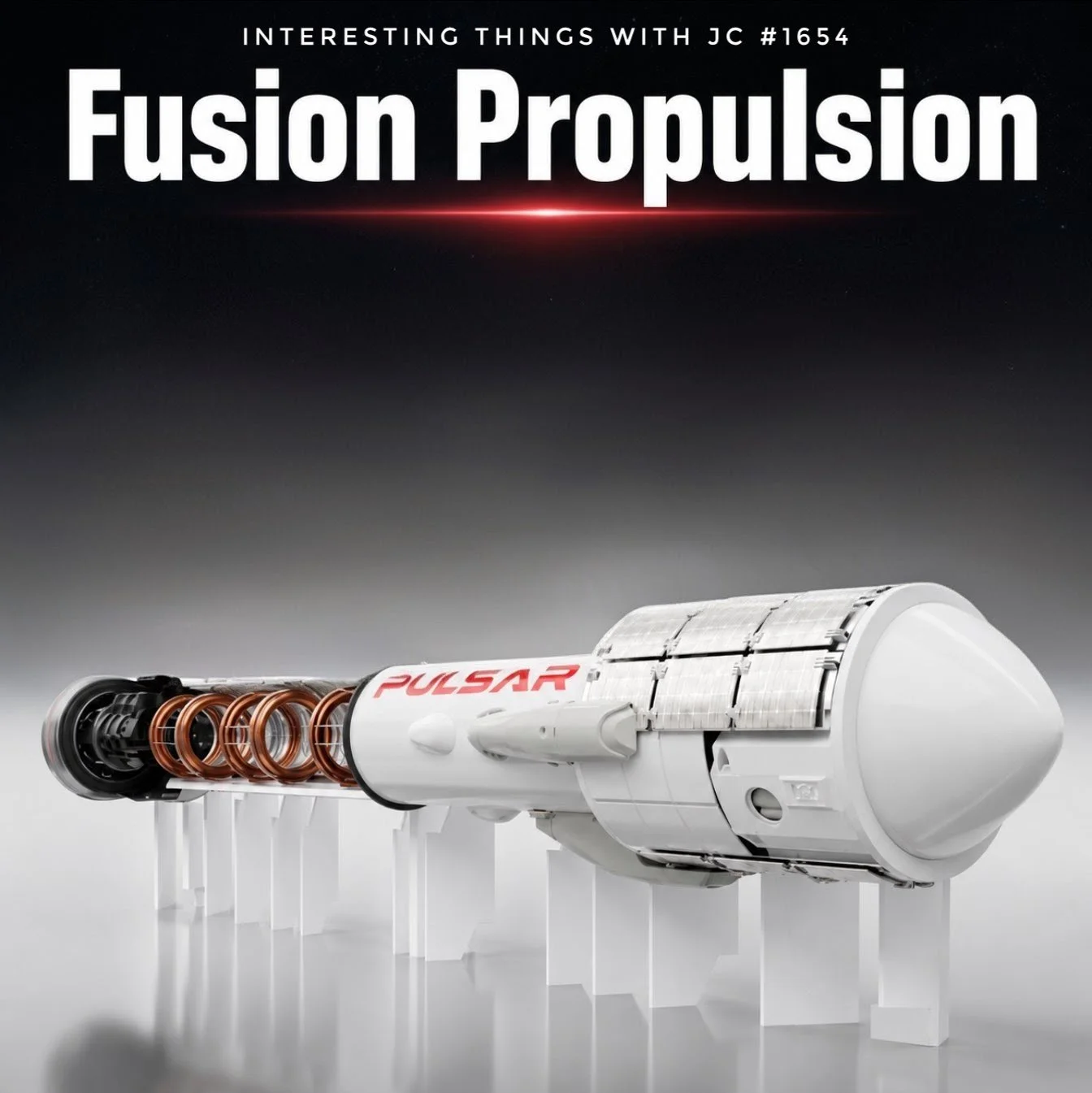
Digital cover image for Interesting Things with JC #1654 titled “Fusion Propulsion,” showing a futuristic white spacecraft engine concept with exposed copper-colored coils on the left, a rounded nose section on the right, and a dark space-like background with a red horizontal glow.
Transcript
Interesting Things with JC #1654:
“Fusion Propulsion”
Every star in the sky is powered by fusion.
Including the Sun.
Fusion propulsion tries to use the same basic process for spacecraft. Instead of burning chemical fuel, fusion forces hydrogen isotopes together under extreme heat and pressure. When those atoms fuse, a small amount of mass converts directly into energy: E=mc^2
And the energy density is enormous.
Chemical rockets expel exhaust at roughly 2 to 4.5 kilometers per second, about 4,500 to 10,000 miles per hour. Many fusion propulsion concepts predict exhaust velocities measured in hundreds of kilometers per second.
That could cut deep-space travel times dramatically.
Some mission studies suggest fusion-powered spacecraft might eventually reach Mars in weeks instead of months, while missions to the outer planets could shrink from years to far shorter durations depending on trajectory and engine design.
The fuel is efficient too. Deuterium can be extracted from seawater. Tritium can potentially be bred from lithium.
The engineering problem is brutal.
Fusion reactions require temperatures above 100 million degrees Celsius, roughly 180 million degrees Fahrenheit, hotter than the Sun’s core. At those temperatures, matter becomes plasma. No normal material can directly contain it.
That is why fusion systems rely on magnetic confinement, laser compression, or pulsed plasma designs.
Projects like ITER in Saint-Paul-lès-Durance are still trying to achieve stable net-positive fusion power on Earth. No nation has yet built a practical fusion rocket engine.
But the physics is real.
NASA, the Department of Defense, and multiple private companies continue studying fusion propulsion because chemical rockets begin to look painfully slow once missions move beyond the Moon and Mars.
The farther humans travel into space, the more fusion stops sounding exotic and starts sounding necessary.
These are interesting things, with JC.
Student Worksheet
Comprehension Questions:
What powers every star in the sky, including the Sun?
What does fusion propulsion try to use for spacecraft?
What are hydrogen isotopes forced to do during fusion?
Why is exhaust velocity important for spacecraft travel time?
Why can no normal material directly contain fusion plasma?
Analysis Questions:
Compare chemical propulsion and fusion propulsion using energy source, exhaust velocity, and engineering difficulty.
Explain why deuterium and tritium are discussed as possible fusion fuels.
Why does the episode describe the engineering problem as “brutal”?
How could shorter travel times affect mission planning, crew safety, and spacecraft design?
Reflection Prompt: In 5–7 sentences, explain whether fusion propulsion sounds more like science fiction, engineering research, or both. Use at least three vocabulary terms.
Difficulty Scaling: Emerging learners may answer in short paragraphs with sentence starters. Advanced learners should include a labeled comparison table and one quantitative statement about exhaust velocity.
Student Output: Submit written answers, one comparison table, and one reflection paragraph.
Academic Integrity Guidance: Use your own words. Do not copy definitions or explanations from online sources. When using evidence from the episode, refer to the idea rather than copying long phrases.
Teacher Guide
Quick Start: Begin with the podcast audio. Ask students to listen for the difference between chemical rockets and fusion propulsion.
Pacing Guide — Audio-First:
Podcast listening and first impressions: 5 minutes
Vocabulary clarification: 8 minutes
Guided comprehension: 10 minutes
Small-group analysis: 12 minutes
Reflection and exit ticket: 10 minutes
Bell Ringer: Write this prompt on the board: “Why might a rocket that uses more energetic fuel travel through deep space more efficiently?”
Audio Guidance: During listening, students should mark any mention of fuel, heat, plasma, exhaust velocity, or travel time.
Audio Fallback: If audio is unavailable, read the transcript aloud with pauses after each major idea.
Time on Task: Standard lesson length is 45 minutes; extended version is 60–70 minutes with research extension.
Materials: Podcast audio or transcript, worksheet, calculator, projector or board, optional propulsion comparison chart.
Vocabulary Prep: Pre-teach fusion, plasma, isotope, and exhaust velocity before analysis questions.
Misconceptions:
Fusion propulsion does not mean a spacecraft is powered by a tiny star.
Fusion is not the same process as chemical burning.
High exhaust velocity does not remove the need for careful trajectory planning.
Fusion power research on Earth does not mean practical fusion rockets already exist.
Discussion Prompts:
Why does fuel energy density matter more as missions go farther from Earth?
What makes plasma containment different from holding ordinary hot gas?
Should mission planners rely on unproven propulsion concepts when designing future missions?
Formative Checkpoints:
Students can state one difference between combustion and fusion.
Students can explain why plasma requires special confinement.
Students can connect exhaust velocity to travel time.
Differentiation: Provide vocabulary sentence frames for support. Let advanced students compare propulsion systems using specific impulse, power-to-mass ratio, and mission duration.
Assessment Differentiation: Students may submit written responses, an annotated diagram, or a short oral explanation.
Time Flexibility: For a 30-minute lesson, use the podcast, vocabulary, three comprehension questions, and exit ticket. For a longer lesson, add the extension research.
Substitute Readiness: The lesson can be completed with only the transcript and worksheet. Have students read silently, answer questions, and complete the reflection.
Engagement Strategy: Use a “claim-check” routine: students identify one claim from the episode, then explain what evidence would be needed to test it.
Extensions: Have students research one propulsion concept: fusion driven rocket, nuclear electric propulsion, solar electric propulsion, or chemical propulsion.
Cross-Curricular: Physics connects through energy and motion; chemistry through isotopes; engineering through design constraints; math through velocity comparison.
SEL: Emphasize responsible optimism: advanced technology requires patience, evidence, teamwork, and respect for safety limits.
Skill Emphasis: Students practice technical listening, evidence-based comparison, systems thinking, and clear scientific explanation.
Answer Key:
Stars are powered by fusion.
Fusion propulsion tries to use fusion reactions to propel spacecraft.
Hydrogen isotopes are forced together under extreme heat and pressure.
Higher exhaust velocity can increase propulsion efficiency and potentially reduce deep-space travel time.
Fusion plasma is far too hot for ordinary materials, so it must be controlled by fields, compression, or pulsed designs.
Chemical propulsion uses combustion; fusion propulsion would use nuclear reactions.
Deuterium is relatively available from seawater, while tritium may be bred from lithium.
The engineering challenge is controlling extremely hot plasma while building a practical, lightweight, reliable engine.
Quiz
What process powers the Sun and other stars?
A. Combustion
B. Fusion
C. Fission
D. Solar reflectionIn fusion propulsion, what type of fuel is commonly discussed?
A. Hydrogen isotopes
B. Liquid oxygen only
C. Coal dust
D. Compressed nitrogenWhy is plasma difficult to contain?
A. It is colder than ordinary gas
B. It cannot move through space
C. It is extremely hot and electrically charged
D. It has no particlesWhat advantage do many fusion propulsion concepts seek?
A. Lower exhaust velocity
B. Higher exhaust velocity
C. No need for fuel
D. Instant travelWhat is the current status of practical fusion rocket engines?
A. They are already used on crewed Mars missions
B. They are common in commercial satellites
C. They remain research concepts
D. They have replaced chemical rockets
Assessment
Open-Ended Questions:
Explain how fusion propulsion could change mission planning for travel beyond Mars. Include at least two technical reasons.
Describe the main engineering barriers to building a practical fusion rocket engine. Use at least three vocabulary terms.
3–2–1 Rubric:
3: Response accurately explains fusion propulsion, uses vocabulary correctly, connects propulsion to mission design, and identifies engineering limits.
2: Response explains the basic idea but lacks detail, uses limited vocabulary, or gives only one clear engineering challenge.
1: Response is incomplete, confuses fusion with combustion, or does not connect the concept to spacecraft propulsion.
Exit Ticket: In one sentence, explain why fusion propulsion is promising. In one sentence, explain why it is not yet practical.
Standards Alignment
NGSS HS-PS1-8 — Nuclear Processes: Students evaluate fusion as a nuclear process by explaining how hydrogen isotopes combine, how mass-energy conversion releases energy, and why fusion differs from chemical combustion.
NGSS HS-PS3-1 — Energy in Systems: Students use the episode to explain how energy changes form in propulsion systems, connecting stored nuclear energy to kinetic energy in high-speed exhaust.
NGSS HS-PS3-3 — Energy Transfer and Design: Students compare chemical and fusion propulsion by analyzing how different energy sources affect exhaust velocity, mission efficiency, and spacecraft design constraints.
NGSS HS-ETS1-1 — Engineering Problem Definition: Students identify the practical engineering problem of fusion propulsion by defining criteria and constraints, including plasma temperature, confinement, fuel supply, mass, reliability, and mission safety.
NGSS HS-ETS1-3 — Evaluating Solutions: Students compare multiple propulsion approaches and evaluate tradeoffs among performance, feasibility, safety, timeline, and technological readiness.
CCSS RST.9-10.2 / RST.11-12.2 — Central Ideas in Technical Texts: Students determine the central idea of the episode and summarize how fusion propulsion could affect deep-space travel without adding unsupported claims.
CCSS RST.9-10.7 / RST.11-12.7 — Integrating Technical Information: Students translate information from the transcript into a comparison table or diagram showing relationships among fuel type, energy density, exhaust velocity, and mission duration.
CCSS WHST.9-10.1 / WHST.11-12.1 — Evidence-Based Argument: Students write a supported claim about whether fusion propulsion is a near-term technology, a long-term research goal, or both.
CCSS WHST.9-10.9 / WHST.11-12.9 — Drawing Evidence from Informational Text: Students use details from the transcript to support explanations about plasma confinement, fuel efficiency, and propulsion limits.
ISTE 1.3 Knowledge Constructor: Students gather, evaluate, and organize technical information about fusion propulsion to build an evidence-based explanation of an emerging aerospace technology.
ISTE 1.5 Computational Thinker: Students use quantitative reasoning to compare exhaust velocity ranges and explain how propulsion performance can influence mission planning.
CTE STEM Career Cluster — Engineering and Technology Pathway: Students connect classroom physics to aerospace engineering practices by identifying how testing, modeling, safety review, and design iteration apply to advanced propulsion.
C3 D2.Geo.3.9-12 — Human Systems and Distance: Students explain how transportation limits shape human activity by connecting spacecraft propulsion capability to possible exploration of Mars and the outer planets.
C3 D4.2.9-12 — Constructing Explanations: Students construct a clear explanation of why fusion propulsion is scientifically plausible but not yet operational, using evidence and technical vocabulary.
Career Readiness — Critical Thinking and Problem Solving: Students analyze a complex real-world technology by separating scientific principles from unresolved engineering barriers.
Career Readiness — Technical Communication: Students communicate advanced propulsion concepts accurately through written responses, discussion, and visual comparison tools.
Career Readiness — Responsibility and Safety: Students explain why high-energy systems require disciplined testing, risk analysis, and ethical responsibility before human use.
Homeschool/Lifelong Learning — Scientific Literacy: Learners connect a short-form science narrative to broader physics concepts, strengthening independent learning and evidence-based reasoning.
Homeschool/Lifelong Learning — Applied Inquiry: Learners generate questions about future spacecraft propulsion and identify what evidence would be needed to evaluate those claims.
Show Notes
Fusion propulsion explores whether the same basic process that powers stars could someday move spacecraft through deep space. This episode gives students a practical way to connect nuclear physics, plasma science, fuel efficiency, and mission design. The topic matters because chemical rockets are powerful but limited, while future missions to Mars and the outer planets may require propulsion systems with far greater energy density and exhaust velocity.
References
Department of Energy, Office of Science. (2026). DOE explains... deuterium-tritium fusion fuel.https://www.energy.gov/science/doe-explainsdeuterium-tritium-fusion-fuel
ITER Organization. (2023). 60 years of progress.https://www.iter.org/fusion-energy/60-years-progress
NASA Jet Propulsion Laboratory. (2026). NASA fires up powerful lithium-fed thruster for trips to Mars.https://www.nasa.gov/missions/tech-demonstration/nasa-fires-up-powerful-lithium-fed-thruster-for-trips-to-mars/
Slough, J., Pancotti, A., Kirtley, D., Pihl, C., & Pfaff, M. (2012). Nuclear propulsion through direct conversion of fusion energy: The fusion driven rocket, Phase I final report. NASA Innovative Advanced Concepts. https://www.nasa.gov/wp-content/uploads/2017/07/niac_2011_phasei_slough_fusionrocket_tagged.pdf