1680: "The Overview Effect: How Does a Cosmic Perspective Change Us?"
Interesting Things with JC #1680: "The Overview Effect: How Does a Cosmic Perspective Change Us?" – An astronaut sees Earth from space and the known facts stop behaving like ordinary facts. Borders disappear, the atmosphere looks thin, and the planet becomes one finite system as the same perception shift keeps appearing across crews.
Curriculum - Episode Anchor
Episode Title: The Overview Effect
Episode Number: 1680
Host: JC
Audience: Grades 9–12, Introductory College, Homeschool Learners, Lifelong Learners
Subject Area: Space Science, Psychology, Cognitive Science, Human Behavior
Lesson Overview
Objectives:
Explain the Overview Effect and its significance in human spaceflight.
Analyze how perspective influences cognition, behavior, and decision-making.
Evaluate astronaut experiences as examples of cognitive reframing.
Connect changes in perspective to personal, societal, and scientific understanding.
Essential Question: How can a change in perspective alter the way people understand themselves and the world?
Success Criteria:
Define the Overview Effect using accurate academic language.
Identify recurring themes reported by astronauts.
Explain cognitive reframing using evidence from the episode.
Apply the concept of perspective shifts to real-world situations.
Student Relevance Statement: Students regularly encounter situations where changing perspective improves understanding, problem-solving, communication, and relationships.
Real-World Connection: Researchers, psychologists, astronauts, military leaders, educators, and business professionals study perspective-taking because it influences judgment, cooperation, leadership, and innovation.
Workforce Reality: Careers in aerospace, psychology, environmental science, diplomacy, education, healthcare, leadership, and technology require individuals to understand complex systems and consider multiple viewpoints.
Key Vocabulary
Overview Effect(OH-ver-vyoo ih-FEKT) — A cognitive and emotional shift experienced when viewing Earth from space.
Psychological(sy-kah-LOJ-i-kul) — Relating to the mind, behavior, and mental processes.
Perspective(per-SPEK-tiv) — A particular attitude or way of viewing something.
Cognitive Reframing(KOG-ni-tiv ree-FRAY-ming) — Reorganizing how a situation is understood or interpreted.
Perception(per-SEP-shun) — The process of recognizing and interpreting information.
Ecological System(ee-kah-LOJ-i-kul SIS-tum) — An interconnected network of living and nonliving components.
Atmosphere(AT-muhs-feer) — The layer of gases surrounding Earth.
Spaceflight(SPAYS-flyt) — Travel through outer space.
Interconnectedness(in-ter-kuh-NEK-tid-nis) — The condition of being linked together within a larger system.
Mental Model(MEN-tul MOD-ul) — An internal framework used to understand the world.
Narrative Core
Open: Fewer than 700 people in human history have traveled into space, yet many return describing remarkably similar changes in how they think about themselves and the world.
Info: This shared experience is known as the Overview Effect, a psychological phenomenon associated with viewing Earth from space.
Details: Astronauts often report increased feelings of connection to humanity, reduced focus on political and cultural divisions, and heightened awareness of Earth's fragile environmental systems. Researchers note that the transformation appears to result from perspective rather than new information.
Reflection: The Overview Effect suggests that human understanding is influenced not only by what we know, but also by how we experience what we know. A new perspective can reorganize existing knowledge into entirely new insights.
Closing: These are interesting things, with JC.
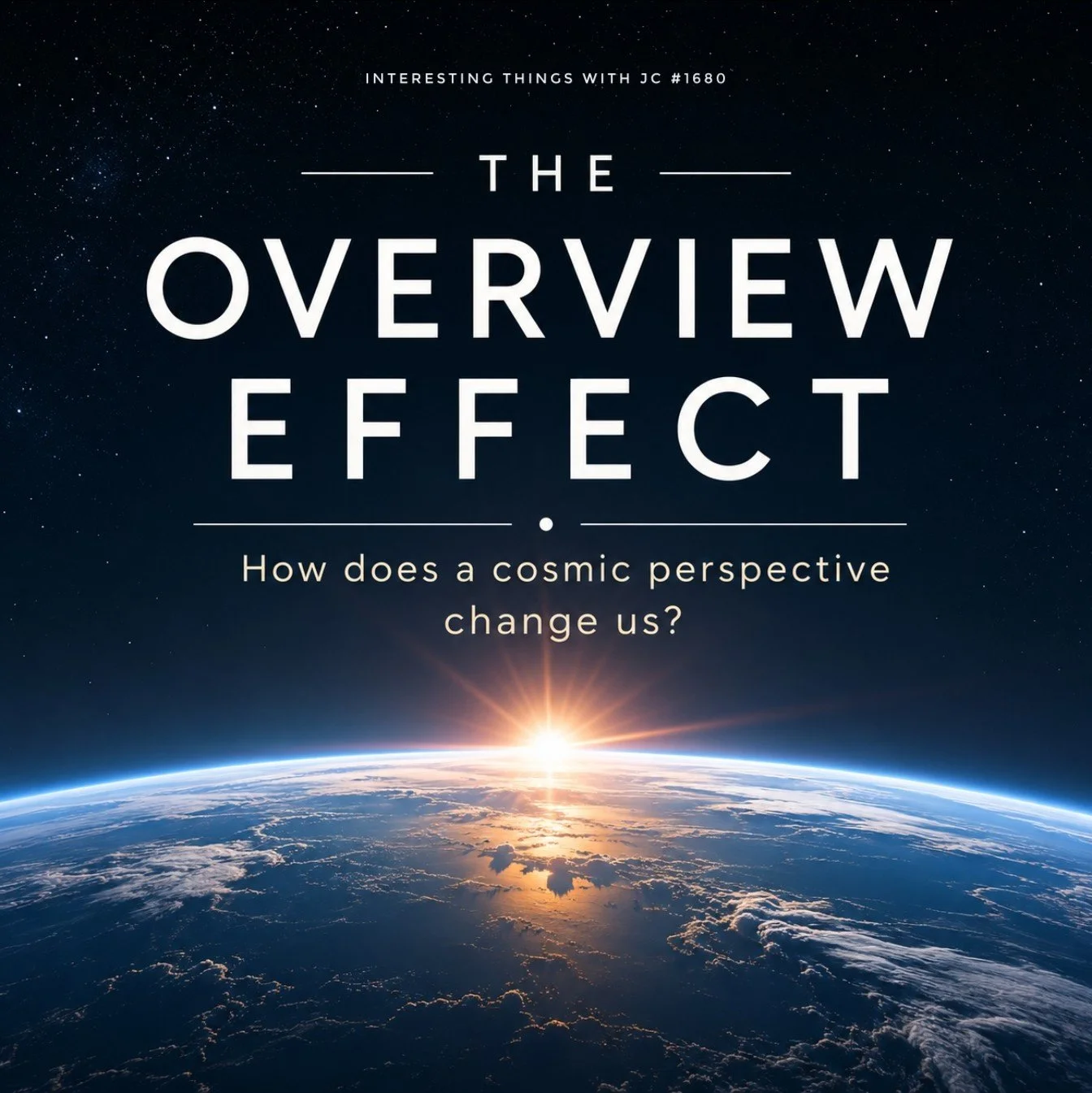
Promotional graphic for Interesting Things with JC #1680 titled The Overview Effect. The image shows Earth viewed from space with sunlight rising over the planet’s horizon against a dark, star-filled sky. Large white text reads “The Overview Effect,” with the subtitle “How does a cosmic perspective change us?” centered above the Earth.
Transcript
Interesting Things with JC #1680:
"The Overview Effect: How Does a Cosmic Perspective Change Us?"
Fewer than 700 people in human history have traveled into space.
Yet astronauts from different countries, cultures, religions, and professions often return describing remarkably similar changes in how they think about themselves and the world.
This phenomenon is known as the Overview Effect.
Unlike motion sickness, bone loss, or other physical consequences of spaceflight, the Overview Effect is psychological. It refers to the shift in perception that can occur when a person sees Earth from space and suddenly understands, not as an abstract idea but as a direct observation, that our planet is a single, finite system.
Researchers who study astronaut experiences have found recurring themes. Many report feeling more connected to humanity as a whole. Others describe a reduced focus on political, national, or cultural divisions. Some experience an increased awareness of how dependent life is on Earth's thin atmosphere, oceans, and ecological systems.
What makes this particularly interesting is that the change appears to result from perspective rather than new information. Astronauts already know the Earth is round. They already understand geography, climate, and international borders. The facts are not new. The view is.
Psychologists sometimes refer to this as a cognitive reframing event. A person encounters a perspective so different from everyday experience that existing mental models are reorganized. Similar effects can occur after major life events, but space offers a unique vantage point that very few humans have ever experienced directly.
Scientists are increasingly interested in what this means for future exploration. As missions to the Moon and Mars become more realistic, researchers are studying not only the physical effects of long duration spaceflight, but also how these profound shifts in perception influence decision making, cooperation, and mental health.
There is also an intriguing question closer to home. If a view of Earth from space can consistently alter how people think, what other perspectives might change our understanding of ourselves?
The Overview Effect suggests that knowledge alone does not always transform us. Sometimes transformation comes from seeing familiar things from a completely unfamiliar vantage point.
These are interesting things, with JC.
Student Worksheet
Comprehension Questions
What is the Overview Effect?
Why is the Overview Effect considered psychological rather than physical?
What common themes do astronauts report after seeing Earth from space?
Why do researchers believe perspective plays a central role in the Overview Effect?
What future missions are discussed in the episode?
Analysis Questions
Why might viewing Earth without visible borders influence how a person thinks about humanity?
How does the Overview Effect demonstrate cognitive reframing?
Why can direct observation sometimes have a greater impact than factual knowledge alone?
How might the Overview Effect influence leadership and cooperation?
Reflection Prompt
Describe a moment when a change in perspective altered your understanding of a person, event, or issue. What changed and why?
Difficulty Scaling
Emerging: Complete comprehension questions using evidence from the transcript.
Proficient: Complete all comprehension and analysis questions.
Advanced: Write a one-page essay connecting the Overview Effect to a personal or historical example of perspective change.
Student Output Expectations
Complete sentences.
Evidence-based responses.
Appropriate academic vocabulary.
Reflection response of at least 150 words.
Academic Integrity Guidance
Use your own words.
Support claims with evidence from the transcript.
Acknowledge outside sources if used.
Avoid copying from classmates or internet sources.
Teacher Guide
Quick Start
Begin with the Bell Ringer.
Preview vocabulary.
Play the podcast episode.
Conduct guided discussion.
Complete worksheet activities.
Finish with assessment and exit ticket.
Pacing Guide (Audio-First)
Bell Ringer — 5 minutes
Vocabulary Preview — 5 minutes
Podcast Listening — 5 minutes
Discussion — 10 minutes
Worksheet Activities — 15 minutes
Assessment — 5 minutes
Exit Ticket — 5 minutes
Bell Ringer
Ask students:
"Can simply seeing something from a different perspective change the way a person thinks? Explain."
Audio Guidance
Students should listen for:
Definitions
Repeated astronaut experiences
Evidence of cognitive reframing
Examples of perspective shifts
Audio Fallback
If audio is unavailable:
Read transcript aloud.
Conduct paired reading.
Complete discussion using transcript evidence.
Time on Task
Approximately 50 minutes.
Materials
Podcast episode or transcript
Worksheet
Writing materials
Projector or display (optional)
Vocabulary Strategy
Introduce key terms before listening and revisit them during discussion.
Misconceptions
The Overview Effect is not caused by learning new facts.
It is not a medical condition.
It does not affect every astronaut identically.
Perspective shifts can occur outside spaceflight.
Discussion Prompts
Why do astronauts from different backgrounds often report similar experiences?
What makes Earth appear different from space?
Why can perspective be as powerful as information?
How might the Overview Effect influence future Mars missions?
Formative Checkpoints
Vocabulary review
Discussion participation
Evidence use during responses
Worksheet completion
Differentiation
Guided notes
Partner discussions
Sentence starters
Extended writing opportunities
Assessment Differentiation
Oral response option
Visual presentation option
Written essay option
Time Flexibility
30-minute abbreviated lesson
50-minute standard lesson
Multi-day extension unit
Substitute Readiness
Transcript, worksheet, discussion prompts, and answer key support independent implementation.
Engagement Strategy
Display astronaut photographs of Earth from orbit and ask students to record observations before introducing the Overview Effect.
Extensions
Research astronaut accounts of the Overview Effect.
Compare perspective shifts in psychology, literature, and history.
Investigate psychological challenges of long-duration spaceflight.
Cross-Curricular Connections
Psychology
Environmental Science
Astronomy
Geography
Leadership Studies
Communications
SEL Connection
Students practice empathy, reflection, perspective-taking, and self-awareness.
Skill Emphasis
Critical thinking
Observation
Reflection
Evidence evaluation
Communication
Answer Key
Comprehension
A psychological shift caused by viewing Earth from space.
It affects perception and thinking rather than the body.
Greater connection to humanity and awareness of Earth's systems.
The perspective itself appears to create the change.
Missions to the Moon and Mars.
Analysis (Sample Responses)
Borders disappear visually, emphasizing shared humanity.
Existing mental models are reorganized.
Direct experiences can produce stronger cognitive impacts.
Broader perspectives may improve cooperation and decision-making.
Quiz
Multiple Choice Questions
What is the Overview Effect?
A. A spacecraft navigation system
B. A psychological shift from viewing Earth from space
C. A medical condition
D. A communication method
What common experience do many astronauts report?
A. Greater connection to humanity
B. Fear of exploration
C. Reduced curiosity
D. Loss of memory
According to researchers, the Overview Effect primarily results from:
A. New scientific information
B. Advanced technology
C. Perspective
D. Physical training
Cognitive reframing refers to:
A. Building spacecraft
B. Improving memory
C. Reorganizing understanding
D. Learning geography
Researchers studying future exploration are interested in how the Overview Effect influences:
A. Agriculture
B. Decision-making and cooperation
C. Rocket fuel
D. Manufacturing
Assessment
Open-Ended Questions
Explain how the Overview Effect demonstrates the relationship between perception and understanding.
Evaluate how a significant change in perspective might influence decision-making in society, leadership, or personal life.
3–2–1 Rubric
3 — Exceeds Expectations
Thorough explanation
Strong evidence
Insightful reflection
Clear connections to lesson concepts
2 — Meets Expectations
Accurate explanation
Adequate evidence
Relevant reflection
1 — Developing
Limited explanation
Minimal evidence
Incomplete reflection
Exit Ticket
What is one idea from today's lesson that changed how you think about perspective?
Why is the Overview Effect significant?
What question do you still have?
Standards Alignment
NGSS (Next Generation Science Standards)
HS-ETS1-3: Evaluate solutions to complex real-world problems involving scientific and technological systems. Students analyze how psychological factors may affect future exploration missions.
HS-ETS1-4: Use evidence and models to predict impacts of technological and human systems.
HS-LS2-7: Evaluate human interactions within interconnected Earth systems.
Science and Engineering Practice: Obtaining, evaluating, and communicating information from scientific sources.
CCSS English Language Arts
RST.11-12.1: Cite specific textual evidence to support analysis.
RST.11-12.2: Determine central ideas of scientific and technical texts.
RST.11-12.7: Integrate information from multiple formats and sources.
WHST.11-12.1: Write evidence-based arguments.
WHST.11-12.9: Draw evidence from informational texts.
SL.11-12.1: Participate effectively in collaborative discussions.
SL.11-12.4: Present findings clearly and logically.
C3 Framework
D2.Geo.2.9-12: Analyze relationships among people, places, and environments.
D2.Geo.4.9-12: Evaluate impacts of human-environment interactions.
D3.1.9-12: Gather and evaluate evidence.
D4.1.9-12: Construct claims supported by evidence.
ISTE Standards
1.1 Empowered Learner: Reflect on learning and personal growth.
1.3 Knowledge Constructor: Evaluate information critically.
1.6 Creative Communicator: Express ideas clearly.
1.7 Global Collaborator: Examine shared human challenges.
Career Readiness
Critical Thinking
Communication
Collaboration
Systems Thinking
Leadership Awareness
Adaptability
UK National Curriculum Connections
Science: Earth within the wider universe.
Working Scientifically: Evaluation of evidence and communication of conclusions.
Citizenship: Understanding global interconnectedness.
International Baccalaureate Connections
Global Context: Scientific and Technical Innovation
Global Context: Identities and Relationships
ATL Skills: Research, Reflection, Communication, Critical Thinking
Homeschool and Lifelong Learning Outcomes
Interdisciplinary thinking
Reflective practice
Media literacy
Scientific reasoning
Personal growth through perspective-taking
Measurable Skills Demonstrated
Define and explain the Overview Effect.
Analyze how perspective influences cognition.
Evaluate evidence from astronaut experiences.
Construct evidence-based arguments.
Communicate findings effectively.
Apply concepts to real-world situations.
Show Notes
This lesson examines the Overview Effect, a psychological phenomenon reported by astronauts who view Earth from space. Students explore how perspective influences cognition, perception, decision-making, and human behavior. By connecting psychology, space exploration, and critical thinking, learners gain insight into how a simple change in viewpoint can transform understanding. The lesson encourages reflection on how perspective shapes both personal experiences and broader societal relationships.
References
Koren, M. (2022, December 10). Seeing Earth from space will change you. The Atlantic. https://www.theatlantic.com/magazine/archive/2023/01/astronauts-visiting-space-overview-effect-spacex-blue-origin/672226/
McConville, S. (2021). The overview effect. The Resurgence Trust. https://www.resurgence.org/magazine/article/the-overview-effect.html
Ploeg, G. (2018, February 6). The overview effect, as seen from Earth. Center for Humans and Nature. https://www.humansandnature.org/the-overview-effect-as-seen-from-earth
National Aeronautics and Space Administration. (2024). Human research program. https://www.nasa.gov/hrp/
National Aeronautics and Space Administration. (2024). Earth observatory. https://earthobservatory.nasa.gov/
National Aeronautics and Space Administration. (2024). Humans in space. https://www.nasa.gov/humans-in-space/