1760: "The Greek That Stayed Behind"
Interesting Things with JC #1760: "The Greek That Stayed Behind"
Muslim families in Turkey still speak a form of Greek that survived the 1923 population exchange. Now fewer children are learning it, and researchers are racing to record the people who still speak it.
Curriculum - Episode Anchor
Episode Title: The Greek That Stayed Behind
Episode Number: 1760
Host: JC
Audience: Grades 9–12, introductory college, homeschool, lifelong learners
Subject Area: Linguistics, world history, geography, cultural studies, language preservation
Lesson Overview
Learning Objectives
Explain why Romeyka continued to be spoken in northeastern Turkey after the 1923 compulsory population exchange.
Distinguish between a living language that preserves older features and an ancient language that has remained unchanged.
Analyze how migration, religion, geography, language contact, and intergenerational transmission can shape language history.
Evaluate why documenting endangered languages matters to linguistic and historical research.
Essential Question: How can a living language preserve evidence of the past while continuing to change?
Success Criteria: Students can explain Romeyka's historical circumstances, identify at least two forces affecting its development, correct the misconception that it is unchanged Ancient Greek, and use evidence from the episode to explain why its future is uncertain.
Student Relevance Statement: The languages and dialects people speak at home can contain histories that are not obvious from national borders, school languages, or official identities.
Real-World Connection: Romeyka demonstrates how researchers use recordings, grammatical analysis, oral histories, and fieldwork to investigate language change and document endangered varieties.
Workforce Reality: Linguistic research develops skills used in education, translation, archival work, anthropology, historical research, digital humanities, data collection, and cultural-resource documentation.
Key Vocabulary
Terms
Romeyka(roh-MAY-kah) — An endangered Greek variety spoken by Muslim communities in northeastern Turkey, particularly in the Trabzon region.
Ioanna Sitaridou(ee-OH-nah see-tah-REE-doo) — University of Cambridge professor whose fieldwork and research examine Romeyka, its grammar, history, and vitality.
Population exchange(pop-yuh-LAY-shun eks-CHAYNJ) — A state-organized transfer of populations; the 1923 Greek-Turkish exchange largely classified people according to religion.
Hellenistic Greek(hel-uh-NIS-tik Greek) — Greek associated with the Hellenistic period; research on Romeyka identifies grammatical continuities reaching back to this historical stage.
Language contact(LANG-gwij KON-takt) — Interaction between languages and their speakers that can influence vocabulary, grammar, pronunciation, and patterns of use.
Intergenerational transmission(in-ter-jen-uh-RAY-shuh-nuhl tranz-MISH-un) — The process by which a language is passed from one generation to the next.
Endangered language(en-DAYN-jerd LANG-gwij) — A language or language variety at risk of losing speakers and regular transmission to younger generations.
Infinitive(in-FIN-uh-tiv) — A grammatical verb form preserved in Romeyka but lost from other Greek varieties known today.
Narrative Core
Open: In the mountains of northeastern Turkey, some Muslim families speak a form of Greek at home. That linguistic fact opens a much larger story about migration, religion, geography, and the way languages survive.
Info: Romeyka developed from Greek spoken for centuries around the Black Sea. During the compulsory Greek-Turkish population exchange of 1923, religion was the principal criterion determining which populations were exchanged. Greek-speaking Christians departed from Pontus, while Greek-speaking Muslims could remain in Turkey.
Details: Romeyka did not remain frozen after those events. Speakers continued using and changing it while living in a predominantly Turkish-speaking environment. Professor Ioanna Sitaridou's research shows that Romeyka preserves grammatical characteristics with deep historical roots, including an infinitive associated with earlier stages of Greek, while also representing a living and independently developing variety.
Reflection: Describing Romeyka simply as "Ancient Greek" still spoken today obscures the more important linguistic story. Languages change whenever communities use them. Romeyka is valuable precisely because continuity and change occurred together.
Closing: These are interesting things, with JC.
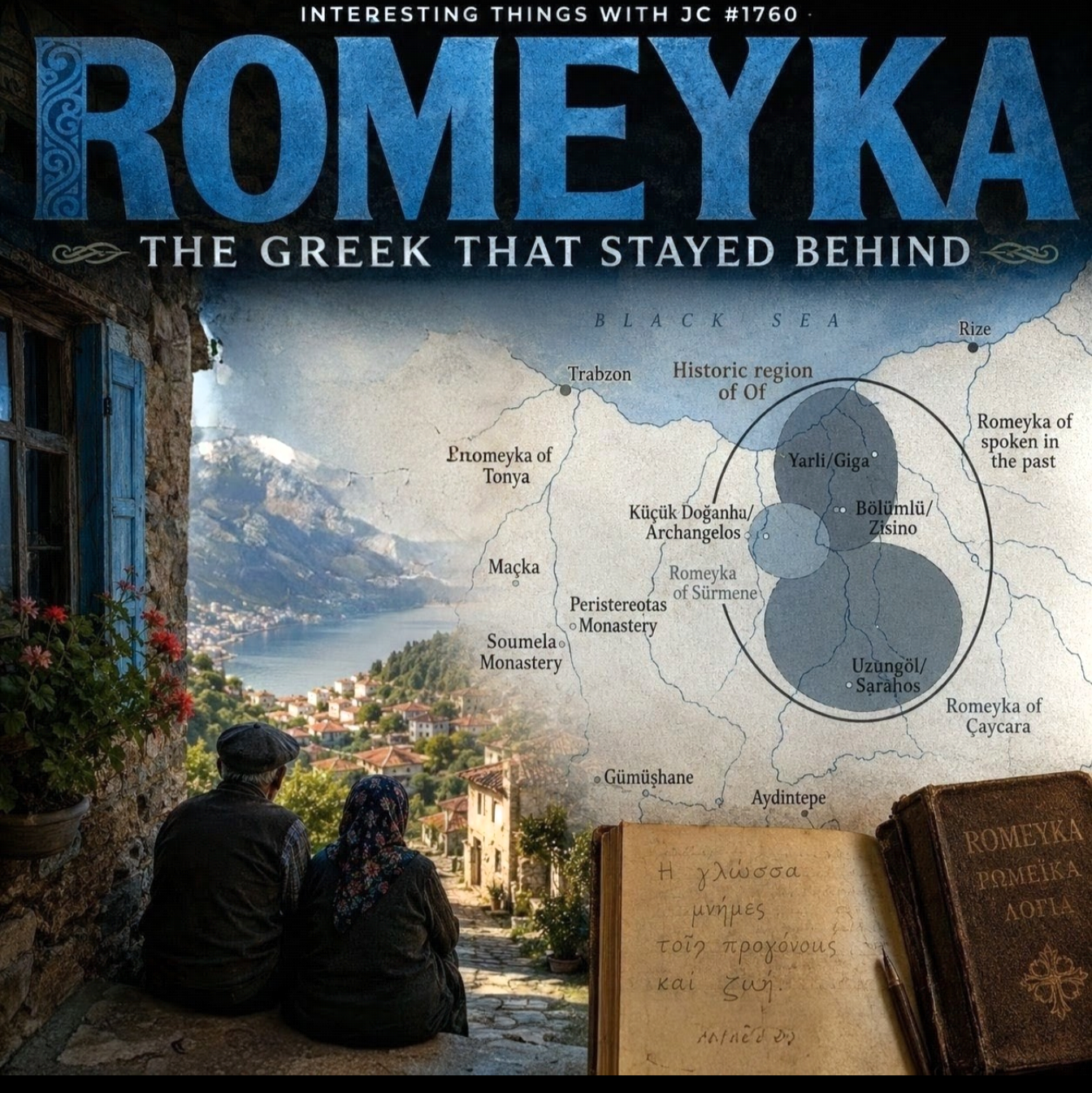
Promotional artwork for Interesting Things with JC #1760: Romeyka — The Greek That Stayed Behind. Large blue lettering reading “ROMEYKA” appears above a map of northeastern Turkey’s Black Sea region, highlighting areas associated with Romeyka and locations including Trabzon. At left, an older man and woman sit overlooking a mountain village and water. An open handwritten book and a dark book labeled “ROMEYKA” appear in the foreground. The image combines landscape, map, and historical-language imagery to represent the survival of Romeyka, a Greek variety spoken in northeastern Turkey.
Transcript
Interesting Things with JC #1760: "The Greek That Stayed Behind"
In the mountains of northeastern Turkey, there are Muslim families who speak Greek at home. They didn’t learn it in school, and it wasn’t brought there by recent immigrants. Their language is called Romeyka (roh-MAY-kah), a form of Greek with roots reaching back through centuries of life around the Black Sea.
Romeyka grew out of the Greek spoken for centuries in the region. When Greece and Turkey carried out their compulsory (kum-PUL-suh-ree) population exchange in 1923, religion largely determined who had to move. Greek-speaking Christians left the region, while Greek-speaking Muslims could remain. That left communities around Trabzon (TRAB-zon) where Greek continued to be spoken.
But the Greek spoken there didn’t follow the same path as the Greek spoken in Greece. Romeyka continued to change through everyday use and centuries of contact with Turkish, while also holding onto features that disappeared from other forms of Greek. Professor Ioanna Sitaridou (ee-OH-nah see-tah-REE-doo) of the University of Cambridge has spent years recording speakers and studying those differences. Her research argues that Romeyka preserves grammatical features reaching back to Hellenistic (hel-uh-NIS-tik) Greek and developed along a different historical path from the Greek that eventually became the modern standard.
That has sometimes led to Romeyka being described as Ancient Greek still being spoken today. But that isn’t really what it is. No language sits untouched for two thousand years. Romeyka changed because people kept using it. Parents passed it to children, neighboring villages developed their own variations, and Turkish became part of the linguistic (ling-GWIS-tik) world around it. What survived wasn’t an ancient language frozen in time, but a living one that carried some very old pieces forward.
Now that chain is weakening. People have moved away from the mountain villages, Turkish dominates education and public life, and fewer young people are learning Romeyka at home. Researchers are recording speakers and collecting their voices while those older forms of the language can still be heard.
Romeyka survived all this time without anyone setting out to preserve it. People simply kept speaking it. Whether the next generation will do the same is no longer certain.
These are interesting things, with JC.
Student Worksheet
Comprehension
Where is Romeyka spoken according to the episode?
Why were Greek-speaking Muslim communities able to remain in the Trabzon region during the 1923 population exchange?
Who is Professor Ioanna Sitaridou, and what does she study?
Identify two influences on the development of Romeyka.
What factors now threaten continued transmission of Romeyka?
Analysis
Why is describing Romeyka as "Ancient Greek still being spoken today" misleading?
Explain how the 1923 population exchange demonstrates that language, religion, and national identity do not always align neatly.
How can Romeyka simultaneously preserve old grammatical features and still qualify as a changing modern language?
What kinds of evidence might recordings of present-day speakers provide that written historical documents cannot?
Reflection
If a language variety disappears but researchers preserve extensive recordings of it, what has been saved and what has been lost? Explain your distinction.
Difficulty Scaling
Level 1 — Recall: Complete Questions 1–5 using direct evidence from the transcript.
Level 2 — Analysis: Complete Questions 6–9 using evidence plus explanation.
Level 3 — Synthesis: Complete Question 10 and connect Romeyka to a broader principle about language, identity, history, or cultural transmission.
Student Output: Answer Questions 1–10 in complete sentences. Analysis and reflection responses should cite specific evidence or ideas from the episode.
Academic Integrity Guidance: Students may consult the transcript and assigned sources but should express explanations in their own words. Any outside information should be identified and sourced according to teacher requirements.
Teacher Guide
Quick Start: Introduce the essential question, conduct the bell ringer, play or read the episode once without interruption, then use a second listening or transcript review for evidence collection.
Pacing Guide — Audio First
0–5 minutes: Bell ringer and geographic orientation.
5–10 minutes: First uninterrupted listening.
10–18 minutes: Vocabulary review and second listening/transcript check.
18–30 minutes: Student Worksheet Questions 1–9.
30–40 minutes: Evidence-based discussion.
40–47 minutes: Reflection Question 10.
47–50 minutes: Exit Ticket.
Bell Ringer: Ask students: "Can two communities speak forms of the same language but have different religions, national identities, and histories? Explain."
Audio Guidance: On the first listen, students should identify the central story rather than attempt to record every fact. During the second listen, focus attention on 1923, language change, Sitaridou's research, and present-day endangerment.
Audio Fallback: If audio is unavailable, read the transcript aloud or assign alternating paragraph readers while maintaining the episode's original sequence.
Time on Task: Approximately 50 minutes for a standard lesson; 70–90 minutes with the extension activity.
Materials
Episode audio or teacher-read transcript
Student Worksheet
Map showing Turkey, Greece, the Black Sea, and Trabzon
Writing materials or digital response platform
Vocabulary Prep
Contrast "endangered" with "extinct."
Explain that "Greek-speaking" describes language use and does not by itself specify religion or nationality.
Introduce "intergenerational transmission" before discussing language endangerment.
Misconceptions
Romeyka is not Ancient Greek preserved unchanged for two millennia.
Greek-speaking communities in the region were not all Christian.
The 1923 population exchange did not classify every person simply by the language spoken.
Preservation of older grammatical features does not mean a language stopped evolving.
Discussion Prompts
Why might geographic isolation help preserve distinctive linguistic features?
Why is family transmission especially important for a language not dominant in schools and public institutions?
Does preserving recordings preserve a language in the same sense as maintaining a community of speakers? Why or why not?
Formative Checkpoints
Students correctly connect religion to the 1923 exchange described in the episode.
Students distinguish linguistic continuity from linguistic immobility.
Students identify migration and reduced transmission as present-day pressures.
Students support analysis with episode evidence.
Differentiation
Additional Support: Provide a cause-and-effect organizer with the headings "1923 Exchange," "Language Contact," "Migration," and "Transmission."
Advanced Learners: Ask students to investigate the linguistic significance of Romeyka's infinitive and explain why it matters for reconstructing Greek language history.
English Learners: Preteach vocabulary and permit paired discussion before written responses.
Assessment Differentiation: Allow oral responses, a structured evidence organizer, or extended analytical writing while measuring the same core understanding.
Time Flexibility: For a 30-minute period, complete Questions 1–7 and the Exit Ticket. For a block period, add mapping and source-analysis activities.
Substitute Readiness: Provide the transcript, worksheet, vocabulary list, and answer key. No prior expertise in Greek or linguistics is required.
Engagement Strategy: Before revealing the historical explanation, ask students to predict how a Greek-speaking Muslim community could have remained in northeastern Turkey.
Extensions
Map historic and present-day locations associated with Romeyka.
Compare Romeyka with another endangered or heritage language.
Examine how audio archives allow future researchers to study pronunciation and grammar.
Research one grammatical feature documented by Sitaridou.
Cross-Curricular Connections
History: Population movement and the 1923 Greek-Turkish exchange.
Geography: Black Sea communities, mountain settlement, migration, and isolation.
English Language Arts: Claims, evidence, terminology, and explanatory writing.
Linguistics: Language change, contact, grammar, and transmission.
SEL: Encourage respectful discussion of how language can connect individuals with family, place, memory, and community without assuming that language determines identity.
Skill Emphasis: Evidence evaluation, causal reasoning, historical context, source interpretation, and distinguishing simplified claims from more precise explanations.
Answer Key
Northeastern Turkey, especially communities around Trabzon.
Religion largely determined inclusion in the exchange; Greek-speaking Muslims could remain while Greek-speaking Christians were required to leave.
She is a University of Cambridge professor and researcher who has recorded and studied Romeyka and its linguistic features.
Acceptable answers include continued community use, Turkish contact, geographic variation, and intergenerational transmission.
Migration away from villages, Turkish dominance in education/public life, and declining transmission to younger speakers.
Romeyka has continued changing; it preserves old features but is not an unchanged ancient language.
Greek-speaking Muslims remained while Greek-speaking Christians departed, demonstrating that language and religion did not map onto one another perfectly.
Languages can retain inherited structures while simultaneously developing new features through ordinary use and contact.
Recordings provide pronunciation, spontaneous speech, grammatical judgments, constructions, and other evidence unavailable or difficult to recover from historical texts alone.
Strong answers distinguish preservation of linguistic evidence from preservation of an actively transmitting speech community.
Quiz
Multiple Choice
What most directly explains why Greek-speaking Muslim communities remained around Trabzon after the 1923 population exchange?
A. They had recently immigrated from Greece.
B. Religion largely determined who was exchanged.
C. Romeyka was Turkey's official regional language.
D. Mountain communities were legally excluded because of geography.Which statement best describes Romeyka?
A. Ancient Greek preserved without change
B. Modern Standard Greek transplanted recently from Greece
C. A living Greek variety that changed while preserving some older features
D. A Turkish dialect containing Greek vocabularyWhat is a major focus of Professor Ioanna Sitaridou's research?
A. Replacing Romeyka with standardized Greek
B. Recording speakers and analyzing Romeyka's linguistic characteristics
C. Proving that Romeyka has never changed
D. Establishing Romeyka as Turkey's official languageWhich process is most important for keeping a language actively spoken across generations?
A. Intergenerational transmission
B. Geographic renaming
C. Translation into Latin
D. Political boundary changes aloneWhy are researchers recording Romeyka speakers?
A. The language has no connection to historical Greek.
B. Younger generations increasingly use Romeyka in schools.
C. Researchers want evidence while older forms and speakers can still be documented.
D. Romeyka recently became the dominant language of northeastern Turkey.
Assessment
Open-Ended Questions
Explain how the events of 1923 contributed to Romeyka's continued presence in northeastern Turkey. Use at least two pieces of evidence from the lesson.
Evaluate the statement: "Romeyka survived because it never changed." Explain why the statement is accurate or inaccurate using principles of language change and evidence from the episode.
3–2–1 Rubric
3 — Proficient: Accurate claim, specific evidence, clear historical or linguistic reasoning, and appropriate vocabulary.
2 — Developing: Generally accurate understanding with some evidence, but reasoning or terminology is incomplete.
1 — Beginning: Limited or inaccurate explanation with little supporting evidence.
Exit Ticket: In 2–3 sentences, explain the difference between preserving an old linguistic feature and preserving an entire language unchanged.
Standards Alignment
NGSS — Science & Engineering Practices
SEP — Analyzing and Interpreting Data — Students interpret linguistic and historical evidence to explain patterns of continuity and change.
SEP — Constructing Explanations — Students construct an evidence-based explanation for Romeyka's survival and present-day endangerment.
CCSS Reading
CCSS.ELA-LITERACY.RH.9-10.1 — Cite specific textual evidence to support analysis of primary and secondary sources — Students identify transcript evidence supporting historical and linguistic explanations.
CCSS.ELA-LITERACY.RH.11-12.2 — Determine the central ideas or information of a primary or secondary source — Students identify and summarize the episode's central distinction between linguistic preservation and linguistic immobility.
CCSS Writing
CCSS.ELA-LITERACY.WHST.9-10.2 — Write informative/explanatory texts — Students explain historical and linguistic relationships using precise terminology and evidence.
CCSS.ELA-LITERACY.WHST.11-12.9 — Draw evidence from informational texts to support analysis, reflection, and research — Students incorporate transcript evidence into analytical responses.
C3 Framework
D2.His.14.9-12 — Analyze multiple and complex causes and effects of events in the past — Students connect the 1923 exchange, religion, migration, language contact, and family transmission to Romeyka's present circumstances.
D2.Geo.4.9-12 — Analyze relationships and interactions within and between human and physical systems — Students examine how geography, settlement, mobility, and linguistic communities interact.
ISTE / CTE
ISTE 1.3 — Knowledge Constructor — Students evaluate information from research sources and distinguish simplified popular descriptions from evidence-based linguistic explanations.
CTE — Communication and Information Literacy — Students synthesize historical and linguistic information and communicate conclusions supported by evidence.
Career Readiness Competencies
Critical Thinking: Distinguish a compelling simplification from a more accurate evidence-based explanation.
Communication: Explain specialized linguistic concepts clearly to a general audience.
Research Literacy: Evaluate recordings, scholarly research, historical context, and secondary sources as different forms of evidence.
Homeschool/Lifelong Learning
Learners connect language history with geography, migration, and family transmission.
Learners practice evaluating claims rather than accepting memorable descriptions at face value.
Learners can extend the lesson through independent investigation of endangered and heritage languages.
Show Notes
In northeastern Turkey, Muslim communities around Trabzon have maintained Romeyka, a Greek variety whose history reveals an unusual intersection of language, religion, geography, and migration. Episode 1760 examines how the 1923 population exchange helped create the circumstances in which these speakers remained, how Romeyka continued evolving while preserving unusually old grammatical features, and why declining intergenerational transmission now threatens its future. In the classroom, the story provides a concise case study in historical causation, linguistic change, evidence evaluation, and the complexity of cultural identity.
References
Sitaridou, I. (2010). Against all odds: Archaic Greek in a modern world. University of Cambridge. https://www.cam.ac.uk/research/news/against-all-odds-archaic-greek-in-a-modern-world
University of Cambridge. (2024). Last chance to record archaic Greek language 'heading for extinction'. https://www.cam.ac.uk/research/news/last-chance-to-record-archaic-greek-language-heading-for-extinction
Sitaridou, I., & Kavčič, J. (2025). Fifteen years of Romeyka fieldwork: Key findings on the language, its development, vitality and prospects for survival. University of Cambridge Apollo Repository. https://www.repository.cam.ac.uk/items/5f2cc089-073c-4efd-a071-ee1462522579
Cambridge Centre for Greek Studies. (2024). Endangered Greek varieties and heritage preservation: Professor Ioanna Sitaridou's Romeyka exhibition at MOHA, Kavala. https://www.ccgs.csah.cam.ac.uk/news/endangered-greek-varieties-and-heritage-preservation-professor-ioanna-sitaridous-romeyka
Sitaridou, I. (2024). Romeyka. University of Cambridge Apollo Repository. https://www.repository.cam.ac.uk/items/99116a6c-0ddf-444b-aa9d-f914c5ec81c3