1077: ""The Legend of Stingy Jack: The Origins of the Jack-o’-Lantern"
Interesting Things with JC #1077: "The Legend of Stingy Jack: The Origins of the Jack-o’-Lantern" –Before pumpkins lit our porches, one man tricked the Devil, and paid a haunting price. Discover the eerie origin of Halloween’s most iconic glow.
Curriculum - Episode Anchor
Episode Title: The Legend of Stingy Jack: The Origins of the Jack-o’-Lantern
Episode Number: 1077
Host: JC
Audience: Grades 9–12, college intro, homeschool, lifelong learners
Subject Area: Folklore, History, Cultural Traditions, Literature
Lesson Overview
Students will:
Define key terms such as folklore, Samhain, and jack-o’-lantern in historical and cultural context.
Compare early Celtic traditions with American Halloween customs using historical examples.
Analyze the narrative structure and moral lessons of the Stingy Jack legend.
Explain how immigration influences cultural practices and traditions.
Key Vocabulary
Folklore (/ˈfoʊk.lɔːr/) — Traditional beliefs and stories passed through generations. “The tale of Stingy Jack is part of Irish folklore.”
Samhain (/ˈsaʊ.wɪn/) — An ancient Celtic festival marking the end of harvest and the beginning of winter.
Lantern (/ˈlæn.tɚn/) — A portable light source; in this story, a symbol of wandering spirits.
Immigrant (/ˈɪm.ɪ.ɡrənt/) — A person who moves to a new country. Irish immigrants brought the jack-o’-lantern tradition to America.
Miserly (/ˈmaɪ.zɚ.li/) — Extremely reluctant to spend money. Jack’s miserly nature is central to the story’s moral.
Narrative Core
Open: The tale opens with a question: why do we carve glowing faces into pumpkins on Halloween?
Info: Background is given on Stingy Jack, a trickster from Irish legend, and his encounter with the Devil.
Details: Jack traps the Devil twice, making deals that eventually get him banned from both heaven and hell.
Reflection: The story illustrates deeper themes—greed, consequences, and beliefs in the supernatural—especially during Samhain.
Closing: These are interesting things, with JC.
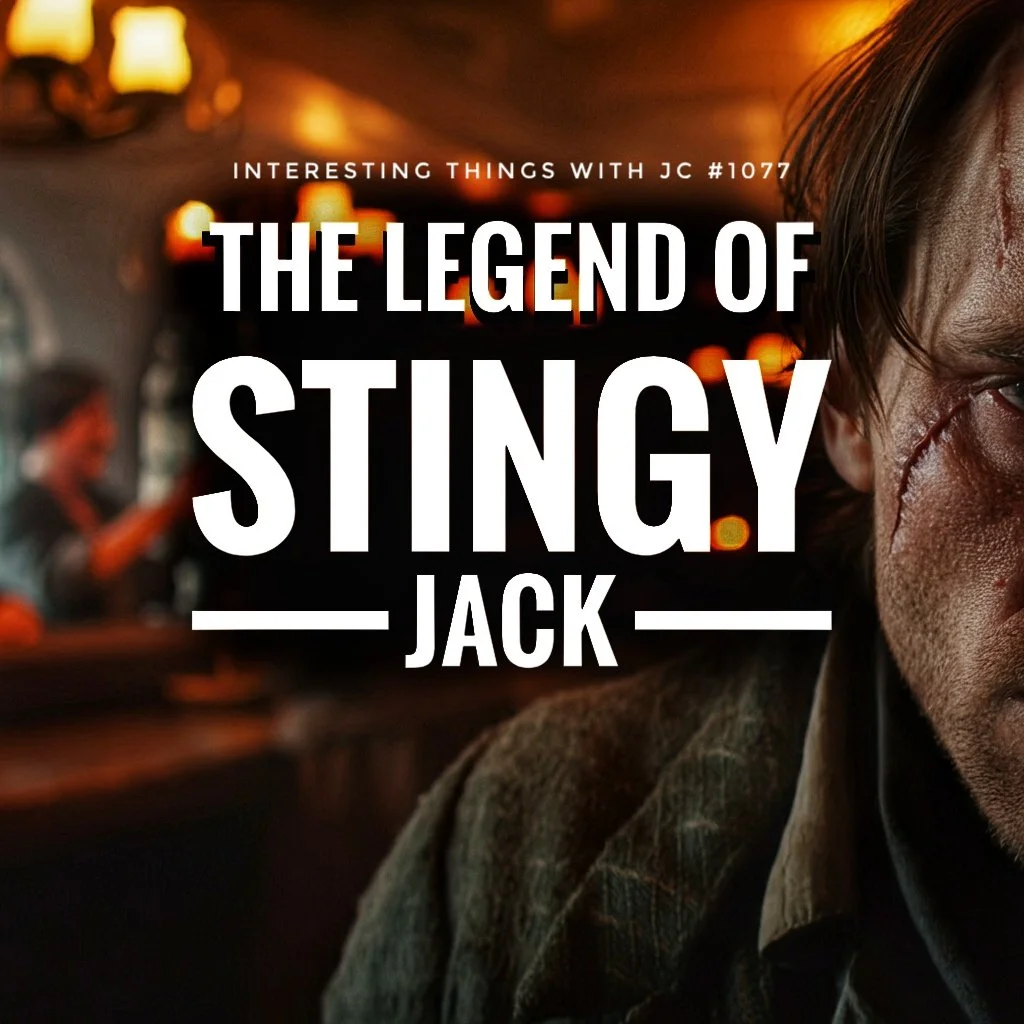
Promotional image for podcast episode Interesting Things with JC #1077: The Legend of Stingy Jack. The text is centered in bold white lettering over a dimly lit tavern background. On the right side, a close-up of a rugged man's scarred face is partially visible, representing the folklore character Stingy Jack. Warm, orange lights blur in the background, enhancing the eerie, historical atmosphere.
Transcript
On a chilly autumn night, as the flicker of candlelight inside carved pumpkins illuminates doorsteps, one might wonder why we carve these glowing faces every Halloween. The tradition, steeped in centuries-old folklore, leads us to the curious figure of Stingy Jack (pronounced STIN-jee), a clever trickster from ancient Ireland whose story forever linked his name to the jack-o’-lantern.
Jack was known far and wide for his deceit and greed—traits that earned him the nickname "Stingy". One fateful night, Jack encountered none other than the Devil himself at a local tavern. The two shared drinks, but when it came time to pay, Jack, being the miser he was, tricked the Devil into transforming into a silver coin. Rather than using it to pay the tab, Jack slipped the coin into his pocket alongside a silver cross, trapping the Devil in this form.
Recognizing his predicament, the Devil struck a deal with Jack: he would be freed only if he promised not to claim Jack’s soul for ten years. Jack, satisfied with his short-term victory, agreed and released the Devil.
When the ten years had passed, the Devil returned to collect Jack’s soul. This time, Jack was ready with another trick. He asked the Devil to climb a tree to fetch him an apple. As the Devil scaled the tree, Jack carved a cross into the bark, once again trapping his adversary. In exchange for his release, the Devil was forced to promise that he would never take Jack’s soul.
Years later, Jack’s cunning caught up with him. When he died, he found himself barred from both heaven and hell. Heaven rejected him for his sinful life, and the Devil, bound by their agreement, refused him entry to hell. Condemned to wander the earth for eternity, Jack was given only a single ember from hell’s fires to light his way. He placed the ember inside a hollowed-out turnip, creating a makeshift lantern as he roamed the dark, lonely roads.
This spectral figure became known as Jack of the Lantern, later shortened to Jack-o’-Lantern. His lantern, glowing dimly through the night, became a symbol of wandering spirits and the thin veil between the living and the dead, especially during the Celtic festival of Samhain (pronounced SOW-in). Celebrated at the end of the harvest, Samhain marked the time when the boundary between worlds was at its thinnest, and spirits like Jack were believed to roam freely.
To protect themselves from such wandering spirits, the people of Ireland and Scotland began carving their own lanterns. Using turnips, beets, or potatoes, they etched eerie faces into the vegetables and placed them near doorways or windows, hoping to ward off unwanted spirits like Jack. The eerie glow of the lanterns was a reminder that not all souls found peace in the afterlife.
When Irish immigrants arrived in America during the 19th century, they discovered that pumpkins—native to North America—were an ideal substitute for their traditional lanterns. Larger and easier to carve, the pumpkin soon became the vessel of choice for Halloween, a practice that remains with us today.
Though the tale of Stingy Jack is primarily folklore, it reflects deeper cultural values of the time. Jack’s trickery and the consequences of his selfishness serve as cautionary lessons about greed and deceit. Furthermore, the story’s evolution through Irish and Scottish communities reflects the strong belief in the supernatural, especially during Samhain, a festival that symbolized the passage between seasons and the thinning of the boundary between life and death.
The use of carved lanterns to ward off spirits was more than just a practical measure; it represented the struggle between good and evil, light and dark, and the efforts of the living to protect themselves from the unknown forces that could disrupt their world. In many ways, the jack-o’-lantern symbolizes the delicate balance between life and death, reminding us of our own mortality.
The name "Stingy Jack" itself emphasizes the moral lesson—"stingy" (STIN-jee), referring to Jack’s miserly nature, underlines his downfall. His story serves as a reminder that trying to outwit fate can lead to an eternity of regret.
The legend of Stingy Jack is a well-documented part of Irish folklore. Though there is no historical record of an actual person named Jack, the use of lanterns to ward off evil spirits during Samhain is an authentic practice. The transformation from turnips to pumpkins is historically accurate, occurring during Irish immigration to America in the 19th century. The cultural significance of the jack-o'-lantern remains tied to the belief in spirits and the supernatural, rooted deeply in the Celtic traditions of Samhain.
The tale of Stingy Jack offers more than just an eerie Halloween story—it’s a glimpse into the cultural heritage of Ireland and Scotland, where folklore served not just to entertain but to teach lessons and protect against the unknown. As we carve pumpkins each year, we are unknowingly keeping alive an ancient tradition born of one man's cleverness, his eternal curse, and the thin veil that separates the living from the dead
These are, interesting things, with JC.
Student Worksheet
Who was Stingy Jack, and what was his reputation?
Describe how Jack trapped the Devil the first time.
What role did the Celtic festival of Samhain play in the development of the jack-o’-lantern?
Why did Irish immigrants switch from turnips to pumpkins in America?
What moral lessons can be drawn from the legend of Stingy Jack?
Teacher Guide
Estimated Time: 1 class period (45–60 minutes)
Pre-Teaching Vocabulary Strategy:
Introduce the words “folklore,” “Samhain,” and “miserly” using image associations and real-world examples.
Use think-pair-share to connect vocabulary to students’ own cultural traditions or holiday experiences.
Anticipated Misconceptions:
Students may assume Halloween always involved pumpkins.
Students might interpret the story literally rather than as allegorical folklore.
Mispronunciation of “Samhain” and misunderstanding its role in Celtic culture.
Discussion Prompts:
What do cultural stories like this teach us about the values of past societies?
How do immigration and adaptation shape holiday traditions?
Should folklore always be taken as moral lessons? Why or why not?
Differentiation Strategies:
ESL: Provide visuals for vocabulary and a brief glossary.
IEP: Offer audio and text versions of the transcript; chunk text into sections.
Gifted: Challenge students to trace other holiday traditions with folk origins and present a comparative analysis.
Extension Activities:
Research project: Compare the legend of Stingy Jack with another cultural ghost or spirit story (e.g., Día de los Muertos, Obon Festival).
Creative writing: Rewrite the Stingy Jack tale in a modern setting.
Art integration: Design alternative jack-o’-lanterns using different vegetables.
Cross-Curricular Connections:
History: Migration patterns of Irish immigrants.
Literature: Narrative analysis and symbolism in folklore.
Sociology/Anthropology: Cultural practices tied to death and the afterlife.
Quiz
What trick did Jack use to trap the Devil the first time?
A. A turnip trap
B. A silver coin and cross
C. A pumpkin with a candle
D. A fake death notice
Answer: BWhy was Jack denied entry into both heaven and hell?
A. He was forgotten by everyone
B. He had no burial
C. He tricked the Devil and led a sinful life
D. He turned into a ghost
Answer: CWhat vegetable was originally used for jack-o’-lanterns in Ireland?
A. Pumpkin
B. Cabbage
C. Beet
D. Turnip
Answer: DWhat festival marks the origin of the jack-o’-lantern tradition?
A. All Saints’ Day
B. Halloween
C. Samhain
D. Beltane
Answer: CWhy did Irish immigrants switch to using pumpkins?
A. They were cheaper
B. Pumpkins were native to America and easier to carve
C. Pumpkins glowed brighter
D. There were no turnips
Answer: B
Assessment
Analyze how the story of Stingy Jack reflects the cultural values and fears of early Irish society.
Compare the transformation of the jack-o’-lantern tradition from Ireland to the United States.
3–2–1 Rubric:
3: Accurate, complete, thoughtful
2: Partial or missing detail
1: Inaccurate or vague
Standards Alignment
U.S. Standards:
CCSS.ELA-LITERACY.RL.9-10.2 – Determine a theme or central idea and analyze its development through details in the text.
CCSS.ELA-LITERACY.RI.11-12.3 – Analyze complex ideas in a text through effective explanation.
C3.D2.His.2.9-12 – Analyze change and continuity in cultural traditions over time.
CTE.ACCT.B.01.04 – Analyze customs, beliefs, and traditions of a culture using primary sources.
UK / International Equivalents:
OCR GCSE English Literature J352 – Analyze how writers use structure and form to shape meaning.
IB MYP Language and Literature Criterion B – Organizing, interpreting, and presenting cultural texts.
Cambridge IGCSE Literature (0475) Assessment Objective AO2 – Understanding language, form, and structure in cultural narratives.
Show Notes
In this captivating episode, JC explores the eerie legend of Stingy Jack and how a clever tale of trickery and eternal wandering gave rise to one of Halloween’s most iconic symbols—the jack-o’-lantern. From the ancient Celtic festival of Samhain to 19th-century Irish immigration in America, students trace the evolution of a folk tradition that bridges life, death, and the supernatural. With rich cultural context and a cautionary moral, the episode provides opportunities for cross-disciplinary connections in history, literature, and anthropology. It’s a meaningful way to explore how storytelling shapes our rituals and beliefs, especially around death and seasonal change. This episode is dedicated to Jen Hasse.
References
Nangia, T., & The Editors of Encyclopaedia Britannica. (2025, October 23). Jack-o’-lantern. Encyclopaedia Britannica. https://www.britannica.com/art/jack-o-lantern-decoration
Thomas, H. (2021, October 26). The origins of Halloween traditions. Library of Congress — Headlines & Heroes. https://blogs.loc.gov/headlinesandheroes/2021/10/the-origins-of-halloween-traditions/
National Museum of Ireland. (2025). Ghost turnip (F1943.350). https://www.museum.ie/en-IE/Collections-Research/Collection/Top-things-to-see-in-the-Irish-Folklife-Collection/Artefact/Ghost-turnip/b202e8ea-0728-4b3d-b0f1-82660fe45ce9
Nalewicki, J. (2021, October 22). When people carved turnips instead of pumpkins for Halloween. Smithsonian Magazine. https://www.smithsonianmag.com/smart-news/when-people-carved-turnips-instead-of-pumpkins-for-halloween-180978922/
Preston, C., & The Editors of Encyclopaedia Britannica. (2025, October 29). Samhain. Encyclopaedia Britannica. https://www.britannica.com/topic/Samhain
Reinhard, E. (2024, October 30). Halloween’s ghouls, ghosts, and tricky treats hark back to Celtic festival of Samhain. Rutgers University–Camden. https://camden.rutgers.edu/news/halloweens-ghouls-ghosts-and-tricky-treats-hark-back-celtic-festival-samhain