1425: "The Steam That Moved a Nation"
Interesting Things with JC #1425: "The Steam That Moved a Nation" – It wasn’t made for looks. It was made to pull half a mountain. At Steamtown, the ghost of American industry still breathes iron and fire. Step aboard.
Curriculum - Episode Anchor
Episode Title: The Steam That Moved a Nation
Episode Number: #1425
Host: JC
Audience: Grades 9–12, college intro, homeschool, lifelong learners
Subject Area: U.S. History, Industrialization, Mechanical Engineering, Cultural Studies
Lesson Overview
By the end of this lesson, learners will be able to:
Define key terms such as "roundhouse," "Big Boy," and "boiler pressure" within the context of steam locomotion and industrial heritage.
Compare steam locomotion to modern transportation in terms of engineering, cultural significance, and national impact.
Analyze the historical importance of Steamtown and the evolution of American infrastructure from 1860 to 1960.
Explain why steam power served as more than just a technological advancement—how it shaped American identity and movement.
Key Vocabulary
Locomotive (ˌloʊ.kəˈmoʊ.tɪv) — A powered rail vehicle used for pulling trains. In the episode, steam locomotives represent technological strength and national development.
Roundhouse (ˈraʊndˌhaʊs) — A building with a circular or semicircular shape used for servicing locomotives; featured as Steamtown’s centerpiece.
Boiler Pressure (ˈbɔɪ.lɚ ˈpreʃ.ɚ) — The internal pressure generated by steam to move pistons. JC explains how 200 psi translates into motion without electronics.
Turntable (ˈtɝːnˌteɪ.bəl) — A rotating platform used to turn locomotives around, a key functional part of historic train yards.
Preservation (ˌprez.ɚˈveɪ.ʃən) — The act of maintaining and protecting artifacts or knowledge, used here to describe the efforts at Steamtown to keep steam technology and culture alive.
Narrative Core
Open – The sensory memory of steam: the smell of oil, the sound of the whistle, and the feel of weight in motion.
Info – Introduction to Steamtown National Historic Site and its role in preserving steam railroading.
Details – Specific examples of locomotives like the Big Boy #4012, historical data about miles of track, and the shift to diesel.
Reflection – Emphasis on memory, generational knowledge, and the cultural silence that replaced the rhythmic thunder of steam.
Closing – "These are interesting things, with JC."
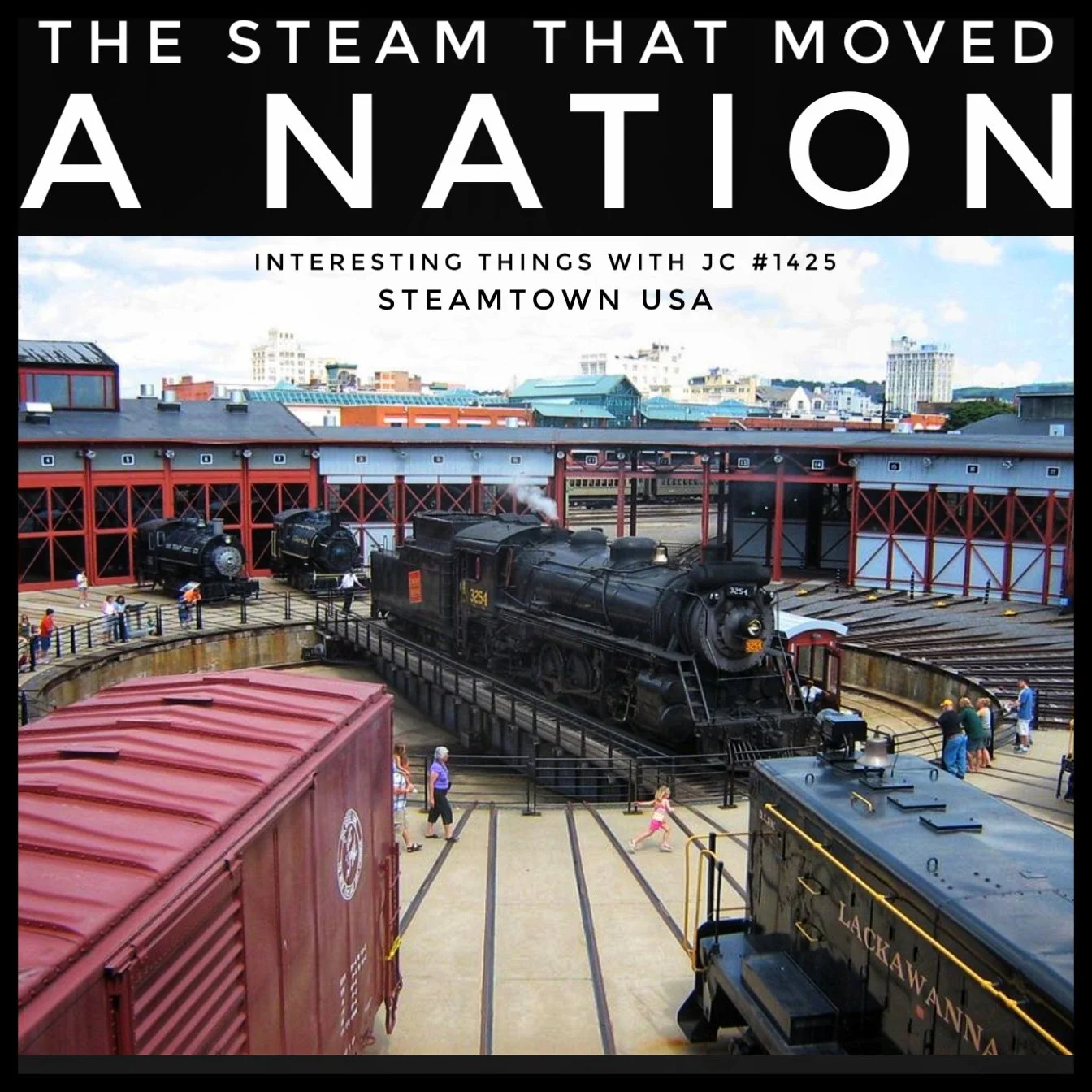
A black steam locomotive on the turntable at Steamtown USA in Scranton, with visitors nearby and roundhouse engines in the background. Text reads: The Steam That Moved a Nation – Interesting Things with JC (Jim Connors) #1425.”
Transcript
There’s a smell to it—old iron, oil, heat, and soot. If you’ve ever stood near a steam locomotive under power, you don’t forget it. There’s something alive in the way the wheels groan, the pistons hiss, and the whistle cuts through air like a blade. It’s not nostalgia. It’s weight. Literal weight, hundreds of tons of it, and the force that moved a nation for nearly a century. At Steamtown National Historic Site in Scranton, Pennsylvania, that sound still echoes. Not as performance. As preservation.
This isn’t a museum in the usual sense. It’s a working rail yard. Part archive, part machine shop, part national altar to American horsepower. The National Park Service took control of the site in 1986, and it remains one of the only parks in the system dedicated solely to the history of steam railroading in the United States. The site spans 62.5 acres (25.3 hectares), built on the original yard of the Delaware, Lackawanna and Western Railroad. Inside, visitors don’t just walk past glass cases—they walk through cinders, oil drips, and the memory of industrial America.
The centerpiece is a roundhouse and turntable, fully restored and operational. Here, locomotives like the Boston & Maine #3713 and Union Pacific #4012 are not just displayed, they’re cared for like relics. The #4012 alone weighs over 1.2 million pounds (544,310 kilograms). It was part of the “Big Boy” class, engines built to haul freight over the Wasatch Mountains without needing help. It’s the kind of machine that makes you step back on instinct. And it wasn’t made for looks.
Steamtown tells the story of how these machines knit together a fractured, growing country. Before highways. Before jets. Steam rail was the connective tissue of commerce and human movement. In 1860, the United States had 30,000 miles (48,280 kilometers) of track. By 1900, that number had reached nearly 200,000 miles (321,870 kilometers). Cities grew around junctions. Coal moved east. Grain moved west. Soldiers moved to war. Steam wasn’t part of life—it was life.
And then, as quickly as it had come, it was gone. Diesel began replacing steam in the 1930s. By 1960, steam locomotives had all but vanished from American railroads. The fires were dropped. The whistles fell silent. A way of life ended, not slowly, but almost overnight. Engines were scrapped. Yards went dark. And the memory of the age of steam started fading into postcards and black-and-white photographs.
That’s why Steamtown matters. Because it’s not just preserving metal. It’s preserving memory. There are men and women there who learned steam maintenance from people who learned it firsthand in the 1940s. Every bolt tightened is a relay of knowledge. Every scheduled excursion, most pulled by vintage engines like Canadian National #3254 or Baldwin Locomotive Works #26, is a reminder that American progress once had a rhythm, and it sounded like pounding rods and drive wheels on steel.
You can stand on the footplate of a locomotive and feel the deck shake beneath your boots. You can ride the rails and understand the sheer scale of a machine that can convert 200 psi of boiler pressure into forward motion without a single microchip. You can watch teenagers stare at these iron beasts with awe, not irony. That matters.
Because we live in an era where we ask machines to whisper. But once, they roared.
And in that contrast, between the algorithmic silence of today’s transport and the muscular rhythm of steam, you feel the difference. One moves you. The other reminds you what it meant to be moved.
These are interesting things, with JC.
Student Worksheet
What makes Steamtown National Historic Site different from a traditional museum?
Explain why the Union Pacific #4012 was considered an engineering marvel.
How did steam locomotives help unify the United States during the 19th century?
Why is the preservation of steam technology considered culturally important?
Describe the emotional or symbolic difference between steam and modern transport, as conveyed in the episode.
Teacher Guide
Estimated Time: 1–2 class periods (45–90 minutes)
Pre-Teaching Vocabulary Strategy:
Use images and brief video clips of steam locomotives. Conduct a "word splash" with the five vocabulary terms.
Anticipated Misconceptions:
Students may believe steam trains are only European or fictional (e.g., Hogwarts Express).
Some may not realize the role of trains in shaping U.S. history beyond the Transcontinental Railroad.
Discussion Prompts:
What do machines tell us about the eras they were built in?
Is there value in preserving obsolete technologies? Why or why not?
Can you think of another object or machine that symbolizes national identity?
Differentiation Strategies:
ESL: Use visual vocabulary flashcards and bilingual definitions.
IEP: Provide audio transcript and sentence stems for written responses.
Gifted: Have students research other national railway preservation projects globally.
Extension Activities:
Research and present on a famous steam locomotive from another country.
Create a model demonstrating the mechanical principles of a steam engine.
Write a fictional journal entry from a 1940s train engineer.
Cross-Curricular Connections:
Physics: Thermodynamics of steam power
History: Industrial Revolution, westward expansion
Engineering: Mechanical systems and pressure dynamics
Art: Poster design for a steam-powered railway
Quiz
Q1. What is the main focus of Steamtown National Historic Site?
A. Diesel engine manufacturing
B. Modern rail transport innovation
C. Steam railroading history and preservation
D. Commercial passenger rail services
Answer: C
Q2. What class of locomotive was Union Pacific #4012 part of?
A. Liberty Class
B. Big Boy Class
C. Centennial Class
D. Steamliner Class
Answer: B
Q3. By 1900, how many miles of railroad track existed in the U.S.?
A. 30,000
B. 100,000
C. 150,000
D. Nearly 200,000
Answer: D
Q4. What replaced steam engines in the mid-20th century?
A. Electric motors
B. Jet engines
C. Diesel locomotives
D. Solar-powered engines
Answer: C
Q5. Why is preserving steam locomotives described as preserving memory?
A. Because they are used daily
B. Because they generate revenue
C. Because they connect people to historical ways of life
D. Because they are environmentally sustainable
Answer: C
Assessment
Analyze how the rise and fall of steam railroads shaped both the economy and culture of the United States.
Compare the sensory and emotional experience of riding a steam locomotive with modern travel. What do we gain and lose?
3–2–1 Rubric:
3 = Accurate, complete, thoughtful
2 = Partial or missing detail
1 = Inaccurate or vague
Standards Alignment
CCSS.ELA-LITERACY.RI.9-10.3
Analyze how the author unfolds a series of ideas or events and the connections among them.
C3.D2.His.2.9-12
Analyze change and continuity in historical eras using relevant evidence.
NGSS HS-PS3-3
Design, build, and refine a device that works within given constraints to convert one form of energy into another (e.g., steam to mechanical energy).
ISTE Standard 1.1.D (Empowered Learner)
Students understand the fundamental concepts of technology operations, applying them through exploration of steam-based transportation.
UK AQA GCSE History: The Industrial Revolution
Explores industrial transport systems and their societal effects.
IB MYP Individuals and Societies Criterion B: Investigating
Develop factual and conceptual understanding through source evaluation—such as primary accounts of industrial transport.
Show Notes
In Episode #1425 of Interesting Things with JC, the story of steam locomotion comes alive through a visit to the Steamtown National Historic Site in Scranton, Pennsylvania. This episode is more than just a look at mechanical innovation—it’s an immersion into the industrial spirit that connected an emerging nation. With vivid sensory detail and factual grounding, JC illustrates how locomotives like the Big Boy #4012 were engineering marvels that also served as cultural symbols. The episode encourages reflection on what it means to preserve technology, memory, and identity. For students and educators, this topic offers compelling links to physics, history, and cultural studies—reminding us how yesterday’s machines shaped today’s world.
References
National Park Service. (n.d.). History of the Union Pacific “Big Boy” No. 4012. U.S. Department of the Interior. Retrieved September 30, 2025, from https://www.nps.gov/stea/learn/historyculture/history-of-the-union-pacific-big-boy-no-4012.htm
National Park Service. (2021, October 18). Big Boy No. 4012 returns to static exhibition. U.S. Department of the Interior. Retrieved September 30, 2025, from https://www.nps.gov/stea/learn/big-boy-no-4012-returns-to-static-exhibition.htm
SteamGiants. (n.d.). Union Pacific #4012, Big Boy at Steamtown. Steam Giants. Retrieved September 30, 2025, from https://steamgiants.com/big-boy/union-pacific-4012-big-boy