1466: "What is a Veteran?"
Interesting Things with JC #1466: "What is a Veteran?" – From ancient Rome to today’s armed forces, the word “veteran” has carried centuries of honor. What does it really mean to serve, to return, and to keep faith long after the battle ends?
Curriculum - Episode Anchor
Episode Title: What Is a Veteran?
Episode Number: #1466
Host: JC
Audience: Grades 9–12, college intro, homeschool, lifelong learners
Subject Area: U.S. History, Civics, Social Studies, Military History
Lesson Overview
By the end of this lesson, students will be able to:
Define the term “veteran” and explain its origins in ancient Rome and modern U.S. law.
Compare the evolving definitions of military service from the 18th century to the present.
Analyze the social, civic, and ethical meanings of military service beyond combat roles.
Explain how Veterans Day honors the commitments and risks undertaken by members of the U.S. Armed Forces.
Key Vocabulary
Veteranus (veh-teh-RAH-nus) — A Roman soldier who had completed his service in the legions and earned the right to return home.
Oath (OH-th) — A solemn pledge to serve and protect, often sworn by members of the military when they enlist.
Enlistment (en-LIST-ment) — The act of joining the armed forces voluntarily for a set term of service.
Continental Congress (KON-tuh-NEN-tuhl KONG-res) — The governing body of the American colonies during the Revolution, which first promised pensions for disabled soldiers.
Honorably Discharged (ON-er-ah-blee DIS-chahrjd) — Released from military service under conditions that meet or exceed required standards of conduct and performance.
Narrative Core
Open — The episode opens with a moment of national pause on November 11, describing the sights and sounds of Veterans Day parades and ceremonies.
Info — JC traces the word “veteran” back to its Roman roots, explaining how the concept of earned rest and service traveled across centuries.
Details — The story explains how the United States adopted and expanded the term, from 1776 pensions for disabled soldiers to a modern definition that includes all who served honorably.
Reflection — The episode deepens into the personal meaning of service, emphasizing that veterans are united not by rank or politics but by a kept promise and willingness to risk.
Closing — “These are interesting things, with JC.”
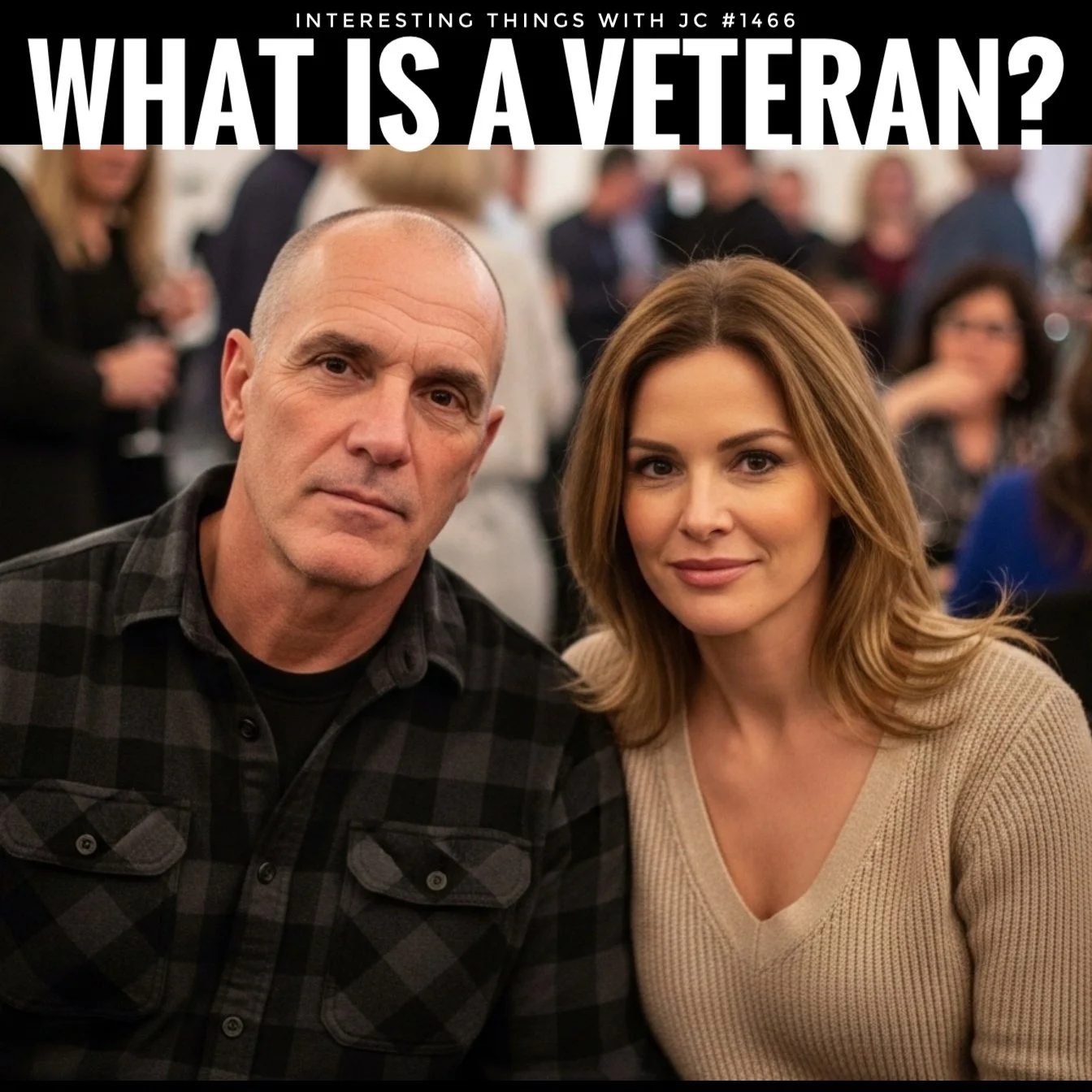
A man and woman sit closely together at an indoor event, both with calm, direct expressions that suggest shared experience. They are framed under the title “Interesting Things with JC #1466 – What Is a Veteran?”, allowing viewers to recognize that either or both could be veterans in a crowd of civilians.
Transcript
On November 11, the United States stops to remember. Flags go up, speeches get made, parades roll by. We call it Veterans Day. But who, exactly, is a veteran?
The word goes back to ancient Rome. A veteranus (veh-teh-RAH-nus) was a soldier who had finished his time in the legions and earned the right to go home. When the United States built its own Army, that same idea crossed the ocean. The new republic used the old word for people who had served this country in uniform.
By 1776, the Continental Congress was already promising pensions for soldiers “disabled in the service of the United States.” After every war that followed, the definition of “veteran” grew. It moved beyond one battle, one branch, or one kind of job. Today, it means anyone who served honorably in any branch of the Armed Forces, in wartime or peacetime. That adds up to more than 18 million Americans.
But a veteran is more than a line in a law book or a number in a report. It might be someone who did one enlistment or someone who stayed for an entire career. It might be a mechanic who kept aircraft flying, a corpsman who patched up the wounded, a cook who made sure a unit got one hot meal in a frozen place. Some veterans came home and slipped back into regular life. Others never came home at all.
What they share is not age, rank, or politics. It is a promise they made and kept. At some point in their lives, they raised a hand, took an oath, and accepted that their life could be used to protect someone else’s. That commitment does not end when the uniform goes in the closet.
So if you see a veteran at the store, on a job site, in a classroom, at a clinic, or standing by a gravesite on November 11, remember this: you are not just looking at what they did. You are looking at what they were willing to risk.
These are interesting things, with JC.
Student Worksheet
What is the origin of the word “veteran,” and how did it evolve into its current meaning in the United States?
What action taken by the Continental Congress in 1776 set a precedent for how America supports veterans?
According to the episode, what unites all veterans, regardless of their specific duties or roles?
How does the episode suggest we view veterans in everyday life, beyond ceremonies and holidays?
Creative prompt: Write a short reflection or poem titled “What They Were Willing to Risk,” inspired by the episode.
Teacher Guide
Estimated Time:
45–60 minutes
Pre-Teaching Vocabulary Strategy:
Preview the Latin root “veteranus” and related English derivatives (“veteran,” “veterinary,” “veterancy”). Use contextual examples from Roman and early American history.
Anticipated Misconceptions:
That “veteran” only refers to combat soldiers.
That Veterans Day is the same as Memorial Day.
That only older individuals are veterans.
Discussion Prompts:
How does the concept of service shape the identity of a veteran?
Why is it important to recognize non-combat roles in the military?
In what ways can civilians honor veterans beyond public ceremonies?
Differentiation Strategies:
ESL: Provide bilingual definitions and use visual aids for key terms.
IEP: Use guided note templates and oral comprehension checks.
Gifted: Research and compare how other nations define and honor veterans (e.g., Canada’s Remembrance Day, France’s Armistice Day).
Extension Activities:
Interview a veteran about their service and reflect on how their experience aligns with the episode’s themes.
Create a timeline showing how veteran benefits have evolved since 1776.
Write a persuasive essay advocating for veteran support programs using historical evidence.
Cross-Curricular Connections:
Civics: Explore how government policies impact veteran care.
History: Trace the evolution of U.S. military service across eras.
Ethics: Discuss moral obligations societies hold toward those who serve.
Quiz
Q1. The word “veteran” comes from which civilization?
A. Greece
B. Rome
C. Egypt
D. Britain
Answer: B
Q2. What did the Continental Congress promise in 1776?
A. Free land for farmers
B. Pensions for soldiers disabled in service
C. Citizenship for volunteers
D. Weapons for all militias
Answer: B
Q3. Approximately how many Americans today are considered veterans?
A. 8 million
B. 12 million
C. 18 million
D. 25 million
Answer: C
Q4. What quality unites all veterans according to the episode?
A. Political affiliation
B. Length of service
C. A kept promise and willingness to risk
D. Military rank
Answer: C
Q5. What does the episode suggest we see when we look at a veteran?
A. What they did
B. What they were willing to risk
C. How long they served
D. Their medals and honors
Answer: B
Assessment
Explain how the definition of “veteran” has evolved from ancient Rome to modern America.
Reflect on the phrase, “You are looking at what they were willing to risk.” What does this mean about the role of veterans in society today?
3–2–1 Rubric:
3 = Accurate, complete, and thoughtful with historical and civic context.
2 = Partial explanation with limited examples or insight.
1 = Vague or inaccurate response showing limited understanding.
Standards Alignment
Common Core (CCSS.ELA-LITERACY.RH.9-10.2)
Determine central ideas of a primary or secondary source and summarize them accurately.
→ Students analyze JC’s narrative to identify the historical and ethical dimensions of “veteran.”
C3 Framework (D2.Civ.7.9-12)
Apply civic virtues and democratic principles in personal and public contexts.
→ Encourages understanding of citizenship and service as civic ideals.
CTE (Government & Public Administration Pathway: GOVT-1)
Explain the role of government in supporting veterans through policy and legislation.
→ Links to early pensions and modern veteran care.
ISTE Standard 1.3a
Students plan and employ strategies to respect diverse perspectives.
→ Promotes empathy and awareness of veterans’ varied experiences.
UK National Curriculum: History KS4 (AQA)
Develop and sustain a sense of chronology and empathy through the study of individuals and events.
→ Enables students to compare Roman, British, and U.S. commemorations of service.
IB MYP Individuals & Societies Criterion B
Investigating: Explain and analyze key historical concepts using evidence.
→ Students research how societies define and honor military service.
Show Notes
In this episode, JC explores what it truly means to be a veteran — from ancient Rome’s legionaries to modern Americans who take an oath to serve. The narrative connects centuries of military tradition to the present, showing that service is not defined by combat or rank, but by commitment and courage. With over 18 million veterans in the U.S. today, the story challenges listeners to see Veterans Day not only as remembrance but as recognition of sacrifice and promise. This episode is ideal for discussions on civic identity, historical continuity, and ethical responsibility.
References
Legal Information Institute. (n.d.). 38 U.S. Code § 101: Definitions. Cornell Law School. https://www.law.cornell.edu/uscode/text/38/101
Moreno, M. E. (2025, September 29). U.S. Department of Veterans Affairs: Who is a veteran? Congressional Research Service. https://www.congress.gov/crs-product/R47299
Schaeffer, K. (2023, November 8). The changing face of America’s veteran population. Pew Research Center. https://www.pewresearch.org/short-reads/2023/11/08/the-changing-face-of-americas-veteran-population/
U.S. Department of Veterans Affairs. (n.d.). History of Veterans Day. https://department.va.gov/veterans-day/history-of-veterans-day/
U.S. Census Bureau. (2024, October 16). Veterans Day 2024: November 11 (Facts for Features). https://www.census.gov/newsroom/facts-for-features/2024/veterans-day.html