1458: "How a Wardrobe Malfunction Invented the Modern Bra"
Interesting Things with JC #1458: "How a Wardrobe Malfunction Invented the Modern Bra" – A ruined dress, two handkerchiefs, and a flash of frustration led to one of fashion’s most quietly radical inventions. What started in a mirror reshaped the world.
Curriculum - Episode Anchor
Episode Title: How a Wardrobe Malfunction Invented the Modern Bra
Episode Number: #1458
Host: JC
Audience: Grades 9–12, college intro, homeschool, lifelong learners
Subject Area: History, Science, Invention & Innovation, Design & Technology
Lesson Overview
Students will:
Define the historical context in which the modern brassiere was invented.
Compare corsetry with early brassiere design to evaluate social and technological shifts.
Analyze how a personal innovation responded to cultural and material constraints of its era.
Explain how World War I influenced fashion, industry, and women’s physical autonomy.
Key Vocabulary
Corset (/ˈkɔːr.sət/) — A structured undergarment stiffened with bone or steel, worn to shape the torso. In 1912, corsets were required formalwear for women.
Brassiere (/brəˈzɪər/) — An undergarment providing bust support; Mary Phelps Jacob’s design replaced traditional corsets with a more flexible alternative.
Silhouette (/ˌsɪl.uˈɛt/) — The outline or general shape of clothing on the body. Mary’s concern over her corset disrupting the dress’s silhouette led to her invention.
Patent (/ˈpæt.ənt/) — Legal protection for an invention. Mary filed U.S. Patent No. 1,115,674 for her “Brassiere” in 1914.
War Industries Board (/wɔːr ˈɪn.də.striz bɔːrd/) — U.S. agency during World War I that coordinated war supplies, which encouraged abandoning corsets to conserve steel.
Narrative Core (Based on the PSF – relabeled)
Open – A moment in 1912: Mary Phelps Jacob needs to fix a problem with a silk gown and a corset.
Info – Background on corsets as fashion necessities and physical constraints in early 20th-century society.
Details – Mary designs a new undergarment from handkerchiefs and ribbon, files a patent, and sells the design to Warner Brothers Corset Company.
Reflection – The brassiere’s invention aligned with a larger cultural shift: World War I’s impact on gender roles, mobility, and industry.
Closing – “These are interesting things, with JC.”
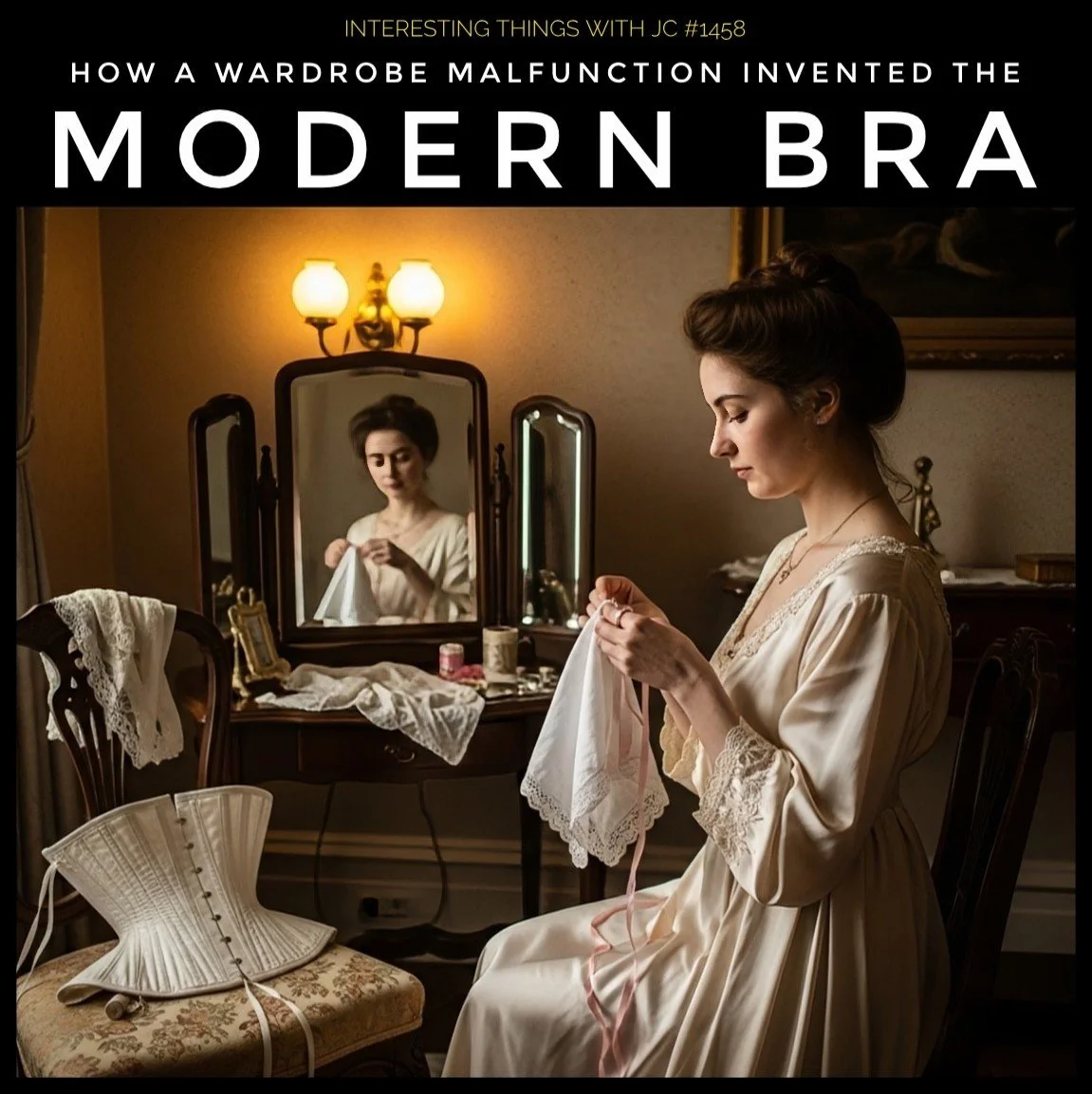
A young woman in early-1900s clothing sits at a vanity table in a softly lit bedroom, sewing two white handkerchiefs together with a pink ribbon. A mirror behind her reflects her focused expression. A whalebone corset rests unused on a nearby chair, symbolizing a shift from rigid corsetry to the first modern bra. Vintage lace, thread, and sewing tools are arranged on the vanity, reinforcing the historical setting and hand-made nature of the invention.
Transcript
In 1912, while headlines told stories of the RMS Titanic, a unique invention was taking shape in a New York townhouse. No engineers. No factory. Just a silk evening gown, a stubborn corset, and a determined nineteen-year-old named Mary Phelps Jacob.
Mary was dressing for a high-society ball. Her gown was sheer silk chiffon, meant to float. But like every woman of her time, she was supposed to wear a whalebone and steel corset. They weighed close to three pounds, about 1.4 kilograms, stiff enough to bend steel stays and tight enough to make breathing a negotiation. When Mary looked in the mirror, she didn’t see elegance. She saw the hard ridge of a corset poking through delicate fabric. That ruined the silhouette. And in 1912, if you wanted to look right, you fixed your clothes, not your standards.
So Mary improvised. She called her maid, grabbed two silk handkerchiefs, a needle, thread, and a pink ribbon. Together they stitched a lightweight, two-cup support garment that held shape without metal or bone. It didn’t dig, squeeze, or cinch. It let her move. At the ball, her friends didn’t compliment the dress first. They noticed she could laugh, breathe, and dance. Several asked for the same design that very night.
Two years later, on November 3, 1914, Mary filed U.S. Patent No. 1,115,674 for her “Brassiere.” She produced them by hand for a brief time, selling each for a dollar, roughly $30 today. But she wasn’t interested in running a factory. So she sold the patent to the Warner Brothers Corset Company of Bridgeport, Connecticut for $1,500, equivalent to about $45,000 today. Warner went on to earn more than $15 million from the design, roughly $480 million in modern value.
Mary’s invention arrived right as the world changed. With World War I, women stepped into factories, offices, and medical corps roles. Movement mattered. Comfort mattered. Steel mattered too: corsets consumed thousands of tons of steel, and the U.S. War Industries Board even encouraged abandoning them in 1917, freeing enough metal to build two naval battleships. The era of rigid corsetry faded. Mary’s flexible brassiere fit the times, and then defined them.
Mary later became a writer, publisher, and patron of the arts under the name Caresse Crosby. Yet it was that hand-stitched ribbon-and-handkerchief creation that changed daily life around the world. Not by committee, trend movement, or ideology. Just one practical mind solving a problem in her bedroom.
These are interesting things, with JC.
Student Worksheet
What problem was Mary Phelps Jacob trying to solve before the ball in 1912?
How did the corset affect women’s mobility and comfort in the early 1900s?
What materials did Mary use to create the first modern bra?
Why was the U.S. War Industries Board interested in women abandoning corsets during World War I?
Imagine you are Mary’s friend at the ball. Write a short note to her requesting your own version of her new design.
Teacher Guide
Estimated Time:
45–60 minutes
Pre-Teaching Vocabulary Strategy:
Introduce corset vs. brassiere visually using historical photos. Use a Think-Pair-Share around what makes an invention meaningful.
Anticipated Misconceptions:
Students may assume bras always existed in modern form.
Some may confuse Mary Phelps Jacob with a fashion designer rather than an inventor.
Discussion Prompts:
How do simple inventions sometimes create massive cultural change?
Should necessity or discomfort be a primary motivator in innovation?
How do wartime conditions shape civilian life and personal freedom?
Differentiation Strategies:
ESL: Use labeled images and sentence frames to describe corsets and bras.
IEP: Provide cloze notes with key facts missing from the transcript.
Gifted: Research other wartime inventions driven by material conservation.
Extension Activities:
Design Challenge: Recreate Mary’s prototype using modern materials.
Write a historical fiction diary entry from Mary’s perspective on patent day.
Research: Track the evolution of women’s fashion from 1900–1950.
Cross-Curricular Connections:
History: Industrialization and WWI domestic policy.
Economics: Patent licensing and intellectual property value.
Engineering: Material science and early wearable technology.
Quiz
Q1. What year did Mary Phelps Jacob file the patent for the brassiere?
A. 1912
B. 1914
C. 1917
D. 1920
Answer: B
Q2. What item did Mary use to create the first bra?
A. Lace and elastic
B. Linen and cotton
C. Handkerchiefs and ribbon
D. Leather and rope
Answer: C
Q3. Why was the War Industries Board involved in discouraging corset use?
A. Corsets were unfashionable
B. Corsets posed a safety risk
C. Corsets used too much steel
D. Corsets were banned
Answer: C
Q4. What company purchased Mary’s bra patent?
A. Sears & Roebuck
B. Warner Brothers Corset Company
C. Playtex
D. Hanes
Answer: B
Q5. What social change contributed to the popularity of the brassiere?
A. The Titanic’s sinking
B. Rise of the film industry
C. Women entering the workforce during WWI
D. Invention of nylon
Answer: C
Assessment
In what ways did Mary Phelps Jacob’s invention represent both innovation and cultural resistance?
Analyze the economic journey of Mary’s invention: Why did Warner Brothers profit so heavily while Mary did not?
3–2–1 Rubric:
3 = Accurate, complete, thoughtful
2 = Partial or missing detail
1 = Inaccurate or vague
Standards Alignment
Common Core – History/Social Studies
CCSS.ELA-LITERACY.RH.9-10.2 — Determine the central ideas of a historical text and explain their development.
CCSS.ELA-LITERACY.RH.11-12.3 — Evaluate various explanations for actions or events and determine which explanation best accords with textual evidence.
C3 Framework for Social Studies
D2.His.4.9-12 — Analyze complex factors that influenced the perspectives of people during different historical eras.
D2.His.14.9-12 — Analyze multiple and complex causes and effects in history.
NGSS (Crosscutting Concepts: Influence of Engineering, Technology, and Science on Society and the Natural World)
HS-ETS1-1 — Analyze a major global challenge to specify qualitative and quantitative criteria for solutions.
ISTE (International Society for Technology in Education)
ISTE 4a — Students know and use a deliberate design process for generating ideas, testing theories, and creating innovative artifacts.
UK National Curriculum – History (Key Stage 4)
GCSE History AQA 8145 — Understand significant events in British and global history, including cultural shifts prompted by war and technology.
IB MYP Individuals and Societies
Criterion B: Investigation — Students develop focused research questions and apply historical context to inquiry.
Show Notes
In this episode, JC spotlights a forgotten innovation born out of frustration with fashion norms. When Mary Phelps Jacob couldn’t tolerate the rigid lines of her corset beneath a delicate gown, she stitched together the first modern brassiere—changing women’s daily lives and the undergarment industry forever. The episode reveals how Mary’s simple solution—two handkerchiefs, a pink ribbon, and ingenuity—aligned with broader social changes during World War I, especially as women entered the workforce and materials like steel were prioritized for military needs. This moment of personal creativity connects to themes of autonomy, invention, and societal transformation, making it deeply relevant for today’s learners as they explore how seemingly small acts of innovation can ripple across time.
References:
U.S. Patent and Trademark Office. (1914). Patent No. 1,115,674. https://patents.google.com/patent/US1115674A/en
Bellis, M. (2019, February 1). The history of the brassiere. ThoughtCo.
Connecticut Humanities. (n.d.). From bombs to bras: World War I conservation measures transform the lives of women. ConnecticutHistory.org. https://connecticuthistory.org/from-bombs-to-bras-world-war-i-conservation-measures-transform-the-lives-of-women/
Lemelson-MIT Program. (n.d.). Mary Phelps Jacob. Lemelson–MIT Inventor Archive. https://lemelson.mit.edu/resources/mary-jacob
University of Wollongong. (2014, November). The story of the bra. https://www.uow.edu.au/media/2014/the-story-of--the-bra.php