1477: "Telekinesis"
Interesting Things with JC #1477: "Telekinesis" – The claims were bold, the tests were careful, and each new setup revealed something the stories never mentioned. The mind is powerful, but not in the way people hoped.
Curriculum - Episode Anchor
Episode Title: Telekinesis
Episode Number: 1477
Host: JC
Audience: Grades 9–12, college intro, homeschool, lifelong learners
Subject Area: History of Science, Physics, Critical Thinking, Experimental Design
Lesson Overview
Students will:
• Define telekinesis and explain its claims across historical periods.
• Compare major case studies that tested paranormal claims under controlled conditions.
• Analyze how experimental controls influence scientific outcomes.
• Explain why modern physics does not support telekinesis as a real physical phenomenon.
Key Vocabulary
• Telekinesis (tel-uh-kuh-NEE-sis) — The claimed ability to move objects using only the mind.
• Controlled experiment (kun-TROLD ek-SPAIR-uh-ment) — A test where variables are monitored or restricted to determine cause and effect.
• Microvolt (MY-kro-volt) — A unit of electrical potential equal to one millionth of a volt; used to measure brain electrical activity.
• Thermal motion (THER-mul MO-shun) — The random movement of particles due to heat; disrupts quantum effects at larger scales.
• Replication (rep-li-KAY-shun) — Repeating an experiment to confirm results and reduce errors or bias.
Narrative Core
Open: People have been fascinated with mind-over-matter claims for centuries, and the episode hooks listeners by introducing telekinesis as a longstanding mystery.
Info: Historical context describes major scientific investigations from the late 1800s, 1920s, and Cold War era that attempted to test telekinesis under more rigorous conditions.
Details: Turns and key facts appear as each case study fails under tighter controls: Daniel Dunglas Home’s sessions cease to show movement, “Margery” Crandon’s séance tricks are traced to her foot, and Uri Geller’s spoon bending disappears under double-sealed, fully observed conditions. Modern physics explains why telekinesis lacks a plausible mechanism.
Reflection: The episode emphasizes the importance of controlled testing, improved instrumentation, and critical thinking when exploring extraordinary claims.
Closing: These are interesting things, with JC.
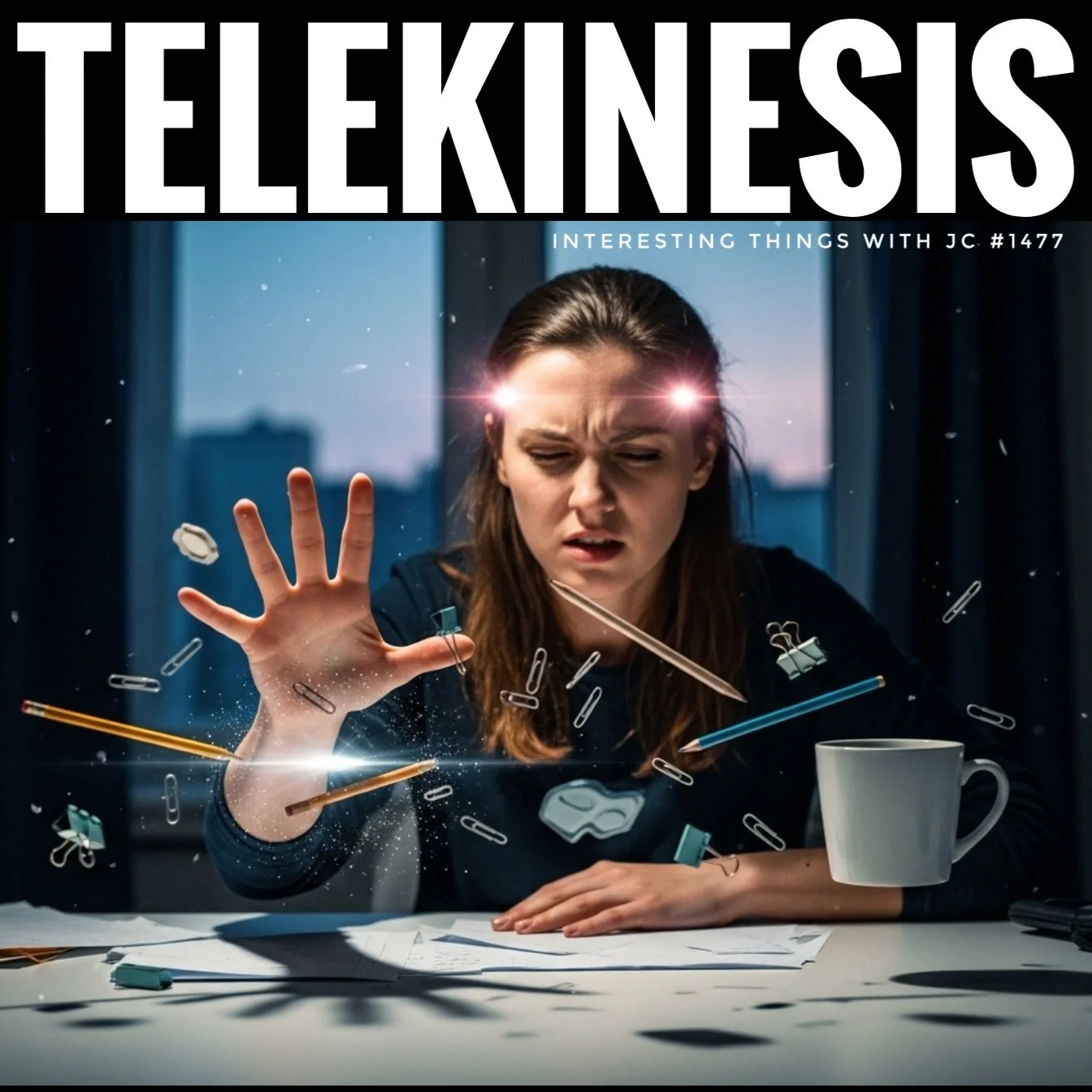
A young woman sits at a desk in a dim, modern room at night, concentrating intensely with her hand held out in front of her. Office items such as pencils, paper clips, erasers, and binder clips appear to float in mid-air as if pushed away from her hand. A white coffee mug sits on the desk beside scattered papers. Bright glowing light rests on her forehead, suggesting the idea of telekinetic power. The word “TELEKINESIS” appears in bold white letters across the top, with “Interesting Things with JC #1477” printed beneath it.
Transcript
People have talked about mind over matter for centuries, but the strongest pressure to test it came during three key periods. Each one produced case studies that still get cited today.
One of the earliest formal tests happened in the late 1800s. Sir William Crookes (krooks), a respected chemist, investigated medium Daniel Dunglas Home (hyoom). Home claimed he could move objects without touching them. Crookes built controls around the table, added spring gauges, and recorded every step. When Home had room to move his legs or arms, objects shifted. When Crookes locked the table legs, added brighter lighting, and put markers around every object, the movement stopped. This became one of the first controlled studies to show that telekinesis did not hold up under repeatable conditions.
A second well documented case involved Mina Crandon, known as “Margery,” in the 1920s. She performed séances where a wooden box lid would rise without human contact. Investigators from Harvard built a sealed apparatus that tracked pressure from all directions. When they reran the tests, the force came from her foot and not her mind. The case became a teaching tool for how easily observers can be misled without proper controls.
The Cold War created the most famous modern case study. In the 1970s, researchers at Stanford Research Institute tested Uri Geller (gel-er). They monitored metal samples with precision instruments and used sealed boxes to prevent physical contact. When everything was double sealed and watched from all angles, nothing bent. When the team relaxed the rules, spoons bent again, which matched tricks already demonstrated by stage magicians. Independent replications at Caltech and elsewhere produced the same results. Under tight controls, there was no measurable effect.
Modern physics adds the final piece. Today’s equipment can detect forces around one trillionth of a newton, which is roughly one ten billionth of an ounce. That sensitivity can pick up light pressure from an insect landing on a sensor. Even at that level, the human brain has never produced a force strong enough to move an external object. The electrical fields produced by the brain measure in microvolts, a millionth of a volt, and drop off sharply with distance. They are nowhere near strong enough to push or pull anything solid.
Some people point to quantum mechanics as a possible explanation. Physicists note that quantum effects work at scales billions of times smaller than neurons. Inside a warm human body, thermal motion washes out those effects instantly. Nothing in peer reviewed physics offers a mechanism for telekinesis as shown in entertainment.
What these case studies do show is the value of controlled testing. They pushed scientists to improve sensors, data logging, and experimental design. The topic survives because the mind is powerful in many ways, just not in the way people imagine when they picture objects sliding across a table.
These are interesting things, with JC.
Student Worksheet
Describe how Sir William Crookes tested Daniel Dunglas Home and what changed when stronger controls were added.
Explain what investigators discovered about “Margery” Crandon’s séance phenomena.
Summarize the findings from the Stanford Research Institute tests on Uri Geller.
Why does modern physics rule out telekinesis as depicted in entertainment?
Creative Prompt: Design your own controlled experiment to test a paranormal claim. What variables would you control?
Teacher Guide
Estimated Time
45–60 minutes
Pre-Teaching Vocabulary Strategy
Introduce terms using a Frayer Model or quick-write: students predict definitions, then adjust after hearing the episode.
Anticipated Misconceptions
• Students may believe extraordinary claims require less evidence because they are “popular.”
• Some may think quantum mechanics allows anything; clarify scale and thermal effects.
• Students may assume historical investigators were naïve—highlight how methods evolved.
Discussion Prompts
• Why are tight experimental controls essential when testing extraordinary claims?
• How do these case studies demonstrate the difference between anecdote and evidence?
• What modern tools make it easier to test claims today?
Differentiation Strategies
• ESL: Provide vocabulary cards with visual cues and sample sentences.
• IEP: Offer guided notes with pre-written cues for timelines and case studies.
• Gifted: Challenge students to compare these investigations with other historical scientific controversies.
Extension Activities
• Students research another paranormal claim and evaluate the evidence.
• Create a lab-style proposal for testing a myth or piece of pseudoscience.
• Compare scientific skepticism across different historical eras.
Cross-Curricular Connections
• Physics: Forces, electrical fields, and quantum scale.
• History: Scientific investigation in the Victorian era, the 1920s, and the Cold War.
• Media Literacy: Why stage magic and entertainment use misdirection.
Quiz
Q1. What stopped object movement during Crookes’ final tests with Home?
A. A different table
B. Locked table legs and brighter lighting
C. A new medium
D. A change in weather
Answer: B
Q2. What revealed the true cause of Margery’s wooden box movement?
A. A video recording
B. A sealed apparatus tracking pressure
C. A stage magician’s report
D. A confession
Answer: B
Q3. What happened when controls were relaxed in the Geller tests?
A. Nothing changed
B. Instruments broke
C. Spoons bent again
D. The test was canceled
Answer: C
Q4. How strong are the brain’s electrical fields?
A. Strong enough to move small objects
B. About one volt
C. Measured in microvolts
D. Too strong to measure
Answer: C
Q5. Why can’t quantum mechanics explain telekinesis?
A. Quantum effects don’t exist
B. They require metal objects
C. They occur on scales far smaller than neurons and are washed out by heat
D. Scientists don’t study quantum physics
Answer: C
Assessment
Analyze why each major telekinesis case study failed when proper controls were implemented.
Explain how modern physics reinforces conclusions drawn from historical investigations.
3–2–1 Rubric
3 = Accurate, complete, thoughtful; includes clear references to case studies and physics.
2 = Partial explanation; missing one or more key details or examples.
1 = Inaccurate, vague, or unsupported statements.
Standards Alignment
NGSS (Science)
• HS-PS2-1 — Use data to analyze forces; students examine why no measurable force from the brain can move objects.
• HS-PS3-2 — Understand thermal energy; linked to why thermal motion disrupts quantum effects.
• HS-ETS1-3 — Evaluate testing solutions; connected to designing controlled experiments.
Common Core ELA
• CCSS.ELA-LITERACY.RST.11-12.1 — Cite specific evidence; students reference case studies.
• CCSS.ELA-LITERACY.RST.11-12.3 — Follow complex scientific procedures; linked to experimental design.
• CCSS.ELA-LITERACY.WHST.11-12.2 — Write explanatory texts; used in assessment and worksheet responses.
C3 (Social Studies/Inquiry)
• D1.3.9-12 — Identify evidence across historical sources; applies to comparing claims and investigations.
• D3.3.9-12 — Evaluate sources and data; students critique case study evidence.
ISTE Standards
• ISTE 3.3 Knowledge Constructor — Students critically evaluate information about paranormal claims.
• ISTE 4.1 Empowered Learner — Students design their own investigations.
International Equivalents
• UK AQA GCSE Physics 4.5 Forces — Relates to understanding measurable forces and limits of physical effects.
• IB MYP Science Criterion B (Inquiring and Designing) — Students develop controlled investigation proposals.
• Cambridge IGCSE Physics 1.2 Experimental Techniques — Aligns with evaluating and improving experimental controls.
Show Notes
This episode explores the long history of testing telekinesis, from Victorian séances to Cold War laboratories, showing how improved experimental controls consistently eliminate supposed paranormal effects. Each case study highlights a key principle: extraordinary claims require rigorous evidence. The episode connects directly to physics, the scientific method, and media literacy, helping students understand why controlled experiments matter and how scientific knowledge advances through careful testing and replication. These discussions support critical thinking skills that remain vital in today’s information-rich world.
References
Alvarado, C. S., Biondi, K., & Kramer, S. (2006). Historical notes on psychic phenomena in specialised journals. European Journal of Parapsychology, 21(1), 33-54. Retrieved from https://med.virginia.edu/perceptual-studies/wp-content/uploads/sites/360/2015/11/Alvarado-Biondi-Kramer-Journals-EJP-2006-paper.pdf
Derbyshire, D. (2013, October 19). The psychology of spiritualism: Science and séances. The Guardian. Retrieved from https://www.theguardian.com/science/2013/oct/20/seances-and-science
Escolà-Gascón, Á. (2023). Follow-up on the U.S. Central Intelligence Agency’s (CIA) remote-viewing programmes: A critique and review. Frontiers in Psychology. Retrieved from https://pmc.ncbi.nlm.nih.gov/articles/PMC10275521/
Noakes, R. (2014). Psychical research and the troubles of experimental physics. Studies in History and Philosophy of Science Part A, 45, 1–12. https://doi.org/10.1016/j.shpsa.2014.05.002
Pruitt, S. (2018, October 17). The CIA recruited ‘mind-readers’ to spy on the Soviets in the 1970s. History.com. Retrieved from https://www.history.com/articles/cia-esp-espionage-soviet-union-cold-war
Schorr, A. (2008, October 29). U.S. and Soviet spooks studied paranormal powers to find new weapons. Scientific American Blog. Retrieved from https://www.scientificamerican.com/blog/news-blog/us-and-soviet-spooks-studied-parano-2008-10-29/
Storm, L., Tressoldi, P. E., & Di Risio, L. (2010). Meta-analysis of free-response studies, 1992–2008: Assessing the noise-reduction model in parapsychology. Psychological Bulletin, 136(4), 471–485. Retrieved from https://www.plosone.org/article/fetchObjectAttachment.action?uri=10.1371/journal.pone.0025213&representation=PDF