1478: "Sensory Deprivation"
Interesting Things with JC #1478: "Sensory Deprivation" – When the world goes silent, the brain doesn’t shut down, it shifts. What happens when you take away all the noise? You start to hear yourself.
Curriculum - Episode Anchor
Episode Title: Sensory Deprivation
Episode Number: #1478
Host: JC
Audience: Grades 9–12, college intro, homeschool, lifelong learners
Subject Area: Psychology, Neuroscience, Health & Wellness
Lesson Overview
By the end of this lesson, students will be able to:
Define sensory deprivation and explain the concept of a float tank.
Compare normal brain activity with brain behavior during sensory deprivation.
Analyze the psychological and physiological responses triggered by a lack of external stimuli.
Explain how sensory deprivation is used in modern therapeutic and recreational contexts.
Key Vocabulary
Sensory Deprivation (/ˈsɛn.sə.ri ˌdɛ.prəˈveɪ.ʃən/) — A condition in which an individual receives less than normal sensory input. In the episode, the float tank cuts off external stimuli like sight, sound, and touch.
Float Tank (/floʊt tæŋk/) — A dark, soundproof tank filled with saltwater at skin temperature, used to induce sensory deprivation.
Homeostasis (/ˌhoʊ.mi.oʊˈsteɪ.sɪs/) — The body's tendency to maintain internal balance. In the absence of external cues, the brain shifts to internal monitoring for balance.
Hallucination (/həˌluː.sɪˈneɪ.ʃən/) — The experience of perceiving something not present. In prolonged sensory deprivation, some subjects experience hallucinations as the brain tries to self-stimulate.
Cognitive Shift (/ˈkɒɡ.nə.tɪv ʃɪft/) — A change in mental processing, such as the inward turn of thought during low-stimulus experiences.
Narrative Core
Open: The listener is immersed in a vivid description of a float tank where external sensory input fades, and internal experience heightens.
Info: The episode provides historical background on 1950s sensory deprivation studies and explains how the brain continuously processes background stimuli.
Details: The story reveals how sensory deprivation leads to inward focus, distorted time perception, and sometimes hallucinations as the brain tries to compensate.
Reflection: The episode reflects on how much unconscious tension we carry from constant stimulation and the value of disconnecting.
Closing: "These are interesting things, with JC."
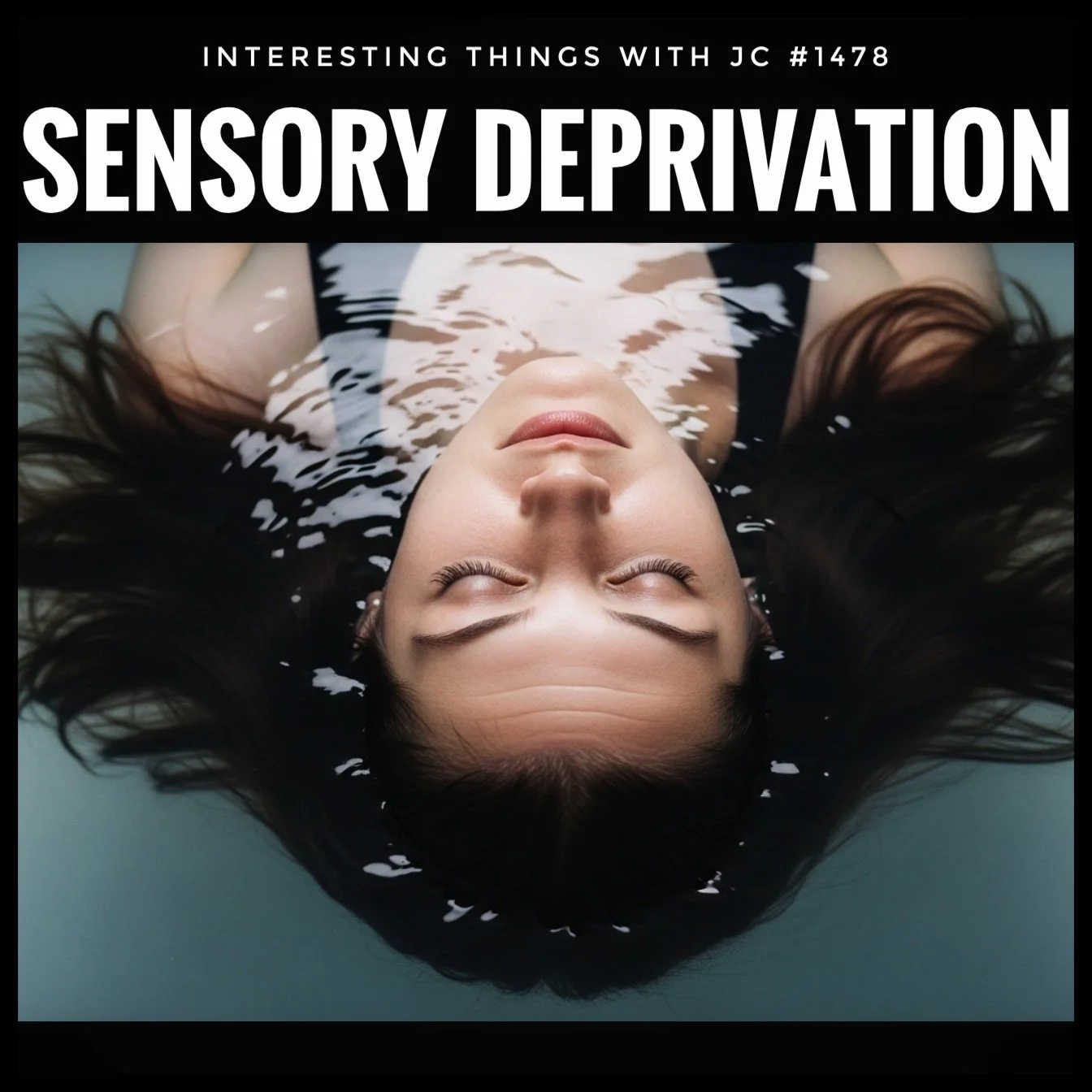
A woman floats on her back in a sensory deprivation tank with her eyes closed. Her face is relaxed, and the water surrounds her head, creating a calm, quiet atmosphere. The lighting is soft, and only her head and upper shoulders are visible above the surface.
Transcript
Step into a sensory deprivation tank and the outside world drops away. The water sits at skin temperature, about 93 to 94 degrees Fahrenheit, or roughly 34 degrees Celsius. After a moment you stop feeling the edge between your body and the water. The salt keeps you floating without effort. The space goes dark and quiet. With sight, sound, and touch mostly taken out of the picture, your brain suddenly has almost nothing new to take in.
Under normal conditions the brain is always busy. It tracks small changes in light, vibration, temperature, and pressure. It listens for steady background noise even when you think you’re relaxed. When that feed shuts down, the mind shifts inward. Researchers in the 1950s learned that people in low-input settings fall into slower internal rhythms. They start noticing signals they usually overlook. Heartbeat and breath stand out. Muscle tension becomes obvious. Some people feel creative thoughts drifting up. Others notice time slipping. Many who think they floated for ten minutes find they were in the tank closer to an hour. With fewer cues to check, the brain stops measuring time and settles into longer, steadier cycles.
When the outside world gets too quiet for too long, the brain sometimes starts generating its own input. Early isolation studies showed subjects seeing faint shapes, hearing soft tones, or sensing light touches that weren’t there. These weren’t supernatural. They were the brain trying to fill a gap. That’s why modern float tanks keep sessions within set limits. The goal is calm and recovery, not confusion.
Float therapy today is used by athletes for recovery, by students during heavy study periods, and by people trying to step away from constant stress. What makes the experience interesting is how quickly the shift takes hold. Within minutes the outside fades and the inner world sharpens. Sensory deprivation doesn’t quiet the brain. It reveals just how active it stays when the world finally goes silent, and how much tension comes from noise we don’t even realize we’re carrying.
These are interesting things, with JC.
Student Worksheet
What is the average temperature of water in a sensory deprivation tank, and why is it important?
How does the brain react when deprived of regular sensory input?
Why do some people experience hallucinations in prolonged sensory deprivation?
Describe how time perception is altered during float sessions.
What modern uses of float therapy are mentioned in the episode?
Teacher Guide
Estimated Time: 45–60 minutes
Pre-Teaching Vocabulary Strategy:
Use a Frayer Model for "Sensory Deprivation" and "Cognitive Shift".
Introduce terms with visual examples (e.g., float tank images or videos).
Anticipated Misconceptions:
Students may think hallucinations are supernatural rather than neurological.
Some may assume float tanks are dangerous due to media portrayals.
Misunderstanding the difference between relaxation and true sensory deprivation.
Discussion Prompts:
How does the modern world over-stimulate our senses?
Could sensory deprivation be used in education or therapy more widely?
Why might time feel distorted when no external cues are present?
Differentiation Strategies:
ESL: Use visual vocabulary flashcards with translations.
IEP: Provide audio version of transcript and guided note-taking.
Gifted: Ask students to research and present on float therapy neuroscience.
Extension Activities:
Research historical studies from the 1950s on sensory deprivation.
Compare sensory deprivation with meditation or sleep cycles.
Design a mock experiment testing cognitive effects post-float.
Cross-Curricular Connections:
Psychology: Brain processing and perception
Biology: Homeostasis and neural stimulation
Physics: Buoyancy and saltwater density
Health: Stress recovery and wellness techniques
Quiz
Q1. What is the purpose of the salt in a float tank?
A. To heat the water
B. To keep the body afloat
C. To disinfect the tank
D. To reduce sound
Answer: B
Q2. Which part of the brain remains active even when external stimuli are reduced?
A. Brainstem
B. Cerebellum
C. Prefrontal cortex
D. The whole brain remains active
Answer: D
Q3. What happens to time perception in a float tank?
A. It becomes faster
B. It stops completely
C. It becomes distorted
D. It becomes more accurate
Answer: C
Q4. Why are modern float sessions time-limited?
A. To prevent boredom
B. To save electricity
C. To avoid overstimulation
D. To avoid brain confusion from long deprivation
Answer: D
Q5. What decade did researchers begin studying sensory deprivation?
A. 1930s
B. 1950s
C. 1970s
D. 1990s
Answer: B
Assessment
Analyze how sensory deprivation impacts both physical and mental states. Use examples from the episode.
Compare the use of float therapy in sports recovery versus academic stress relief.
3–2–1 Rubric:
3 = Accurate, complete, thoughtful
2 = Partial or missing detail
1 = Inaccurate or vague
Standards Alignment
U.S. Standards
NGSS HS-LS1-3 — Students analyze feedback mechanisms that maintain homeostasis, linked to the body’s internal response to external sensory deprivation.
CCSS.ELA-LITERACY.RST.9-10.2 — Determine central ideas and summarize technical texts, applied to interpreting the episode’s core content.
C3.D2.Psy.2.9-12 — Analyze how biological and environmental factors influence behaviors and mental processes, directly tied to sensory processing and deprivation.
ISTE 3a — Students plan and employ effective research strategies, such as looking up studies from the 1950s on sensory deprivation.
International Equivalents
UK National Curriculum - KS4 Science (Biology) — Understand how the nervous system enables humans to react to their surroundings.
IB MYP Sciences Criterion A — Knowledge and understanding of scientific content in human biology and psychological function.
Cambridge IGCSE Biology 3.2.3 — Describe the role of the central nervous system and its relation to sensory responses.
Show Notes
In this episode, JC takes us into the quiet, mysterious world of sensory deprivation. By removing sight, sound, and even the sensation of touch, float tanks create a rare state in which the brain, unburdened by external noise, turns inward. This shift reveals just how much background processing the brain performs daily…and how easily our perception of time, tension, and reality can shift in its absence. This episode holds rich classroom relevance, offering insights into neuroscience, psychology, and wellness practices. It encourages students to reflect on modern stress, overstimulation, and the value of intentional silence.
References
Feinstein, J. S., Khalsa, S. S., Yeh, H., & Paulus, M. P. (2018). Examining the short-term anxiolytic and antidepressant effect of Floatation-REST. PLOS ONE, 13(2), e0190292. https://doi.org/10.1371/journal.pone.0190292
Jessen, S., & Kotz, S. A. (2011). The neural processing of emotions in multisensory contexts. Frontiers in Human Neuroscience, 5, 1–10. https://doi.org/10.3389/fnhum.2011.00169
Noreika, V., Falter, C. M., & Rubia, K. (2013). Timing and time perception in the human brain: A review of mental chronometry. Frontiers in Human Neuroscience, 7, 1–15. https://doi.org/10.3389/fnhum.2013.00679
Paulus, M. P., & Stein, M. B. (2010). Interoception in anxiety and depression. Nature Reviews Neuroscience, 11(11), 665–674. https://doi.org/10.1038/nrn2941