1485: "Professor Abel Wolman"
Interesting Things with JC #1485: "Professor Abel Wolman" – Clean water seems automatic, until you learn what it took to make it that way. One civil engineer rewrote the rules of sanitation, and reshaped the modern world. Thank you to long time listener and friend of the podcast the Tech Ed Teacher for suggesting today’s topic!
Curriculum - Episode Anchor
Episode Title: Interesting Things with JC #1485: “Professor Abel Wolman”
Episode Number: 1485
Host: JC
Audience: Grades 9–12, college introductory courses, homeschool, lifelong learners
Subject Focus: Environmental science, civil engineering, public health history, chemistry of water treatment
Lesson Overview
By the end of the lesson, students will be able to:
• Explain how unsafe water contributed to public health crises in the early 1900s.
• Describe Abel Wolman and Linn Enslow’s standardized chlorination method and why it changed water treatment.
• Connect engineering decisions about water and wastewater to modern urban living.
• Compare historic sanitation practices with today’s water infrastructure and safety expectations.
Key Vocabulary
Infrastructure – The fundamental systems a city relies on, including water pipes, sewers, and treatment plants.
Chlorine disinfection – The use of chlorine to eliminate disease-causing microorganisms in drinking water.
Residual chlorine – The small amount of chlorine (typically 0.2–4.0 mg/L) that remains in treated drinking water to keep it safe throughout the distribution system.
Typhoid – A bacterial illness spread through contaminated water or food.
Intercepting sewer – A large sewer line that collects flow from smaller lines to deliver it to a treatment plant.
Wastewater – Used water that contains sewage and must be treated before returning to the environment.
Public health – The science of protecting the health of entire communities through systems such as sanitation and safe water.
Narrative Core
Open: JC begins by contrasting our modern expectation of safe water with the uncertainty of the early 20th century, setting up the story of the engineer who made trust in water possible.
Info: Baltimore in 1892 was booming, but its infrastructure lagged. Diseases like typhoid and cholera spread through water that appeared clean but was contaminated. Wolman entered Johns Hopkins with a belief that engineering and public health were inseparable.
Details: In 1919, Wolman and chemist Linn Enslow developed the first practical, scientific system for standardizing chlorine disinfection in drinking water. Before this, cities guessed the dosing. Their method considered chemistry, temperature, organic load, flow, and microbial counts. This created modern treatment standards and reduced typhoid by more than 80% in adopting cities.
Wolman also pioneered wastewater engineering, insisting on systems that collected sewage, treated it, and protected downstream communities. He defined practical standards for intercepting sewers, pump stations, sludge handling, and scalable treatment plants.
Reflection: JC emphasizes that Wolman’s work rivals vaccines and food safety improvements in impact. Modern life…every shower, hydrant, and drink of water, reflects systems he helped create.
Closing: JC notes Wolman lived to 96 and that his influence is present in every modern water system.
“These are interesting things, with JC.”
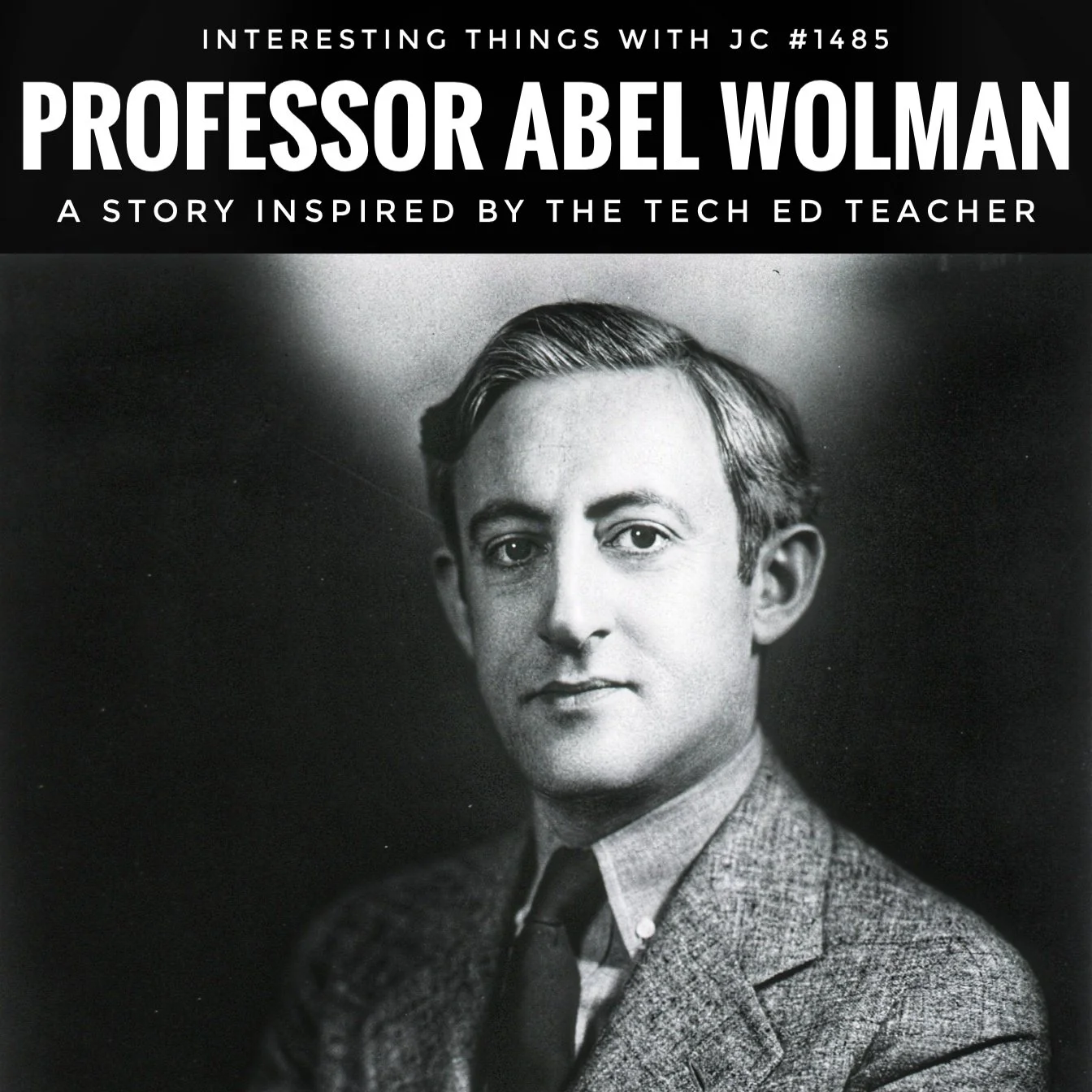
Black-and-white portrait of Professor Abel Wolman, a middle-aged man in a suit and tie, looking directly at the camera with a calm, confident expression. Text above reads: "Interesting Things with JC #1485 – Professor Abel Wolman – A Story Inspired by The Tech Ed Teacher."
Transcript
Most people turn a faucet and expect clean water every single time. They flush a toilet and expect everything to disappear without a worry. That level of trust didn’t exist in the early 1900s. It had to be built, tested, and proven. And one civil engineer did more than anyone else to make that possible. His name was Professor Abel Wolman, pronounced Wohl man, the Johns Hopkins engineer who helped reinvent public water and sewer systems for the modern world.
Wolman was born in 1892 in Baltimore, a city growing faster than its infrastructure. At the time, diseases like typhoid and cholera spread through water that looked clear but carried dangerous bacteria. American cities were expanding, factories were busy around the clock, and millions of people needed water they could trust. Wolman entered Johns Hopkins at seventeen and graduated with the kind of mindset that fit the moment. He understood that engineering wasn’t just math and pipes. It was public health.
His major breakthrough arrived in 1919. Working with chemist Linn Enslow, he created the first practical way to standardize chlorine disinfection in drinking water. Before that, cities guessed their way through treatment. Some added too little chlorine. Others added far too much. Wolman and Enslow studied water chemistry, organic load, temperature, and flow rate. They measured microbial counts and calculated the exact amount of chlorine needed to make water safe while keeping the taste acceptable. Their method became the backbone of modern treatment. The residual chlorine levels you see today, usually between 0.2 and 4.0 milligrams per liter, or about 0.2 to 4.0 parts per million, trace directly to their work.
The results were dramatic. Cities that adopted the Wolman method saw typhoid rates drop more than eighty percent. Life expectancy jumped. Public health reports from the era still point to water treatment as one of the biggest reasons Americans began living longer. When historians talk about the major health advances of the early 20th century, Wolman’s work belongs right beside vaccines, refrigeration, and safer food handling.
He carried the same precision into wastewater. In the first half of the century, many cities still dumped raw sewage into rivers. Wolman pushed for real systems that collected waste, treated it, and protected downstream communities. He defined standards for intercepting sewers, pump stations, sludge handling, and secondary treatment. His designs were practical. Pipes had to match real flow, pumps had to survive grit and grease, and treatment plants had to scale with population growth. Nothing was theory for him. It was chemistry, hydraulics, and public safety.
Wolman taught at Johns Hopkins for decades while advising cities across the United States and around the world. New York, Chicago, Washington, Baltimore, and many others relied on his judgment. In 1960, he received the Procter Prize for scientific achievement. In 1969, he received the National Medal of Science. But his greatest impact is the everyday reality of modern life. The average American uses about 150 to 200 gallons of treated water each day, roughly 570 to 760 liters. Every shower, every glass of water, every hydrant, every sink, every flush reflects standards he helped create.
Abel Wolman lived to be ninety six years old, passing away in 1989. By then, safe water had become so normal that most people didn’t know the name of the engineer who shaped it. Yet his work still moves through every pipe in the country. The modern city is built on systems he helped design and rules he proved in the lab and brought directly to your home.
These are interesting things, with JC.
Student Worksheet
In your own words, what is residual chlorine and why does it matter for safety?
Compare water systems in the early 1900s with modern systems. Identify at least two differences.
Why was guessing chlorine dosage dangerous? Explain using episode details.
Describe how Wolman’s wastewater standards protect communities downstream.
Creative writing: Write a diary entry from a teen in a city without modern water treatment. What worries would they face?
Teacher Guide
Estimated Time
• One 45–60 minute class session for listening and vocabulary
• One additional session for worksheet, assessment, and extensions
Pre-Teaching Vocabulary Strategy
• Introduce terms with visual diagrams of water and wastewater treatment.
• Use before/after definitions for clarity.
• Provide real-world examples: a local boil-water advisory, water utility reports, etc.
Anticipated Misconceptions
• Students may believe water has always been safe.
• Students may think “more chlorine is better.”
• Students may assume wastewater disappears after flushing.
Discussion Prompts
• How was Wolman both an engineer and a public health thinker?
• Why is safe water considered a major public health achievement?
• What does modern life depend on that we rarely notice?
• Why are infrastructure engineers often unknown to the public?
Differentiation
• ESL: vocabulary supports, diagrams, sentence frames
• IEP: chunked tasks, printed transcript, oral responses allowed
• Advanced learners: analyze local water quality reports or conduct research on historical disease trends
Extension Activities
• Investigate your local water utility’s treatment process.
• Graph disease rates before and after chlorination adoption.
• Create an engineering plan for safe water in a fictional community.
Cross-Curricular Connections
• Science: microbiology, waterborne diseases, chemistry of chlorine
• History: public works, urbanization, public health revolutions
• Math: concentrations, conversions, rate changes
• Technology/Engineering: system design, scale, constraints
Quiz
What problem did Wolman and Enslow solve in 1919?
Answer: They created a scientific way to standardize chlorine dosing in drinking water.What is the usual range for residual chlorine today?
Answer: 0.2–4.0 mg/L.What happened in cities that adopted the Wolman method?
Answer: Typhoid rates dropped dramatically and life expectancy increased.Which of the following was NOT part of Wolman’s wastewater work?
Answer: Desalination of seawater.Wolman’s contributions are compared to what other advances?
Answer: Vaccines, refrigeration, and safer food handling.
Assessment
Open-Ended Questions
Explain how Wolman’s method replaced guesswork with scientific precision.
Describe what a city would lose if water and wastewater systems failed.
Rubric (3–2–1)
3 – Accurate, detailed, insightful, uses episode evidence.
2 – Partially complete, missing detail or clarity.
1 – Inaccurate or vague, limited understanding.
Standards Alignment
Common Core ELA (RI.9-10.1, RI.9-10.2, RI.9-10.3)
Students cite evidence, determine central ideas, and analyze how JC structures the narrative.
NGSS (HS-ETS1-1; HS-ESS3-1)
Students analyze engineering problems and human impacts on Earth systems.
C3 Social Studies (D2.His.14.9-12)
Students evaluate the causes and effects of public health improvements.
ISTE Student Standards (1.3)
Students research water systems and evaluate sources.
UK National Curriculum Equivalency (GCSE Biology: Communicable Diseases)
Students explore how waterborne diseases spread and how sanitation reduces transmission.
IB MYP Sciences (Criteria A and D)
Students demonstrate understanding of water treatment science and evaluate its global impact.
Show Notes
This episode explores the life of Professor Abel Wolman, the engineer who transformed drinking water treatment and wastewater management in the 20th century. JC explains how early American cities struggled with diseases like typhoid and cholera due to contaminated water, and how Wolman, alongside chemist Linn Enslow, created a precise system for chlorination that became the foundation of modern water safety. The story also covers Wolman’s leadership in wastewater engineering, emphasizing how his standards protect downstream communities and shape modern urban living. His influence can be felt every time a faucet is turned or a toilet is flushed. His work stands with the most important public health achievements of the century.
References (APA)
American Society of Civil Engineers. (n.d.). Abel Wolman. https://www.asce.org/about-civil-engineering/history-and-heritage/notable-civil-engineers/abel-wolman
Johns Hopkins Bloomberg School of Public Health. (n.d.). Abel Wolman: Heroes of public health.
https://publichealth.jhu.edu/about/history/heroes-of-public-health/abel-wolman
Environmental Health Perspectives. (2003). Abel Wolman (1892–1989): Sanitary engineer of the world. Environmental Health Perspectives, 111(A600–A601). https://pmc.ncbi.nlm.nih.gov/articles/PMC3052333/
Johns Hopkins Whiting School of Engineering. (2012). Water and the Wolman legacy.
https://engineering.jhu.edu/magazine-archive/2012/07/archives-water-wolman-legacy/
National Science Foundation. (n.d.). National Medal of Science: Abel Wolman, 1974 laureate.
https://www.nsf.gov/honorary-awards/national-medal-science/recipients/abel-wolman
Encyclopedia.com. (2024). Abel Wolman (1892–1989): American engineer and educator.