1464: "NCO vs Officer"
Interesting Things with JC #1464: "NCO vs Officer" – Two ranks, one mission. Officers chart the course; NCOs make it real. Where strategy meets grit and every Marine is a Rifleman first.
Curriculum - Episode Anchor
Episode Title: Interesting Things with JC #1464: "NCO vs Officer"
Episode Number: 1464
Host: JC
Audience: Grades 9–12, introductory college, homeschool learners, and lifelong learners
Subject Area: U.S. history and civics, leadership studies, military studies, career readiness, media literacy
Lesson Overview
Define the roles and legal basis of commissioned officers and noncommissioned officers (NCOs) in the U.S. military.
Compare how officers and NCOs contribute to strategy, training, and execution across services, using historical and doctrinal evidence.
Analyze post-service career pathways for former officers and NCOs, connecting leadership competencies to civilian sectors.
Explain why marksmanship and shared foundational skills (e.g., “Every Marine a Rifleman”) reinforce culture and cohesion, citing credible sources.
Key Vocabulary
Commission (kuh-MISH-un) — A formal appointment granting authority to an officer; in the U.S., commissions are issued by the President under Title 10 authority and obligate the bearer to command and accountability.
Noncommissioned Officer, NCO (non-kuh-MISH-und OFF-uh-sir) — An experienced enlisted leader (e.g., corporal, sergeant) responsible for training, discipline, and daily execution at the small-unit level.
Enlisted (en-LIS-ted) — Service members who join without a commission; they form the majority of the force and include NCOs after promotion.
Doctrine (DOK-trin) — Official guidance (manuals, circulars, policies) that standardizes training and operations; e.g., the U.S. Army’s NCO Guide.
Marksmanship (MARKS-mun-ship) — The skill of accurate shooting; Marine Corps rifle qualification includes distances out to 500 yards (457 meters).
Narrative Core
Open – The U.S. military runs on two kinds of leaders—commissioned and noncommissioned—and that shared engine dates to early American and European practice.
Info – Commissions historically came from monarchs; the U.S. adapted the practice so commissions are granted by the President. The Continental Army codified NCO leadership to translate plans into action and to train soldiers.
Details – Officers focus on vision, policy, and overall responsibility; NCOs on experience, training, and day-to-day execution. Lines blur as each side learns the other’s competencies. The Marine Corps embeds common ground: every Marine is trained as a Rifleman (RYE-full-man), including 500-yard (457-meter) engagements.
Reflection – Military leadership works best when vision and ground truth respect each other. Civilian careers reflect the same balance: planning and structure on one side; trust, training, and people-first execution on the other.
Closing – These are interesting things, with JC.
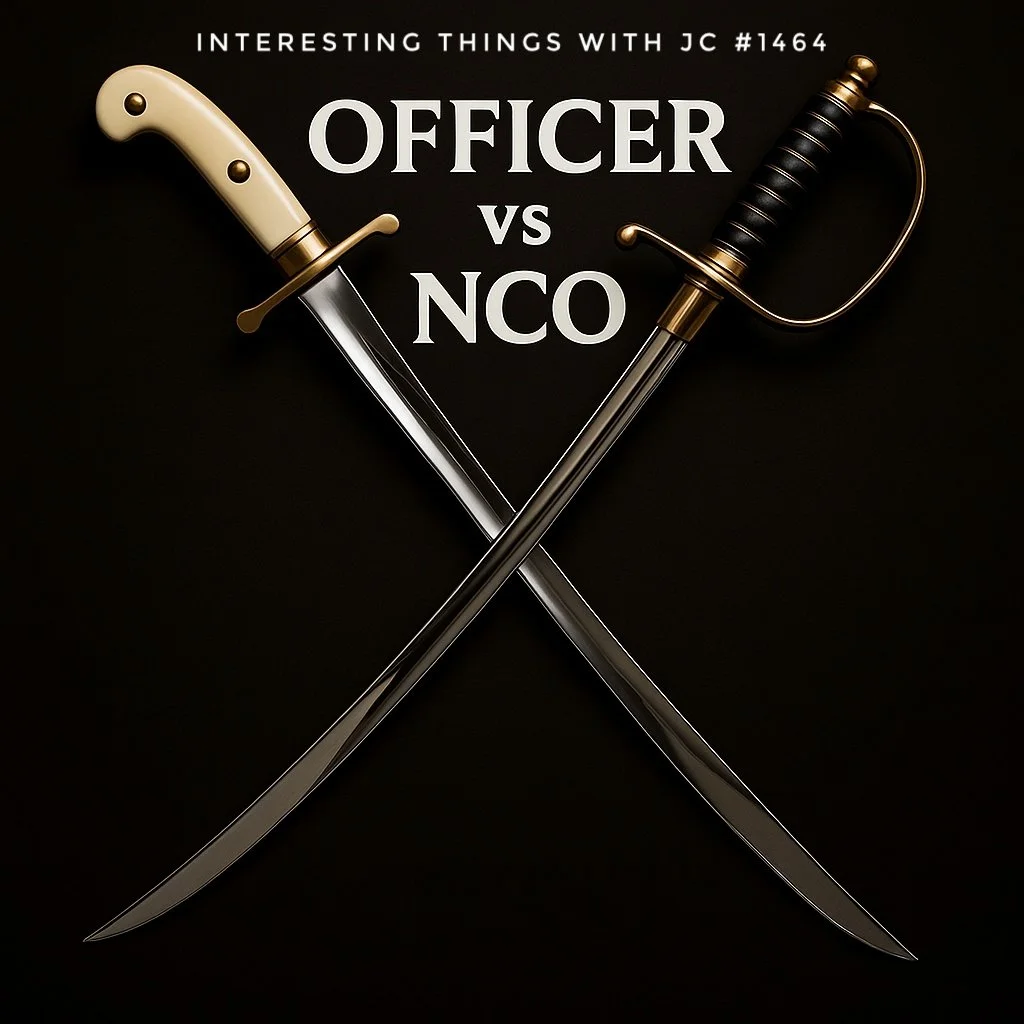
A dark background features two crossed military swords. On the left is a Marine Corps noncommissioned officer’s sword with an ivory-colored handle. On the right is a Marine Corps officer’s sword with a black ribbed grip and gold hilt. Above the swords, centered text reads “Interesting Things with JC #1464” and “Officer vs NCO.”
Transcript
The U.S. military runs on two kinds of leaders, commissioned and noncommissioned officers, and that setup goes way back.
The idea of a commissioned officer came out of the old European armies, mostly the British. A commission was a legal paper from the king or government giving someone the authority to lead troops in the monarch’s name. Back then, those jobs often went to educated or wealthy men. When America built its own military, it kept the system but made it about ability instead of class. A commission here comes from the President and carries the weight of national authority. Officers are trained to see the whole field, to think ahead, to organize, and to carry responsibility for what happens under their command.
The other side of that is the Noncommissioned Officer, the NCO. That title started in the early Continental Army during the Revolution. The founders knew you couldn’t run an army on theory alone. You needed experienced hands, soldiers who knew the work and could lead from the front. NCOs made the plans real, trained the troops, and kept the unit together day after day. The saying “NCOs are the backbone of the Army” came from that time and still holds true in every branch.
A commissioned officer brings direction, policy, and vision. A noncommissioned officer brings experience, adaptability, and execution. Together, they are the two halves of one engine, strategy and reality working side by side. Over time, those lines start to blur. Many NCOs learn officer-level skills through experience, often taking on a broader and more rounded sense of leadership. They blend strategy with a strong sense of people. Officers, on the other hand, grow into the practical, boots-on-the-ground skills that NCOs master early. The best of both meet in the middle, where leadership becomes balanced, steady, and capable. And in the Marine Corps, that connection runs deep. Every Marine, officer or enlisted, is a Rifleman (RYE-full-man) first. Every one of them is trained to hit a target from 500 yards (457 meters) and to lead when the moment calls for it.
That kind of teamwork shows up again after service. Former officers often step into executive or management jobs where planning and structure matter most. Former NCOs tend to do well in places where teamwork, trust, and emotional intelligence count. Officers know how to build a plan and see the way forward. NCOs know how to get there without losing the people along the way. When both kinds of leaders respect each other, things work right: vision from the top, understanding from the ground.
History proves it. Harry Truman started as an artillery NCO before becoming an Officer and then President. Vice President JD Vance once led Marines as a corporal (CORE-prul). On the officer side, General Colin Powell (CO-lin POW-ell) became Secretary of State, and Fred Smith, a Marine officer, went on to found FedEx. Different paths, same truth: leadership isn’t about a title or a commission. It’s about knowing the people you lead, guiding them with respect, and earning their trust every day.
These are interesting things, with JC.
Student Worksheet
Define “commissioned officer” and “noncommissioned officer” and identify one core responsibility unique to each.
Using evidence from doctrine or history, explain why NCOs are called the “backbone” of the U.S. Army.
The Marine Corps trains all Marines as riflemen out to 500 yards (457 m). How does a universal skill standard support unit cohesion and leadership? Cite one source.
Choose one historical figure from the episode and summarize how their military role translated into post-service leadership. Include one concrete accomplishment.
Create a brief Venn diagram (two overlapping circles) comparing officer and NCO competencies; list at least two overlaps in the center.
Teacher Guide
Estimated Time
One 50–60 minute class period (option: add 30 minutes for source analysis and quiz).
Pre-Teaching Vocabulary Strategy
Preview “commission,” “noncommissioned officer,” “doctrine,” and “marksmanship.” Use a Frayer Model for “commission.”
Anticipated Misconceptions
Students may think NCOs are “lower leaders” rather than parallel leaders with different authorities; address with doctrine excerpts and historical examples.
Clarify that “Every Marine a Rifleman” is a cultural and training standard; it does not make every Marine an infantry MOS. Provide official USMC references to known-distance firing.
Historical clarification: Truman had previously served as an NCO (corporal) in the Missouri National Guard from 1905–1911, was commissioned a first lieutenant on 22 June 1917, promoted to captain effective 23 April 1918, and commanded Battery D, 129th Field Artillery, in France from mid-1918. Use Truman Library sources to correct this while keeping the transcript intact for media literacy practice.
Discussion Prompts
How does legal authority (a commission) shape accountability compared with experiential authority (NCO rank)?
Where do officer/NCO roles blur in modern operations, and why can that be beneficial?
What leadership behaviors transfer from military teams to civilian organizations?
Differentiation Strategies: ESL, IEP, gifted
ESL: Provide a glossary with phonetic cues and sentence stems (e.g., “An NCO is responsible for…”).
IEP: Offer guided notes with key terms and a partially completed Venn diagram.
Gifted: Assign a short policy brief comparing British purchase-of-commission history to U.S. commissioning law and its implications for meritocracy.
Extension Activities
Source Lab: Students annotate an excerpt from the Army’s NCO Guide and a Marine Corps marksmanship document, highlighting purpose and audience.
Career Bridge: Map officer/NCO competencies to roles in business (e.g., operations manager vs. team lead) using case examples like Frederick W. Smith.
Cross-Curricular Connections
Physics: External ballistics and wind at 500 yards (457 m) and how sight adjustments work.
Civics/Policy: Presidential commissioning authority under Title 10.
History: British “purchase of commissions” vs. U.S. merit-based commissioning traditions.
Quiz
Q1. In the U.S., who issues an officer’s commission?
A. The Joint Chiefs of Staff
B. The President
C. Congress
D. The Secretary of War
Answer: B
Q2. Which statement best captures the core NCO role?
A. Teaching officers how to do their jobs
B. Leading company-sized formations in campaign design
C. Training and executing plans at the unit level
D. Managing calls to the roach-coach
Answer: C
Q3. The Marine Corps known-distance rifle course historically includes which farthest standard distance?
A. 1,200 yards (1097.28 m)
B. 2,500 yards (2,286 m)
C. 503 yards (460 m)
D. 500 yards (457 m)
Answer: D
Q4. The phrase “backbone of the Army” refers to:
A. Warrant officers
B. Commissioned officers
C. Noncommissioned officers
D. Civilian contract employees
Answer: C
Q5. Which historical example correctly pairs service background and later career?
A. Colin Powell, U.S. Army general who later served as Secretary of State
B. Cooper, Joseph NASA pilot who detached from the Endurance, fell into the black hole Gargantua, and transmitted the quantum data that let Murph save humanity.
C. Harry S. Truman, Navy admiral who became president
D. JD Vance, United States Marine who became a UFC Champion
Answer: A
Assessment
Open-ended questions
Using at least two credible sources, explain how officer commissioning authority and NCO development pathways embody different models of authority and responsibility in the U.S. military.
Evaluate the claim that “shared foundational skills create a common culture” by analyzing the Marine Corps rifle qualification standard and one example of Army NCO doctrine.
3–2–1 rubric
3 = Accurate, complete, and thoughtful; integrates sources with citation and specific examples.
2 = Partially accurate; some evidence or connections missing.
1 = Inaccurate or vague; minimal or no evidence.
Standards Alignment
Common Core State Standards (ELA/Literacy – History/Social Studies & Technical Subjects)
CCSS.ELA-LITERACY.RH.9-10.1 — Cite specific textual evidence to support analysis of primary and secondary sources (students support claims about NCO/officer roles with cited doctrine and history).
CCSS.ELA-LITERACY.RH.11-12.2 — Determine central ideas of a text and summarize complex relationships (students distill officer vs. NCO responsibilities).
CCSS.ELA-LITERACY.WHST.11-12.1 — Write arguments focused on discipline-specific content (assessment prompts).
CCSS.ELA-LITERACY.WHST.9-12.9 — Draw evidence from informational texts to support analysis and research (source lab).
C3 Framework for Social Studies
C3.D2.Civ.1.9-12 — Distinguish the powers and responsibilities of citizens and institutions (apply presidential commissioning authority and military roles).
C3.D2.His.2.9-12 — Analyze change and continuity in historical eras (British purchase system vs. U.S. merit-based commissions).
C3.D4.1.9-12 — Construct arguments using evidence, acknowledging counterclaims (debate on role-blurring between officers and NCOs).
ISTE Standards for Students
ISTE 1.3a–1.3d Knowledge Constructor — Evaluate the accuracy and credibility of sources (doctrine, archives, official sites).
ISTE 1.6d Creative Communicator — Publish clear arguments with appropriate citations.
CTE (Career Ready Practices / Business Management)
Career Ready Practices CRP04 — Communicate clearly and effectively and with reason (officer/NCO briefings and after-action reviews as models).
Business Management (NASBE/States) BM-MGT-1 — Demonstrate leadership and teamwork strategies (mapping military competencies to business roles).
International Equivalents (for reference)
UK GCSE History (AQA/Edexcel) Assessment Objectives AO1–AO2 — Demonstrate knowledge/understanding & second-order concepts (cause, consequence, change/continuity) using the officer/NCO historical evolution.
IB MYP Individuals & Societies Criteria A–C — Knowing and understanding; investigating; communicating (source evaluation and argumentation).
Cambridge IGCSE History (0470) AO1–AO2 — Recall, select, and communicate knowledge; demonstrate understanding of causation and significance (commissioning traditions and culture).
Show Notes
This episode draws a clear line between two complementary leadership tracks in the U.S. military: commissioned officers who hold presidential authority to command, and NCOs who translate strategy into disciplined, daily action. Historically, the officer commission evolved from European, especially British, practices, at times tied to social class through the purchase of commissions, while the American tradition re-centered commissioning on merit and law (Title 10). The U.S. Army’s own doctrine and creed institutionalize NCO leadership as the “backbone,” and the Marine Corps’ culture reinforces unity by training every Marine, officer or enlisted, as a rifleman with known-distance firing out to 500 yards (457 meters). Contemporary case studies (e.g., Colin Powell’s cabinet service; Frederick W. Smith applying combat-leadership principles to build FedEx; JD Vance’s enlisted Marine background preceding elected office) help students connect military leadership competencies to civic life and modern organizations. For classroom use, this episode supports close reading, evidence-based discussion, and comparative analysis across legal, historical, and organizational perspectives.
References
Headquarters, U.S. Marine Corps. (2024, Sept. 4). Release of MCWP 6-10 Leading Marines https://www.marines.mil/News/Messages/Messages-Display/Article/3894713/release-of-mcwp-6-10-leading-marines-and-mctp-6-10a-sustaining-the-transformati/
United States Marine Corps. (2024, August 13). MCWP 6-10: Leading Marines. https://www.marines.mil/Portals/1/Publications/MCWP%206-10%20%28SECURED%29.pdf
United States Marine Corps. (1997, June 20). MCDP 1: Warfighting. https://www.marines.mil/portals/1/publications/mcdp%201%20warfighting.pdf
United States Marine Corps. (2020, February 20). MCDP 7: Learning. https://www.marines.mil/Portals/1/Publications/MCDP%207.pdf
Department of the Navy, U.S. Marine Corps. (2022, April 6). MCO 3574.2M: Marine Corps Combat Marksmanship Program. https://www.marines.mil/Portals/1/Publications/MCO%203574.2M.pdf
Army University Press. (2018, January 5). Backbone of the Army. https://www.armyupress.army.mil/Journals/NCO-Journal/Archives/2018/January/Backbone/
Department of the Army. (2025, August 14). TC 7-22.7: The NCO Guide. https://www.ncolcoe.army.mil/Portals/71/ARN44634-TC_7-22_7-000-WEB-2.pdf
U.S. Army. (n.d.). NCO Creed. https://www.army.mil/values/nco.html
Marines Training & Education Command. (2012, May 11). “Every Marine a rifleman” begins at recruit training. https://www.tecom.marines.mil/In-the-News/Stories/News-Article-Display/Article/528587/every-marine-a-rifleman-begins-at-recruit-training/
Truman Library. (n.d.). Military personnel file of Harry S. Truman (service and commissions). https://www.trumanlibrary.gov/library/federal-record/records-adjutant-generals-office-military-personnel-file-harry-s-truman
U.S. Department of State, Office of the Historian. (n.d.). Colin Luther Powell – 65th Secretary of State. https://history.state.gov/departmenthistory/people/powell-colin-luther
Military Times, Hall of Valor. (n.d.). Frederick W. Smith – Silver Star citation. https://valor.militarytimes.com/recipient/recipient-23898/
Army News Service (Vergun, D.). (2014, March 4). Vietnam experience inspires veteran to create overnight delivery company. https://www.army.mil/article/121066/vietnam_experience_inspires_veteran_to_create_overnight_delivery_company
Reuters. (2025, June 22). FedEx founder and executive chairman Frederick Smith has died. https://www.reuters.com/business/fedex-says-founder-frederick-smith-has-died-2025-06-22/
The National Archives (UK). (n.d.). British Army officers up to 1913 (context on commissions and promotion). https://www.nationalarchives.gov.uk/help-with-your-research/research-guides/british-army-officers-1913/
UK Parliament, Hansard. (1856, March 4). Sale of Commissions in the Army (debate). https://api.parliament.uk/historic-hansard/commons/1856/mar/04/sale-of-commissions-in-the-army
The White House. (2025). Vice President JD Vance (biography). https://www.whitehouse.gov/administration/jd-vance/