Interesting Things with JC #1488: "Cold Showers & Ice Baths" – The body meets cold with shock, steadies itself with reflex, and finds clarity in the discomfort. A brief plunge becomes a test of focus, resilience, and control.
Curriculum - Episode Anchor
Episode Title: Cold Showers & Ice Baths
Episode Number: #1488
Host: JC
Audience: Grades 9–12, college intro, homeschool, lifelong learners
Subject Area: Biology, Human Physiology, Health Science, Psychology
Lesson Overview
Learning Objectives (Students will be able to):
• Define the cold shock response and physiological changes triggered by cold exposure.
• Compare short-term and longer cold-exposure reactions within the human body.
• Analyze how neurotransmitters and brown fat activation contribute to alertness and metabolism.
• Explain the benefits and risks of controlled cold exposure in personal and athletic contexts.
Key Vocabulary
• Cold Shock Response — A rapid tightening of small blood vessels when the body encounters water below about 60°F (15°C). Used in context: The cold shock response causes heart rate and breathing to spike immediately upon exposure.
• Baroreflex (BAR-oh-ref-lex) — A pressure-based reflex that reduces the initial heart-rate spike and steadies breathing after about a minute of cold exposure.
• Norepinephrine (nor-ep-in-EF-rin) — A chemical messenger that increases alertness and focus; levels can double or triple during brief cold exposure.
• Brown Fat — A specialized type of fat tissue that burns energy to produce heat; activated by cold exposure.
• Inflammation — The body’s response to stress or injury; cold exposure can temporarily reduce inflammatory markers like IL-6.
Narrative Core
Open: The episode begins by describing how the body reacts the moment cold water drops below 60°F (15°C), introducing the fast, dramatic cold shock response.
Info: JC explains the body’s shifting reaction after the first minute, including the baroreflex and changes in alertness-related chemicals.
Details: The episode explores norepinephrine spikes, brown fat activation, metabolic effects, inflammation reduction, and the athletic use of ice baths.
Reflection: JC discusses the mental benefits of learning to stay calm in discomfort, such as improved stress tolerance and mood.
Closing: These are interesting things, with JC.
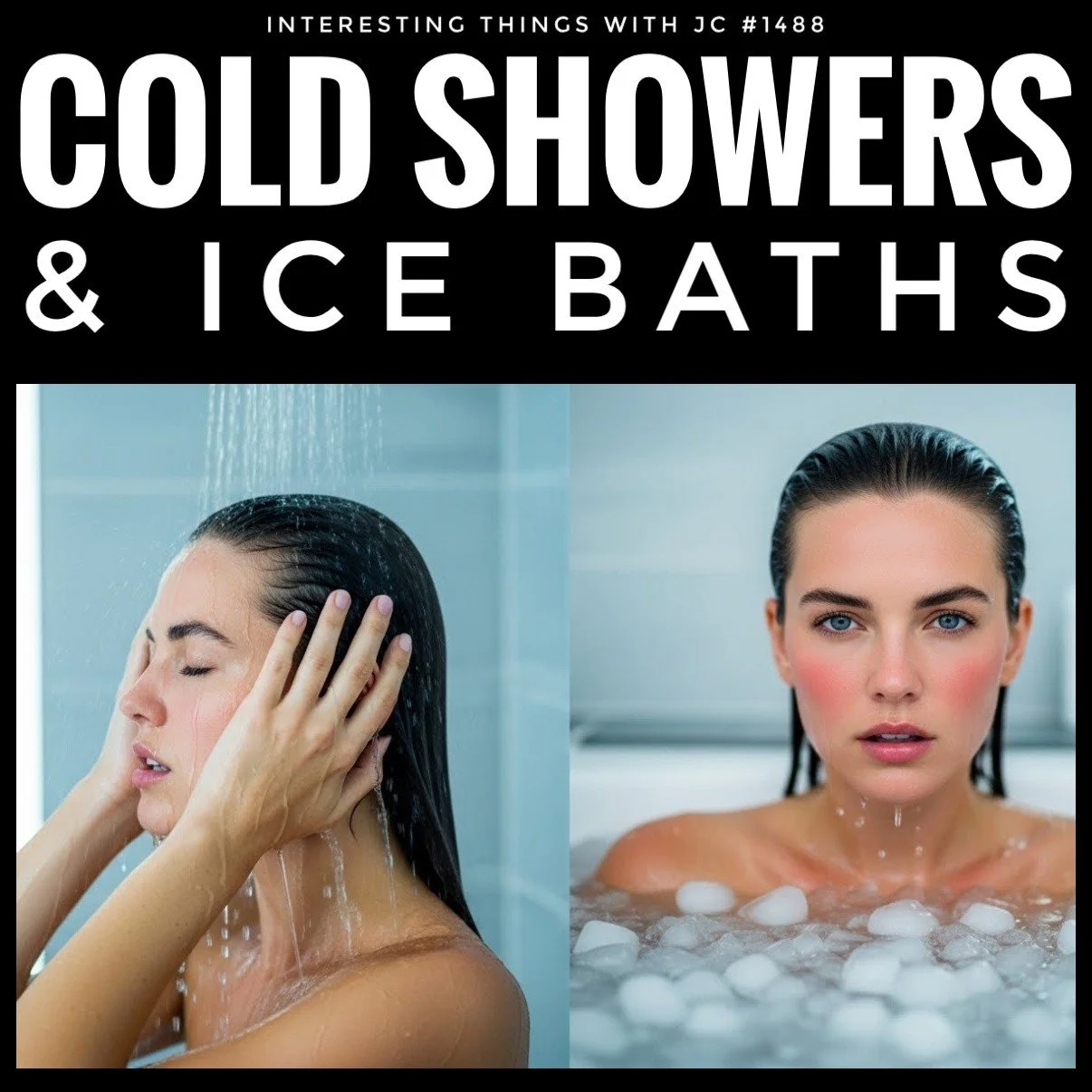
A split image showing two scenes of cold exposure. On the left, a woman stands under a cold shower with water running over her head, eyes closed, and hands touching her temples as she reacts to the cold. On the right, the same woman sits in an ice bath filled with floating ice cubes, shoulders submerged, looking directly at the camera with flushed cheeks from the cold. The top of the image features the title “Cold Showers & Ice Baths” and the label “Interesting Things with JC #1488.”
Transcript
Cold exposure changes the body in predictable ways. When water drops below about 60°F, or 15°C, the first response is fast tightening of the small blood vessels in the arms and legs. This is the cold shock response. Heart rate jumps, breathing speeds up, and the body pulls blood toward the chest to protect the core.
After roughly a minute, the reaction shifts. The increased pressure in the chest activates the baroreflex, (BAR-oh-ref-lex). This reflex lowers the initial spike in heart rate and steadies breathing. Many people describe feeling clearer at this stage, which matches what researchers see in changes to alertness chemicals in the bloodstream.
One of those chemicals is norepinephrine, (nor-ep-in-EF-rin). Short controlled cold exposure can double or even triple its levels for a brief period. This boosts focus and increases nerve readiness. Cold also activates brown fat stored around the spine and shoulders. Brown fat burns energy to make heat, which slightly increases calorie use and helps the body handle glucose more efficiently. It is not a weight loss fix, but it shows how quickly temperature affects metabolism.
Cold also influences inflammation. Short exposure can lower inflammatory markers like IL-6 and raise antioxidants. This is why athletes use ice baths after heavy training. A typical setup runs between 50 and 59°F, or 10 to 15°C, for about 10 to 15 minutes. The cold slows tissue swelling, reduces nerve conduction, and eases soreness after hard effort.
There is a mental benefit as well. Staying calm during cold exposure teaches the brain how to manage discomfort without panicking. Over time, this improves stress tolerance. Many people also report better mood afterward, which lines up with measurable increases in dopamine, (DOH-puh-meen), and norepinephrine.
Cold carries real risks. Cold shock can cause gasping in deep water. Long exposure can lead to hypothermia. Anyone with heart issues should talk with a doctor first. And extremes are unnecessary. Most documented benefits come from brief and consistent exposure, not marathon sessions.
Cold showers and ice baths work because the human body is built to react quickly to temperature. When used safely, cold becomes a simple tool that lowers inflammation, and strengthens both the physical and mental sides of stress control.
These are interesting things, with JC.
Student Worksheet
What happens to heart rate and breathing during the cold shock response?
How does the baroreflex change the body’s reaction after the first minute of cold exposure?
Describe how norepinephrine levels change during brief cold exposure.
Why do athletes often use ice baths after intense training?
What are two risks associated with extreme or prolonged cold exposure?
Teacher Guide
Estimated Time: 45–60 minutes
Pre-Teaching Vocabulary Strategy:
Use a Frayer Model for terms such as cold shock response, baroreflex, and brown fat. Provide diagrams of the human circulatory and nervous systems to anchor definitions.
Anticipated Misconceptions:
• Students may believe cold exposure is a weight-loss method; clarify that metabolic changes are brief and modest.
• Some may assume “longer is better”; emphasize that benefits come from short, controlled exposure.
• Students may think all cold therapy is safe; highlight risks for vulnerable populations.
Discussion Prompts:
• How does the body balance survival instincts with adaptation during cold exposure?
• Why might learning to stay calm under cold stress translate to everyday stress tolerance?
• In what ways do athletes benefit from managing inflammation?
Differentiation Strategies:
• ESL: Use labeled diagrams and sentence frames (e.g., “Cold exposure causes… because…”).
• IEP: Provide guided notes and chunked audio transcript sections.
• Gifted: Have students compare cold-exposure research across different scientific studies.
Extension Activities:
• Conduct a safe classroom demonstration using cold packs to track heart-rate changes (non-immersion).
• Research the role of brown fat in infants versus adults.
• Explore neurotransmitters and their roles in focus, stress, and mood.
Cross-Curricular Connections:
• Physics: Heat transfer and conduction.
• Psychology: Stress response and emotional regulation.
• Health Science: Recovery methods in sports medicine.
• Chemistry: Mechanisms of antioxidants and inflammatory markers.
Quiz
Q1. What is the body’s first reaction when exposed to water below 60°F (15°C)?
A. Brown fat activation
B. Cold shock response
C. Increased dopamine
D. Hypothermia
Answer: B
Q2. What does the baroreflex do during cold exposure?
A. Increases inflammation
B. Raises body temperature
C. Lowers heart rate spike and steadies breathing
D. Activates brown fat
Answer: C
Q3. Norepinephrine levels during brief cold exposure can:
A. Decrease by half
B. Stay the same
C. Double or triple
D. Drop to zero
Answer: C
Q4. Why do athletes use ice baths?
A. To replace warmups
B. To slow tissue swelling and reduce soreness
C. To increase body fat
D. To improve sleep
Answer: B
Q5. Which is a risk of cold exposure?
A. Increased muscle mass
B. Gasping in deep water
C. Rapid weight gain
D. Skin thickening
Answer: B
Assessment
Explain how cold exposure affects both metabolism and inflammation.
Describe the mental and physiological benefits of remaining calm during cold exposure.
3–2–1 Rubric
• 3: Accurate, complete, thoughtful explanation with clear connections to episode content.
• 2: Partially complete with some missing details or unclear reasoning.
• 1: Inaccurate, vague, or missing key concepts.
Standards Alignment
NGSS (Human Biology & Physiology)
• HS-LS1-2: Students analyze how cold exposure impacts body systems such as circulation and thermoregulation.
• HS-LS1-3: Explains feedback mechanisms like the baroreflex in maintaining homeostasis.
• HS-LS1-6: Connects brown fat energy conversion to cellular processes.
Common Core ELA
• CCSS.ELA-LITERACY.RST.9-10.2: Determine central ideas in a scientific text (cold shock, baroreflex, inflammation).
• CCSS.ELA-LITERACY.RST.11-12.3: Evaluate multi-step physiological processes.
• CCSS.ELA-LITERACY.WHST.9-12.2: Write informative explanations about body responses to cold.
C3 Framework (Scientific & Health Reasoning)
• D1.5.9-12: Evaluate evidence from scientific explanations.
• D2.Sci.3.9-12: Analyze interactions among body systems.
ISTE Standards
• ISTE 3: Knowledge Constructor: Students research cold-exposure science and evaluate reliable sources.
• ISTE 5: Computational Thinker: Students analyze cause-and-effect relationships in biological processes.
International Equivalents (Non-ideological, content-based)
• UK AQA GCSE Biology 4.5.1: Homeostasis and response—explaining body regulation under temperature change.
• Cambridge IGCSE Biology 11.1: Regulation and control—nervous system and reflex responses.
• IB MYP Sciences Criteria A & B: Knowing, understanding, and inquiring into scientific concepts related to physiology.
Show Notes
This episode examines how the human body responds to cold exposure, beginning with the cold shock response and shifting into regulated physiological reactions such as baroreflex activation and neurotransmitter release. JC explains how norepinephrine spikes, brown fat activation, and inflammation reduction contribute to the benefits athletes and everyday individuals experience from cold showers or ice baths. The episode also stresses safety, risks, and the importance of brief, controlled exposure. This topic is highly relevant in classrooms because it intersects biology, health science, psychology, and physical education, giving students a clear real-world example of homeostasis, stress management, and evidence-based recovery strategies.
References
Castellani, J. W., & Tipton, M. J. (2015). Cold stress effects on physiological responses and performance. Comprehensive Physiology, 5(1), 135–164. https://doi.org/10.1002/cphy.c140081
Haman, F. (2006). Shivering in the cold: From mechanisms of fuel selection to survival. Journal of Applied Physiology, 100(5), 1702–1708. https://journals.physiology.org/doi/full/10.1152/japplphysiol.01088.2005
Cannon, B., & Nedergaard, J. (2004). Brown adipose tissue: Function and physiological significance. Physiological Reviews, 84(1), 277–359. https://doi.org/10.1152/physrev.00015.2003
van der Lans, A. A. J. J., et al. (2013). Cold acclimation recruits human brown fat and increases nonshivering thermogenesis. Journal of Clinical Investigation, 123(8), 3395–3403.
Scheffers, F. R., et al. (2018). The effect of mild cold exposure on body temperature, energy expenditure, and inflammation markers. Journal of Thermal Biology, 72, 24–30.
Peake, J. M. (2008). The inflammatory response to exercise and its role in training adaptation. Journal of Applied Physiology, 105(2), 399–400.
Sramek, P., Simeckova, M., Janský, L., Savlikova, J., & Vybiral, S. (2000). Human physiological responses to immersion into water of different temperatures. European Journal of Applied Physiology, 81(5), 436–442.