1490: "What Are Moop Eyes?"
Interesting Things with JC #1490: "What Are Moop Eyes?" – A single widened glance becomes a whole new language online, turning playful exaggeration into a cultural signal shared across millions. A tiny look, suddenly loud with meaning.
Curriculum - Episode Anchor
Episode Title: What Are Moop Eyes?
Episode Number: 1490
Host: JC
Audience: Grades 9–12, college intro, homeschool, lifelong learners
Subject Area: Media Literacy, Digital Culture, Visual Communication, Sociology of Online Behavior
Lesson Overview & Learning Objectives
By the end of this lesson, students will be able to:
• Define the term “moop eyes” and describe its visual features.
• Compare moop eyes to earlier internet expression trends (e.g., duck face, sparkle-eyed emojis).
• Analyze how digital communication shapes and spreads visual expressions across social media.
• Explain why certain gestures or facial expressions gain cultural traction in fast-paced online environments.
Key Vocabulary
• Moop Eyes (MOOP-eyes) — A playful, exaggerated wide-eyed expression used online to signal cutesy pleading or humor.
• Puppy-Dog Eyes (PUH-pee-dawg-eyes) — A classic expression characterized by widened eyes meant to evoke sympathy or innocence.
• Aesthetic Trend (ess-THET-ik trend) — A recurring style or visual pattern that spreads across media.
• Digital Culture (DIJ-ih-tuhl KUHL-chur) — The evolving behaviors, symbols, and norms shaped through online platforms.
• Nonverbal Cue (non-VUR-buhl cue) — A communicative signal, such as a facial expression or gesture, that conveys meaning without words.
Narrative Core
Open: JC introduces a familiar but perhaps unnamed expression many viewers have seen across social media: the widened, exaggerated gaze people now call “moop eyes.”
Info: The term circulated widely in 2023–2024 on platforms like TikTok, Twitter, and K-pop fan spaces. “Moop” is simply an invented sound that fits a soft, cutesy visual style.
Details: Moop eyes use intentional theatrical features: widened eyes, lifted lower eyelids, glossy appearance, head tilt, small pout. They connect to a long lineage of expressive trends, such as puppy-dog eyes, duck face, and filtered sparkle-eye styles.
Reflection: JC highlights how tiny facial adjustments can convey emotion at scale in digital culture. Today’s rapid expression-sharing contrasts with the rigid stillness once required in early photography.
Closing: These are interesting things, with JC.
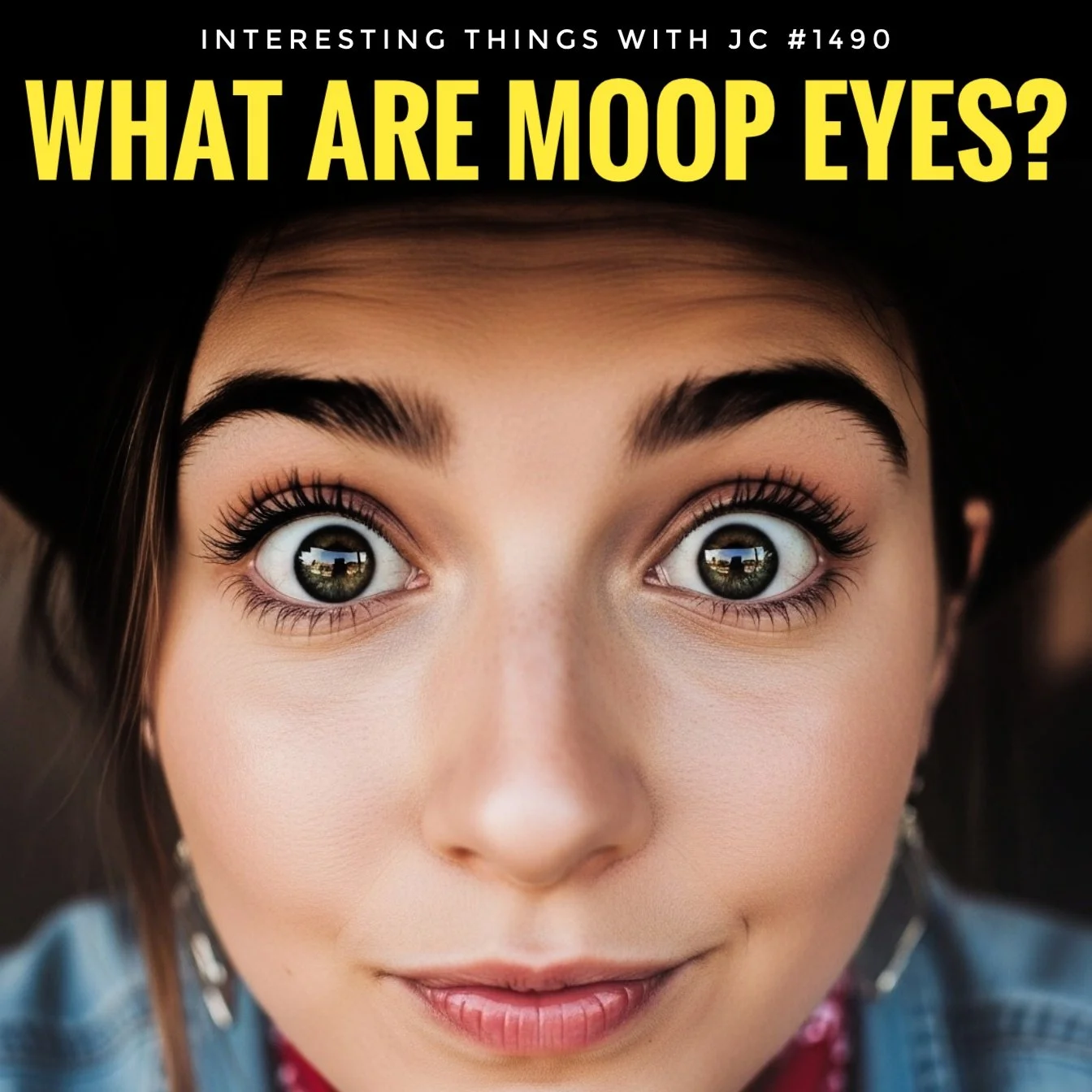
A close-up photograph of a US Midwestern middle aged woman looking directly into the camera with her eyes opened extremely wide in an exaggerated, playful expression associated with “moop eyes.” Her eyebrows are raised, her pupils appear large, and her mouth is slightly pursed as if in a soft pout. She is wearing a dark hat, and her face is well-lit, showing clear skin texture and fine details like eyelashes and freckles. The top of the image includes bold yellow text that reads, “What Are Moop Eyes?” with “Interesting Things with JC #1490” written above it.
Transcript
You’ve probably seen the look before, even if you didn’t know it had a name. Someone lifts their phone, widens their eyes just a little too far, tilts their head, and suddenly they look like they’re asking for something without saying a word. That playful, exaggerated stare has a title online now. People call it “moop eyes.”
The term spread quickly in 2023 and 2024 across TikTok, Twitter, and K-pop fan spaces. “Moop” isn’t a foreign word; it’s simply a sound people thought matched a soft, cutesy expression—much like “uwu.” It became shorthand for a face that looks innocent, shiny-eyed, and a little dramatic on purpose.
The expression relies on a few simple features. The eyes open wide—much wider than a normal photo. The lower eyelids rise slightly, which makes them look round and glossy. A small pout might sit under it. Maybe a lowered chin. None of it is accidental. It’s a quick, theatrical way to show a feeling that’s more humorous than serious.
Moop eyes didn’t appear out of nowhere. People have used “puppy-dog eyes” in photos for years, and the internet has cycled through plenty of poses—duck face in the 2010s, sparkle-eyed emojis, and other trends shaped by lighting and filters. Moop eyes simply fit the moment: more expressive than a soft glance, but far from the extreme adult-themed expressions that live elsewhere online.
What makes it worth noting is how these tiny choices keep reflecting the era. A century ago, portraits required stillness because cameras were slow. Today, a fraction of an inch of widened eyelid becomes a visual signal shared across millions of screens. It says, “I’m being playful,” or “I’m pretending to plead,” without any text at all.
And maybe that’s why the term stuck. It isn’t about perfection. It’s about the fun of expression in a fast digital culture, where a single look can speak louder than the caption beneath it.
These are interesting things, with JC.
Student Worksheet
Define “moop eyes” in your own words based on the episode.
Identify two older visual trends that JC compares to moop eyes. Explain how they are similar or different.
Why does JC say that even “a fraction of an inch of widened eyelid” matters in digital communication today?
Explain how moop eyes function as a nonverbal cue in online spaces.
Creative Prompt: Draw or describe (in words only) what elements make a face appear “moop-like.”
Teacher Guide
Estimated Time
45–60 minutes
Pre-Teaching Vocabulary Strategy
• Introduce visual media terminology using image examples (without students imitating expressions).
• Use Frayer models for terms like aesthetic trend and nonverbal cue.
Anticipated Misconceptions
• Students may think “moop eyes” originated from a specific culture or language; clarify its invented, onomatopoeic origin.
• Students may assume the trend is frivolous; discuss its connection to real communication patterns.
Discussion Prompts
• How do online trends evolve so quickly?
• What makes certain expressions visually “sticky” across cultures?
• Are moop eyes a form of self-presentation or performance?
Differentiation Strategies
• ESL: Provide visual vocabulary cards and sentence frames.
• IEP: Offer structured graphic organizers for comparison tasks.
• Gifted: Invite analysis of micro-expressions using media theory or sociological frameworks.
Extension Activities
• Research another visual trend and map its cultural timeline.
• Compare portrait norms from the 1900s to selfie culture today.
Cross-Curricular Connections
• Psychology: Nonverbal communication and expression.
• Sociology: Spread of trends within digital communities.
• Art/Media: Visual composition and aesthetics in digital photography.
Quiz
Q1. What primarily characterizes “moop eyes”?
A. A neutral gaze
B. Exaggerated wide eyes with a cutesy expression
C. A serious, stern stare
D. A closed-eye smile
Answer: B
Q2. Where did the term “moop eyes” spread most notably in 2023–2024?
A. Printed newspapers
B. Radio broadcasts
C. TikTok, Twitter, and K-pop spaces
D. Academic journals
Answer: C
Q3. Which earlier trend is mentioned as similar in lineage to moop eyes?
A. Slow-shutter portraits
B. Duck face
C. Candlelit selfies
D. VR avatars
Answer: B
Q4. What does JC say modern expression-sharing reflects?
A. Decline in photography
B. A return to 19th-century portrait norms
C. The fast pace of digital culture
D. Reduced use of visual communication
Answer: C
Q5. What does JC emphasize about the meaning of moop eyes?
A. They represent perfection in photography
B. They are mainly used for serious communication
C. They are playful and expressive
D. They require professional lighting
Answer: C
Assessment
Open-Ended Questions
How does the rise of moop eyes illustrate the relationship between facial expression and communication in digital spaces?
Compare moop eyes to another online trend and discuss why certain gestures resonate widely.
3–2–1 Rubric
• 3: Accurate, complete, thoughtful; uses episode evidence.
• 2: Partially correct; missing examples or clarity.
• 1: Inaccurate or vague; limited connection to episode content.
Standards Alignment
Common Core ELA (CCSS)
• CCSS.ELA-LITERACY.RI.9-10.4 – Students determine meaning of vocabulary such as “moop eyes,” “nonverbal cue,” and “aesthetic trend.”
• CCSS.ELA-LITERACY.SL.9-10.1 – Engage in structured discussions about digital expression and cultural trends.
• CCSS.ELA-LITERACY.W.9-10.2 – Write explanatory texts analyzing how moop eyes function as a media phenomenon.
C3 Social Studies Framework
• D2.SOC.2.9-12 – Analyze social norms emerging in digital culture.
• D2.CUL.4.9-12 – Evaluate how cultural symbols (like facial expressions) convey meaning across contexts.
ISTE Standards for Students
• ISTE 3.1 Knowledge Constructor – Students evaluate how social media platforms circulate visual communication.
• ISTE 6.1 Creative Communicator – Students express understanding through visual or written media-analysis tasks.
UK National Curriculum (English)
• Reading: Critical Understanding – Analyze how meaning is conveyed through nonverbal and multimodal texts.
• Spoken English – Engage in discussions interpreting cultural phenomena.
IB MYP Individuals & Societies
• A: Knowing and Understanding – Recognize digital cultural patterns and communication forms.
• C: Communicating – Present clear explanations of social-media-driven expression trends.
Show Notes
This episode explores the rise of “moop eyes,” an expressive, wide-eyed trend that spread across TikTok, Twitter, and K-pop communities in 2023–2024. JC breaks down how the look works, why it spread, and how it fits into a longer history of expressive media trends, from puppy-dog eyes to duck face to filtered emoji aesthetics. The episode is highly relevant for media literacy education: it provides a case study in how digital culture transforms subtle facial gestures into widely shared symbols. For classrooms, it offers an accessible entry point into visual communication, social-emotional expression, and cultural analysis in the age of constant online imagery.
References
Bayer, J. B., & Ellison, N. B. (2021). Social media “cuteness” and performative vulnerability. Journal of Computer-Mediated Communication, 26(6), 301–320. https://doi.org/10.1093/jcmc/zmab018
Lewallen, J., & Behm-Morawitz, E. (2016). Pinterest or Thinterest? Comparing social media imagery across platforms. Computers in Human Behavior, 60, 107–114. https://doi.org/10.1016/j.chb.2016.02.023
Highfield, T., & Leaver, T. (2016). Instagrammatics and digital methods: Studying visual social media, from selfies to emojis. Communication Research and Practice, 2(1), 47–62.