
Interesting Things with JC #1340: "Ellesmere Island in Canada" – Where frost bites the wind and ancient landscapes refuse to blink, Ellesmere is more than remote, it's myth made real.
Curriculum - Episode Anchor
Episode Title: Ellesmere Island in Canada
Episode Number: #1340
Host: JC
Audience: Grades 9–12, college intro, homeschool, lifelong learners
Subject Area: Geography, Environmental Science, Earth Science
Lesson Overview
Students will:
Define the geographic location and physical features of Ellesmere Island.
Compare Ellesmere Island’s climate and ecology with other Arctic regions.
Analyze the environmental and scientific significance of Ellesmere Island in climate studies.
Explain how life persists in extreme environments using Ellesmere Island as a case study.
Key Vocabulary
Ellesmere Island (ELZ-meer) — A vast Arctic island in Canada, larger than Florida, known for its remote location and extreme climate.
Nunavut (NOO-nah-voot) — A Canadian territory where Ellesmere Island is located, home to the Qikiqtaaluk Region.
Qikiqtaaluk (kee-keek-TAH-look) — The region in Nunavut that includes Ellesmere Island.
Permafrost (PUR-mah-frost) — Permanently frozen ground found throughout Ellesmere Island and much of the Arctic.
Glacier (GLAY-sher) — A large, slow-moving mass of ice, such as the ancient glacier ice on Ellesmere Island.
Narrative Core
Open: Way up in the Canadian Arctic sits Ellesmere Island—a place most people will never see, but one that holds a unique position on the planet.
Info: It’s larger than Florida and part of the Qikiqtaaluk Region of Nunavut, with a climate that sees months of darkness and deep cold.
Details: Ellesmere Island hosts the oldest glacier ice in Canada, life forms that survive harsh Arctic conditions, and remote landmarks like Cape Columbia and Qeqertaq Avannarleq.
Reflection: This raw, remote land quietly documents environmental change, offering scientists a view into Earth’s climate history and future.
Closing: These are interesting things, with JC.
Transcript
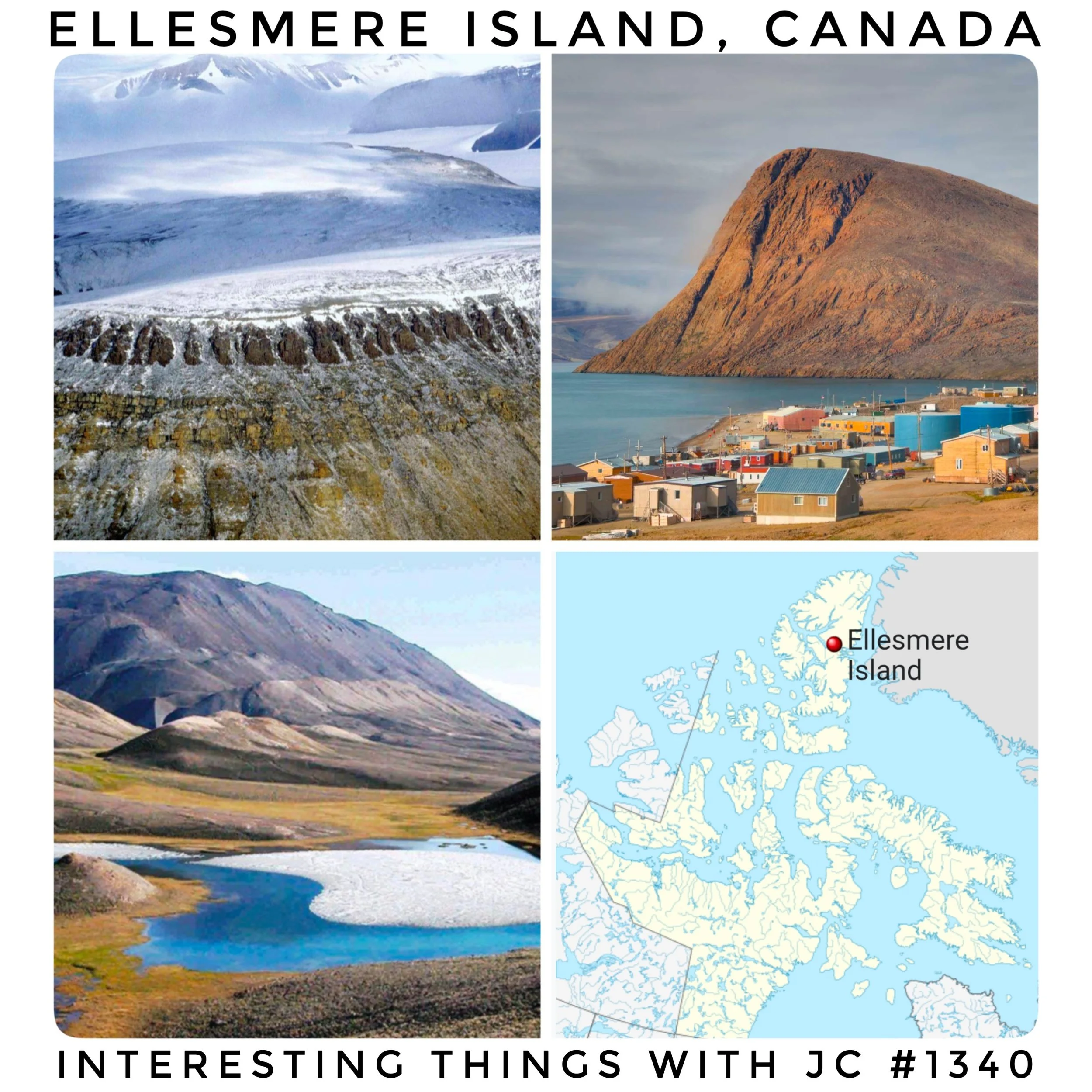
Way up in the Canadian Arctic sits Ellesmere Island—a place most people will never see, but one that holds a unique position on the planet. It’s part of Nunavut’s Qikiqtaaluk (kee-keek-TAH-look) Region and stretches over 75,700 square miles, which makes it larger than Florida.
It's not just big, it’s remote—closer to the North Pole than to most towns. This is true high Arctic terrain. Temperatures can hit minus 40 degrees Fahrenheit, or minus 40 Celsius, and in winter, the sun doesn’t rise for months. The land is covered in ice caps, cliffs, and the oldest known glacier ice in Canada—some of it over 100,000 years old.
Despite the cold, life hangs on. Musk oxen, Arctic wolves, and hares live here. So do ivory gulls. There’s a small outpost called Eureka that gets more sun than any other place in the Canadian Arctic—about 320 days a year.
Ellesmere holds the northernmost point of land in Canada—Cape Columbia. And just offshore, there’s an even more remote gravel bar called Qeqertaq Avannarleq (keh-keh-TAHK ah-VAHN-nar-lek), considered the northernmost land on Earth.
No towns. No roads. Just raw Arctic. For scientists, it's a front-row seat to climate change. For the land itself—it’s been quietly keeping time for over a hundred thousand years.
These are interesting things, with JC.
Student Worksheet
What is the name of the region that includes Ellesmere Island?
Why is Ellesmere Island considered a valuable location for climate scientists?
Describe the living conditions for both humans and animals on Ellesmere Island.
What is unique about the location called Qeqertaq Avannarleq?
Write a short paragraph explaining why remote places like Ellesmere Island matter in global science.
Teacher Guide
Estimated Time: 1–2 class periods (50–90 minutes)
Pre-Teaching Vocabulary Strategy:
Introduce terms via flashcards and pronunciation practice.
Show satellite images or maps for context.
Anticipated Misconceptions:
Students may assume Arctic regions are entirely lifeless.
Some may confuse Ellesmere Island with Greenland or Alaska.
Discussion Prompts:
How does Ellesmere Island challenge your ideas about habitable environments?
In what ways is studying remote regions crucial for understanding climate change?
Differentiation Strategies:
ESL: Provide vocabulary in both English and native languages when possible.
IEP: Use graphic organizers to visualize climate data and geography.
Gifted: Research other Arctic outposts or compare Ellesmere with Antarctica.
Extension Activities:
Create a visual map showing Ellesmere Island and key features like Cape Columbia and Eureka.
Conduct a micro-research project on Arctic wildlife.
Cross-Curricular Connections:
Earth Science: Glaciers, permafrost, Arctic climate.
Geography: Remote landforms, latitude effects.
Environmental Studies: Climate change indicators.
Quiz
Q1. What Canadian territory is Ellesmere Island a part of?
A. Yukon
B. Quebec
C. Nunavut
D. British Columbia
Answer: C
Q2. What makes Ellesmere Island notable geographically?
A. It has tropical rainforests
B. It’s larger than Texas
C. It is closer to the North Pole than to most towns
D. It is home to large cities
Answer: C
Q3. Which of the following animals is found on Ellesmere Island?
A. Polar bears only
B. Giraffes
C. Arctic wolves
D. Elephants
Answer: C
Q4. What is the northernmost point of land in Canada?
A. Eureka
B. Cape Columbia
C. Vancouver Island
D. Mount Logan
Answer: B
Q5. How old is some of the glacier ice found on Ellesmere Island?
A. 1,000 years
B. 10,000 years
C. Over 100,000 years
D. 500 years
Answer: C
Assessment
Explain why Ellesmere Island is a useful place to study climate change.
Compare the ecosystem of Ellesmere Island to that of your local environment.
3–2–1 Rubric:
3 = Accurate, complete, thoughtful
2 = Partial or missing detail
1 = Inaccurate or vague
Standards Alignment
Common Core State Standards (CCSS):
CCSS.ELA-LITERACY.RST.9-10.2 — Determine central ideas and summarize key scientific details.
CCSS.ELA-LITERACY.WHST.9-10.2 — Write informative texts to convey scientific information.
Next Generation Science Standards (NGSS):
HS-ESS3-5 — Analyze geoscience data to forecast the effects of climate change.
HS-ESS2-2 — Analyze data on Earth’s systems to understand changes over time.
C3 Framework for Social Studies:
D2.Geo.2.9-12 — Use maps and geographic representations to explain the characteristics of a location.
D2.Geo.4.9-12 — Analyze relationships between physical geography and environmental challenges.
UK National Curriculum (Geography):
KS4 Physical geography — Understand glaciation, weather, and climate.
AQA GCSE Geography 8035 — Physical landscapes in the UK and global environmental issues.
IB DP Geography:
SL/HL Core Theme 1.3 — Geographic perspectives on climate change and remote landscapes.
Show Notes
In this episode of Interesting Things with JC, listeners are transported to Ellesmere Island, one of Canada’s northernmost and most isolated regions. Nestled in the Qikiqtaaluk Region of Nunavut, this Arctic frontier stretches over 75,000 square miles and is home to some of the oldest glacier ice in North America. The episode explores its harsh but biologically resilient environment, the strategic outpost of Eureka, and key geographic landmarks like Cape Columbia and Qeqertaq Avannarleq. These insights are especially relevant in classrooms focusing on environmental science, geography, and climate studies. As climate change accelerates, places like Ellesmere Island serve as vital indicators and archives of Earth's evolving systems.
References
Government of Canada. (2024). Ellesmere Island Overview. https://www.nrcan.gc.ca
NASA Earth Observatory. (2023). Arctic Ice and Climate Change. https://earthobservatory.nasa.gov
Canadian Encyclopedia. (2023). Ellesmere Island. https://www.thecanadianencyclopedia.ca
Environment and Climate Change Canada. (2024). Climate Data for Eureka Station. https://climate.weather.gc.ca
