1337: "Tamerlane"
Interesting Things with JC #1337: "Tamerlane" – He moved like a shadow, ruled with fire. From pyramids of skulls to Persian mosaics, the story of Timur is one of terror, and legacy.
Curriculum - Episode Anchor
Episode Title: Tamerlane
Episode Number: #1337
Host: JC
Audience: Grades 9–12, college intro, homeschool, lifelong learners
Subject Area: World History, Central Asian Studies, Historical Leadership, Military History
Lesson Overview
Define the historical figure of Timur (Tamerlane) and his geopolitical significance.
Compare the military strategies of Timur with those of Genghis Khan.
Analyze the impact of Timur’s campaigns on Central Asia, the Middle East, and India.
Explain the dual legacy of Timur as both a brutal conqueror and a cultural patron.
Key Vocabulary
Timur (TEE-moor) — Known in the West as Tamerlane, a 14th-century Central Asian ruler who forged a vast empire across Asia.
Samarkand (SAM-ar-kand) — A historic city in present-day Uzbekistan, transformed by Timur into a center of Islamic art and architecture.
Ankara (AN-kah-rah) — Site of the 1402 battle where Timur defeated the Ottoman Sultan Bayezid I.
Gur-e-Amir (GOOR-eh-AH-meer) — Timur’s mausoleum in Samarkand, known for its architectural significance.
Pyramid of Skulls — A fear tactic used by Timur, stacking skulls of the slain as a warning to future rebels.
Narrative Core
Open: The episode opens by framing Timur as a feared figure whose name still resonates across history.
Info: JC introduces Timur’s origin near Samarkand and his claim to Genghis Khan’s legacy, despite lacking a bloodline connection.
Details: The episode covers Timur’s military campaigns, including the sack of Delhi, the Battle of Ankara, and his brutal suppression of revolts.
Reflection: JC examines the paradox of Timur’s legacy—tyrant and patron—and references the eerie prophecy linked to his tomb’s opening.
Closing: “These are interesting things, with JC.”
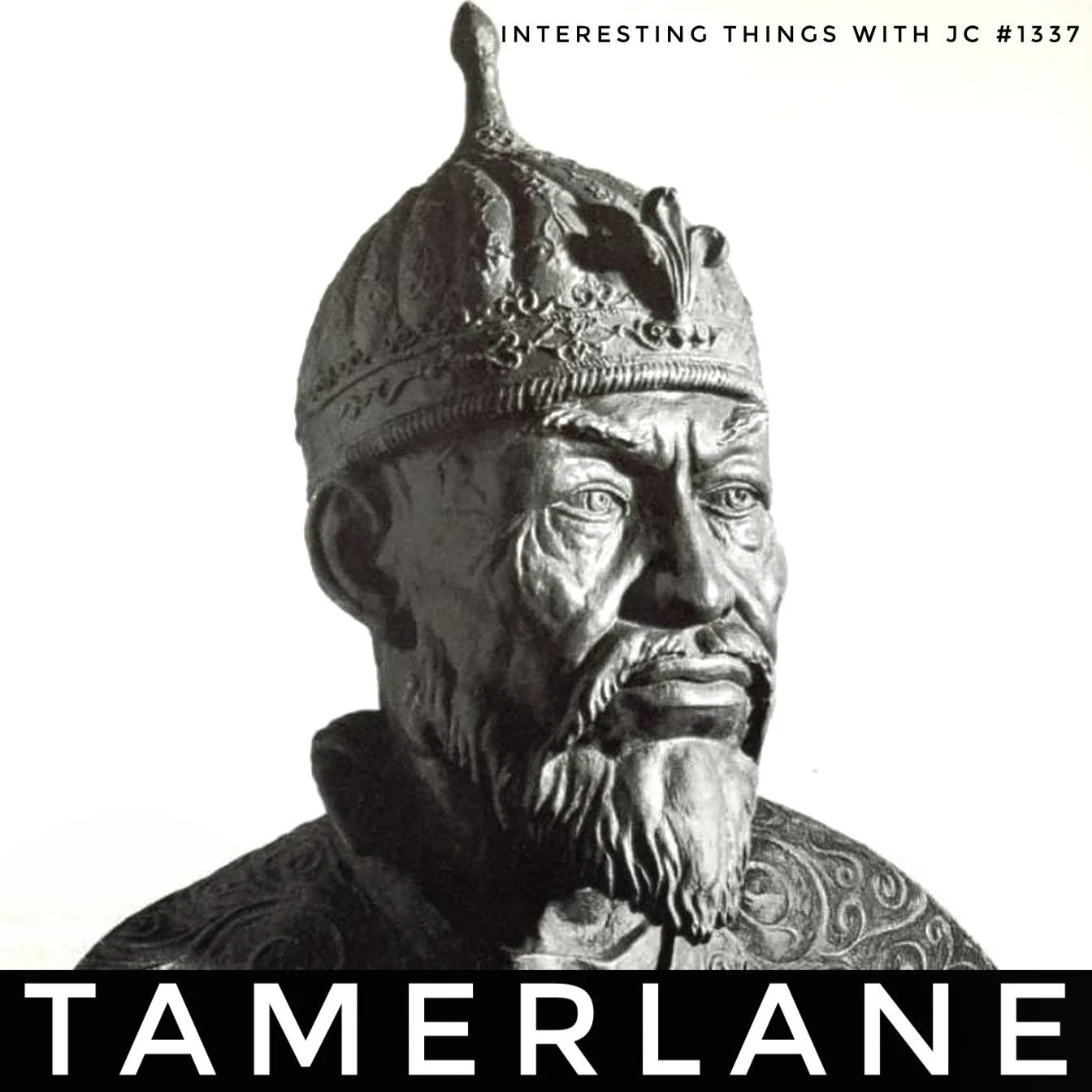
Transcript
He was born in 1336 near Samarkand, in what is now Uzbekistan. His name was Timur (TEE-moor), but history remembers him by a name that echoed fear across empires: Tamerlane. That name came from Timur-i Lang, meaning “Timur the Lame,” a nod to a leg injury he suffered early in life. But what he lacked in movement, he made up for in strategy and ferocity.
Timur saw himself as the heir to Genghis Khan, though he wasn’t related by blood. Still, he adopted the Mongol model, swift cavalry, brutal campaigns, and mobile command. By the late 1300s, he had carved a warpath across Central Asia, Persia, the Caucasus, and into India. In 1398, he sacked Delhi, killing tens of thousands and hauling immense wealth back to Samarkand. Four years later, he defeated the Ottomans at the Battle of Ankara and captured Sultan Bayezid I, who was reportedly kept in an iron cage.
Timur's campaigns weren’t just conquests, they were warnings. After a revolt in Isfahan, he ordered the killing of 70,000 people. His soldiers stacked their skulls into pyramids, sending a message that defiance would not be tolerated. At the peak of his power, his empire covered over 2 million square miles, or 5.2 million square kilometers, one of the largest land empires ever built by force.
Yet he was also a patron of architecture and learning. In Samarkand, he funded breathtaking construction projects, mosques, madrasas, and monuments with turquoise domes and elaborate tilework that still stand today. He wanted to be remembered not just as a conqueror, but as a builder of civilization.
When he died in 1405, he was en route to invade China. He was buried in the Gur-e-Amir, a stunning mausoleum in Samarkand. In 1941, Soviet scientists opened his tomb. Just days later, Hitler invaded the Soviet Union. An old inscription had warned: “Whoever opens my tomb shall unleash an invader more terrible than I.” Coincidence? Maybe. But the timing was chilling.
These are interesting things, with JC.
Student Worksheet
What does “Tamerlane” mean, and what was its origin?
How did Timur emulate the Mongol model in his campaigns?
What happened at the Battle of Ankara in 1402?
Why did Timur create pyramids of skulls in places like Isfahan?
What architectural contributions did Timur make to Samarkand?
Teacher Guide
Estimated Time: 1–2 class periods (50–90 minutes)
Pre-Teaching Vocabulary Strategy: Use a word wall with phonetic pronunciation and map visuals to anchor place names.
Anticipated Misconceptions: Students may confuse Timur with Genghis Khan; clarify their different lineages and timelines.
Discussion Prompts:
Is it possible to view Timur as both a destroyer and a creator?
What role did fear play in Timur’s rule and reputation?
Differentiation Strategies:
ESL: Provide visuals and dual-language vocabulary lists.
IEP: Scaffold with sentence starters and graphic organizers.
Gifted: Explore historiography and how Timur’s legacy is portrayed in different cultures.
Extension Activities:
Create a timeline of Timur’s campaigns.
Analyze the architecture of the Gur-e-Amir and its symbolism.
Cross-Curricular Connections:
Art History: Islamic tilework and architectural motifs.
Geography: Mapping the extent of Timur’s empire.
Ethics: Evaluate wartime atrocities in historical context.
Quiz
What region was Timur born in?
A. Persia
B. Central Asia
C. Anatolia
D. Arabia
Answer: BWhat did Timur reportedly do after a revolt in Isfahan?
A. Forgive the rebels
B. Convert the population
C. Stack skulls into pyramids
D. Burn the city
Answer: CWhat title did Timur take to align himself with Mongol heritage?
A. Sultan of the Steppe
B. Shah of Asia
C. Heir of Genghis
D. Khan of Khans
Answer: CIn what year did Timur sack Delhi?
A. 1389
B. 1398
C. 1402
D. 1405
Answer: BWhere is Timur buried?
A. Delhi
B. Isfahan
C. Samarkand
D. Tashkent
Answer: C
Assessment
Describe the methods Timur used to consolidate power and instill fear.
Discuss how Timur’s architectural legacy contrasts with his military brutality.
3–2–1 Rubric:
3 = Accurate, complete, thoughtful
2 = Partial or missing detail
1 = Inaccurate or vague
Standards Alignment
CCSS.ELA-LITERACY.RH.9-10.2 — Analyze the development of a central idea in historical texts (e.g., Timur’s dual legacy).
C3.D2.His.4.9-12 — Analyze multiple causes and effects in historical change over time.
C3.D2.Geo.3.9-12 — Evaluate the spatial patterns of empires and their transformations.
CTE.HSS.A.2.4 — Explain the influence of military and political leaders on global history.
IGCSE History 0470/11 — Study historical figures in international and imperial contexts.
IB DP History: Paper 2 — Analyze causes and consequences of wars and leadership on a global scale.
Show Notes
In this episode, JC explores the life and legacy of Timur—known in the West as Tamerlane, one of the most powerful and polarizing figures in 14th- and 15th-century history. Born near Samarkand in 1336, Timur emerged from relative obscurity to carve a vast empire across Central Asia, Persia, the Caucasus, and into India using swift cavalry, terror tactics, and brutal campaigns. Notable episodes include the 1398 sack of Delhi, the pyramids of skulls in Isfahan, and the 1402 Battle of Ankara where he captured Ottoman Sultan Bayezid I. At the same time, Timur invested heavily in Samarkand’s urban transformation, creating majestic mosques, madrasas, and monuments that remain architectural marvels today. This clash between ruthless conquest and cultural patronage defines Timur’s legacy. The eerie prophecy associated with the opening of his tomb in 1941 adds a chilling dimension to his story.
References
Manz, B. F. (1989). The Rise and Rule of Tamerlane. Cambridge University Press. Retrieved from https://archive.org/details/riseruleoftamerl00manz
Manz, B. F. (1989). Excerpt from The Rise and Rule of Tamerlane. Cambridge University Press. https://assets.cambridge.org/97805216/33840/excerpt/9780521633840_excerpt.pdf
Tamerlane and the Timurids. (2018). Oxford Research Encyclopedia of Asian History. https://oxfordre.com/asianhistory/view/10.1093/acrefore/9780190277727.001.0001/acrefore-9780190277727-e-10
Timur Lenk (Tamerlane). (n.d.). Oxford Reference. https://www.oxfordreference.com/display/10.1093/acref/9780227679319.001.0001/acref-9780227679319-e-2836