1362: "The Man Who Betrayed Washington"
Interesting Things with JC #1362: "The Man Who Betrayed Washington" – He was once a war hero...wounded, decorated, and trusted by Washington. But ambition turned to treason, and one name became the costliest betrayal in American history.
Curriculum - Episode Anchor
Episode Title: The Man Who Betrayed Washington
Episode Number: 1362
Host: JC
Audience: Grades 9–12, college intro, homeschool, lifelong learners
Subject Area: U.S. History, Government, Civics, Ethics
Lesson Overview
Learning Objectives:
By the end of this lesson, students will be able to:
Define the historical role of Benedict Arnold and Major John André in the context of the American Revolutionary War.
Compare the motives and consequences of betrayal for both Arnold and André.
Analyze the significance of loyalty and treason during wartime in early American history.
Explain how this act of betrayal impacted George Washington personally and the Revolutionary cause as a whole.
Key Vocabulary
Treason (ˈtrē-zᵊn) — The act of betraying one’s country, especially by attempting to overthrow the government or aid its enemies.
Stronghold (ˈstrôNG-ˌhōld) — A fortified place or defensive structure, such as West Point during the Revolution.
Loyalist (ˈloi-ə-list) — A colonist who remained loyal to the British Crown during the American Revolution.
Pariah (pə-ˈrī-ə) — A person who is rejected or cast out by society; Benedict Arnold became one after his betrayal.
Militiamen (mə-ˈli-shə-mən) — Members of a local military force formed from the civilian population, like those who captured André.
Narrative Core (Based on the PSF – Renamed Labels)
Open: The story opens by situating the listener in the year 1780, with the American Revolution in its sixth year and the British targeting West Point, a critical American stronghold.
Info: General Benedict Arnold is introduced as a former hero now feeling embittered, financially strained, and connected to Loyalist sympathies through marriage.
Details: Arnold agrees to betray West Point for money and a British commission, but the plot fails when Major John André is caught with incriminating documents.
Reflection: Washington's sense of betrayal and the national importance of loyalty are emphasized; Arnold's name becomes synonymous with treason.
Closing: These are interesting things, with JC.
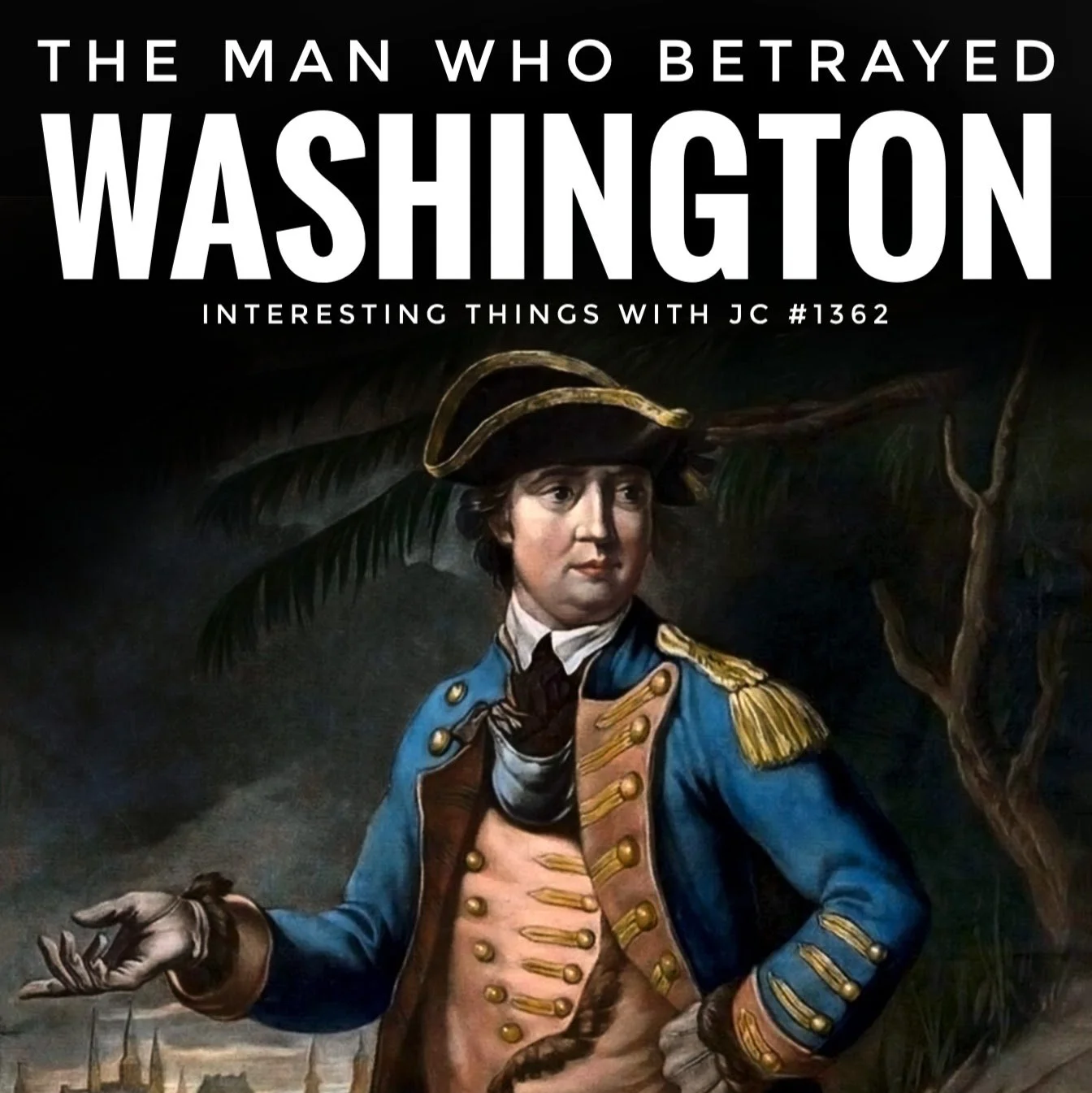
Portrait of a traitor
Transcript
In 1780, America was fighting for its life. Six years into the Revolution, the British aimed to end the war by taking a key stronghold—West Point, perched 80 feet (24.4 meters) above the Hudson River. It was the lock on the door to New England.
The man guarding it was General Benedict Arnold. He had once been a hero—wounded at Saratoga, trusted by Washington. But Arnold felt overlooked, bitter, and broke. He’d married Peggy Shippen, whose Loyalist family favored the Crown. Behind closed doors, the couple opened a channel to the British.
Arnold offered West Point in exchange for £20,000—roughly $3 million today—and a British military commission. Major John André, a well-liked British officer, carried the plans back toward New York. But he was caught near Tarrytown with the stolen documents hidden in his boot.
The betrayal was undeniable. Washington, who had trusted Arnold, faced a blow deeper than tactics. Loyalty wasn’t just a military asset—it was the fabric of the cause. Arnold fled aboard the British ship Vulture. He would live the rest of his life as a pariah—untrusted by the British, hated by Americans.
André wasn’t so lucky. He was hanged as a spy. He was 31.
Three local militiamen—John Paulding, Isaac Van Wart, and David Williams—had stopped him. For that act of loyalty, they were given medals and pensions. And a young nation held.
Benedict Arnold’s name became a synonym for betrayal. Washington never spoke it again.
These are interesting things, with JC.
Student Worksheet
What made West Point strategically important during the American Revolution?
Why did Benedict Arnold decide to betray the American cause?
Describe the role of Major John André in Arnold’s plot.
How did General George Washington react to Arnold’s betrayal?
Who were the three militiamen, and what did they do?
Teacher Guide
Estimated Time: 1 class period (45–60 minutes)
Pre-Teaching Vocabulary Strategy:
Use a Frayer Model or Vocabulary Carousel to pre-teach key terms like “treason” and “Loyalist.”
Anticipated Misconceptions:
Students may conflate the term Loyalist with patriotism; clarify that Loyalists were loyal to Britain, not the revolutionary cause.
Some students may not grasp the depth of Arnold’s betrayal beyond monetary motives; emphasize emotional and ideological aspects.
Discussion Prompts:
What does it mean to be loyal to a cause or country?
Can someone be both a hero and a traitor in their lifetime?
What impact does betrayal have on personal and national identity?
Differentiation Strategies:
ESL: Provide vocabulary support with visuals or multilingual glossaries.
IEP: Use simplified sentence structures and graphic organizers.
Gifted: Invite research into other historical betrayals and their consequences.
Extension Activities:
Write a diary entry from the perspective of one of the militiamen.
Debate: Was Arnold justified in his betrayal? Use historical evidence.
Research spy tactics used during the American Revolution.
Cross-Curricular Connections:
Ethics/Philosophy: Explore concepts of loyalty and betrayal.
Government: Examine how treason is handled legally in the U.S. Constitution.
Geography: Map West Point’s location and why it was key to controlling New England access.
Quiz
What did Benedict Arnold offer to the British in exchange for money and a commission?
A. Control of Boston
B. West Point
C. Fort Ticonderoga
D. The Delaware River
Answer: BHow was Major John André caught?
A. He confessed to a British officer
B. He turned himself in
C. He was captured with documents in his boot
D. He was betrayed by Arnold
Answer: CWhat happened to Benedict Arnold after the plot was uncovered?
A. He was hanged
B. He escaped and lived in France
C. He joined the American forces again
D. He fled and lived as a pariah
Answer: DWhat did George Washington reportedly never do after the betrayal?
A. Return to West Point
B. Write in his journal
C. Speak Arnold’s name again
D. Trust any general
Answer: CWho were the three militiamen that captured André?
A. Paul Revere, Ethan Allen, and William Dawes
B. John Paulding, Isaac Van Wart, and David Williams
C. Nathan Hale, Henry Knox, and Thomas Paine
D. John Adams, Samuel Adams, and Robert Treat Paine
Answer: B
Assessment
Analyze how Benedict Arnold’s betrayal could have changed the outcome of the American Revolution if successful.
Explain the personal and national consequences of betrayal during times of war.
3–2–1 Rubric:
3 = Accurate, complete, thoughtful
2 = Partial or missing detail
1 = Inaccurate or vague
Standards Alignment
U.S. Standards
C3.D2.His.1.9-12: Evaluate how historical events were shaped by unique circumstances.
CCSS.ELA-LITERACY.RH.9-10.2: Determine the central ideas of a primary or secondary source.
CCSS.ELA-LITERACY.RH.11-12.3: Evaluate various explanations for actions or events.
CTE.HSS.C.A1.1: Analyze major historical events and their impact on modern society.
ISTE 1.3b: Students evaluate the accuracy and perspective of sources when investigating issues.
International Equivalents
UK AQA GCSE History 8145/1A: Understanding historical context of power and conflict.
IB DP History (Standard Level): Examine causes and effects of wars; explore leadership and conflict.
Cambridge IGCSE History (0470): Core Content: The development of the USA, 1754–2000.
Show Notes
This episode examines one of the most infamous betrayals in American history—General Benedict Arnold’s attempt to hand over West Point to the British during the American Revolutionary War. It contextualizes his disillusionment, his motivations, and the implications of treason on a young nation's identity and its leadership. The episode not only provides historical facts but also invites ethical and emotional reflection, making it highly relevant to classroom discussions on loyalty, leadership, and moral decision-making under pressure. Ideal for U.S. history units on the Revolution or civic ethics, this content offers interdisciplinary connections across literature, government, and philosophy.
References
McCullough, D. (2005). 1776. Simon & Schuster. https://www.simonandschuster.com/books/1776/David-McCullough/9780743226721
Mount Vernon. (n.d.). Benedict Arnold Biography. https://www.mountvernon.org/library/digitalhistory/digital-encyclopedia/article/benedict-arnold/