1393: "Mary Ann Nichols: The First Victim of Jack the Ripper"
Interesting Things with JC #1393: "Mary Ann Nichols: The First Victim of Jack the Ripper" – A foggy street. A missing four pennies. A discovery that shook Victorian London and ignited a legend. But behind the mystery is a woman whose name demands to be remembered.
Curriculum - Episode Anchor
Episode Title: Mary Ann Nichols: The First Victim of Jack the Ripper
Episode Number: 1393
Host: JC
Audience: Grades 9–12, college intro, homeschool, lifelong learners
Subject Area: History, Criminology, Sociology, Urban Studies
Lesson Overview
By the end of this lesson, students will be able to:
Define key terms related to Victorian London, crime investigation, and social conditions of the East End.
Compare the social realities of Mary Ann Nichols’ life with broader patterns of poverty in industrial-era cities.
Analyze how Nichols’ death shaped public fear, media response, and the London police investigation.
Explain why Nichols’ story remains historically significant beyond the legend of Jack the Ripper.
Key Vocabulary
Carman (KAHR-mən) — A man who drove a horse-drawn cart for transporting goods. Example: Charles Cross, a carman, discovered Nichols’ body.
Common lodging house — A cheap boarding place in Victorian London where poor workers and women stayed night-to-night. Example: Nichols sought a bed costing four pennies.
Coroner (KOR-uh-nər) — An official who investigates suspicious or unexplained deaths. Example: The coroner concluded Nichols’ death was deliberate and fast.
Whitechapel (WYT-chap-uhl) — A working-class district in East London, known in the 1880s for overcrowding, poverty, and crime.
Victorian Era — The period of Queen Victoria’s reign (1837–1901), marked by industrial growth, social inequality, and strict cultural norms.
Narrative Core
Open – A carman named Charles Cross discovered the body of Mary Ann Nichols in Buck’s Row, Whitechapel, in the early morning of August 31, 1888.
Info – Nichols, known as Polly, was born in 1845, married at 19, and had five children. Following poverty and separation, she lived in lodging houses, struggling to afford nightly shelter.
Details – On the night of August 30, she was last seen without enough money for a bed. Hours later, she was found murdered, with injuries suggesting precision and deliberation.
Reflection – Her death was not only the beginning of the Jack the Ripper case but also a lens into the harsh realities of poverty, gender, and safety in Victorian London. Nichols deserves remembrance as a woman and mother, not just as a victim in a legend.
Closing – These are interesting things, with JC.
Transcript
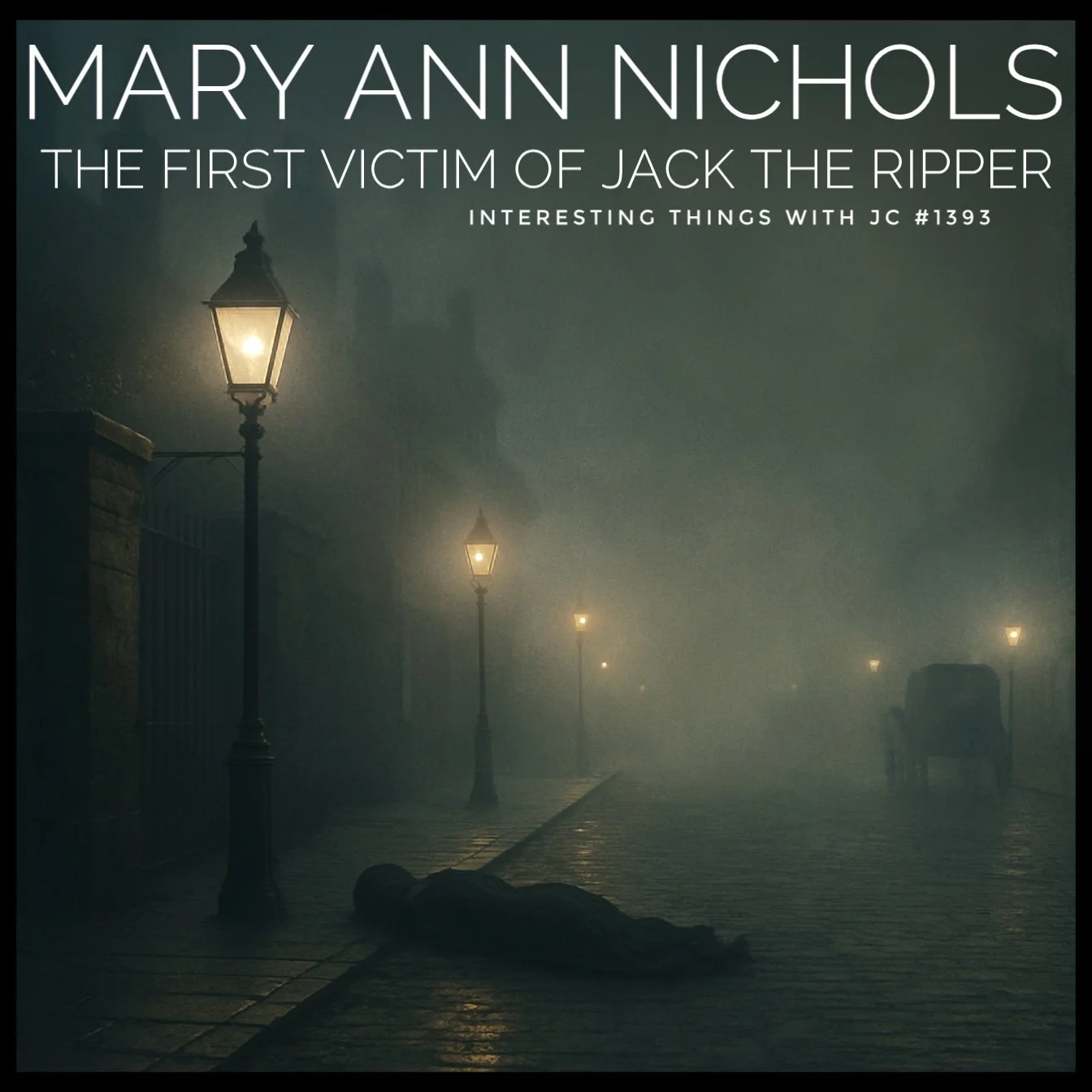
Foggy Victorian street at night lit by gas lamps, with a figure lying on the cobblestones in the foreground and a horse-drawn carriage in the distance. Text at the top reads: “Mary Ann Nichols: The First Victim of Jack the Ripper – Interesting Things with JC #1393.”
At 3:40 in the morning on August 31, 1888, a carman named Charles Cross (KRAHSS) walked his usual route through Buck’s Row in Whitechapel, a working-class district in the East End of London, England. The street was dim, with gas lamps set far apart. Coal smoke hung in the air, and the sound of horse carts echoed faintly on the cobblestones. Near a stable gate, he noticed what looked like a bundle. When he stepped closer, he realized it was the body of a woman. Her name was Mary Ann Nichols. She was forty-three years old. Her death would be remembered as the first in the case the world came to know as Jack the Ripper.
Mary Ann, known as “Polly,” was born in 1845, the daughter of a locksmith. At nineteen, she married William Nichols, a printer’s machinist, and together they had five children. But their marriage fell apart, and Mary drifted into poverty. By 1888, she lived night to night in common lodging houses, where a bed cost four pennies. On the evening of August 30, she was turned away for not having the money. Around 2:30 a.m., she was seen on Whitechapel Road, saying she had earned enough, but she spent it on drink and went back out to try again. She never returned.
When police arrived at Buck’s Row, they found she had been attacked with a knife, suffering serious wounds. The coroner said the assault was fast and deliberate, sparking debate about whether the person responsible had medical knowledge or was simply skilled with a blade. Either way, it was no ordinary street crime.
Whitechapel itself was one of the hardest corners of London. More than 80,000 people lived crowded into less than a square mile—about 2.6 square kilometers. Narrow lanes, dim lamps, and overcrowded housing made danger easy to hide. Poverty and alcoholism were common, and women like Nichols lived on the edge, often with no options beyond a few coins for shelter.
Her death didn’t just trouble Whitechapel—it unsettled the entire city. Newspapers spread the story across Britain and soon abroad. Fear grew quickly, and London police responded with heavier patrols. Families began avoiding the East End at night, and rumors swept through the city about a killer who seemed to strike without warning. Nichols’ case marked the start of one of the largest manhunts of the Victorian era.
Mary Ann Nichols’ death became the beginning of what history calls the Whitechapel murders. Over the following months, at least four more women—Annie Chapman, Elizabeth Stride, Catherine Eddowes, and Mary Jane Kelly—lost their lives in similar ways. The press gave the unknown killer a name: Jack the Ripper. Despite countless theories, the Ripper was never caught. His identity remains unknown, more than a century later.
And yet, the story doesn’t belong to him alone. It belongs to women like Mary Ann Nichols, who lived and died in the harsh streets of London’s East End. On her final night, she only needed four pennies for a bed. That simple fact carries more weight than the mystery of the man who took her life. Nichols deserves to be remembered not as the start of a legend, but as a mother of five, a woman whose struggle was real, and whose name should not be forgotten.
These are interesting things, with JC.
Student Worksheet
Who discovered the body of Mary Ann Nichols, and where?
How much did it cost to rent a bed in a common lodging house?
Why did the coroner’s findings spark debate about the attacker’s possible skills?
Describe the living conditions in Whitechapel in 1888.
Creative prompt: Write a journal entry as if you were a Londoner reading about Nichols’ murder in the newspaper for the first time.
Teacher Guide
Estimated Time: 45–60 minutes
Pre-Teaching Vocabulary Strategy:
Introduce words like “carman,” “lodging house,” and “coroner” with historical visuals and contextual examples.
Anticipated Misconceptions:
Students may assume all of London lived in similar poverty. Clarify the contrast between East End and wealthier areas.
Students may think Jack the Ripper was the focus; stress Nichols as a human story.
Discussion Prompts:
Why is it important to remember the victims, not just the criminal?
How did urban poverty contribute to crime and vulnerability in Whitechapel?
What role did the press play in shaping public fear?
Differentiation Strategies:
ESL: Use vocabulary matching activities with images.
IEP: Provide sentence starters for reflection questions.
Gifted: Encourage students to research how the Ripper case influenced modern criminology.
Extension Activities:
Create a timeline of the Whitechapel murders.
Research other historical examples of how the press influenced public fear of crime.
Compare conditions in Victorian London to another industrial city (e.g., New York’s Lower East Side).
Cross-Curricular Connections:
Sociology: Study urban poverty and crime.
Media Studies: Analyze the role of newspapers.
Ethics: Explore victim remembrance and historical storytelling responsibility.
Quiz
Who discovered Mary Ann Nichols’ body?
A. A police constable
B. Charles Cross
C. A stable worker
D. William Nichols
Answer: BWhat year was Mary Ann Nichols murdered?
A. 1878
B. 1888
C. 1898
D. 1908
Answer: BHow much did a bed in a lodging house cost?
A. Two pennies
B. Four pennies
C. Six pennies
D. Ten pennies
Answer: BWhich factor made Whitechapel particularly dangerous?
A. Open fields and farmland
B. Poor lighting, overcrowding, and poverty
C. Wealthy residents and guards
D. Wide streets with heavy policing
Answer: BHow many other women are most often linked to the Whitechapel murders following Nichols?
A. Two
B. Three
C. Four
D. Six
Answer: C
Assessment
In what ways does Mary Ann Nichols’ story highlight the broader struggles of women in Victorian London?
How did media coverage of Nichols’ murder shape public response and police action in 1888?
Rubric (3–2–1):
3: Accurate, complete, thoughtful
2: Partial or missing detail
1: Inaccurate or vague
Standards Alignment
U.S. Standards
CCSS.ELA-LITERACY.RH.9-10.2 – Determine central ideas of a primary/secondary source; Nichols’ story illustrates poverty, gender, and media.
CCSS.ELA-LITERACY.WHST.9-10.2 – Write informative texts; students may compose historical reflections.
C3.D2.His.5.9-12 – Analyze how people’s perspectives influenced the events of the past; considering how Nichols’ life and death reflected class and gender.
ISTE 3a – Students plan strategies to guide inquiry; researching Ripper-era media and criminology.
UK / International Equivalents
AQA GCSE History Paper 1 (Understanding the Modern World) – Covers crime and punishment in Britain, including 19th-century policing.
Cambridge IGCSE History (0470, Depth Study) – Focus on 19th-century urban conditions and crime.
IB DP History: Individuals and Societies – Analyzing urban challenges and inequality in industrial-era societies.
Show Notes
This episode explores the tragic story of Mary Ann Nichols, the first known victim of Jack the Ripper, murdered in London’s Whitechapel district in 1888. By grounding the narrative in Nichols’ life—her poverty, struggles, and humanity—the episode shifts focus from the anonymous killer to the conditions of the city and the vulnerability of its residents. For classrooms, Nichols’ case provides a compelling entry into Victorian social history, criminology, and the role of media in shaping public perception. It prompts students to think critically about how history remembers victims, how urban poverty influences safety, and how society balances mystery with empathy.
References
Casebook: Jack the Ripper. (n.d.). Inquest: Mary Ann “Polly” Nichols. https://www.casebook.org/official_documents/inquests/inquest_nichols.html
Casebook: Jack the Ripper. (n.d.). Mary Ann “Polly” Nichols [Victim profile]. https://www.casebook.org/victims/polly.html
Daily Telegraph. (1888, September 21). Daily Telegraph – 21 September 1888 [Press report transcript]. Casebook: Jack the Ripper. https://www.casebook.org/press_reports/daily_telegraph/dt880921.html
Evening News. (1888, August 31). Horrible murder in Buck’s Row, Whitechapel [Press report transcript]. Casebook: Jack the Ripper. https://www.casebook.org/press_reports/evening_news/18880831.html
London Museum. (n.d.). Jack the Ripper. https://www.londonmuseum.org.uk/collections/london-stories/jack-ripper/
Survey of London. (n.d.). Historical introduction (Whitechapel). https://surveyoflondon.org/page/historical-introduction/
The National Archives (UK). (n.d.). 19th century Whitechapel: How can we find out what Whitechapel was like in 1888? [Resource pack PDF]. https://cdn.nationalarchives.gov.uk/documents/education/resource-pack-19th-century-whitechapel.pdf
The National Archives (UK). (n.d.). Jack the Ripper [Education resource PDF]. https://cdn.nationalarchives.gov.uk/documents/education/jacktheripper.pdf