1414: "The Real Castles and Lands of Game of Thrones"
Interesting Things with JC #1414: "The Real Castles and Lands of Game of Thrones" – Behind the dragons and politics were real castles, coasts, and ancient streets. From Icelandic rifts to Spanish palaces, fantasy rested on geology and stone. What remains when the stories fade is the land itself.
Curriculum - Episode Anchor
Episode Title: The Real Castles and Lands of Game of Thrones
Episode Number: 1414
Host: JC
Audience: Grades 9–12, college intro, homeschool, lifelong learners
Subject Area: Earth Science, Environmental Science, Architecture, Media Studies
Lesson Overview
By the end of this lesson, students will be able to:
Define key geological and architectural terms connected to the filming locations.
Compare how natural processes like erosion and tectonic shifts shape real landscapes versus their fictional portrayals.
Analyze the relationship between geology, climate, and human construction in sustaining castles and ancient structures.
Explain how physical science (light reflection, weathering, plate movement) affected real-world filming decisions in Game of Thrones.
Key Vocabulary
Erosion (ih-ROH-zhun) — The wearing down of rock and soil by wind, water, or ice. Example: The Azure Window collapsed due to erosion from waves and storms.
Freeze-Thaw Cycle (freez-thaw sy-kl) — Weathering process where water freezes in cracks, expands, and breaks rock apart. Example: Doune Castle’s sandstone walls are weakened by freeze-thaw cycles.
Tectonic Plate (tek-TAH-nik playt) — Large slabs of Earth’s crust that move over time. Example: Þingvellir sits on the boundary of two tectonic plates moving apart.
Porous (POR-us) — A material with tiny holes that allow liquid or air to pass through. Example: Sandstone is porous, making it vulnerable to weathering.
Limestone (LYME-stohn) — A sedimentary rock formed mainly of calcium carbonate. Example: Dubrovnik’s limestone streets reflect sunlight brightly.
Narrative Core
Open – JC introduces the idea that while Game of Thrones was fantasy, its filming locations were built on real geology, architecture, and landscapes.
Info – The episode explains how castles, harbors, and roads in Northern Ireland, Scotland, Croatia, Spain, and Iceland provided natural backdrops for the series.
Details – Specific scientific and historical details reveal how erosion, tectonic shifts, and materials like limestone and sandstone shaped these sites—and even influenced filming challenges.
Reflection – The episode reminds us that fantasy storytelling rests on natural processes and centuries of human construction, connecting science and culture.
Closing – “These are interesting things, with JC.”
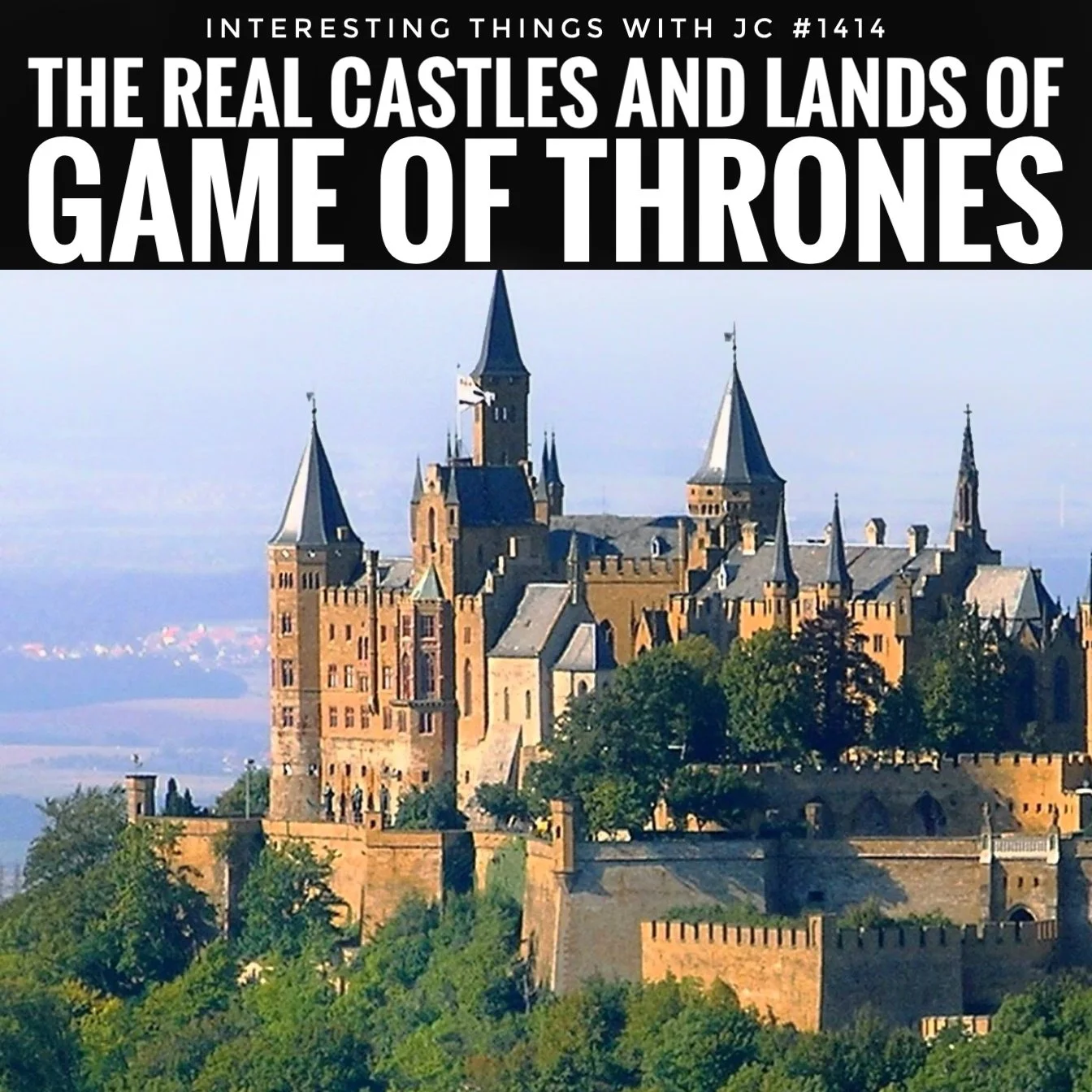
Hohenzollern Castle in Germany sits high on a hill, surrounded by trees, with stone walls, tall towers, and pointed spires. The countryside stretches out behind it under a pale blue sky. While not used in Game of Thrones, the castle’s dramatic look echoes the style of real filming locations shown in the episode “The Real Castles and Lands of Game of Thrones.”
Transcript
Game of Thrones told a fantasy story, but the places where it was filmed are real.
Most of the production was based in Northern Ireland. Castle Ward stood in for Winterfell. Its mix of Gothic stonework and classical design gave the right balance between polished and rough—much like the Stark family itself. The Dark Hedges, a tunnel of beech trees planted in the 1700s, became the Kingsroad. These trees can live 200 to 300 years, but many are already at the end of their lifespan, threatened by fungal decay and storm damage. Their arching canopy forms naturally as upper branches outgrow the lower ones, a biological process that locks them together into that striking tunnel. Ballintoy Harbour, a fishing port built into Jurassic limestone cliffs that rise about 60 feet (18 meters), played the Iron Islands. The jagged coast, shaped by centuries of wave erosion, looked harsh enough without computer effects.
Scotland only appeared once. Doune (DOON) Castle, a 14th-century fortress built from local sandstone, was used as Winterfell in the pilot. Sandstone is porous, which means it breaks down under freeze-thaw cycles and acid rain. That slow chemical weathering explains why castles like Doune, with walls more than 40 feet (12 meters) high, require constant care just to stand today. Producers dropped it after the pilot, partly because the site was already famous from Monty Python and the Holy Grail.
For King’s Landing, crews turned to Dubrovnik (doo-BROOV-nik), Croatia. Its medieval walls, some rising 80 feet (24 meters), had survived wars and earthquakes for centuries. The city’s limestone streets reflect sunlight so well that filmmakers needed very little artificial lighting. Physics reduced the workload.
Before Dubrovnik, the first season used Malta. Mdina (em-DEE-nuh), the “Silent City,” and Fort Ricasoli gave King’s Landing its first look. But filming damaged a natural rock arch called the Azure Window. Public anger over that incident led HBO to move production. The arch itself collapsed in 2017, brought down not by cameras but by natural erosion and winter storms.
When the story went north of the Wall, Iceland became the backdrop. Þingvellir (THING-vell-eer) National Park lies on the Mid-Atlantic Rift, where the North American and Eurasian plates move apart at about an inch, or 2.5 centimeters, per year. The valley, glaciers, lava fields, and steam vents gave the series landscapes that looked alien because they came directly from the planet’s shifting crust.
For Dorne, Seville’s Alcázar (ahl-CAH-zar) Palace was used. Built in the 900s and later expanded by Christian kings, its courtyards and tilework show a mix of cultures. The design wasn’t only for looks. The arches and water features were built to channel breezes and cool the space through evaporation, a practical answer to Andalusia’s hot summers. Girona (zhee-ROH-nuh), another Spanish city, added narrow streets and layered stone walls that gave King’s Landing fresh angles without digital effects.
And then there’s the small detail that reminds us how real filming can be. At the Castle Black set in Northern Ireland, a farmer’s geese honked so loudly they ruined take after take. The only solution was for HBO to buy the whole flock, just to quiet the background.
The dragons may have been special effects. But the castles were carved from sandstone and limestone, the roads ran along tectonic rifts, and even silence sometimes came down to biology. Fantasy rested on real geology, architecture, and centuries of human craft. These are the things that outlast the stories we tell, and they remind us that every piece of legend is built on something solid beneath it.
These are interesting things, with JC.
Student Worksheet
Why was Castle Ward chosen as Winterfell’s filming location, and what architectural styles made it suitable?
Explain how freeze-thaw weathering affects sandstone castles like Doune.
Describe how tectonic plate movement shaped the landscapes of Þingvellir in Iceland.
What caused the Azure Window in Malta to collapse, and why did HBO stop filming there?
How did physics reduce lighting needs in Dubrovnik during filming?
Teacher Guide
Estimated Time: 50–60 minutes
Pre-Teaching Vocabulary Strategy: Introduce geology and architecture terms with visual aids (diagrams of erosion, tectonic plates, limestone structures).
Anticipated Misconceptions:
Students may confuse chemical vs. physical weathering.
Students may assume fantasy sets are computer-generated rather than real-world locations.
Discussion Prompts:
How does geology shape human history and culture?
Why might film crews prefer real locations over digital effects?
Differentiation Strategies:
ESL: Provide vocabulary cards with images.
IEP: Use guided notes with fill-in-the-blank prompts.
Gifted: Research another film that relied heavily on real-world geology and compare.
Extension Activities:
Create a 3D model or sketch of a castle showing how erosion might affect it over centuries.
Write a mini research paper on tectonic activity in Iceland.
Cross-Curricular Connections:
Physics: Reflection of light in Dubrovnik’s streets.
History: Medieval fortress construction.
Geography: Plate tectonics and rift valleys.
Quiz
Q1. Which location served as Winterfell in the pilot episode?
A. Castle Ward
B. Doune Castle
C. Dubrovnik
D. Mdina
Answer: B
Q2. The Dark Hedges became the Kingsroad. What natural process gave them their tunnel-like canopy?
A. Human pruning
B. Disease spread
C. Branches locking as they outgrow lower branches
D. Wind
Answer: C
Q3. Which natural rock formation in Malta collapsed in 2017?
A. The Dark Hedges
B. The Azure Window
C. Ballintoy Harbour cliffs
D. The Alcázar arches
Answer: B
Q4. What geological feature makes Þingvellir unique?
A. It sits on the Mid-Atlantic Rift between two tectonic plates.
B. It was built from porous sandstone.
C. Its walls rise over 80 feet.
D. It reflects light to reduce filming needs.
Answer: A
Q5. Why did filmmakers struggle with sound at the Castle Black set?
A. Ocean waves crashed too loudly.
B. Winds whistled through stone walls.
C. Nearby geese honked during takes.
D. Traffic noise from nearby roads.
Answer: C
Assessment
Compare the natural forces (erosion, tectonics, weathering) that shaped the filming sites of Malta, Iceland, and Scotland.
Explain how the physical sciences (light reflection, weathering, tectonic activity) influenced both the durability of ancient structures and the production of modern media.
3–2–1 Rubric
3 = Accurate, complete, thoughtful
2 = Partial or missing detail
1 = Inaccurate or vague
Standards Alignment
NGSS (Next Generation Science Standards)
HS-ESS2-2: Analyze geoscience data to understand how surface processes like erosion and tectonic activity shape Earth’s features.
HS-PS4-2: Evaluate how physical science principles (light reflection) affect human applications, such as filming.
CCSS (Common Core State Standards, Literacy in Science)
RST.11-12.2: Determine central ideas in a scientific text.
RST.11-12.9: Synthesize information from multiple sources about natural processes affecting historical structures.
C3 (College, Career, and Civic Life Framework for Social Studies)
D2.Geo.5.9-12: Evaluate how human and physical geography influence culture and decision-making.
UK National Curriculum (Geography)
KS5 – Physical Geography: Study of weathering, erosion, and tectonic activity shaping landscapes.
IB DP Geography
Unit: Geophysical Hazards: Understanding tectonic and geomorphological processes.
Show Notes
This episode of Interesting Things with JC explores the real castles, harbors, and landscapes used in the filming of Game of Thrones, grounding fantasy in the realities of geology, architecture, and environmental science. Students learn how erosion, tectonic movement, and material properties shaped historic sites while influencing modern film production. This lesson highlights why science matters in understanding both cultural heritage and contemporary media.
References
Discover Northern Ireland. (n.d.). The Dark Hedges. Discover Northern Ireland. Retrieved September 20, 2025, from https://discovernorthernireland.com/things-to-do/the-dark-hedges-p703291
Causeway Coast & Glens Heritage Trust. (2021, February 5). A new future for the Dark Hedges. CC&GHT. Retrieved September 20, 2025, from https://ccght.org/a-new-future-for-the-dark-hedges/
Panoramic Ireland. (2023, November 24). Six of the Dark Hedges felled in November 2023 due to danger from damage and decay. Panoramic Ireland. Retrieved September 20, 2025, from https://panoramicireland.com/blog-ireland-guide/tree-tunnel-dark-hedges-bregagh-road-antrim-hbo-game-of-thrones-six-trees-cut-down-danger-november-2023
National Trust. (n.d.). Castle Ward. National Trust. Retrieved September 20, 2025, from https://www.nationaltrust.org.uk/visit/northern-ireland/castle-ward
Perceptive Travel. (2018, November 2). A visit to Doune Castle in Scotland. Perceptive Travel. Retrieved September 20, 2025, from https://perceptivetravel.com/blog/2018/11/02/doune-castle/
Variety. (2017, March 8). ‘Game of Thrones’ Azure Window rock formation collapses in Malta. Variety. Retrieved September 20, 2025, from https://variety.com/2017/tv/news/game-of-thrones-azure-window-arch-collapses-1202005335/
The Malting Pot. (2014, April 3). Game of Thrones: How MEPA screwed up Malta’s best filming opportunity yet. The Malting Pot. Retrieved September 20, 2025, from https://themaltingpot.wordpress.com/2014/04/03/game-of-thrones-how-mepa-screwed-up-maltas-best-filming-opportunity-yet/
Rick Steves’ Europe. (2019, April 12). Game of Thrones in Croatia. Rick Steves’ Europe Blog. Retrieved September 20, 2025, from https://blog.ricksteves.com/cameron/2019/04/game-of-thrones-croatia
Voyaged Magazine. (2021, June 15). Real-world Westeros: 7 Game of Thrones filming locations you can actually visit. Voyaged Magazine. Retrieved September 20, 2025, from https://www.voyagedmagazine.com/westeros-game-of-thrones-filming-locations-to-visit/