Interesting Things with JC #1401: "Dorothy Dandridge" – She broke barriers with elegance. An icon of talent, beauty, and courage, Dorothy Dandridge changed what was possible, on stage, on screen, and in history.
Curriculum - Episode Anchor
Episode Title: Dorothy Dandridge
Episode Number: #1401
Host: JC
Audience: Grades 9–12, college intro, homeschool, lifelong learners
Subject Area: U.S. History, Film Studies, African American Studies, Performing Arts, Gender Studies
Lesson Overview
Students will:
Define the historical and cultural significance of Dorothy Dandridge's contributions to film and performing arts.
Compare the systemic challenges faced by Dandridge to those encountered by other artists across racial and gender lines.
Analyze the intersection of race, gender, and media representation in mid-20th-century America.
Explain how Dandridge’s career helped break racial barriers in Hollywood and influenced future generations of performers.
Key Vocabulary
Hays Code (ˈhāz kōd) — A set of moral guidelines that censored U.S. films; limited roles available to Black actors like Dandridge.
Contralto (kən-ˈtral-(ˌ)tō) — The lowest female singing voice; Dandridge’s rich tone helped her stand out on stage.
Cerebral Anoxia (ˈser-ə-brəl ə-ˈnäk-sē-ə) — A condition caused by a lack of oxygen to the brain; affected Dandridge’s daughter from birth.
Tailored Gowns (ˈtā-lərd ɡaʊnz) — Elegant, custom-fitted dresses; a signature of Dandridge’s stage image.
Back Entrance (bak ˈen-trəns) — Symbolic of racial segregation, referring to how Black performers were often denied main access to venues.
Narrative Core
Open — Dandridge’s calm, poised presence is introduced as remarkable, especially in the context of her time.
Info — Her early life with her sister as “The Wonder Children” and move to Los Angeles during the Depression.
Details — Her achievements: live performances across iconic venues, breakthrough roles, and historic Oscar nomination.
Reflection — JC reflects on how systemic racism shaped her career, from segregated entrances to denied credits and opportunity.
Closing — “These are interesting things, with JC.”
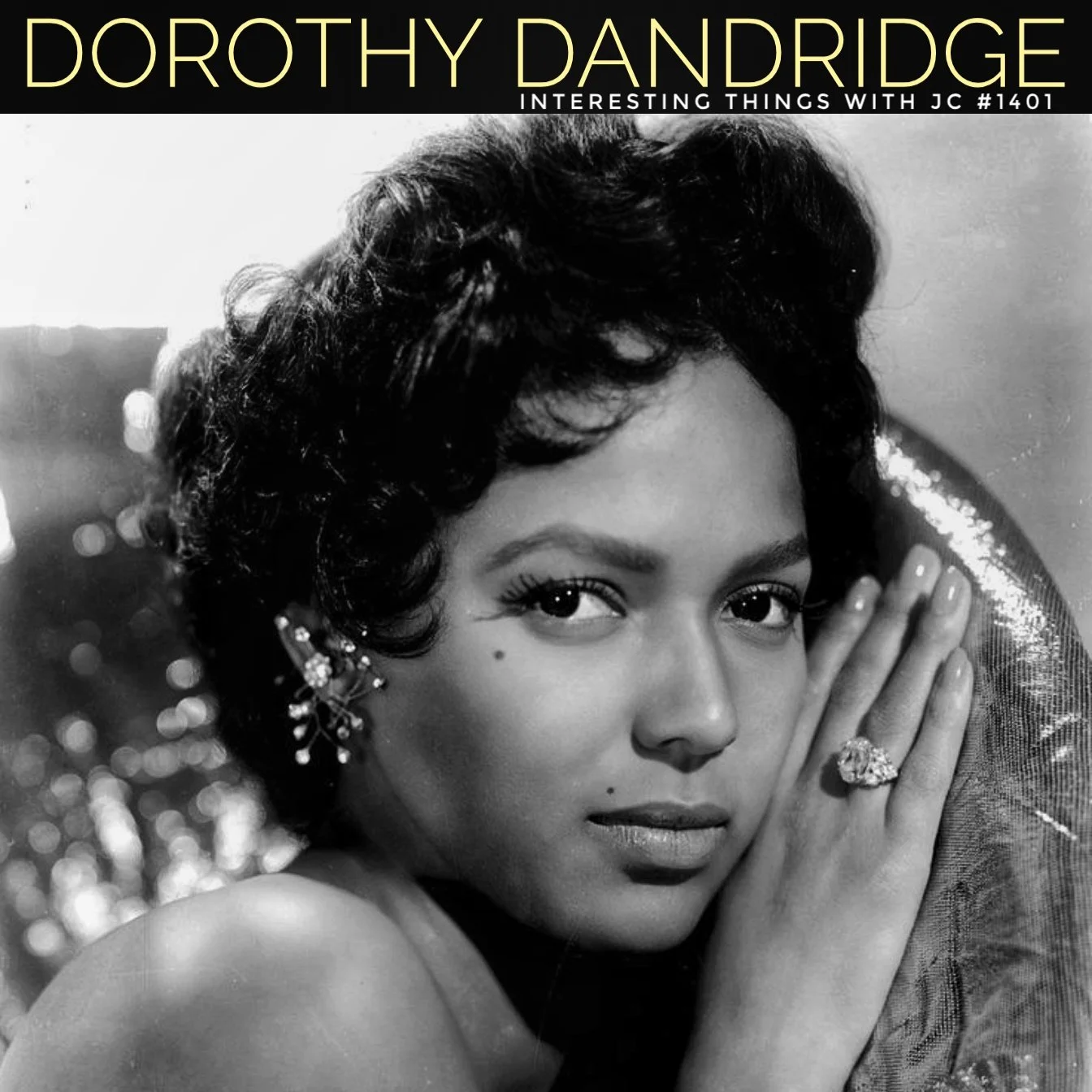
Black-and-white portrait of actress Dorothy Dandridge resting her face on her hands, wearing elegant earrings and a large ring, with a glamorous 1950s hairstyle.
Transcript
She had a presence that turned heads. Calm, polished, sure of herself. But in her time, that didn’t get you far if you were Black and female.
Dorothy Dandridge (DAN-dridge) was born in Cleveland, Ohio, on November 9, 1922. Her mother, Ruby, had a plan. Dorothy and her sister Vivian toured the South during the Great Depression as the Wonder Children, singing in churches and living out of suitcases.
They made it to Los Angeles in the 1930s. Dorothy started getting film work, mostly background roles without credit. The Hays Code kept Black actresses boxed in.
But she didn’t stay there.
She trained in piano, acting, and voice. She performed at the Cotton Club, the Apollo, and in London. Her contralto voice stood out, and so did her presence.
In 1942, she married Harold Nicholas of the Nicholas Brothers. Their daughter, Harolyn, was born in 1943. A birth injury left her with permanent brain damage, later diagnosed as cerebral anoxia. Dorothy kept it private, and cared for her as long as she could.
The marriage ended. Dorothy kept working.
She sang in Vegas, New York, and overseas. Tailored gowns, packed rooms. But offstage, she still had to use back entrances.
That door—meant for workers, deliveries, and second-class access—followed her for most of her career. Even when she was the headliner, she wasn’t always allowed in the front.
In 1954, director Otto Preminger (OH-toe PREM-in-jer) cast her in Carmen Jones, a World War II version of Bizet’s opera. Her singing voice was dubbed, but the performance was hers.
She became the first Black woman nominated for Best Actress at the Academy Awards.
She didn’t win, but Hollywood couldn’t look away anymore.
In Island in the Sun (1957), she played opposite a white British actor. Some theaters in the South refused to show it. Her final major role came in Porgy and Bess (1959). After that, the offers slowed to a stop.
Dorothy returned to nightclubs. Crowds cheered, but hotels kept their rules. She kept entering through the back.
She lost most of her savings to bad management. She sold her house, and custody issues over Harolyn dragged on.
On September 8, 1965, Dorothy was found in her Los Angeles apartment. By the time she passed, many believed the years of exhaustion and stress had simply caught up with her. She was 42.
Dorothy Dandridge didn’t live long, but she moved the line forward.
Her Oscar nomination cracked the system. It took 45 more years before another Black woman—Halle Berry—won Best Actress.
Berry later played her in Introducing Dorothy Dandridge (1999), winning both an Emmy and a Golden Globe.
Dorothy showed what strength under pressure looks like. She didn’t just open a door. She walked through the back one—until it wasn’t the only way in.
These are interesting things, with JC.
Student Worksheet
What was the significance of Dorothy Dandridge's Oscar nomination in 1954?
How did the Hays Code limit the careers of Black actresses like Dandridge?
Describe the symbolic importance of the “back entrance” throughout Dandridge’s life and career.
What challenges did Dorothy face as a mother, and how did she manage them?
How did Halle Berry's portrayal of Dandridge in 1999 help preserve her legacy?
Teacher Guide
Estimated Time: 1–2 class periods (45–60 minutes each)
Pre-Teaching Vocabulary Strategy:
Use photo analysis and oral reading of the transcript to introduce terms.
Provide side-by-side images and definitions (e.g., Hays Code content examples).
Use short clips or readings to support understanding of terms like "contralto" and "biopic."
Anticipated Misconceptions:
Students may assume Dandridge sang in Carmen Jones—clarify her voice was dubbed.
Misunderstanding that a single nomination meant equal treatment in Hollywood.
Confusing cerebral anoxia with other developmental disabilities.
Discussion Prompts:
Why did Hollywood struggle to fully embrace Dorothy Dandridge despite her talents?
What does the metaphor of the “back entrance” reveal about American society during her lifetime?
How has the entertainment industry changed—and not changed—since Dandridge’s time?
Differentiation Strategies:
ESL: Pair vocabulary with visuals and simplified sentence frames.
IEP: Use structured note-taking tools and scaffolded timelines.
Gifted: Compare Dandridge’s legacy to another barrier-breaking artist in a different field.
Extension Activities:
Write a monologue from Dorothy’s point of view, reflecting on her Oscar night.
Research other African American performers of the 1950s and their challenges.
Create a multimedia timeline of representation milestones in American cinema.
Cross-Curricular Connections:
History: Civil Rights era context and racial segregation laws
Media Literacy: Censorship, representation, and systemic exclusion in media
Health/Science: Understanding cerebral anoxia and historical care for children with disabilities
Quiz
Q1. What early name was given to the musical act Dorothy and her sister performed as?
A. The Singing Stars
B. The Wonder Children
C. The Apollo Girls
D. The Harlem Harmonies
Answer: B
Q2. Which 1954 film earned Dandridge her Oscar nomination?
A. Porgy and Bess
B. Carmen Jones
C. Island in the Sun
D. Harlem Nights
Answer: B
Q3. What condition affected Dorothy’s daughter, Harolyn?
A. Down Syndrome
B. Autism
C. Cerebral Anoxia
D. Epilepsy
Answer: C
Q4. How did segregation affect Dandridge’s nightclub performances?
A. She was not allowed to perform in most cities.
B. She had to enter through back entrances, even as the headliner.
C. She was forced to perform behind curtains.
D. She could only perform for Black audiences.
Answer: B
Q5. Who played Dorothy Dandridge in a 1999 biopic?
A. Angela Bassett
B. Halle Berry
C. Regina King
D. Cicely Tyson
Answer: B
Assessment
How did Dorothy Dandridge both benefit from and challenge the limitations of her time in Hollywood? Provide examples from her career.
Analyze the metaphor of the “back entrance” as it appears in the episode. How does it represent broader social and racial inequalities?
3–2–1 Rubric
3 = Accurate, complete, thoughtful response with clear examples and historical context
2 = Partial or generalized answer; some connection to content but lacks detail
1 = Inaccurate or vague response with little connection to episode material
Standards Alignment
U.S. Standards:
CCSS.ELA-LITERACY.RH.11-12.6 — Evaluate authors’ differing points of view on the same historical event or issue.
C3.D2.His.16.9-12 — Integrate evidence from multiple sources into a coherent understanding of an idea or event.
NCAS.1.HS.III — Evaluate a range of actor's choices and the effects on audience understanding.
CCSS.ELA-LITERACY.SL.11-12.4 — Present information, findings, and supporting evidence clearly and concisely.
ISTE 1.3.D — Students explore real-world issues to build knowledge and make informed decisions.
International Equivalents:
UK AQA GCSE History — America 1920–1973: Opportunity and inequality — Examines race, media, and civil rights movement.
Cambridge IGCSE Literature (0475) — Understanding character and historical context through performance-based texts.
IB MYP Individuals & Societies (MYP Year 5) — Analyze how identities and relationships influence perspectives.
OCR GCSE Drama J316 — Performance context — Understand how social and historical context informs dramatic work.
Show Notes
Episode #1401 of Interesting Things with JC delivers a profound exploration of Dorothy Dandridge’s life—both her luminous triumphs and the shadow of systemic inequality. From her start as a child performer during the Great Depression to her barrier-breaking Oscar nomination in Carmen Jones, JC gives voice to a woman whose artistry was often overlooked by a society unwilling to see her worth. Her story intersects with themes of race, gender, motherhood, and artistic legacy. In the classroom, this episode offers rich ground for historical inquiry, media analysis, and conversations around representation that remain urgent today.
References
Britannica. (n.d.). Dorothy Dandridge. In Encyclopaedia Britannica. Retrieved September 6, 2025, from https://www.britannica.com/biography/Dorothy-Dandridge
Case Western Reserve University. (n.d.). Dandridge, Dorothy. In Encyclopedia of Cleveland History. Retrieved September 6, 2025, from https://case.edu/ech/articles/d/dandridge-dorothy
BlackPast. (n.d.). Dorothy Dandridge (1922–1964). Retrieved September 6, 2025, from https://www.blackpast.org/african-american-history/dandridge-dorothy-1922-1964/
Turner Classic Movies. (n.d.). Dorothy Dandridge biography. Retrieved September 6, 2025, from https://www.tcm.com/tcmdb/title/454287/introducing-dorothy-dandridge#overview