1792: "The Compact Disc Era"
Interesting Things with JC #1792: "The Compact Disc Era"
CDs went from replacing records and cassettes to dominating music sales, appearing in nearly every car, and then losing the dashboard slot to the digital music they helped make normal.
Curriculum - Episode Anchor
Episode Title: The Compact Disc Era
Episode Number: 1792
Host: JC
Series: Interesting Things with JC
Audience: Grades 9–12, introductory college, homeschool, lifelong learners
Subject Area: Technology history, engineering, music history, economics, media studies
Estimated Audio Runtime: Approximately 2 minutes 35 seconds
Central Question: How did the compact disc transform recorded music, and why did the digital technology it popularized eventually make the disc itself unnecessary?
Learning Objectives
Students will be able to:
Explain how a compact disc stores and reproduces digital audio.
Identify major milestones in the commercial history of the CD.
Distinguish analog physical media from digitally encoded physical media.
Explain how MP3 compression, internet distribution, downloads, and streaming reduced dependence on physical discs.
Use the disappearance of CD players from automobiles as evidence of technological change.
Analyze how one technology can help create the conditions for its own replacement.
Lesson Overview
The compact disc represents an important transition in the history of recorded sound. Developed through cooperation between Philips and Sony, the standardized audio CD stored digitally encoded sound on an optical disc approximately 12 centimeters, or 4.7 inches, in diameter. Commercial CD hardware and recordings entered the Japanese market in October 1982, followed by wider international adoption.
By the 1990s, CDs had overtaken earlier formats such as cassettes in the United States. At the format's commercial height around 2000, hundreds of millions of discs were being shipped annually in the U.S. alone. The subsequent growth of compressed audio files, internet file sharing, legal downloads, smartphones, and streaming separated digital music from the physical disc that had initially delivered it.
The lesson uses that transition to examine technological succession: inventions do not always disappear because their underlying technology fails. Sometimes their most important features survive in a newer system.
Key Vocabulary
Compact Disc (CD): A standardized optical disc used to store digitally encoded information, including audio.
Digital Audio: Sound represented as numerical data rather than as a continuously varying physical signal.
Sampling Rate: The number of measurements taken from an audio signal each second. Standard CD audio uses 44,100 samples per second, or 44.1 kHz.
Bit Depth: The number of bits available to represent each audio sample. Standard CD audio uses 16-bit encoding.
Optical Storage: Data storage read using light, typically a laser.
Pit: A microscopic physical feature in a CD's data layer used as part of the optical encoding system.
MP3: A compressed digital-audio format designed to substantially reduce file size.
Compression: Reducing the amount of digital data required to represent information.
Streaming: Delivering audio or video over a network for playback without requiring the listener to possess a physical copy.
Physical Media: A tangible object carrying recorded information, such as a vinyl record, cassette, or compact disc.
Obsolescence: The process through which a product or technology becomes less useful or commercially important because newer alternatives have emerged.
Narrative Core
The CD's historical importance goes beyond replacing records and cassette tapes. It helped normalize the idea that recorded music could exist as digital information.
That distinction matters. A vinyl record physically reproduces an analog representation through a groove. A cassette stores magnetic patterns on tape. A conventional audio CD instead contains digitally encoded information read optically.
The CD nevertheless remained a physical product. Music still had to be manufactured onto discs, packaged, transported, purchased, stored, and inserted into a machine.
Once digital music could be compressed into comparatively small files and transferred through computer networks, the physical carrier became optional. MP3s and file sharing demonstrated that separation dramatically. Commercial downloads provided another distribution model, followed by smartphones and streaming.
The automobile provides an especially visible record of this transition. CD players became commonplace in vehicle audio systems during the format's dominance. As consumers increasingly brought music into cars through portable digital devices, USB connections, Bluetooth, smartphones, Apple CarPlay, Android Auto, and streaming services, manufacturers increasingly eliminated dedicated optical drives.
The underlying pattern is therefore not simply CD versus streaming. The CD helped establish digital audio as ordinary consumer technology. Later technologies retained the digital information while eliminating the disc.
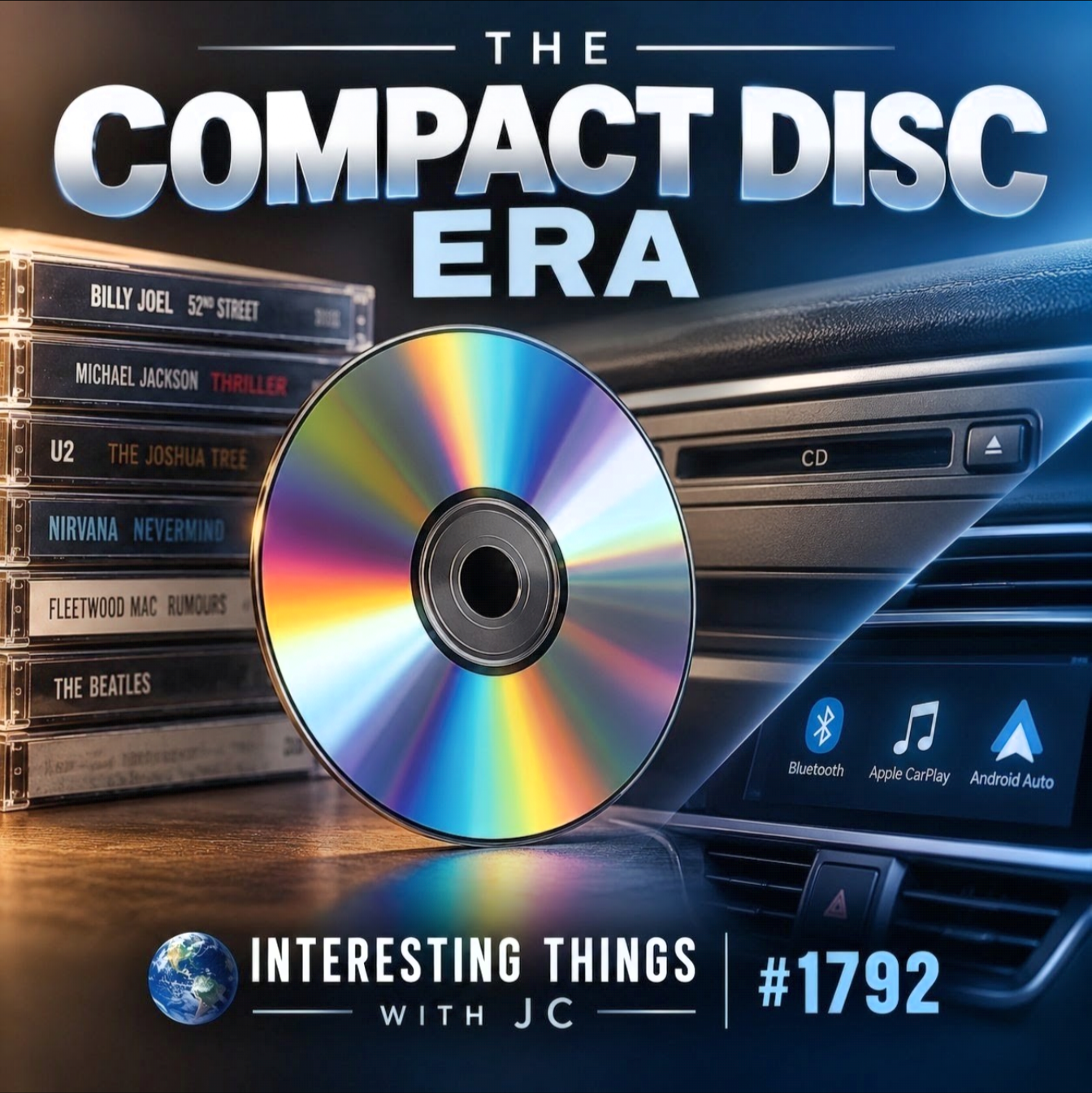
Podcast cover for Interesting Things with JC #1792, “The Compact Disc Era.” A reflective compact disc stands beside stacked CD cases and a car stereo with a CD slot. The image transitions to a modern vehicle touchscreen showing Bluetooth, Apple CarPlay, and Android Auto, illustrating the shift from physical CDs to digital music.
Transcript
Interesting Things with JC #1792:
"The Compact Disc Era"
For about 20 years, the compact disc was how millions of people built a music collection. But when the CD arrived in 1982, even the companies developing it couldn't know just how completely it would replace what came before it, or how quickly something else would eventually replace the CD.
Sony and Philips jointly developed the format, settling on a disc 12 centimeters, or 4.7 inches, across, with 16-bit digital audio sampled at 44.1 kilohertz. On October 1, 1982, Sony launched the CDP-101, the first commercial CD player, in Japan for 168,000 yen. It arrived alongside 50 albums released on CD by CBS/Sony. Billy Joel's "52nd Street" was among them.
The advantages were obvious. Unlike a record, there was no needle touching the music. Unlike a cassette, there was no tape to rewind, stretch, or get eaten by the machine. A laser read microscopic pits encoded into the disc, and listeners could jump directly from track 2 to track 9 with the push of a button.
At first, the hardware was expensive and the music selection limited. Then prices fell, catalogs expanded, and CD players moved into homes, portable players, and especially cars. By 1992, CDs were outselling cassette tapes in the United States.
Then came the peak.
In 2000, Americans bought about 943 million CDs, generating more than $13 billion in U.S. recorded-music revenue.
But something else had already changed. Music itself no longer needed the disc.
MP3s could travel across the internet. File sharing demonstrated that enormous music libraries could exist without shelves of plastic cases. Legal downloads followed, and eventually streaming removed even the need to own the digital file.
You can see the change inside your car. For years, a CD player was expected equipment, first in the dashboard and later as part of an integrated entertainment system. Today, many new vehicles don't offer one at all. USB ports, Bluetooth, smartphones, Apple CarPlay and Android Auto have taken its place. The little slot in the dashboard simply disappeared.
The compact disc helped teach an entire generation to expect music digitally.
Eventually, digital music outgrew the disc.
These are interesting things, with JC.
Student Worksheet
Comprehension
Which two companies jointly developed the standardized compact disc system?
What are the diameter, bit depth, and sampling rate associated with standard audio CDs?
What commercial CD player did Sony introduce in Japan in October 1982?
Identify two practical advantages CDs offered over cassette tapes.
Approximately when did CDs overtake cassettes in the United States?
Analysis
Why is a compact disc considered both a digital technology and a form of physical media?
Explain why MP3 files represented a more fundamental change than simply introducing another kind of music disc.
What does the disappearance of CD players from many new automobiles reveal about changing consumer behavior?
Compare the physical requirements for listening to a CD with those for streaming a song.
Explain the statement: “Eventually, digital music outgrew the disc.”
Reflection
Identify another technology that helped establish a behavior or standard but was later replaced by a technology using the same basic idea.
Does technological obsolescence necessarily mean the older technology was unsuccessful? Use the CD as evidence.
Difficulty Scaling
Level 1: Identify dates, technologies, definitions, and chronological relationships.
Level 2: Explain relationships among physical media, digital encoding, downloads, and streaming.
Level 3: Analyze the CD as an example of technological succession and changing consumer infrastructure.
Student Output: Complete questions 1–10 in full sentences and choose either question 11 or 12 for a 150–250 word evidence-based response.
Academic Integrity Guidance: Distinguish facts drawn from the episode or sources from your own interpretation. Cite outside evidence used in extended responses.
Teacher Guide
Quick Start: Play the episode once without interruption. Ask students to identify the moment when the story changes from the rise of the CD to its decline. Play it a second time while students record the technologies responsible for each transition.
Pacing Guide — Audio First
0–5 minutes: Listen to the episode and record three facts.
5–10 minutes: Construct a class timeline: cassette → CD → MP3/download → smartphone → streaming.
10–20 minutes: Examine how information storage differs from information distribution.
20–30 minutes: Complete worksheet questions 1–10.
30–40 minutes: Discuss why vehicle dashboards provide useful physical evidence of changing technology.
40–50 minutes: Complete and discuss the reflection response.
Materials
Episode audio and transcript
Student worksheet
Internet or library access for extension research
Optional examples or photographs of vinyl records, cassettes, CDs, MP3 players, and vehicle audio systems
Discussion Prompts
When did the CD cease being necessary rather than merely becoming less popular?
What part of the CD survived into streaming?
Why might automobile interiors preserve evidence of technological transitions particularly well?
How can convenience outweigh ownership in consumer technology?
What contemporary technology might currently be undergoing a similar transition?
Formative Checkpoints
Students correctly distinguish digital encoding from internet distribution.
Students recognize that CDs contain digital audio despite being physical objects.
Students can explain why streaming represents distribution without physical media.
Students support technological claims with evidence from the timeline.
Differentiation
Additional Support: Provide students with the major dates and ask them to arrange the events chronologically before answering questions.
Advanced Learners: Research optical-disc error correction, Reed-Solomon coding, or psychoacoustic compression in MP3 encoding.
English Learners: Pair vocabulary with physical examples or images of each format and emphasize comparisons among record, cassette, CD, and streaming.
Homeschool: Examine music-playing equipment currently available in the household and identify which generations of technology it represents.
Answer Key
Sony and Philips.
12 cm/4.7 in; 16-bit; 44.1 kHz.
Sony CDP-101.
Examples include direct track access, no rewinding, no tape to stretch or become tangled, and optical rather than contact-based playback.
By the early 1990s; the episode identifies 1992.
The information is digitally encoded, but it is carried on a manufactured physical disc.
MP3s allowed digital music to exist as transferable computer files without requiring a dedicated physical music carrier.
Consumers increasingly access music through phones, wireless connections, digital files, and streaming rather than discs.
CDs require possession of a disc and compatible optical player; streaming generally requires a compatible digital device, software, and network connection.
Digital audio remained useful after the physical CD became unnecessary.
11–12. Answers will vary but should use specific evidence and logical reasoning.
Quiz
Multiple Choice
Standard audio CDs have a diameter of approximately:
A. 6 cm
B. 8 cm
C. 12 cm
D. 20 cmStandard CD audio uses which sampling rate?
A. 8 kHz
B. 22.05 kHz
C. 44.1 kHz
D. 192 kHzWhich companies jointly developed the standardized CD system?
A. Apple and IBM
B. Sony and Philips
C. RCA and Microsoft
D. Panasonic and WarnerSony's first commercial CD player was the:
A. Walkman
B. CDP-101
C. Discman 1
D. MP3-101Which development most directly removed the requirement for music to remain attached to a physical disc?
A. Larger speakers
B. Magnetic tape
C. Transferable digital audio files
D. FM broadcastingWhy could listeners jump directly between tracks on a CD?
A. Optical digital playback permitted direct access to indexed tracks.
B. The disc physically changed speed for every song.
C. CDs contained several separate needles.
D. Each track was stored on a different disc layer.Which sequence best represents the broad technological transition discussed in the episode?
A. Streaming → cassette → CD → vinyl
B. Cassette → CD → downloadable files → streaming
C. CD → vinyl → cassette → radio
D. MP3 → cassette → CD → streamingThe disappearance of CD drives from many automobile dashboards primarily demonstrates:
A. CDs cannot contain music.
B. Automobiles no longer contain audio systems.
C. alternative digital connections and services reduced the need for dedicated optical drives.
D. digital audio was abandoned.A CD differs from a vinyl record because CD audio is:
A. digitally encoded.
B. stored exclusively through magnetism.
C. mechanically amplified without electronics.
D. transmitted through radio.The episode's final idea, “digital music outgrew the disc,” means:
A. modern music files are physically larger than CDs.
B. digital audio continued while dependence on the physical CD declined.
C. CDs stopped containing digital information.
D. music stopped being recorded digitally.
Quiz Answer Key: 1-C, 2-C, 3-B, 4-B, 5-C, 6-A, 7-B, 8-C, 9-A, 10-B
Assessment
Performance Task: Create a one-page technological succession analysis tracing recorded music through at least four stages: cassette, compact disc, downloadable digital audio, and streaming. Identify what changed at each stage and what remained.
Required Evidence
At least four correctly sequenced technologies
At least three dates or time periods
Explanation of physical versus digital storage
Explanation of ownership versus access
At least two credible sources
A concluding explanation of whether the CD should be considered a failed technology, a transitional technology, or both, supported by evidence
Assessment Rubric — 20 Points
Historical Accuracy — 5 points: Dates, chronology, technologies, and claims are accurate.
Technical Understanding — 5 points: Clearly explains digital encoding, physical media, files, and streaming.
Evidence — 4 points: Uses specific evidence from the episode and credible outside sources.
Analysis — 4 points: Explains technological succession rather than merely listing devices.
Communication — 2 points: Work is clear, organized, and appropriately cited.
Mastery Benchmark: 16/20 points demonstrates proficiency.
Standards Alignment
NGSS — Science & Engineering Practices
HS-ETS1-3 — Evaluate a solution to a complex real-world problem based on prioritized criteria and trade-offs — Students evaluate advantages and limitations of successive music-distribution technologies, including portability, physical storage, accessibility, and infrastructure.
SEP — Analyzing and Interpreting Data — Students use historical adoption and sales information to identify technological transitions and explain changing consumer behavior.
SEP — Engaging in Argument from Evidence — Students construct an evidence-based explanation of whether the CD represents technological failure, success, or transition.
CCSS Reading
CCSS.ELA-LITERACY.RST.9-10.1 — Cite specific textual evidence to support analysis of science and technical texts — Students identify transcript and source evidence explaining the transition from optical discs to networked digital distribution.
CCSS.ELA-LITERACY.RST.11-12.3 — Follow precisely a complex multistep procedure when carrying out experiments, taking measurements, or performing technical tasks; analyze specific results based on explanations in the text — Students examine the sequence connecting digital encoding, compression, distribution, and playback technologies.
CCSS.ELA-LITERACY.RH.11-12.7 — Integrate and evaluate multiple sources of information presented in diverse formats and media — Students combine audio narrative, historical data, technical documentation, and visual timelines.
CCSS Writing
CCSS.ELA-LITERACY.WHST.9-10.2 — Write informative/explanatory texts, including the narration of historical events, scientific procedures/experiments, or technical processes — Students explain the technological progression from physical digital media to network-based music.
CCSS.ELA-LITERACY.WHST.11-12.1 — Write arguments focused on discipline-specific content — Students develop an evidence-based interpretation of technological obsolescence.
CCSS.ELA-LITERACY.WHST.11-12.9 — Draw evidence from informational texts to support analysis, reflection, and research — Students incorporate evidence from technical and historical sources into the assessment.
ISTE Standards for Students
1.3 Knowledge Constructor — Students evaluate historical and technical sources to construct an explanation of technological change.
1.5 Computational Thinker — Students examine how digitization and compression altered the storage and movement of information.
1.6 Creative Communicator — Students communicate technological succession through an organized explanatory product.
C3 Framework
D2.His.1.9-12 — Evaluate how historical events and developments were shaped by unique circumstances of time and place as well as broader historical contexts — Students connect the CD's adoption and decline to changes in computing, internet access, mobile devices, and consumer behavior.
D2.His.2.9-12 — Analyze change and continuity in historical eras — Students identify what changed and what remained constant as recorded music moved from discs to files and streaming.
Career Readiness Competencies
Technology literacy
Evidence-based reasoning
Historical analysis
Data interpretation
Technical communication
Media literacy
Show Notes
Interesting Things with JC #1792, “The Compact Disc Era,” examines how Sony and Philips helped establish the compact disc as a major consumer audio format beginning in 1982, how CDs came to dominate recorded music, and how MP3s, downloads, smartphones, Bluetooth, and streaming eventually removed the need for a physical digital music carrier.
The episode uses one particularly visible artifact of that transition: the automobile CD player. Once a familiar dashboard feature, the dedicated CD slot has disappeared from many modern vehicles as digital connections and smartphone integration have taken its place.
Key Topics: compact disc history, Sony CDP-101, Philips, Sony, digital audio, 44.1 kHz, 16-bit audio, optical storage, MP3, music downloads, streaming, Bluetooth, automobile CD players, technological obsolescence
Free Classroom Use: Curriculum materials are available for educational use with attribution. No login or paywall.
Watch: youtube.com/@interestingthingswithjc
RSS/MP3 & Curriculum: JimConnors.net
References
Sony Group Corporation — Sony History, Chapter 8: This is the replacement of the gramophone record!
Corporate history covering Sony's development and commercialization of the compact disc and CDP-101.
https://www.sony.com/en/SonyInfo/CorporateInfo/History/SonyHistory/2-08.htmlPhilips — The history of the CD
Historical material concerning Philips' role in optical audio-disc development and collaboration with Sony.
https://www.philips.com/a-w/research/technologies/cd.htmlRecording Industry Association of America — U.S. Sales Database
Historical recorded-music shipment and revenue statistics documenting changes among physical and digital formats.
https://www.riaa.com/u-s-sales-database/Library of Congress — Digital Audio Preservation
Technical and preservation information useful for understanding digitally encoded audio formats and long-term media preservation.
https://www.loc.gov/preservation/digital/formats/content/sound.shtmlFraunhofer IIS — MP3
Background on the development and operation of MP3 audio compression technology.
https://www.iis.fraunhofer.de/en/ff/amm/consumer-electronics/mp3.htmlFederal Reserve Bank of St. Louis — Recorded Music Industry Data Resources
Economic and historical data resources useful for examining changes in media consumption and technology markets.
https://fred.stlouisfed.org/