1801: "Projectiles Launched at an Angle"
Interesting Things with JC #1801: "Projectiles Launched at an Angle"
Throw 2 baseballs at different angles, using exactly the same speed, and both can land at the same distance. Discover why a higher throw doesn't always travel farther and what gravity has to do with it.
Curriculum - Episode Anchor
Series: Interesting Things with JC
Episode Number: 1801
Episode Title: Projectiles Launched at an Angle
Host: JC
Subject Area: Physics, Physical Science, Mathematics, Engineering
Audience: Grades 9–12, introductory college, homeschool, lifelong learners
Instructional Duration: 45–60 minutes
Instructional Level: High school physics, with introductory and advanced extensions
Prerequisite Knowledge: Speed, velocity, acceleration, gravity, basic trigonometry
Central Question: How does the angle at which an object is launched affect its height, time in the air, and horizontal distance?
Learning Objectives
Students will be able to:
Distinguish horizontal and vertical components of projectile motion.
Explain how gravity affects vertical velocity.
Calculate horizontal and vertical velocity components using trigonometry.
Predict how launch angle changes maximum height, flight time, and range.
Explain why complementary launch angles can produce identical horizontal ranges.
Identify assumptions and limitations of ideal projectile-motion models.
Apply projectile-motion principles to familiar situations.
Essential Understanding: A projectile follows a single trajectory, but its motion can be analyzed using independent horizontal and vertical components.
Lesson Overview
This lesson examines the motion of objects launched at an angle relative to the horizontal.
Using baseballs as an accessible example, students investigate how launch angle influences a projectile's trajectory.
The lesson emphasizes that horizontal and vertical motion can be analyzed independently when air resistance is neglected.
Students discover why a ball launched at 30 degrees can travel the same horizontal distance as one launched at 60 degrees, despite following a substantially different path.
Scientific Context
For ideal projectile motion near Earth's surface:
Horizontal acceleration is zero.
Vertical acceleration is approximately −9.81 m/s² (−32.2 ft/s²).
Horizontal velocity remains constant.
Vertical velocity changes continuously under gravity.
At maximum height, vertical velocity is zero.
Total velocity at maximum height is generally not zero.
The trajectory is parabolic.
Mathematical Relationships
For an initial speed (v₀) launched at an angle (θ):
Horizontal Velocity
vₓ = v₀ × cos(θ)
Initial Vertical Velocity
vᵧ₀ = v₀ × sin(θ)
Vertical Velocity After Time t
vᵧ = vᵧ₀ − (g × t)
Horizontal Displacement
x = vₓ × t
Vertical Displacement
y = (vᵧ₀ × t) − (0.5 × g × t²)
For Equal Launch and Landing Elevations
Total Flight Time:
T = (2 × v₀ × sin(θ)) ÷ g
Horizontal Range:
R = (v₀² × sin(2θ)) ÷ g
Formula Key
v₀ = Initial launch speed
vₓ = Horizontal velocity
vᵧ₀ = Initial vertical velocity
vᵧ = Vertical velocity at time t
θ = Launch angle measured above horizontal
g = Magnitude of gravitational acceleration (9.81 m/s²)
t = Elapsed time
x = Horizontal displacement
y = Vertical displacement relative to launch position
T = Total flight time
R = Horizontal range
Instructional Caution
These equations describe idealized projectile motion under constant gravitational acceleration, without aerodynamic drag.
The flight-time and horizontal-range equations assume that the projectile launches and lands at the same elevation. Different launch and landing elevations require additional calculations.
Key Vocabulary
1. Projectile
An object moving through the air under the influence of gravity after launch, assuming other forces are negligible.
2. Projectile Motion
The movement of a launched object along a trajectory determined by its initial velocity and acceleration.
3. Trajectory (truh-JEK-tuh-ree)
The path followed by a moving object.
4. Velocity (vuh-LOSS-ih-tee)
Speed together with direction.
5. Horizontal Component
The portion of velocity directed parallel to the ground.
6. Vertical Component
The portion of velocity directed upward or downward.
7. Acceleration
The rate at which velocity changes over time.
8. Gravity
The gravitational interaction responsible for the downward acceleration of freely moving objects near Earth's surface.
9. Launch Angle
The angle between an object's initial velocity and the horizontal.
10. Parabola (puh-RAB-uh-luh)
A mathematical curve describing an ideal projectile's trajectory.
11. Range
The horizontal distance traveled by a projectile.
12. Maximum Height
The greatest vertical position reached relative to the launch point.
13. Complementary Angles
Two angles whose sum equals 90 degrees.
14. Air Resistance
A force opposing an object's motion relative to the surrounding air.
15. Vector
A quantity possessing both magnitude and direction.
Narrative Core
Open — Establishing Curiosity
A baseball thrown straight upward returns toward its starting position.
Throw that same baseball forward at an angle, and it follows a curved trajectory.
Changing the launch angle changes the shape of that trajectory, but not always the horizontal distance traveled.
Info — Understanding Motion
Projectile motion involves 2 independent components.
Horizontal motion determines how rapidly the object moves forward.
Vertical motion determines how the object's height changes.
Under ideal conditions, gravity changes vertical velocity without changing horizontal velocity.
Details — The Scientific Discovery
A projectile launched at 30 degrees and another launched at 60 degrees can travel identical horizontal distances when their initial speeds match and they land at their original launch height.
The 60-degree projectile travels higher and remains airborne longer.
The 30-degree projectile moves horizontally faster but remains airborne for less time.
These differences compensate, producing equal ranges.
Reflection — Applications
Understanding projectile motion supports the analysis of sports, engineering, transportation, and aerospace systems.
Real-world applications require consideration of additional factors, including air resistance, launch height, wind, and object geometry.
Closing — Central Understanding
A projectile's trajectory results from the combination of its horizontal and vertical motion.
Understanding those components makes the overall path predictable under specified physical conditions.
Transcript
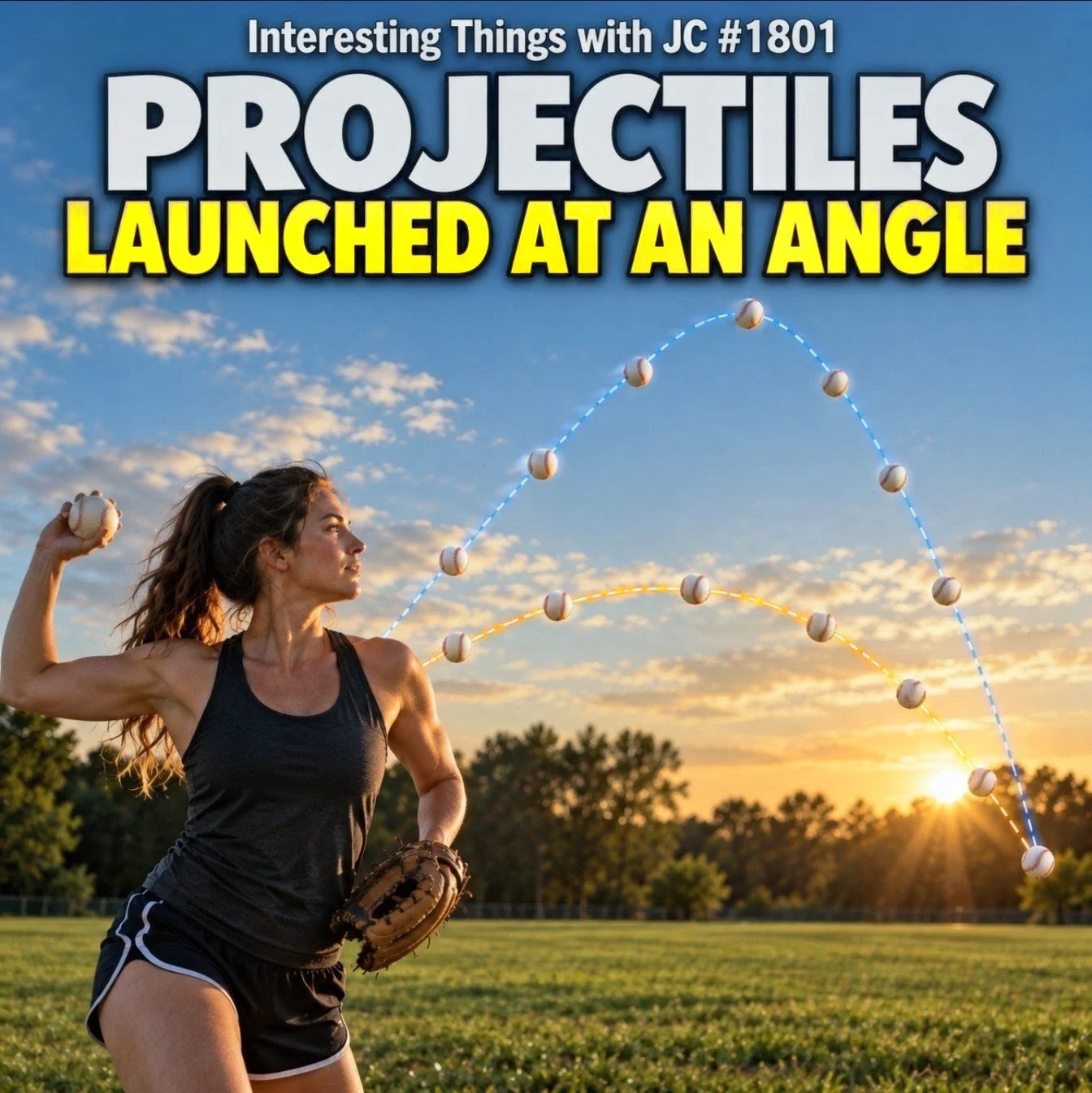
Square podcast cover art for Interesting Things with JC, episode #1801, “Projectiles Launched at an Angle.” A woman with a ponytail prepares to throw a baseball on a sunlit grassy field. Blue and orange curved trajectories illustrate how different launch angles affect a projectile’s flight. The episode number appears at the top, with the title in large white lettering.
Interesting Things with JC #1801:
"Projectiles Launched at an Angle"
Throw a baseball straight up, and it comes straight back down. Throw it forward at an angle, and it follows a curved path. But something interesting happens when you change that angle, even if you throw the ball at exactly the same speed.
When an object is launched at an angle, its motion has 2 parts: horizontal and vertical. Physicists call these components of velocity.
The horizontal component carries the object forward, while the vertical component determines how quickly it rises or falls.
Gravity constantly changes the vertical velocity, pulling downward at approximately 32.2 feet per second squared, or 9.81 meters per second squared. But without air resistance, gravity doesn't change the horizontal velocity.
Consider launching a ball at 45 degrees, traveling 44.7 miles per hour, or 20 meters per second.
At that angle, its horizontal and upward vertical velocities are equal, each approximately 31.6 miles per hour, or 14.1 meters per second.
As the ball climbs, gravity slows its upward movement until its vertical velocity reaches zero at the highest point.
But the ball hasn't stopped. It's still moving forward at the same horizontal speed.
Gravity then accelerates it downward, producing the familiar curved path called a parabola.
Now here's something less obvious.
Launch that same ball at 30 degrees, then again at 60 degrees, using exactly the same initial speed.
Ignoring air resistance, both balls travel the same horizontal distance, provided they land at their original launch height.
The 60-degree shot climbs higher and stays airborne longer. The 30-degree shot follows a flatter path but moves forward faster.
Both reach the same distance because the extra time in the air balances the difference in horizontal speed.
And under those same conditions, 45 degrees produces the greatest possible horizontal range.
Change the launch height or introduce air resistance, and those results can change.
That's why the angle of a basketball shot, the trajectory of a golf ball, or the launch of a rocket involves more than simply aiming upward.
The launch angle determines how the object's initial speed is divided between moving forward and moving upward. Once it's airborne, gravity determines how its vertical motion changes.
These are interesting things, with JC.
Student Worksheet
Student Name: ____________________
Date: ____________________
Class: ____________________
Part A — Comprehension
What are the 2 components of projectile velocity?
Which component is directly affected by gravity?
What happens to vertical velocity at maximum height?
Does a projectile stop moving at its highest point? Explain.
What shape does an ideal projectile follow?
Part B — Conceptual Analysis
Why does a projectile launched at 60 degrees remain airborne longer than one launched at 30 degrees when initial speeds are equal?
Why can these 2 launch angles produce identical horizontal ranges?
Why does a 45-degree launch maximize horizontal range under ideal conditions?
How would air resistance change the motion of a baseball?
Why might the maximum-range angle differ when launching from an elevated platform?
Part C — Mathematical Investigation
Assume:
Initial velocity: 20 m/s
Gravitational acceleration: 9.81 m/s²
No air resistance
Equal launch and landing elevations
Problem 1 — Horizontal Velocity
Calculate horizontal velocity for launch angles of:
30 degrees
45 degrees
60 degrees
Formula: vₓ = v₀ × cos(θ)
Problem 2 — Vertical Velocity
Calculate initial vertical velocity for:
30 degrees
45 degrees
60 degrees
Formula: vᵧ₀ = v₀ × sin(θ)
Problem 3 — Flight Time
Calculate total flight time for each launch angle: 30, 45, and 60 degrees.
Formula: T = (2 × v₀ × sin(θ)) ÷ g
Problem 4 — Horizontal Range
Calculate horizontal range for each launch angle: 30, 45, and 60 degrees.
Formula: R = vₓ × T
Problem 5 — Maximum Height
Calculate maximum height for each launch angle: 30, 45, and 60 degrees.
Formula: H = vᵧ₀² ÷ (2 × g)
Formula Key
v₀ = Initial launch speed
vₓ = Horizontal velocity
vᵧ₀ = Initial vertical velocity
θ = Launch angle
g = Gravitational acceleration
T = Total flight time
R = Horizontal range
H = Maximum height
Student Instructions
Show all calculations, including formula substitutions and units. Round final answers to 2 decimal places. Use degree mode on your calculator for trigonometric functions.
Part D — Results Table
Complete the following results for each launch angle using your calculations from Part C.
30-Degree Launch
Horizontal Velocity: __________________ m/s
Initial Vertical Velocity: __________________ m/s
Flight Time: __________________ seconds
Horizontal Range: __________________ meters
Maximum Height: __________________ meters
45-Degree Launch
Horizontal Velocity: __________________ m/s
Initial Vertical Velocity: __________________ m/s
Flight Time: __________________ seconds
Horizontal Range: __________________ meters
Maximum Height: __________________ meters
60-Degree Launch
Horizontal Velocity: __________________ m/s
Initial Vertical Velocity: __________________ m/s
Flight Time: __________________ seconds
Horizontal Range: __________________ meters
Maximum Height: __________________ meters
Part E — Reflection
Explain why launching an object higher does not necessarily make it travel farther horizontally.
Identify a real-world activity where understanding launch angle is important.
Explain one limitation of the ideal projectile-motion model.
Difficulty Scaling
Level 1: Identify components and explain their behavior.
Level 2: Calculate velocities, flight times, heights, and ranges.
Level 3: Derive the complementary-angle relationship mathematically and evaluate model limitations.
Student Output: Completed worksheet, calculation table, and written reflection.
Academic Integrity Guidance: Show calculations, identify assumptions, and distinguish measured observations from theoretical predictions. Calculators and simulations may be used when authorized by the instructor.
Teacher Guide
Quick Start: Play the episode before presenting the equations. Ask students to predict whether a higher launch angle always produces greater horizontal distance.
Materials
Podcast audio or transcript
Calculator with trigonometric functions
Graph paper
Pencil
Optional computer or tablet
Optional projectile-motion simulation
Optional soft foam ball and measuring tape
Pacing Guide — Audio First
0–5 minutes: Introduce the central question and collect predictions.
5–10 minutes: Play the podcast episode.
10–20 minutes: Discuss horizontal and vertical velocity.
20–35 minutes: Complete the mathematical investigation.
35–45 minutes: Compare results and explain complementary angles.
45–55 minutes: Complete reflection questions and quiz.
55–60 minutes: Review conclusions and collect exit tickets.
Worked Example — Projectile Motion
Initial velocity: v₀ = 20 m/s
Launch angle: θ = 45°
Horizontal velocity: vₓ = 20 × cos(45°) = 14.14 m/s
Initial vertical velocity: vᵧ₀ = 20 × sin(45°) = 14.14 m/s
Flight time: T = (2 × 14.14) ÷ 9.81 = 2.88 seconds
Horizontal range: R = 14.14 × 2.88 ≈ 40.8 meters (133.8 feet)
Maximum height: H = 14.14² ÷ (2 × 9.81) ≈ 10.2 meters (33.4 feet)
All calculations assume no air resistance and equal launch and landing elevations. Values are rounded.
Worksheet Answer Key
Comprehension
Horizontal and vertical.
Vertical.
It becomes zero momentarily.
No. Horizontal velocity remains nonzero for an angled launch under ideal conditions.
A parabola.
Conceptual Analysis
Its greater initial vertical velocity requires more time for gravity to reverse its upward motion and return it to the original height.
The higher-angle launch has a longer flight time but a smaller horizontal velocity.
The range equation contains \(\sin(2\theta)\), which reaches its maximum value at \(\theta=45^\circ\) within the standard 0–90-degree launch-angle range.
Air resistance reduces horizontal speed and changes the trajectory from the ideal parabola.
Additional falling time changes the balance between horizontal and vertical velocity.
Mathematical Results
AngleHorizontal VelocityVertical VelocityFlight TimeRangeMaximum Height30°17.32 m/s10.00 m/s2.04 s35.31 m5.10 m45°14.14 m/s14.14 m/s2.88 s40.77 m10.19 m60°10.00 m/s17.32 m/s3.53 s35.31 m15.29 m
Reflection Guidance
Horizontal range depends on both horizontal speed and time in the air.
Accept supported examples involving sports, engineering, or transportation.
Accept air resistance, wind, variable launch height, or other relevant limitations.
Common Misconceptions
A projectile stops moving at maximum height.
Gravity affects horizontal velocity directly.
A higher launch angle always produces a greater range.
Horizontal and vertical velocities must have equal magnitudes.
A projectile's path is always perfectly parabolic.
The 45-degree rule applies regardless of launch conditions.
Formative Checkpoints
Students correctly identify velocity components.
Students explain the highest-point condition.
Students calculate the range of a 45-degree launch.
Students explain complementary-angle behavior.
Students distinguish idealized predictions from real-world trajectories.
Differentiation
Additional Support: Provide a diagram showing horizontal and vertical velocity arrows.
Advanced Learners: Derive the range equation and analyze unequal launch and landing elevations.
English Learners: Use labeled diagrams and vocabulary cards.
Students Requiring Accessibility Supports: Provide the transcript, accessible digital equations, and alternative response formats.
Optional Investigation
Use the PhET Projectile Motion Simulation.
Select ideal conditions without air resistance.
Set initial speed to 20 m/s.
Launch at 30, 45, and 60 degrees.
Record the horizontal range and maximum height.
Compare the results with calculated predictions.
Enable air resistance and observe changes.
Explain differences between the ideal and drag-inclusive models.
Quiz
Student Name: ____________________
Date: ____________________
Multiple Choice
Which force causes the vertical acceleration of an ideal projectile near Earth's surface?
A. Magnetism
B. Gravity
C. Horizontal velocity
D. Air pressureWhat happens to horizontal velocity when air resistance is ignored?
A. It increases continuously.
B. It decreases continuously.
C. It remains constant.
D. It becomes zero at maximum height.At maximum height, vertical velocity is:
A. Maximum
B. Zero
C. Equal to gravitational acceleration
D. Always equal to horizontal velocityUnder ideal conditions, which launch angle produces the greatest range for equal launch and landing heights?
A. 15 degrees
B. 30 degrees
C. 45 degrees
D. 75 degreesWhich pair represents complementary launch angles?
A. 20° and 60°
B. 30° and 60°
C. 45° and 60°
D. 60° and 90°A projectile launched at 60 degrees generally reaches a greater maximum height than one launched at 30 degrees when:
A. Initial speeds are equal.
B. Gravity is absent.
C. Horizontal speeds are equal.
D. Both objects have zero initial vertical velocity.Which quantity changes continuously during ideal projectile motion?
A. Horizontal acceleration
B. Horizontal velocity
C. Vertical velocity
D. MassA projectile's ideal trajectory is:
A. Circular
B. Parabolic
C. Rectangular
D. Spiral
Short Answer
Explain why 30-degree and 60-degree launches can produce equal ranges.
Explain why a projectile continues moving horizontally at maximum height.
Quiz Answer Key
B
C
B
C
B
A
C
B
The 60-degree launch has a longer flight time but a lower horizontal velocity; the 30-degree launch has a shorter flight time but a higher horizontal velocity. These effects balance under ideal equal-elevation conditions.
Gravity changes vertical velocity, while horizontal velocity remains constant when air resistance is ignored.
Assessment
Assessment Structure
Total Points: 100
ComponentPointsComprehension Questions15Conceptual Analysis20Mathematical Calculations30Results Table15Reflection Questions10Quiz10Total100
Assessment Rubric
CriterionExemplaryProficientDevelopingBeginningScientific UnderstandingAccurate and detailed explanationsMostly accurate explanationsPartial understandingMajor misconceptionsMathematical AccuracyCorrect formulas, substitutions, units, and resultsMinor computational errorsMultiple errorsUnable to apply equationsConceptual AnalysisExplains relationships and assumptionsExplains main relationshipsLimited explanationIncorrect relationshipsScientific CommunicationClear, precise, evidence-basedGenerally clearIncomplete or impreciseUnclear or unsupportedApplicationCorrectly applies concepts to new situationsApplies concepts with minor errorsLimited transferCannot apply concepts
Performance Levels
90–100: Advanced mastery
80–89: Proficient
70–79: Developing proficiency
60–69: Limited proficiency
Below 60: Additional instruction recommended
Mastery Evidence
Students demonstrate mastery when they can calculate projectile quantities, explain the independence of velocity components, and identify the conditions under which complementary-angle relationships apply.
Assessment Note: Mathematical results should be evaluated using appropriate rounding tolerances.
Standards Alignment
NGSS — Science & Engineering Practices
Using Mathematics and Computational Thinking: Students calculate velocity components, flight time, maximum height, and range using mathematical models.
Developing and Using Models: Students compare idealized projectile-motion predictions with simulations and recognize model limitations.
Analyzing and Interpreting Data: Students compare launch-angle results and identify relationships between angle, range, and maximum height.
Constructing Explanations and Designing Solutions: Students explain projectile trajectories using established physical principles.
NGSS — Disciplinary Core Ideas
HS-PS2-1 — Motion and Stability: Forces and Interactions: Students analyze projectile motion using mathematical representations of acceleration and velocity. The lesson supports this performance expectation; full alignment requires explicit treatment of Newton's second law and net force.
HS-PS2.A — Forces and Motion: Students connect gravitational force with acceleration and changes in motion.
NGSS — Crosscutting Concepts
Patterns: Students identify equal-range relationships for complementary angles.
Cause and Effect: Students explain how launch angle affects the components of initial velocity.
Systems and System Models: Students analyze horizontal and vertical motion separately within a combined physical system.
Common Core State Standards — Mathematics
CCSS.MATH.CONTENT.HSF.TF.A.2 — Trigonometric Functions: Students use sine and cosine to calculate velocity components.
CCSS.MATH.CONTENT.HSF.TF.C.8 — Trigonometric Identities: Students can extend the investigation by applying double-angle relationships.
CCSS.MATH.PRACTICE.MP2 — Reason Abstractly and Quantitatively: Students connect mathematical expressions with measurable physical quantities.
CCSS.MATH.PRACTICE.MP4 — Model with Mathematics: Students construct and evaluate mathematical models of projectile motion.
CCSS.MATH.PRACTICE.MP6 — Attend to Precision: Students use appropriate units, significant figures, and rounding.
CCSS Reading — Science and Technical Subjects
CCSS.ELA-LITERACY.RST.9-10.1 — Cite Specific Textual Evidence: Students support explanations using information from the episode transcript.
CCSS.ELA-LITERACY.RST.9-10.7 — Translate Quantitative or Technical Information: Students interpret numerical data and translate between equations, tables, and verbal explanations.
CCSS.ELA-LITERACY.RST.11-12.3 — Follow Precisely a Complex Multistep Procedure: Students complete calculations and investigations involving multiple mathematical steps.
CCSS.ELA-LITERACY.RST.11-12.7 — Integrate and Evaluate Multiple Sources of Information: Students compare transcript explanations, equations, and simulation results.
CCSS Writing
CCSS.ELA-LITERACY.WHST.9-10.2 — Write Informative/Explanatory Texts: Students explain projectile-motion principles using scientific terminology.
CCSS.ELA-LITERACY.WHST.9-10.9 — Draw Evidence from Informational Texts: Students support written explanations with evidence from the transcript and investigation.
CCSS.ELA-LITERACY.WHST.11-12.2 — Write Informative/Explanatory Texts: Advanced students produce mathematically supported explanations of projectile behavior.
ISTE Standards for Students
1.3 Knowledge Constructor: Students evaluate information from the episode, calculations, and simulation.
1.4 Innovative Designer: Students use simulation tools to test how changing launch conditions affects outcomes.
1.5 Computational Thinker: Students analyze numerical patterns and model projectile behavior.
Bloom's Taxonomy
Remember: Define velocity, trajectory, acceleration, and range.
Understand: Explain horizontal and vertical motion.
Apply: Calculate projectile quantities.
Analyze: Compare trajectories at different launch angles.
Evaluate: Assess limitations of ideal projectile models.
Create: Design a simulation investigation testing projectile behavior.
Universal Design for Learning
Multiple Means of Engagement: Sports examples, simulations, and student predictions.
Multiple Means of Representation: Audio, transcript, diagrams, equations, and numerical tables.
Multiple Means of Action and Expression: Written explanations, calculations, verbal responses, and simulation reports.
Career and Technical Education Connections
Engineering: Modeling motion and predicting object trajectories.
Aerospace: Understanding the initial trajectory of launched vehicles.
Sports Science: Analyzing the relationship between launch angle and distance.
Computer Science: Developing simulations using mathematical models.
International Curriculum Connections
International Baccalaureate Physics: Kinematics, vector components, and two-dimensional motion.
Cambridge International AS & A Level Physics: Motion in two dimensions and projectile-motion calculations.
England National Curriculum — GCSE Physics: Motion, forces, acceleration, and gravitational effects. Projectile-component calculations extend beyond some GCSE specifications.
England National Curriculum — A Level Physics: Projectile motion, vector analysis, and mathematical modeling.
Standards Implementation Note: These alignments identify relevant standards and instructional connections. A single lesson does not necessarily satisfy every element of a complete performance expectation or qualification specification.
Show Notes
Students discover why baseballs launched at 30 and 60 degrees can travel identical horizontal distances under ideal conditions, and why 45 degrees produces the greatest range when launch and landing heights are equal.
Key Concepts: Projectile motion, launch angle, velocity components, gravity, maximum height, horizontal range, complementary angles.
Curriculum Applications: Physics, mathematics, engineering, introductory mechanics.
Educational Use: This curriculum is intended for classroom instruction, homeschool learning, independent study, and educational enrichment.
Permissions: Free classroom use with attribution to Interesting Things with JC and Jim Connors LLC. No resale or unauthorized commercial redistribution.
Accessibility: Transcript-based instruction, written activities, and adaptable assessment formats support accessible learning.
References
Halliday, D., Resnick, R., & Walker, J. (2018). Fundamentals of physics (11th ed.). Wiley.
OpenStax. (2022). University physics volume 1. Rice University. https://openstax.org/details/books/university-physics-volume-1
OpenStax. (2016). College physics. Rice University. https://openstax.org/details/books/college-physics
University of Colorado Boulder. (n.d.). Projectile motion [Interactive simulation]. PhET Interactive Simulations. https://phet.colorado.edu/en/simulations/projectile-motion
National Research Council. (2012). A framework for K–12 science education: Practices, crosscutting concepts, and core ideas. National Academies Press. https://doi.org/10.17226/13165
NGSS Lead States. (2013). Next generation science standards: For states, by states. National Academies Press. https://doi.org/10.17226/18290
National Governors Association Center for Best Practices, & Council of Chief State School Officers. (2010). Common core state standards. https://www.thecorestandards.org/
International Society for Technology in Education. (2016). ISTE standards for students. https://iste.org/standards/students
CAST. (2024). Universal design for learning guidelines version 3.0. https://udlguidelines.cast.org/