1800: "The Siege of Yorktown"
Interesting Things with JC #1800: "The Siege of Yorktown"
On October 9, 1781, George Washington fired an American cannon at Yorktown as 8,000 British troops faced a massive American and French army. But the British had an even bigger problem: their escape by sea had been cut off.
Curriculum - Episode Anchor
Episode Title: The Siege of Yorktown Episode Number: 1800 Series: Interesting Things with JC Host: JC Historical Anchor: October 9, 1781 Audience: Grades 9–12, introductory college, homeschool, lifelong learners Subject Areas: United States History, World History, Civics, Geography, Military History, Historical Research Instructional Duration: 50–60 minutes, with optional extensions
Central Question: How did American and French cooperation at Yorktown transform a British military position into a decisive defeat?
Historical Focus
On October 9, 1781, George Washington fired the first American cannon of the allied bombardment at Yorktown, Virginia. French artillery had begun firing earlier that afternoon. The bombardment was part of a coordinated siege involving American ground forces, French soldiers, and French naval power.
Historical Significance
The British surrender on October 19, 1781, effectively ended major British offensive operations against the rebelling American colonies. The Revolutionary War continued, and American independence received formal British recognition through the Treaty of Paris in 1783.
Essential Understanding
Yorktown demonstrates how military geography, logistics, international alliances, coordinated operations, and political consequences can determine the outcome of a war.
Lesson Overview
Lesson Description
Students investigate the Siege of Yorktown as a military operation and an event with international consequences. Using the episode, historical maps, primary sources, and evidence-based discussion, students examine why British General Charles Cornwallis could not escape, how French military support contributed to the victory, and why the surrender accelerated peace negotiations without immediately ending the war.
Learning Objectives
By the end of the lesson, students will be able to:
Identify the principal commanders, dates, locations, and military forces involved in the Yorktown campaign.
Explain how the French naval victory in the Chesapeake contributed to the British defeat.
Describe the purpose of siege trenches, artillery bombardment, and defensive redoubts.
Construct an accurate chronology of events from September 5 through October 19, 1781.
Distinguish the military surrender at Yorktown from the diplomatic recognition of American independence in 1783.
Analyze how geography and logistics influenced military decisions.
Support a historical argument with at least two pieces of evidence from reliable sources.
Essential Questions
Why did Cornwallis become trapped at Yorktown?
Could Washington have achieved the same outcome without French assistance?
Why was control of Chesapeake Bay strategically important?
How did the British surrender influence political decisions in London?
What distinguishes winning a major battle from ending a war?
Expected Learning Outcomes
Students will produce a completed historical worksheet, a ten-question knowledge assessment, and a short evidence-based written explanation identifying the principal causes and consequences of the British defeat.
Historical Accuracy Notes
Washington fired the first American cannon on October 9, not the first allied cannon.
French naval forces under Admiral François Joseph Paul de Grasse had fought British forces at the Battle of the Chesapeake on September 5.
The October 19 capitulation involved approximately 8,000 British and German military personnel, although historical counts vary according to which categories are included.
Cornwallis did not personally participate in the formal surrender ceremony.
The Revolutionary War did not formally end in October 1781.
Key Vocabulary
Siege (seej): A military operation in which forces surround a defended position to compel its surrender.
Artillery (ar-TILL-er-ee): Large weapons, including cannons and mortars, used to fire projectiles at enemy positions.
Bombardment (bom-BARD-ment): Sustained attacks using artillery or other explosive weapons.
Redoubt (ree-DOWT): A small, usually enclosed defensive fortification.
Capitulation (kuh-pitch-uh-LAY-shun): Formal surrender under agreed conditions.
Logistics (loh-JISS-tiks): Planning and movement of troops, supplies, equipment, and transportation.
Alliance (uh-LY-uhns): An agreement between nations to cooperate toward shared objectives.
Blockade (blah-KAYD): An operation designed to prevent access to or departure from a location, particularly by sea.
Chesapeake Bay (CHESS-uh-peek): A large estuary along the Atlantic coast of Maryland and Virginia.
Cornwallis (corn-WALL-iss): British general commanding forces at Yorktown.
Rochambeau (roh-sham-BOH): French general commanding the principal French army supporting Washington.
De Grasse (duh GRAHSS): French admiral whose fleet secured naval control essential to the Yorktown campaign.
Treaty of Paris: The 1783 agreement in which Britain formally recognized American independence.
Primary Source: Evidence produced by participants or observers during the historical period being studied.
Secondary Source: A later interpretation or explanation based on historical evidence.
Vocabulary Application
Students select five terms and explain how each contributed to either the military outcome at Yorktown or its political consequences.
Narrative Core
Open — The Artillery Begins
On October 9, 1781, George Washington personally fired the first American cannon during the allied bombardment of Yorktown. French artillery had begun firing earlier that afternoon. British troops under General Charles Cornwallis were increasingly surrounded by American and French forces.
The bombardment was only one part of the operation. The British army also faced a serious problem beyond its defensive lines: access to Chesapeake Bay.
Info — The Strategic Situation
Cornwallis had established his army at Yorktown, along the York River, expecting access to British naval support.
Washington and French General Rochambeau shifted their operational focus from New York toward Virginia. Meanwhile, Admiral de Grasse brought French naval forces into the Chesapeake region.
On September 5, French and British fleets fought the Battle of the Chesapeake. The British fleet withdrew, leaving the French in a position to maintain control of access to the bay during the critical siege.
The British army's ability to receive assistance or evacuate by sea was severely compromised.
Details — The Siege
On September 28, American and French troops advanced toward Yorktown and began surrounding British positions.
Allied engineers directed the construction of trenches and artillery positions. These allowed soldiers to move progressively closer while reducing exposure to British fire.
On October 9, the major bombardment began.
On October 14, allied troops captured two important British redoubts. American soldiers under Alexander Hamilton assaulted Redoubt 10, while French soldiers attacked Redoubt 9.
The captured positions enabled the allies to extend their siege works and place additional pressure on the British defenses.
Cornwallis attempted to move troops across the York River, but weather disrupted the effort.
On October 17, he requested a ceasefire. The formal surrender followed on October 19.
Reflection — Beyond the Battlefield
The British defeat resulted from several connected circumstances: the allied numerical advantage, siege engineering, artillery, French naval control, and the British army's inability to escape or receive effective relief.
Yorktown also illustrates the importance of international relationships in the American Revolution. American forces did not achieve the victory independently; French soldiers, commanders, naval crews, supplies, and financial support played essential roles.
Closing — Military Victory and Political Settlement
The British surrender changed the political circumstances of the war. It weakened support for continuing the conflict against the American colonies and contributed to the movement toward peace negotiations.
Britain formally recognized American independence in 1783.
Yorktown was not the last fighting of the Revolutionary War, but it was the decisive American victory that helped make the eventual peace possible.
Transcript
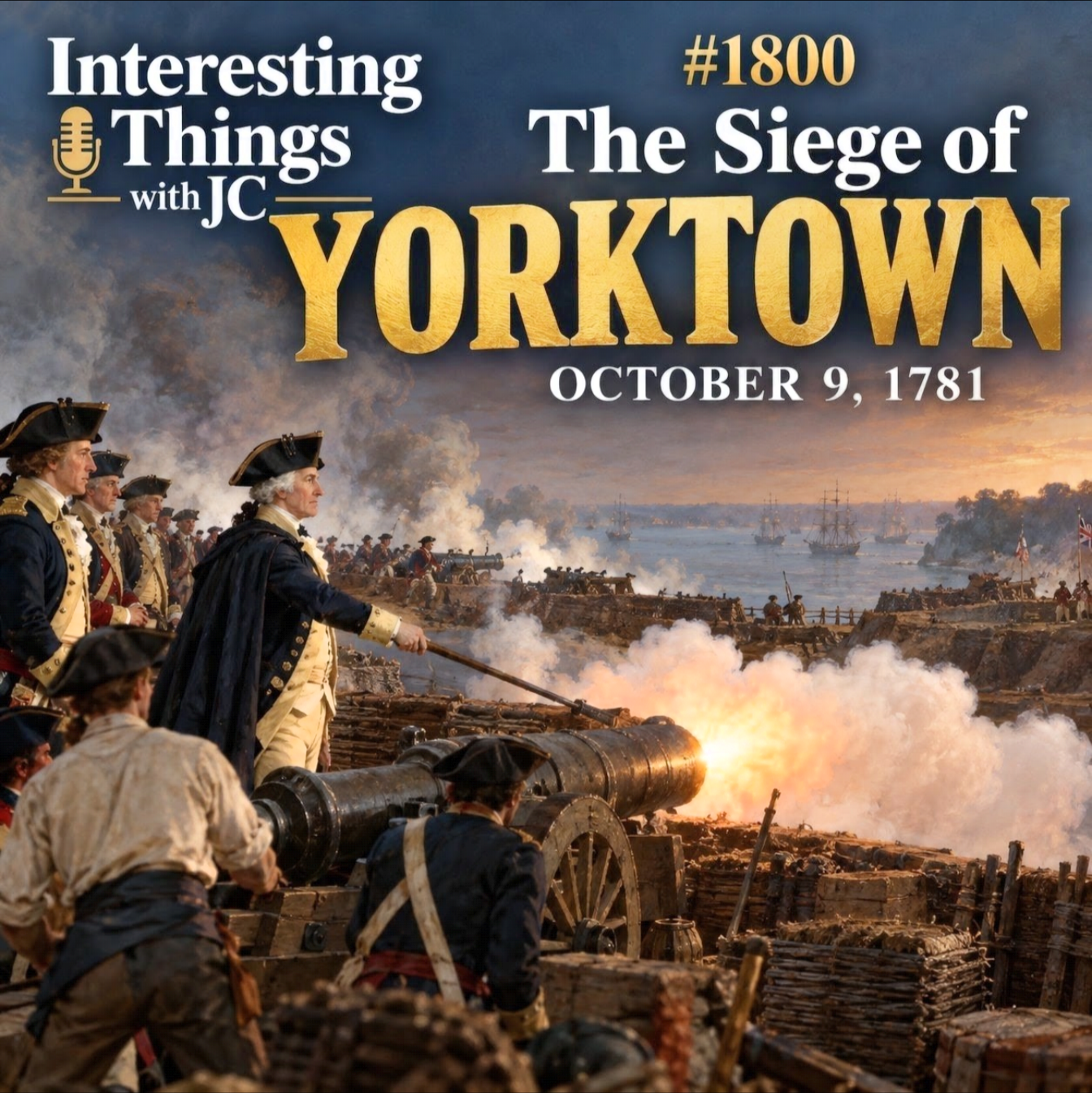
Podcast cover art for Interesting Things with JC, episode #1800, “The Siege of Yorktown.” A dramatic historical illustration depicts George Washington and Continental Army soldiers operating a cannon during the 1781 siege. Bright orange cannon fire illuminates the smoky battlefield, with soldiers, defensive trenches, fortifications, and distant sailing ships beneath a cloudy sky. Large gold and white lettering identifies the episode title, “The Siege of Yorktown,” with “October 9, 1781” below. The artwork uses warm amber tones and dark battlefield shadows to portray the American Revolutionary War.
Interesting Things with JC #1800:
"The Siege of Yorktown"
On October 9, 1781, George Washington stood beside an American cannon outside Yorktown, Virginia. His army was finally close enough to strike the British defenses with heavy artillery.
Washington personally fired the first American cannon of the bombardment. French artillery had opened fire earlier that afternoon, and soon the combined forces were pounding British positions.
Inside Yorktown, British General Charles Cornwallis commanded roughly 8,000 troops. Outside, approximately 17,000 American and French soldiers had surrounded his army.
But the trap extended beyond the battlefield.
Weeks earlier, a French fleet commanded by Admiral François de Grasse (frahn-SWAH duh GRAHSS) had fought off British warships near Chesapeake Bay, preventing the British navy from rescuing Cornwallis or delivering reinforcements.
Washington had originally considered attacking British-held New York City. Instead, working with French General Rochambeau (roh-sham-BOH), he marched south to Virginia.
The siege began September 28, with allied soldiers digging protective trenches that brought their cannons progressively closer.
On October 14, American troops led by Alexander Hamilton captured one British defensive position while French troops seized another. Those victories allowed the allies to move their artillery even closer.
Cornwallis attempted to escape across the York River, but a storm disrupted the operation.
On October 17, he requested a ceasefire. Two days later, British forces surrendered, including roughly 8,000 British and German military personnel.
Cornwallis did not attend the ceremony, citing illness. His deputy, Charles O'Hara, appeared instead and was directed to American General Benjamin Lincoln to complete the surrender.
Yorktown did not immediately end the Revolutionary War. Fighting continued, and Britain formally recognized American independence in the Treaty of Paris in 1783.
But losing an entire British field army weakened support in London for continuing the war and helped move both sides toward peace.
The victory at Yorktown came through coordinated American and French operations on land and at sea, demonstrating how an international alliance helped secure American independence.
These are interesting things, with JC.
Student Worksheet
Student Name: ________________________ Date: _____________ Class: __________________
Instructions: Listen to the episode, examine the assigned historical sources, and answer using complete sentences. Use specific evidence wherever requested.
Part A — Comprehension
What happened on October 9, 1781, and what distinction must historians make concerning Washington's cannon shot?
Who commanded the British army at Yorktown?
Approximately how many troops served in the combined American and French army surrounding Yorktown?
What role did Admiral de Grasse play in the campaign?
Why did Washington and Rochambeau move their forces toward Virginia?
What was the purpose of the trenches constructed around Yorktown?
What happened at Redoubts 9 and 10 on October 14?
Why did Cornwallis's attempt to escape fail?
On what date did the British formally surrender?
What event in 1783 formally recognized American independence?
Part B — Chronological Reasoning
Place these events in chronological order and supply their dates: British surrender; Battle of the Chesapeake; Allied bombardment; Capture of Redoubts 9 and 10; Beginning of the siege; Cornwallis requests a ceasefire.
Explain why the naval battle occurred before the siege but was essential to the siege's success.
Part C — Geographic and Strategic Analysis
Locate Yorktown, the York River, Chesapeake Bay, and the Atlantic Ocean on a historical or modern map. Explain the geographic relationship between these locations.
How might the outcome have differed if the British fleet had retained control of Chesapeake Bay?
Explain why a defensive position that appears strong on land can become vulnerable when supply and evacuation routes are unavailable.
Part D — Historical Evidence
Read two assigned sources: one National Park Service account and one primary document or contemporary map from the Library of Congress or National Archives.
Identify the author or creator, approximate date, and purpose of each source.
Describe one historical claim supported by both sources.
Identify one important difference between the sources. Does the difference reflect perspective, purpose, date, or evidence?
Explain why a contemporary military map might be valuable even if it does not describe soldiers' personal experiences.
Part E — Written Analysis
20. Write 150–200 words responding to the following:
Was Yorktown primarily a victory of military force, strategic geography, or international cooperation?
Develop a clear argument, use at least two specific pieces of evidence, acknowledge at least one additional contributing factor, and explain the relationship between the factors.
Difficulty Scaling
Level 1 — Foundational: Answer questions 1–12 with access to the transcript and vocabulary.
Level 2 — Proficient: Complete questions 1–20 using at least two historical sources.
Level 3 — Advanced: Compare two historians' interpretations of the campaign and evaluate the relative importance of naval power, ground operations, and diplomacy.
Student Output: Completed worksheet, chronological timeline, annotated geographic explanation, and evidence-based paragraph.
Academic Integrity Guidance: Students must distinguish their own analysis from information obtained from sources. Quotations and paraphrased claims require attribution. AI-generated or secondary summaries should not replace examination of assigned historical evidence.
Teacher Guide
Quick Start: This lesson is designed for one 55-minute class period. Students listen to the episode, analyze the campaign's geography, construct a timeline, and develop an evidence-based explanation of the British defeat.
Materials
Episode #1800 audio and full transcript
Student worksheet and vocabulary reference
Historical map of Yorktown and Chesapeake Bay
Projector or student devices
National Park Service historical chronology
Primary-source map or document from the Library of Congress
Paper, pencils, or digital response tools
Preparation
Review the episode and historical chronology.
Display a map showing Yorktown, the York River, Chesapeake Bay, and the Atlantic Ocean.
Prepare the student worksheet and source excerpts.
Explain that Washington's October 9 cannon shot marked the opening of American artillery fire, not the beginning of the entire siege or the first allied artillery fire.
Pacing Guide — Audio First
0–5 minutes — Opening: Display a map of Yorktown. Ask students to identify potential land and water escape routes.
5–9 minutes — Episode: Play the podcast without interruption. Students identify three factors contributing to the British defeat.
9–17 minutes — Comprehension: Students complete worksheet questions 1–10 independently or in pairs.
17–27 minutes — Chronology: Students arrange six major events in sequence and explain their relationship.
27–37 minutes — Geographic Analysis: Examine naval access, river crossings, British fortifications, and allied positions.
37–47 minutes — Evidence Investigation: Compare a historical map with a written source. Students identify supporting evidence and source limitations.
47–55 minutes — Exit Assessment: Students write a brief argument explaining the most important factor in the victory.
Discussion Prompts
What military advantages did Cornwallis possess before the allied siege?
Why did British naval support matter?
How did French involvement change the military balance?
Could Washington have succeeded with a smaller army but without French naval support?
Why did the surrender of one army influence political decisions in Britain?
Why should historians distinguish military victory from formal diplomatic settlement?
Teacher Answer Key — Student Worksheet
Part A — Comprehension
Washington fired the first American cannon of the October 9 bombardment; French artillery had opened fire earlier.
General Charles Cornwallis.
Approximately 17,000 American and French troops.
He commanded French naval forces that secured control of Chesapeake Bay after fighting the British fleet.
They shifted their campaign toward Cornwallis's exposed position in Virginia, where French naval assistance made an encirclement possible.
Trenches protected allied troops and allowed artillery to approach British fortifications.
American troops captured Redoubt 10; French troops captured Redoubt 9.
Bad weather disrupted his attempted evacuation across the York River.
October 19, 1781.
The Treaty of Paris, signed September 3, 1783.
Part B — Chronology
Correct sequence:
September 5, 1781 — Battle of the Chesapeake
September 28, 1781 — Beginning of the siege
October 9, 1781 — Major allied bombardment
October 14, 1781 — Capture of Redoubts 9 and 10
October 17, 1781 — Cornwallis requests a ceasefire
October 19, 1781 — British surrender
French naval control reduced Britain's ability to reinforce, supply, or evacuate Cornwallis, making the land siege more effective.
Part C — Geographic Analysis
Yorktown sits along the York River, which connects with Chesapeake Bay and ultimately the Atlantic Ocean. Naval access through the bay was therefore strategically important.
A successful British relief operation might have delivered reinforcements, supplies, or evacuation assistance, potentially altering the outcome.
A defended position becomes vulnerable when surrounding forces can restrict movement, supplies, reinforcements, and withdrawal.
Part D — Historical Evidence
Answers vary according to assigned sources. Students must identify provenance and purpose accurately.
Accept a claim supported by evidence in both documents, such as the location of Yorktown or the importance of allied positions.
Accept a documented difference involving purpose, perspective, information available, or the date of creation.
Military maps can establish geography, fortifications, troop positions, and operational planning, but they may not adequately represent individual experiences or the entire course of events.
Part E — Written Analysis
20. Strong responses should argue for one factor while acknowledging the interaction of several factors. For example, international cooperation made possible the naval control and combined ground operations necessary to trap Cornwallis.
Formative Checkpoints
Students accurately distinguish October 9 from September 28.
Students identify both French land and naval contributions.
Students explain the relationship between geography and military logistics.
Students recognize that the Revolutionary War continued after Yorktown.
Students distinguish historical evidence from speculation about alternative outcomes.
Common Misconceptions
Washington fired the first cannon of the entire siege: French artillery began the October 9 bombardment before Washington fired the first American cannon.
The American army defeated Cornwallis without foreign assistance: French soldiers, naval forces, commanders, and resources were essential.
Yorktown ended the Revolutionary War immediately: The surrender was decisive, but fighting and diplomatic negotiations continued.
Cornwallis personally handed his sword to Washington: Cornwallis did not attend the ceremony. His representative, Charles O'Hara, participated, and Benjamin Lincoln received the formal surrender.
The British surrendered simply because their army was outnumbered: Numerical superiority mattered, but naval control, artillery, siege engineering, and restricted escape routes were also decisive.
Differentiation
Additional Support: Provide a partially completed timeline, labeled map, and vocabulary definitions.
Advanced Learners: Evaluate the relative importance of French naval control and American ground operations using multiple primary sources.
English Learners: Preteach geographic and military terminology; allow collaborative discussion before written responses.
Students with Disabilities: Offer transcripts, adjustable audio playback, enlarged maps, accessible text, and alternative response formats.
Homeschool: Complete the audio lesson and map analysis together, then assign the historical argument independently.
Introductory College: Add a historiographical comparison and formal source evaluation.
Extension Activities
Reconstruct the campaign using a historical map and identify possible British withdrawal routes.
Investigate the Battle of the Chesapeake and explain why naval warfare mattered in a land campaign.
Examine the surrender ceremony and distinguish historical documentation from later artistic representations.
Compare Yorktown with another siege, identifying similarities and differences in logistics and military engineering.
Research how news of the surrender influenced parliamentary debate in Britain.
Quiz
Student Name: __________________________ Date: __________________ Total Points: 20 Instructions: Select the best answer for questions 1–8. Answer questions 9–10 in complete sentences.
Multiple Choice — 2 Points Each
1. What occurred on October 9, 1781?
A. The Treaty of Paris was signed.
B. Washington fired the first American cannon of the allied bombardment.
C. Cornwallis surrendered.
D. The French fleet arrived in Virginia.
2. Who commanded British forces at Yorktown?
A. William Howe
B. Henry Clinton
C. Charles Cornwallis
D. John Burgoyne
3. Which French admiral played a central role in securing Chesapeake Bay?
A. Lafayette
B. De Grasse
C. Rochambeau
D. D'Estaing
4. Why was control of Chesapeake Bay important?
A. It prevented British troops from using their artillery.
B. It enabled Washington to attack Canada.
C. It restricted British naval reinforcement and evacuation.
D. It ended all British naval operations worldwide.
5. What was the purpose of allied siege trenches?
A. To transport supplies to Boston
B. To protect troops and move artillery closer
C. To divert the York River
D. To conceal the French fleet
6. Which American officer led the assault on Redoubt 10?
A. Alexander Hamilton
B. Benedict Arnold
C. Nathanael Greene
D. Daniel Morgan
7. What disrupted Cornwallis's attempted escape across the York River?
A. A shortage of horses
B. An earthquake
C. Severe weather
D. A destroyed bridge
8. When did Britain formally recognize American independence?
A. 1776
B. 1778
C. 1781
D. 1783
Short Answer — 2 Points Each
9. Identify two ways French military assistance contributed to the Yorktown victory.
10. Explain why historians should not describe October 19, 1781, as the formal end of the Revolutionary War.
Quiz Answer Key
Question 1: B — Washington fired the first American cannon of the allied bombardment.
Question 2: C — Charles Cornwallis.
Question 3: B — De Grasse.
Question 4: C — It restricted British naval reinforcement and evacuation.
Question 5: B — To protect troops and move artillery closer.
Question 6: A — Alexander Hamilton.
Question 7: C — Severe weather.
Question 8: D — 1783.
Question 9: French naval control and French ground troops, artillery, or engineering.
Question 10: Fighting and diplomacy continued; the 1783 treaty formally recognized independence.
Scoring Guidance: For short answers, award 2 points for a complete, accurate response; 1 for a partially correct response; 0 for an incorrect or missing response.
Assessment
Summative Assessment — Historical Argument
Prompt: Explain how the American and French alliance contributed to the British defeat at Yorktown and why the surrender influenced the outcome of the Revolutionary War.
Required Student Product: A 300–400-word historical argument or an equivalent 3–4-minute oral presentation.
Requirements
Present a defensible historical claim.
Identify at least three contributing factors.
Include two specific historical events with correct dates.
Use at least two credible sources, including one primary source.
Explain the relationship between military victory and diplomatic settlement.
Include a source list.
Analytic Assessment Rubric
Historical Accuracy
4 — Advanced: Accurate chronology and precise historical details.
3 — Proficient: Mostly accurate, with minor omissions.
2 — Developing: Some significant historical errors.
1 — Beginning: Major historical inaccuracies.
Causal Reasoning
4 — Advanced: Clearly explains interacting causes and consequences.
3 — Proficient: Explains the principal causes.
2 — Developing: Lists causes with limited explanation.
1 — Beginning: Demonstrates little understanding of historical causation.
Evidence
4 — Advanced: Uses strong, relevant evidence from multiple credible sources.
3 — Proficient: Provides adequate supporting evidence.
2 — Developing: Uses limited or weak evidence.
1 — Beginning: Makes unsupported claims.
Geographic Understanding
4 — Advanced: Clearly connects geography and military logistics to historical outcomes.
3 — Proficient: Provides a correct geographic explanation.
2 — Developing: Demonstrates partial geographic understanding.
1 — Beginning: Geographic reasoning is absent.
Communication
4 — Advanced: Presents a clear, coherent, and persuasive argument.
3 — Proficient: Communicates ideas logically and understandably.
2 — Developing: Demonstrates uneven organization or clarity.
1 — Beginning: Presents ideas that are difficult to follow.
Scoring: 20 points maximum, with five criteria worth four points each.
Performance Levels
18–20 points: Advanced Mastery
15–17 points: Proficient
11–14 points: Developing
5–10 points: Needs Additional Instruction
Assessment Validity: Scores reflect achievement against this classroom rubric, not a standardized historical knowledge measure.
Alternative Demonstrations of Learning
Annotated military campaign map with a 250-word explanation.
Recorded historical analysis with source citations.
Comparative essay examining the Battle of the Chesapeake and Siege of Yorktown.
Structured debate about the relative importance of American and French contributions.
Student Self-Assessment
Students should confirm that they can explain the British military position, identify the French contribution, distinguish 1781 from 1783, and defend their conclusions with historical evidence.
Standards Alignment
C3 Framework — College, Career, and Civic Life
D2.His.1.9-12 — Evaluate how historical events and developments were shaped by unique circumstances of time and place as well as broader historical contexts. Students examine Yorktown within the Revolutionary War and the international conflict involving Britain and France.
D2.His.2.9-12 — Analyze change and continuity in historical eras. Students distinguish the military turning point in 1781 from the diplomatic settlement in 1783.
D2.His.14.9-12 — Analyze multiple and complex causes and effects of events in the past. Students evaluate naval control, siege tactics, logistics, and political consequences.
D2.His.16.9-12 — Integrate evidence from multiple relevant historical sources and interpretations into a reasoned argument about the past. Students develop an evidence-supported explanation of the British defeat.
D3.1.9-12 — Gather relevant information from multiple sources representing a wide range of views while using the origin, authority, structure, context, and corroborative value of the sources to guide the selection. Students investigate maps, historical records, and scholarly interpretations.
D4.1.9-12 — Construct arguments using precise and knowledgeable claims, with evidence from multiple sources, while acknowledging counterclaims and evidentiary weaknesses. Students prepare a historical argument.
Common Core State Standards — Reading
CCSS.ELA-LITERACY.RH.9-10.1 — Cite specific textual evidence to support analysis of primary and secondary sources. Students cite evidence concerning the campaign's military and political consequences.
CCSS.ELA-LITERACY.RH.9-10.3 — Analyze in detail a series of events described in a text; determine whether earlier events caused later ones or simply preceded them. Students distinguish chronology from causation.
CCSS.ELA-LITERACY.RH.11-12.1 — Cite specific textual evidence to support analysis of primary and secondary sources, connecting insights gained from specific details to an understanding of the text as a whole. Students connect military details to the larger outcome.
CCSS.ELA-LITERACY.RH.11-12.7 — Integrate and evaluate multiple sources of information presented in diverse formats and media. Students compare maps, audio, and written historical accounts.
Common Core State Standards — Writing
CCSS.ELA-LITERACY.WHST.9-10.1 — Write arguments focused on discipline-specific content. Students develop claims concerning the causes of the victory.
CCSS.ELA-LITERACY.WHST.9-10.6 — Use technology, including the Internet, to produce, publish, and update individual or shared writing products. Students may prepare digitally supported historical explanations.
CCSS.ELA-LITERACY.WHST.11-12.1 — Write arguments focused on discipline-specific content. Students construct historically defensible arguments using relevant evidence.
CCSS.ELA-LITERACY.WHST.11-12.7 — Conduct short as well as more sustained research projects to answer a question or solve a problem. Students investigate the military and diplomatic consequences of Yorktown.
NGSS — Science and Engineering Practices
Interdisciplinary Practice Connections, Not Formal NGSS Performance-Expectation Alignment
Analyzing and Interpreting Data: Students interpret historical maps, geographic distances, and force estimates.
Constructing Explanations and Designing Solutions: Students explain how military engineering and geographic constraints influenced the siege.
Engaging in Argument from Evidence: Students compare explanations of the British defeat using historical evidence.
The episode is primarily a history and civics lesson. No NGSS disciplinary core idea or performance expectation is claimed as a direct alignment.
ISTE Standards for Students
1.3 Knowledge Constructor: Students critically curate information from digital resources and assess the credibility of historical evidence.
1.6 Creative Communicator: Students communicate historical explanations using an appropriate digital format.
1.7 Global Collaborator: Students examine international cooperation and may work collaboratively to analyze historical perspectives.
ACRL Framework for Information Literacy
Authority Is Constructed and Contextual: Evaluate differences between contemporary records, later historical interpretations, and educational summaries.
Information Creation as a Process: Consider how historical documents, maps, and accounts were created.
Research as Inquiry: Develop questions about competing explanations for Yorktown's outcome.
Scholarship as Conversation: Compare historical interpretations of French and American contributions.
Bloom's Revised Taxonomy
Remember: Identify key dates, military commanders, and geographic locations associated with the Siege of Yorktown.
Understand: Explain the purpose of siege tactics and their role in the British defeat.
Apply: Use historical maps to identify naval and land approaches to Yorktown.
Analyze: Examine relationships among military strategies, geographic conditions, and contributing factors.
Evaluate: Judge the relative importance of French naval control and American and French ground operations.
Create: Develop an evidence-supported historical argument explaining the causes and consequences of the Siege of Yorktown.
Universal Design for Learning — UDL
Engagement: Provide choices among geographic, military, and diplomatic investigations.
Representation: Present information through audio, transcript, maps, and written historical sources.
Action and Expression: Permit written, oral, visual, or digital demonstrations of learning.
International Curriculum Connections
United Kingdom National Curriculum — History: Supports the study of historical inquiry, chronology, international relations, and Britain's changing global position during the late eighteenth century.
International Baccalaureate — History: Supports source evaluation, historical causation, perspectives, and international conflict.
Cambridge International — History: Supports the analysis of causes and consequences, historical significance, and the evaluation of source evidence.
These are thematic and skills-based connections, not claims of direct alignment to a particular examination syllabus.
Career and Technical Education Connections
Historical Research and Archival Studies: Source evaluation, documentation, and evidence management.
Geographic Information Systems: Spatial interpretation and mapping.
Public History and Museum Education: Communicating complex events accurately to public audiences.
Strategic Planning and Logistics: Examining resource constraints and coordinated operations.
Show Notes
Episode: Interesting Things with JC #1800: "The Siege of Yorktown" Historical Date: October 9, 1781 Category: American History, Revolutionary War, Military History, International Relations Audience: General listeners, students, educators, homeschool families, lifelong learners
Episode Description
On October 9, 1781, George Washington fired the first American cannon during the allied bombardment of Yorktown, Virginia. British General Charles Cornwallis was surrounded by American and French troops, while French naval forces controlled the critical approach through Chesapeake Bay.
The resulting siege ended in British surrender on October 19 and helped change the political direction of the Revolutionary War. This episode examines the military operation, French contributions, and the events that led toward the recognition of American independence in 1783.
Key Historical Dates
September 5, 1781: Battle of the Chesapeake.
September 28, 1781: Allied siege of Yorktown begins.
October 9, 1781: Allied heavy artillery bombardment begins.
October 14, 1781: American and French forces capture Redoubts 9 and 10.
October 17, 1781: British General Cornwallis requests a ceasefire.
October 19, 1781: British forces formally surrender at Yorktown.
September 3, 1783: Treaty of Paris is signed, formally recognizing American independence.
Key Figures
George Washington — Commander in chief of the Continental Army
Charles Cornwallis — British commander at Yorktown
Jean-Baptiste de Rochambeau — French army commander
François Joseph Paul de Grasse — French naval commander
Alexander Hamilton — Commander of the American assault on Redoubt 10
Benjamin Lincoln — American general who received the ceremonial surrender from the British representative
Charles O'Hara — British officer who represented Cornwallis during the surrender ceremony
Suggested Classroom Applications
Historical chronology, primary-source analysis, military geography, international alliances, historical causation, argumentative writing, media literacy.
Accessibility
The curriculum provides a full transcript, defined vocabulary, pronunciation guidance, structured activities, and alternative assessment methods.
Educators should supply accessible descriptions or text equivalents for historical maps and visual sources.
Educational Use
Free curriculum materials available at JimConnors.net. No login or paywall required.
Classroom and homeschool use is permitted with attribution to Interesting Things with JC and Jim Connors LLC.
Commercial resale or redistribution as a competing curriculum product is not authorized.
References
Historical Research — APA Style
American Battlefield Trust. (n.d.). Yorktown. https://www.battlefields.org/learn/revolutionary-war/battles/yorktown
George Washington's Mount Vernon. (n.d.). The Yorktown campaign. https://www.mountvernon.org/george-washington/the-revolutionary-war/washingtons-revolutionary-war-battles/the-yorktown-campaign
National Park Service. (n.d.). Siege of Yorktown timeline. Yorktown Battlefield, Colonial National Historical Park. https://www.nps.gov/york/learn/historyculture/siegetimeline.htm
National Archives. (n.d.). Founding documents: Treaty of Paris (1783). https://www.archives.gov/milestone-documents/treaty-of-paris
Library of Congress. (n.d.). Maps. https://www.loc.gov/maps/
Curriculum and Standards
Achieve. (2013). Next generation science standards. https://www.nextgenscience.org/
Association of College and Research Libraries. (2016). Framework for information literacy for higher education. American Library Association. https://www.ala.org/acrl/standards/ilframework
Common Core State Standards Initiative. (2010). English language arts standards. https://www.thecorestandards.org/ELA-Literacy/
International Society for Technology in Education. (n.d.). ISTE standards for students. https://iste.org/standards/students
National Council for the Social Studies. (2013). The college, career, and civic life (C3) framework for social studies state standards. https://www.socialstudies.org/standards/c3
CAST. (2024). Universal design for learning guidelines version 3.0. https://udlguidelines.cast.org/
International Baccalaureate Organization. (n.d.). History. https://www.ibo.org/programmes/diploma-programme/curriculum/individuals-and-societies/history/
Cambridge International Education. (n.d.). Cambridge International AS & A Level History (9489). https://www.cambridgeinternational.org/programmes-and-qualifications/cambridge-international-as-and-a-level-history-9489/
Source Integrity Note:
The references above provide historical research and educational standards resources.
Specific primary documents should be selected and examined before assigning the primary-source comparison activity.
Historical numerical estimates are approximate and may vary across sources.
Free educational classroom use with attribution; no commercial resale.