1799: “Horizontal Projectiles”
Interesting Things with JC #1799: “Horizontal Projectiles”
Launch one ball sideways and drop another from the same height. Ignoring air resistance, they hit the ground at the same time, even though one traveled across the room.
Curriculum - Episode Anchor
Episode Title: Horizontal Projectiles
Episode Number: 1799
Series: Interesting Things with JC
Host: JC
Audience: Grades 9–12, introductory college, homeschool, lifelong learners
Subject Area: Physics, physical science, mathematics
Primary Concept: Horizontal projectile motion
Estimated Audio Runtime: Under 3 minutes
Instructional Time: 35–50 minutes
Essential Question: Why does an object launched horizontally fall at the same rate as an object simply dropped from the same height?
Learning Objectives
Students will be able to:
Explain why horizontal and vertical motion can be analyzed independently.
Identify gravitational acceleration as approximately 9.81 m/s² or 32.2 ft/s² near Earth’s surface.
Explain why horizontal velocity does not determine the time required for a horizontal projectile to fall from a given height.
Calculate fall time and horizontal range for a simple horizontal projectile.
Distinguish an ideal projectile model from real-world motion affected by air resistance, wind, spin, and shape.
Lesson Overview
A horizontal projectile moves in two dimensions simultaneously. In the ideal introductory model, horizontal velocity remains constant while gravity accelerates the object vertically downward. Separating these components makes seemingly complicated curved motion predictable. OpenStax describes the same central principle: perpendicular components of projectile motion can be analyzed independently when air resistance is neglected.
Core Equations
Horizontal displacement: x = vₓt
Vertical displacement for a horizontal launch: Δy = ½gt²
Fall time: t = √(2Δy/g)
Gravitational acceleration: g ≈ 9.81 m/s² ≈ 32.2 ft/s²
Central Demonstration
Two identical objects begin at the same height. One is dropped while the other is launched horizontally. In the ideal model, both have the same initial vertical velocity—zero—and experience the same downward acceleration. They therefore reach the floor simultaneously.
Key Vocabulary
Projectile (pruh-JEK-tile) — An object moving through the air after being launched and, in the ideal model, acted upon only by gravity.
Projectile motion — Two-dimensional motion combining horizontal and vertical components.
Trajectory (truh-JEK-tuh-ree) — The path followed by a moving projectile.
Horizontal velocity — The rate and direction of motion parallel to the ground.
Vertical velocity — The rate and direction of upward or downward motion.
Acceleration due to gravity — Near Earth’s surface, approximately 9.81 m/s² or 32.2 ft/s² downward.
Parabola (puh-RAB-uh-luh) — The mathematical curve produced by ideal projectile motion under uniform gravity when air resistance is neglected.
Range — Horizontal distance traveled by a projectile.
Independent components — Horizontal and vertical parts of motion that can be analyzed separately while sharing the same elapsed time.
Air resistance — A force produced by motion through air that can alter an object's ideal projectile trajectory.
Narrative Core
Open: A ball rolling across a table reaches the edge. It continues moving forward while beginning to fall.
Info: Horizontal velocity does not prevent or delay gravitational acceleration. A horizontally launched ball and a simultaneously dropped ball fall through the same vertical distance in the same amount of time under the ideal model.
Details: Horizontal motion has approximately zero acceleration when air resistance is ignored. Vertical motion accelerates downward at approximately 9.81 m/s². The common variable connecting the two components is time.
Numerical Example: From a height of 4.9 m (about 16 ft), an object takes approximately 1 second to fall. At a horizontal velocity of 5 m/s (about 11 mph), it travels approximately 5 m (16 ft). At 10 m/s (about 22 mph), it travels approximately 10 m (33 ft).
Reflection: Increasing horizontal speed increases horizontal distance, not fall time, when launch height and initial vertical velocity remain unchanged.
Closing Connection: Once horizontal and vertical motion are separated, the curved trajectory can be calculated.
Transcript
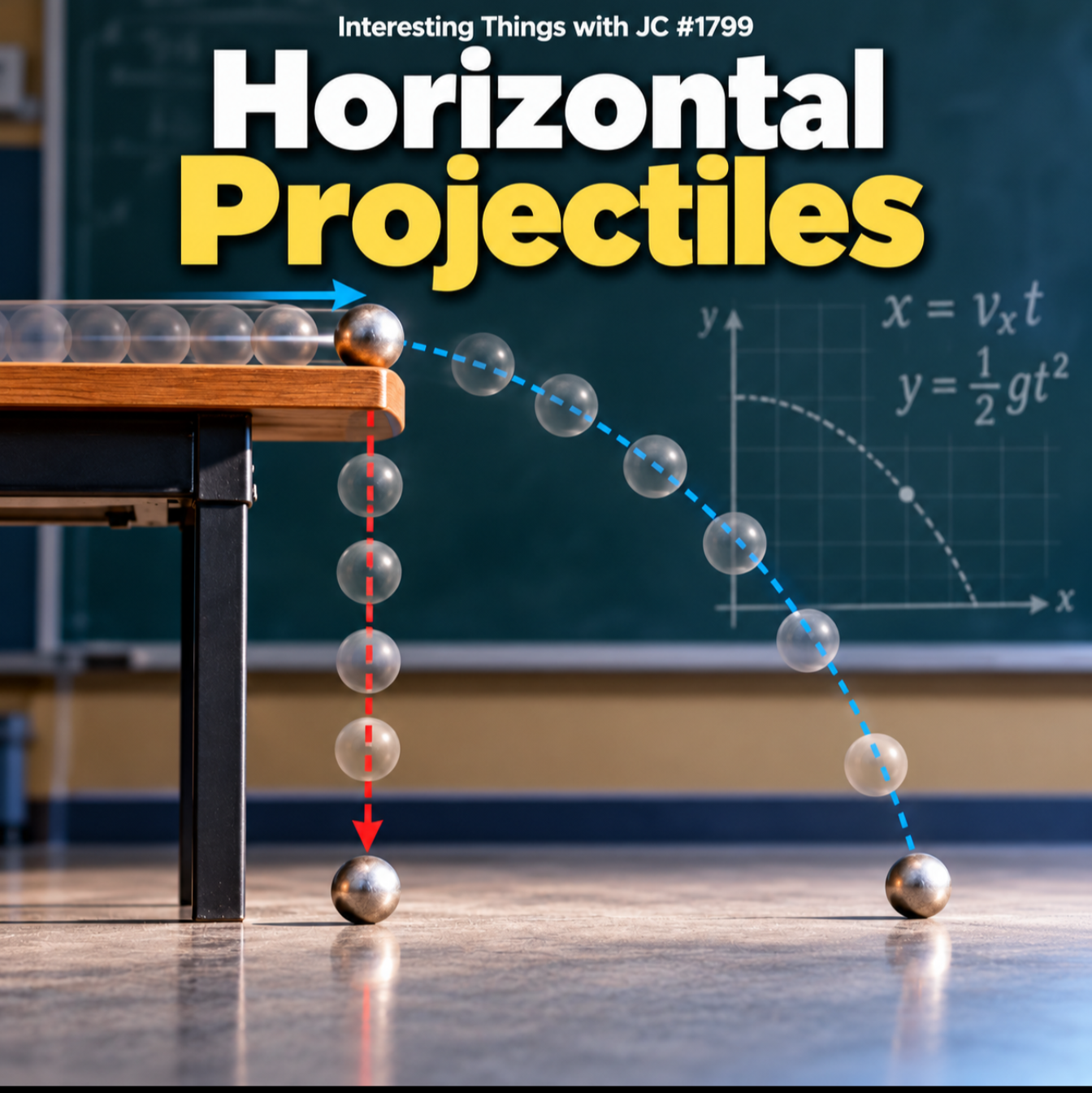
Educational podcast cover art for Interesting Things with JC #1799, titled “Horizontal Projectiles.” A steel ball rolls off a wooden table, following a curved blue dashed trajectory, while a second ball falls vertically along a red dashed line. Transparent ball positions illustrate motion over time. Physics equations and a trajectory graph appear on a dark teal chalkboard. The title is displayed in large white and yellow lettering above the demonstration.
Interesting Things with JC #1799:
"Horizontal Projectiles"
Roll a ball across a table and let it go over the edge.
It keeps moving forward while gravity pulls it toward the floor. That combination creates the curved path of a horizontal projectile.
The interesting part is what happens if we compare it with a ball that isn't moving forward.
Take two identical balls at the same height. Launch one horizontally and simply drop the other.
Which one hits the floor first?
Ignoring air resistance, they hit at the same time.
Both begin falling from the same height with zero vertical velocity. Both accelerate downward at about 32.2 feet per second squared, or 9.81 meters per second squared.
The sideways speed doesn't change how quickly either ball falls.
Launch the first ball faster and it travels farther across the room, but it still hits the floor at the same time as the dropped ball.
That's because its sideways motion and its falling motion can be calculated separately.
Horizontally, the ball keeps moving at nearly the same speed.
Vertically, gravity makes it fall faster and faster.
Ignoring air resistance, those two motions together produce a curved path called a parabola.
Suppose a ball leaves a platform 4.9 meters, or about 16 feet, above the ground. It takes roughly one second to fall.
If it's moving horizontally at 5 meters per second, about 11 miles per hour, it'll travel about 5 meters, or 16 feet, before hitting the ground.
Launch it at 10 meters per second, about 22 miles per hour, and it'll travel about 10 meters, or 33 feet.
Twice the sideways speed. Twice the distance.
But the fall still takes about one second.
Air resistance, wind, spin, and the shape of an object can change what happens in the real world. But this basic physics applies to everything from a marble rolling off a desk to a package released from a moving aircraft.
The object moves forward because of the speed it already has.
It moves downward because of gravity.
Put the two together, and you can predict where it will land.
These are interesting things, with JC.
Student Worksheet
Comprehension
What two types of motion occur simultaneously after a ball rolls horizontally off a table?
What causes the ball's vertical acceleration?
Approximately how large is gravitational acceleration near Earth's surface?
In the ideal model, what happens to horizontal velocity after the ball leaves the table?
Why do a horizontally launched ball and a dropped ball hit the ground at the same time when released from the same height?
Analysis
A projectile leaves a platform horizontally at 6 m/s and remains airborne for 2 seconds. How far does it travel horizontally?
If its horizontal velocity increases to 12 m/s while its launch height remains unchanged, how long does it remain airborne in the ideal model?
How far horizontally would it travel at 12 m/s during those 2 seconds?
A student says, “A faster horizontal projectile stays in the air longer because it has farther to travel.” Explain the error.
Why must horizontal and vertical motion share the same value for time?
Application
A ball rolls horizontally from a 4.9 m platform at 8 m/s. Using approximately 1 second as its fall time, estimate its horizontal range.
Predict what happens to its range if horizontal velocity doubles while height remains constant.
Name two real-world factors that could make the actual trajectory differ from the ideal calculation.
Reflection
Explain in your own words how one object can move horizontally at constant velocity while simultaneously accelerating vertically.
What observation from the two-ball demonstration provides evidence that horizontal velocity does not control fall time?
Difficulty Scaling
Level 1: Describe horizontal and vertical motion verbally.
Level 2: Calculate horizontal distance using x = vₓt.
Level 3: Calculate fall time using t = √(2Δy/g), then determine horizontal range.
Student Output: Complete questions 1–15 and show calculations with units for numerical problems.
Academic Integrity Guidance: Students should explain reasoning in their own words and identify assumptions used in calculations.
Teacher Guide
Quick Start: Play the episode without introducing the central result. Before the two-ball answer is revealed, pause and have students predict which object reaches the floor first.
Pacing Guide — Audio First
0–5 minutes: Introduce the prediction question and record student hypotheses.
5–10 minutes: Play the episode.
10–18 minutes: Diagram horizontal and vertical components.
18–28 minutes: Work through x = vₓt and Δy = ½gt².
28–38 minutes: Students complete worksheet calculations.
38–45 minutes: Discuss assumptions and real-world departures from the ideal model.
Materials
Two similar balls
Table or elevated horizontal surface
Meter stick or tape measure
Stopwatch or slow-motion phone video if available
Calculator
Student worksheet
Demonstration
Place two similar balls at the same height.
Arrange for one to fall vertically while the other receives a horizontal velocity at approximately the same instant.
Ask students to predict which reaches the floor first.
Release both.
Repeat several times.
If available, record the event in slow motion and compare vertical positions frame by frame.
Safety: Use lightweight objects, keep the landing area clear, and do not launch objects toward people, windows, equipment, or fragile materials.
Formative Checkpoints
Can students identify which component gravity changes?
Can students explain why horizontal velocity remains constant only in the idealized model?
Can students distinguish velocity from acceleration?
Can students correctly identify time as the shared variable connecting horizontal and vertical calculations?
Common Misconceptions
A faster horizontal projectile falls more slowly.
Forward motion somehow competes against gravity.
Gravity begins acting only after horizontal velocity decreases.
A curved trajectory means gravity acts diagonally.
A horizontally launched object has an initial downward velocity.
Differentiation
Additional Support: Use separate x and y diagrams before combining the motions.
Advanced Learners: Require students to derive t = √(2h/g) from h = ½gt².
English Learners: Pair vocabulary with diagrams showing velocity and acceleration vectors.
College Extension: Derive the trajectory equation y(x) by eliminating time from the horizontal and vertical equations.
Answer Key
Horizontal motion and vertical falling motion.
Gravity.
Approximately 9.81 m/s² or 32.2 ft/s² downward.
It remains constant when air resistance is neglected.
Their vertical initial conditions and gravitational acceleration are identical.
12 m.
2 seconds.
24 m.
Fall time is controlled by vertical motion; horizontal distance does not determine how long gravity takes to move the object through the vertical distance.
Both motions occur simultaneously for the same object.
Approximately 8 m.
The horizontal range doubles.
Any two: air resistance, wind, spin, object shape.
Responses should recognize that perpendicular velocity components can change independently.
Both balls reach the ground simultaneously despite different horizontal velocities.
Quiz
Multiple Choice
A horizontal projectile initially has which vertical velocity?
A. Equal to its horizontal velocity
B. Zero
C. 9.81 m/s
D. InfiniteIgnoring air resistance, horizontal acceleration is:
A. 9.81 m/s²
B. 32.2 m/s²
C. Zero
D. Dependent on massNear Earth's surface, vertical acceleration is approximately:
A. 1 m/s²
B. 5 m/s²
C. 9.81 m/s² downward
D. ZeroA ball is launched horizontally while another is dropped from the same height at the same instant. Ignoring air resistance, which lands first?
A. Launched ball
B. Dropped ball
C. They land together
D. It depends on horizontal speedDoubling horizontal velocity while maintaining the same launch height will ideally:
A. Double fall time
B. Halve fall time
C. Leave fall time unchanged
D. Eliminate gravityA projectile travels horizontally at 7 m/s for 2 seconds. Its horizontal displacement is:
A. 3.5 m
B. 7 m
C. 9 m
D. 14 mThe ideal path of a projectile under uniform gravity is:
A. Circular
B. Parabolic
C. Rectangular
D. Vertical onlyWhich can alter an actual projectile trajectory?
A. Air resistance
B. Wind
C. Spin
D. All of the aboveWhat variable connects the horizontal and vertical components?
A. Mass
B. Time
C. Temperature
D. DensityA projectile moving horizontally faster from the same height will generally:
A. Travel farther horizontally before landing
B. Fall more slowly
C. Experience less gravity
D. Stop accelerating vertically
Answer Key: 1-B, 2-C, 3-C, 4-C, 5-C, 6-D, 7-B, 8-D, 9-B, 10-A
Assessment
Performance Task: Predict the landing location of a horizontally launched object.
Students are given or measure:
Launch height
Horizontal velocity
Gravitational acceleration
Students must:
Draw and label the horizontal and vertical components.
Calculate fall time using t = √(2h/g).
Calculate horizontal range using x = vₓt.
State the predicted landing location.
Identify at least two assumptions in the calculation.
Explain why changing horizontal velocity changes range but not ideal fall time.
Assessment Rubric — 20 Points
Conceptual Understanding — 5 points: Correctly explains independence of horizontal and vertical motion.
Mathematical Reasoning — 5 points: Selects and applies appropriate equations.
Accuracy — 4 points: Calculations, units, and final prediction are correct.
Model Limitations — 3 points: Identifies relevant assumptions such as negligible air resistance.
Communication — 3 points: Reasoning is clear, organized, and scientifically precise.
Mastery Benchmark: 16/20 points or 80%.
Standards Alignment
NGSS — Science & Engineering Practices
HS-PS2-1 — Analyze data to support the claim that Newton's second law of motion describes the mathematical relationship among net force, mass, and acceleration. Students connect gravitational force with vertical acceleration while distinguishing the absence of horizontal acceleration in the ideal model.
Using Mathematics and Computational Thinking — Students use kinematic relationships to calculate time and horizontal displacement.
Developing and Using Models — Students construct a two-component model of projectile motion and evaluate where ideal assumptions depart from actual motion.
NGSS — Disciplinary Core Ideas
PS2.A — Forces and Motion — Students examine changes in vertical velocity produced by gravitational acceleration while horizontal velocity remains constant in the simplified model.
CCSS Mathematics
CCSS.MATH.CONTENT.HSA-CED.A.4 — Rearrange formulas to highlight a quantity of interest. Students rearrange vertical displacement equations to solve for time.
CCSS.MATH.CONTENT.HSF-IF.C.7 — Graph functions and show key features of the graph. Students may graph projectile position and recognize a parabolic trajectory.
CCSS.MATH.PRACTICE.MP4 — Model with mathematics. Students use equations to predict projectile landing position.
CCSS Reading
CCSS.ELA-LITERACY.RST.9-10.1 — Cite specific textual evidence to support analysis of science and technical texts. Students use information from the transcript and supporting physics material to justify explanations.
CCSS.ELA-LITERACY.RST.11-12.3 — Follow precisely a complex multistep procedure when carrying out experiments, taking measurements, or performing technical tasks. Students perform the projectile demonstration and analyze its results.
CCSS Writing
CCSS.ELA-LITERACY.WHST.9-10.2 — Write informative/explanatory texts to examine and convey complex scientific ideas clearly and accurately.
CCSS.ELA-LITERACY.WHST.11-12.2 — Write informative/explanatory texts, including scientific procedures, experiments, or technical processes.
Bloom's Taxonomy
Remember: Define projectile, trajectory, velocity, and acceleration.
Understand: Explain independent horizontal and vertical motion.
Apply: Calculate range and fall time.
Analyze: Compare launched and dropped objects.
Evaluate: Identify limitations of the ideal model.
Create: Develop a model predicting a projectile's landing position.
UDL
Multiple Means of Engagement: Prediction and physical demonstration.
Multiple Means of Representation: Audio, equations, diagrams, observation, and numerical examples.
Multiple Means of Action and Expression: Written explanation, mathematical calculation, diagramming, and experimental analysis.
ISTE
1.5 Computational Thinker: Students formulate problems, organize data, and use mathematical models to test solutions.
1.6 Creative Communicator: Students communicate physical relationships through equations, diagrams, and written explanations.
Career Readiness Competencies
Quantitative reasoning
Data interpretation
Mathematical modeling
Evidence-based prediction
Technical communication
Model evaluation and error analysis
Show Notes
Interesting Things with JC #1799 examines one of the most useful ideas in introductory mechanics: a projectile's horizontal and vertical motion can be analyzed separately.
Students investigate why a ball launched horizontally and a ball dropped from the same height reach the ground simultaneously in the ideal model, then use gravitational acceleration, fall time, and horizontal velocity to predict where a projectile will land.
Classroom Topics: projectile motion, kinematics, gravity, velocity, acceleration, parabolas, mathematical modeling.
References
OpenStax. (n.d.). 5.3 Projectile motion. Physics. Rice University. https://openstax.org/books/physics/pages/5-3-projectile-motion
OpenStax. (n.d.). 4.3 Projectile motion. University Physics Volume 1. Rice University. https://openstax.org/books/university-physics-volume-1/pages/4-3-projectile-motion
OpenStax. (n.d.). 3.4 Projectile motion. College Physics 2e. Rice University. https://openstax.org/books/college-physics-2e/pages/3-4-projectile-motion