Interesting Things with JC #1798: "Oh, God! starring George Burns as God and John Denver"
On October 7, 1977, George Burns appeared as God opposite John Denver, playing an ordinary grocery store manager suddenly expected to convince everyone that God had actually spoken to him.
Curriculum - Episode Anchor
Episode Title: Oh, God!, starring George Burns as God and John Denver
Episode Number: 1798
Series: Interesting Things with JC
Host: JC
Film: Oh, God!
U.S. Release Date: October 7, 1977
Director: Carl Reiner
Screenwriter: Larry Gelbart
Source: Avery Corman's 1971 novel Oh, God!
Principal Cast: George Burns as God; John Denver as Jerry Landers
Audience: Grades 9–12, introductory college, homeschool, lifelong learners
Subject Areas: Film history, English Language Arts, media literacy, history, ethics, critical thinking
Lesson Length: 45–60 minutes
Episode Runtime: Under 3 minutes
Essential Question: What happens when one person's extraordinary experience must be evaluated by people who did not experience it themselves?
Learning Objectives
Students will be able to:
Identify major people, dates, and production facts associated with Oh, God!
Explain why casting George Burns and John Denver affected the film's premise and tone.
Distinguish among a claim, testimony, evidence, corroboration, belief, and proof.
Analyze how comedy can be used to explore serious social and philosophical questions.
Explain the difference between personal certainty and publicly verifiable evidence.
Evaluate the credibility and relevance of information from historical and media sources.
Support an interpretation using evidence from the episode transcript.
Lesson Overview
Released in the United States on October 7, 1977, Oh, God! placed an unusual pair at the center of a mainstream Hollywood comedy: 81-year-old George Burns as God and singer-songwriter John Denver as grocery-store assistant manager Jerry Landers.
The casting was deliberately ordinary. Burns's God does not arrive surrounded by spectacle. He appears as an elderly man with glasses, speaks conversationally, and interacts with Jerry as though an encounter with God could occur in everyday life.
Denver was making his feature-film acting debut, but he was not originally the only actor associated with Jerry. Contemporary trade reporting cited by the American Film Institute records that Alan Arkin had previously been announced opposite Burns. Production plans also changed behind the camera: Larry Gelbart had earlier been announced as the project's director before Carl Reiner ultimately directed and Gelbart wrote the screenplay.
These production details provide an entry point into a larger classroom question. Jerry believes something extraordinary has happened to him. Everyone else must decide whether his testimony is credible without having shared the experience.
The lesson therefore treats Oh, God! as both film history and a case study in evidence, testimony, credibility, corroboration, and the different standards people and institutions use when deciding what to believe.
Instructional Focus
American film history of the 1970s
Adaptation from literature to film
Casting and characterization
Claim versus evidence
Testimony and corroboration
Credibility and skepticism
Media literacy
Comedy as social commentary
Central Understanding: A person can be completely convinced by an experience while still being unable to demonstrate that experience independently to someone else. Evaluating that difference is fundamental to historical research, journalism, science, law, and everyday critical thinking.
Key Vocabulary
Adaptation (ad-ap-TAY-shun): A work recreated in another form or medium, such as a novel made into a film.
Claim: A statement presented as true that may require evidence or justification.
Evidence: Information that supports, weakens, or helps evaluate a claim.
Testimony (TES-tuh-moh-nee): A person's account of something the person says they experienced, observed, or knows.
Corroboration (kuh-rob-uh-RAY-shun): Independent evidence or information that supports an account or claim.
Credibility: The degree to which a source or statement can reasonably be considered trustworthy.
Verification: The process of checking whether information or a claim can be confirmed.
Empirical (em-PEER-ih-kul): Based on observation, measurement, or experience that can be examined.
Skepticism: Questioning whether available evidence adequately supports a claim rather than automatically accepting it.
Burden of Proof: The responsibility for providing adequate support for a claim.
Protagonist (pro-TAG-uh-nist): The principal character around whom a story's central conflict develops.
Theology (thee-OL-uh-jee): The study of religious beliefs and ideas concerning God or the divine.
Satire: Humor, irony, or exaggeration used to examine people, institutions, beliefs, or social practices.
Screenplay: The written script from which a motion picture is produced.
Narrative Core
Open
The episode introduces the film through its central visual joke: audiences were introduced to God as an 81-year-old man wearing glasses and a fishing hat who looked like George Burns.
Information
John Denver portrays Jerry Landers, an assistant manager at a grocery store who receives a message telling him to meet God. Jerry initially assumes someone is playing a joke on him.
God then appears as an ordinary elderly man.
Details
The restrained portrayal matters. Burns does not play God through elaborate costumes, thunder, or a booming supernatural voice. His character is calm, conversational, funny, and practical.
Denver's casting reinforces the ordinariness of Jerry. This was Denver's feature-film acting debut, placing a performer already widely known as a musician into the role of an everyday working man.
The production itself could have been different. Alan Arkin had previously been announced opposite Burns, while Larry Gelbart had once been associated with directing the picture. Carl Reiner ultimately directed, and Gelbart wrote the screenplay. The story originated with Avery Corman's 1971 novel.
Discovery
The central problem moves beyond comedy when Jerry tells other people what happened.
Jerry experienced the encounters. Other people did not.
That creates two separate questions:
Does Jerry sincerely believe what he says happened?
Can Jerry provide enough evidence for other people to conclude that it actually happened?
Those questions are related but are not identical.
Reflection
The distinction extends beyond the film. Historians evaluate eyewitness accounts. Courts evaluate testimony. Journalists seek independent confirmation. Scientists attempt to reproduce observations. Individuals routinely decide whether another person's account is credible.
Different fields may apply different standards, but each confronts some version of the same problem: what justifies accepting a claim?
Closing Connection
Oh, God! makes that abstract problem understandable by giving it to an ordinary grocery-store employee.
Meeting God may be extraordinary.
Convincing everyone else that the meeting happened may be harder.
Transcript
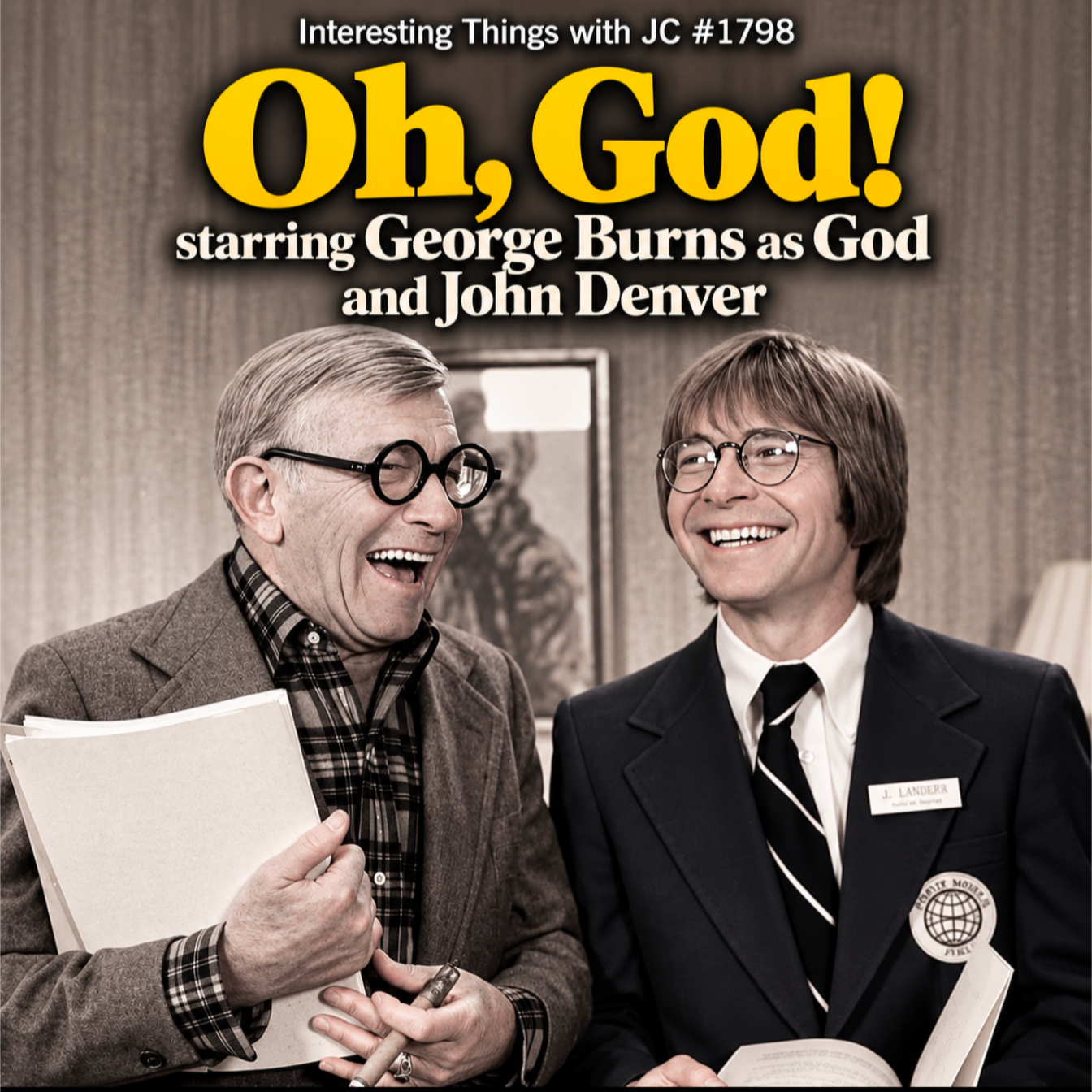
Square podcast cover for Interesting Things with JC #1798 featuring a vintage-style black-and-white image of George Burns and John Denver smiling and laughing together while holding papers. Burns appears on the left wearing glasses, with Denver on the right. Text across the upper portion reads, “Interesting Things with JC #1798,” followed by the large yellow title “Oh, God!” and the subtitle, “starring George Burns as God and John Denver.”
Interesting Things with JC #1798:
"Oh, God!, starring George Burns as God and John Denver"
On October 7, 1977, movie audiences were introduced to God.
He was 81 years old, wore glasses and a fishing hat, and looked a lot like George Burns.
In Oh, God!, John Denver plays Jerry Landers, an assistant manager at a grocery store who receives a message asking him to meet with God. Jerry assumes somebody is playing a joke. Then God actually appears, looking like an ordinary old man.
That was part of what made the movie work.
Burns didn't play God with thunder, robes or a booming voice. His God was calm, funny and practical. Denver, meanwhile, was making his feature-film acting debut.
And Denver almost wasn't there.
In June 1976, Daily Variety reported that Alan Arkin had been cast opposite Burns. The movie almost looked different behind the camera, too. Screenwriter Larry Gelbart had originally been announced to make his feature-film directing debut on Oh, God! Instead, Carl Reiner ultimately directed, with Gelbart writing the screenplay.
The story came from Avery Corman's 1971 novel and asked a surprisingly good question beneath all the comedy:
What would actually happen if an ordinary person claimed God had spoken to them?
Jerry isn't simply believed. People question his sanity. Religious leaders challenge him. His family gets pulled into the attention. Eventually, he finds himself in court trying to establish whether his conversations with God are real.
The movie became a hit, and Gelbart's screenplay was nominated for an Academy Award. It also won the Writers Guild of America award for adapted comedy.
Oh, God! was successful enough to produce two sequels, both bringing Burns back as God.
But the original's cleverest idea may have been its simplest. God chooses an entirely ordinary man to deliver his message.
Meeting God might be the easy part.
Getting anybody else to believe you is considerably harder.
These are interesting things, with JC.
Student Worksheet
Part A — Comprehension
When was Oh, God! released in the United States?
How old was George Burns when the film was released?
Who does Burns portray?
Who portrays Jerry Landers?
What is Jerry's occupation?
What does Jerry initially think is happening when he receives the message?
How does Burns's portrayal differ from stereotypical cinematic images of God?
What was significant about Oh, God! in John Denver's acting career?
Which actor had previously been reported as cast opposite Burns?
Who wrote the screenplay?
Who ultimately directed the film?
Who wrote the original novel?
What happens when Jerry tells other people about his encounters?
What major Academy Award recognition did the screenplay receive?
What happened to the film series after the success of the original?
Part B — Evidence and Reasoning
Write one claim made by Jerry in the story.
What direct evidence does Jerry personally possess because of his experience?
Why can't other characters automatically possess the same evidence?
What type of evidence could potentially corroborate Jerry's account?
Explain the difference between testimony and corroboration.
Does questioning Jerry's story necessarily mean another character has concluded that Jerry is lying? Explain.
Explain the difference between saying "Jerry believes he met God" and "Jerry proved that he met God."
Why might a court require a different standard of evidence than Jerry's family?
Why might a religious authority evaluate Jerry's claim differently from a court?
Why would independent evidence generally strengthen an extraordinary claim?
Part C — Film Analysis
Why is Jerry's ordinary occupation important to the story?
How would the film's premise change if Jerry were a famous religious leader instead of a grocery-store employee?
What does casting an 81-year-old comedian as God contribute to the film's tone?
Why might comedy be particularly effective for exploring a potentially divisive subject?
How might the film have felt different if Alan Arkin had played Jerry instead of John Denver?
Why is the fact that Denver was making his feature-film acting debut relevant to understanding the casting?
What does the production history demonstrate about how films can change before reaching audiences?
Part D — Critical Thinking
Can testimony be evidence even when it cannot independently prove a claim? Explain.
Can a person sincerely report something that did not occur exactly as remembered? Explain why sincerity and accuracy are separate questions.
Give a nonreligious example of a claim that might initially depend primarily on one person's testimony.
What additional evidence would help investigators evaluate your example?
Why is "I don't know" sometimes a stronger conclusion than immediately deciding that a claim is either true or false?
Explain the episode's final idea in your own words: why might persuading others be harder than having the experience itself?
Difficulty Scaling
Level 1 — Comprehension: Questions 1–15 test factual understanding.
Level 2 — Application: Questions 16–25 require students to apply concepts involving evidence and credibility.
Level 3 — Analysis: Questions 26–32 examine filmmaking and narrative choices.
Level 4 — Evaluation: Questions 33–38 require independent reasoning.
Student Output: Complete Parts A and B. Select three questions from Parts C and D and answer each in 100–150 words using evidence from the transcript.
Academic Integrity Guidance: Students should distinguish factual statements about the film from personal interpretations. Religious belief or nonbelief should not be treated as evidence for or against factual claims about the movie or its production.
Teacher Guide
Quick Start: Do not begin by asking students whether they believe in God. The instructional question is evidence and credibility, not religious belief. Begin with the film's premise: an ordinary person reports an extraordinary personal experience that nobody else initially shares.
Materials
Episode #1798 audio
Episode transcript
Student worksheet
Quiz
Assessment prompt and rubric
Internet access for optional source-evaluation activity
Optional legal pads or evidence-chart worksheets
Pacing Guide — Audio First
0–5 minutes — Hook: Write on the board: "How can you prove something happened if you were the only person who experienced it?" Students respond privately in one or two sentences.
5–9 minutes — Listen: Play Episode #1798 without interruption.
9–14 minutes — Recall: Students identify five factual claims made in the episode.
14–20 minutes — Vocabulary: Introduce claim, evidence, testimony, corroboration, credibility, verification, and skepticism.
20–30 minutes — Evidence Exercise: Students classify statements from the episode as claim, evidence, testimony, interpretation, or historical fact.
30–40 minutes — Worksheet: Students complete Parts A and B individually or in pairs.
40–50 minutes — Discussion: Compare standards of evidence used by families, historians, journalists, scientists, courts, and religious institutions.
50–55 minutes — Quiz: Administer the 10-question quiz.
55–60 minutes — Exit Ticket: Students answer: "What is the difference between believing someone's account and demonstrating that the account is true?"
Evidence Exercise
Classify each statement before discussing why.
"Oh, God! was released in 1977." — Historical claim that can be independently verified.
"Jerry says God spoke to him." — Report of testimony within the story.
"Jerry sincerely believes God spoke to him." — Claim about Jerry's state of mind.
"Therefore God spoke to Jerry." — Conclusion requiring additional support.
"George Burns was 81 when the film was released." — Verifiable biographical claim.
"Burns was the perfect actor for the role." — Interpretation or opinion.
"Alan Arkin had previously been announced opposite Burns." — Historical production claim requiring documentary sourcing.
"The casting made the movie funnier." — Interpretive claim requiring argument rather than simple factual verification.
Discussion Prompts
Why does the story use an ordinary person rather than an established authority figure?
Is testimony evidence?
When does testimony become stronger evidence?
What makes a source credible?
Is an extraordinary claim automatically false?
Is refusing to accept a claim immediately the same as rejecting it?
Why do historians seek multiple independent sources?
Why do scientists value repeatability?
Why do courts permit eyewitness testimony while also questioning its reliability?
Can different institutions reasonably apply different standards of evidence?
Formative Checkpoints
Student correctly identifies a claim.
Student distinguishes testimony from independent corroboration.
Student understands that testimony can constitute evidence without necessarily establishing proof.
Student distinguishes sincerity from factual accuracy.
Student understands skepticism as questioning rather than automatic denial.
Student supports interpretations with transcript evidence.
Student distinguishes verifiable production facts from opinions about the film.
Common Misconceptions
"If somebody believes something strongly, it must be true." Sincerity addresses whether someone believes a claim, not necessarily whether the claim accurately describes reality.
"Testimony isn't evidence." Testimony is evidence. Its strength depends on context, reliability, consistency, corroboration, and other factors.
"If there isn't proof, the claim must be false." Lack of sufficient evidence may justify withholding a conclusion rather than declaring the opposite conclusion true.
"Skepticism means disbelief." Skepticism involves critical examination and may result in acceptance, rejection, or continued uncertainty.
"This lesson asks whether God exists." It does not. Students analyze evidence, testimony, filmmaking, and the historical film.
"Movies accurately reproduce the books they adapt." Adaptation involves creative decisions, omissions, additions, casting choices, and structural changes.
Differentiation
Additional Support: Provide students with cards labeled CLAIM, TESTIMONY, EVIDENCE, CORROBORATION, and OPINION and have them physically classify examples.
Advanced Learners: Compare standards of evidence in science, journalism, history, and law. Require students to explain why no single standard applies identically to every discipline.
English Learners: Preteach the seven evidence-related vocabulary terms using simple nonreligious scenarios.
Homeschool: Watch the film after completing the audio lesson and identify scenes illustrating testimony, skepticism, corroboration, and authority.
College Extension: Introduce epistemology and examine the distinctions among belief, justification, knowledge, testimony, and uncertainty.
Media Literacy Extension: Give students two online sources discussing the film's production and have them compare authorship, sourcing, evidence, publication context, and agreement between sources.
Teacher Answer Guide — Worksheet
October 7, 1977.
God.
John Denver.
Assistant manager at a grocery store.
He suspects someone is playing a joke.
Burns presents God as an ordinary elderly man rather than through spectacular imagery.
It was Denver's feature-film acting debut.
Alan Arkin.
Larry Gelbart.
Carl Reiner.
Avery Corman.
His account is questioned, religious leaders challenge him, his family faces attention, and the conflict eventually reaches a courtroom.
Gelbart's screenplay received an Academy Award nomination.
Two sequels followed, with Burns returning.
16–25. Answers should distinguish Jerry's direct personal experience from evidence available independently to others.
26–32. Responses should analyze casting, characterization, adaptation, and production choices using evidence.
33–38. Accept multiple defensible answers when students distinguish claims from evidence and explain their reasoning.
Quiz
Multiple Choice
Oh, God! was released in the United States in:
A. 1971
B. 1975
C. 1977
D. 1984Who portrayed God?
A. John Denver
B. George Burns
C. Alan Arkin
D. Carl ReinerJerry Landers works primarily as:
A. A minister
B. A lawyer
C. A grocery-store assistant manager
D. A journalistOh, God! represented what milestone for John Denver?
A. His first recording
B. His feature-film acting debut
C. His directorial debut
D. His first comedy albumWhich actor had previously been reported as cast opposite George Burns?
A. Alan Arkin
B. Gene Wilder
C. Richard Dreyfuss
D. Steve MartinWho ultimately directed Oh, God!?
A. Avery Corman
B. Larry Gelbart
C. Carl Reiner
D. George BurnsCorroboration means:
A. Repeating a claim many times
B. Independent information supporting an account
C. Assuming a witness is mistaken
D. Expressing an opinionWhich statement best distinguishes testimony from corroboration?
A. Testimony is always false; corroboration is always true.
B. Testimony is an account from a source; corroboration provides independent support for that account.
C. They mean exactly the same thing.
D. Neither can be evidence.Skepticism most accurately means:
A. Automatically declaring unusual claims false
B. Questioning whether available evidence sufficiently supports a claim
C. Refusing to consider evidence
D. Accepting only eyewitness accountsWhich best describes the central analytical problem explored by the episode?
A. Whether comedy was popular in 1977
B. Whether John Denver preferred acting to music
C. How an extraordinary personal experience can be demonstrated to people who did not share it
D. Whether novels are better than films
Answer Key: 1-C, 2-B, 3-C, 4-B, 5-A, 6-C, 7-B, 8-B, 9-B, 10-C.
Scoring
9–10 correct: Mastery
7–8 correct: Proficient
5–6 correct: Developing
0–4 correct: Review recommended
Assessment
Performance Task — The Problem of Proof
Prompt: Jerry Landers believes that he has directly communicated with God. Other people must evaluate his claim without sharing his experience. Using Episode #1798 as your primary source, explain the difference between personal certainty and publicly verifiable evidence. Then compare Jerry's problem with one nonreligious situation involving eyewitness testimony, historical evidence, journalism, science, law, or everyday decision-making.
Length: 500–750 words.
Required Elements
Accurate explanation of the premise of Oh, God!
Identification of at least one claim
Explanation of testimony as evidence
Explanation of corroboration
Distinction between personal certainty and independent verification
At least three specific references to Episode #1798
One appropriate nonreligious comparison
Consideration of uncertainty
Evidence-based conclusion
Optional Research Extension: Students may independently verify one production-history claim from the episode using two reputable sources and briefly explain why those sources are credible.
Assessment Rubric — 24 Points
Historical Accuracy — 4 points: Film, production, and historical information is represented accurately.
Understanding of Evidence — 4 points: Clearly distinguishes claims, testimony, evidence, corroboration, and verification.
Reasoning — 4 points: Conclusions follow logically from evidence.
Source Use — 4 points: Uses specific episode evidence accurately and appropriately.
Comparison — 4 points: Applies concepts successfully to a relevant nonreligious example.
Communication — 4 points: Writing is organized, precise, readable, and appropriately sourced.
Performance Levels
22–24 — Advanced: Nuanced understanding, accurate evidence, strong comparison, and sophisticated reasoning.
18–21 — Proficient: Accurate understanding with relevant evidence and logical analysis.
13–17 — Developing: Basic understanding is present, but distinctions or evidence require greater precision.
0–12 — Beginning: Significant factual or conceptual misunderstandings require reteaching.
Exit Assessment
In 75–100 words, answer:
"Why does evidence that convinces one person not necessarily convince another?"
A successful response should mention access to evidence, credibility, corroboration, or differing standards of proof.
Standards Alignment
CCSS Reading — Informational Text
CCSS.ELA-LITERACY.RI.9-10.1 — Cite strong and thorough textual evidence to support analysis of what the text says explicitly as well as inferences drawn from the text. Students cite Episode #1798 while distinguishing factual statements from interpretation.
CCSS.ELA-LITERACY.RI.9-10.8 — Delineate and evaluate the argument and specific claims in a text. Students distinguish claims from supporting evidence and evaluate their strength.
CCSS.ELA-LITERACY.RI.11-12.1 — Cite strong and thorough textual evidence to support analysis, including determining where the text leaves matters uncertain. Students identify uncertainty rather than treating incomplete evidence as proof of either conclusion.
CCSS.ELA-LITERACY.RI.11-12.7 — Integrate and evaluate multiple sources of information presented in different media or formats. Extension students compare audio, transcript, film-history sources, and optional film excerpts.
CCSS Writing
CCSS.ELA-LITERACY.WHST.9-10.1 — Write arguments focused on discipline-specific content. Students construct evidence-supported explanations concerning credibility and verification.
CCSS.ELA-LITERACY.WHST.9-10.9 — Draw evidence from informational texts to support analysis, reflection, and research. Students cite the transcript in analytical responses.
CCSS.ELA-LITERACY.WHST.11-12.1 — Write arguments focused on discipline-specific content. Advanced students develop claims and address competing interpretations.
CCSS.ELA-LITERACY.WHST.11-12.9 — Draw evidence from informational texts to support analysis, reflection, and research. Students integrate episode evidence and optional external research.
CCSS Speaking and Listening
CCSS.ELA-LITERACY.SL.9-10.1 — Initiate and participate effectively in collaborative discussions. Students evaluate evidence while responding respectfully to competing interpretations.
CCSS.ELA-LITERACY.SL.11-12.1 — Initiate and participate effectively in collaborative discussions. Students justify conclusions using evidence and respond thoughtfully to disagreement.
C3 Framework
D1.5.9-12 — Determine the kinds of sources that will be helpful in answering compelling and supporting questions. Students identify evidence necessary to investigate claims.
D3.1.9-12 — Gather relevant information from multiple sources while considering origin, authority, structure, context, and corroborative value. Students evaluate production-history sources.
D3.2.9-12 — Evaluate the credibility of a source by examining how experts value the source. Students compare source authority and reliability.
D4.1.9-12 — Construct arguments using precise and knowledgeable claims, with evidence from multiple sources. Students complete the evidence-based assessment.
ISTE Standards for Students
1.3.a — Effective Research Strategies: Students plan strategies for locating information needed to verify production-history claims.
1.3.b — Evaluate Information: Students evaluate accuracy, perspective, credibility, and relevance of media and information sources.
1.3.c — Curate Information: Students organize evidence from multiple sources to demonstrate meaningful connections or conclusions.
ACRL Framework for Information Literacy
Authority Is Constructed and Contextual: Students examine why authority depends partly on the question being investigated.
Information Creation as a Process: Students distinguish a trade publication, film database, podcast, motion picture, and later retrospective source.
Research as Inquiry: Students develop questions that require additional evidence rather than beginning with predetermined conclusions.
Scholarship as Conversation: Students understand that historical claims can be refined when additional primary or authoritative sources become available.
National Core Arts Standards — Media Arts
MA:Re7.1.HSII — Analyze the qualities of and relationships between the components in media artworks. Students examine casting, screenplay, performance, characterization, and comedy.
MA:Cn11.1.HSI — Demonstrate and explain how media artworks and ideas relate to various contexts, purposes, and values. Students connect Oh, God! to its 1977 historical and cultural setting.
Bloom's Revised Taxonomy
Remember: Identify Burns, Denver, Reiner, Gelbart, Corman, Arkin, and the 1977 release.
Understand: Explain the premise and production history.
Apply: Classify examples as claims, testimony, evidence, corroboration, or opinion.
Analyze: Examine relationships among evidence, credibility, and institutional standards.
Evaluate: Judge the strength of evidence without confusing uncertainty with rejection.
Create: Construct an evidence-based argument applying the concepts to another situation.
Universal Design for Learning
Multiple Means of Engagement: Film history, humor, philosophical inquiry, and evidence analysis provide different entry points.
Multiple Means of Representation: Information is available through audio, transcript, vocabulary instruction, discussion, and optional film material.
Multiple Means of Action and Expression: Students demonstrate learning through classification, discussion, short responses, quizzes, and extended writing.
Career Readiness Competencies
Critical thinking
Source evaluation
Evidence-based decision-making
Written communication
Oral communication
Media literacy
Respectful discussion
Recognition of uncertainty
Distinguishing fact from interpretation
Verification before conclusion
Show Notes
Interesting Things with JC #1798 examines Oh, God!, the 1977 comedy starring George Burns as God and John Denver as grocery-store assistant manager Jerry Landers.
Released October 7, 1977, the film originated with Avery Corman's novel and reached theaters under director Carl Reiner with a screenplay by Larry Gelbart. Denver was making his feature-film acting debut, although contemporary trade reporting shows that Alan Arkin had previously been associated with the role opposite Burns.
The accompanying lesson uses the movie's premise to explore film history, adaptation, testimony, evidence, corroboration, credibility, skepticism, and the difference between personal certainty and independently verifiable evidence.
Classroom Themes: Film history, 1970s American culture, evidence, testimony, credibility, corroboration, critical thinking, media literacy, adaptation, comedy.
Classroom Use: Grades 9–12, introductory college, homeschool, and lifelong learning.
Free curriculum materials available on the website, no login, no paywall.
References
Academy of Motion Picture Arts and Sciences. (n.d.). The 50th Academy Awards | 1978. https://www.oscars.org/oscars/ceremonies/1978
American Film Institute. (n.d.). Oh, God! (1977). AFI Catalog of Feature Films. https://catalog.afi.com/Film/55908-OH-GOD
Association of College and Research Libraries. (2016). Framework for information literacy for higher education. American Library Association. https://www.ala.org/acrl/standards/ilframework
Common Core State Standards Initiative. (n.d.). English language arts standards. https://www.thecorestandards.org/ELA-Literacy/
Corman, A. (1971). Oh, God! New American Library.
International Society for Technology in Education. (n.d.). ISTE standards for students. https://iste.org/standards/students
National Coalition for Core Arts Standards. (n.d.). National Core Arts Standards. https://www.nationalartsstandards.org/
National Council for the Social Studies. (2013). The college, career, and civic life (C3) framework for social studies state standards. https://www.socialstudies.org/standards/c3
Writers Guild of America West. (n.d.). Writers Guild Awards. https://www.wga.org/the-guild/awards