Interesting Things with JC #1797: "A Reversible Weakness in Alzheimer’s Gene"
Scientists found a way to reverse some damage linked to the strongest known genetic risk factor for late-onset Alzheimer’s. Instead of changing the gene, they blocked one of the signals it sets off.
Curriculum - Episode Anchor
Episode Title: A Reversible Weakness in Alzheimer’s Gene
Episode Number: 1797
Series: Interesting Things with JC
Host: JC
Audience: Grades 9–12, introductory college, homeschool, lifelong learners
Subject Area: Biology, genetics, neuroscience, health science, scientific literacy
Estimated Audio Length: Under 3 minutes
Central Question: How can an inherited genetic risk contribute to Alzheimer’s disease through the brain’s blood vessels, and can researchers interfere with the damage without changing the gene itself?
Learning Objectives
Students will be able to:
Explain the difference between inheriting APOE4 and developing Alzheimer’s disease.
Describe the basic function of the blood-brain barrier and pericytes.
Explain how altered pericyte behavior may contribute to fibrosis and vascular amyloid.
Describe why targeting a downstream biological pathway differs from changing a gene.
Distinguish laboratory and animal findings from an established human treatment.
Evaluate why reversibility of a disease mechanism can be scientifically important.
Lesson Overview
APOE4 is the strongest known genetic risk factor for late-onset Alzheimer’s disease, but genetic risk is not the same as genetic destiny. Episode #1797 examines research suggesting that APOE4 may contribute to disease partly by changing cells surrounding the brain’s smallest blood vessels.
The episode focuses on pericytes, specialized cells that help maintain small blood vessels and the blood-brain barrier. Researchers found evidence that APOE4 can push some of these cells toward a scar-forming state associated with fibrosis, reduced normal pericyte coverage, and vascular amyloid accumulation.
Most importantly, researchers interfered with signaling involving transforming growth factor beta, or TGF-beta. Some pathological changes improved. The educational significance is the distinction between an inherited genetic variant and the biological processes occurring downstream of that variant: the gene remained, but some consequences appeared modifiable.
Essential Understanding: A genetic risk factor can influence a chain of biological events. Interrupting part of that chain may provide a therapeutic target even when the inherited gene itself cannot be changed.
Important Limitation: These findings do not establish a treatment or cure for Alzheimer’s disease. The work described remains preclinical research.
Key Vocabulary
APOE — Apolipoprotein E (ap-oh-LIP-oh-pro-teen E): A gene that provides instructions for producing a protein involved in transporting fats and cholesterol and has several common genetic variants.
APOE4: A version of APOE associated with substantially increased risk for late-onset Alzheimer’s disease. Carrying APOE4 does not guarantee development of the disease.
Alzheimer’s disease: A progressive neurodegenerative disease associated with deterioration of memory, thinking, behavior, and eventually many basic functions.
Blood-brain barrier: A highly selective biological boundary formed around blood vessels in the central nervous system that regulates movement of substances between circulating blood and brain tissue.
Pericyte (PAIR-ih-site): A specialized cell closely associated with capillaries and other small blood vessels that contributes to vascular stability and blood-brain barrier function.
Fibrosis (fy-BROH-sis): Excessive formation or accumulation of fibrous, scar-like tissue.
Amyloid (AM-ih-loyd): A general term for abnormal protein deposits. In Alzheimer’s research, amyloid-beta is particularly important.
Vascular amyloid: Amyloid deposited within or around blood-vessel walls.
TGF-beta: Transforming growth factor beta, a signaling molecule involved in processes including cell growth, repair, inflammation, and fibrosis.
Cell-signaling pathway: A molecular communication system through which cells receive and respond to biological signals.
Genetic risk factor: An inherited genetic characteristic associated with increased probability of developing a condition but which does not necessarily cause that condition by itself.
Preclinical research: Research performed before a treatment is established for human clinical use, commonly involving cells, tissues, or animal models.
Narrative Core
Problem
Scientists have known for decades that APOE4 increases the risk of late-onset Alzheimer’s disease. Knowing that a genetic variant increases risk, however, does not completely explain the biological steps connecting that variant to disease.
Discovery
Researchers investigated the brain’s vascular system, particularly pericytes surrounding small blood vessels. APOE4 was associated with changes in these cells resembling processes involved in scar formation.
The changes included:
Increased fibrosis around blood vessels.
Reduced normal pericyte coverage.
Increased amyloid accumulation associated with blood vessels.
This suggests that APOE4’s effects may involve not only neurons but also the biological infrastructure supporting brain circulation and the blood-brain barrier.
Intervention
Researchers targeted signaling involving TGF-beta rather than attempting to alter APOE4 itself.
When this signaling was reduced, researchers observed improvement in several measures:
Pericyte coverage improved.
Fibrosis decreased.
Vascular amyloid decreased.
Similar effects were observed in older mice carrying APOE4.
Scientific Importance
The experiment separates two ideas that students can easily confuse:
APOE4 itself is inherited.
Some biological consequences associated with APOE4 may be modifiable.
This does not demonstrate that Alzheimer’s disease can currently be reversed in humans. Instead, it identifies a potentially actionable biological mechanism connecting genetic risk with vascular damage.
The important finding is not that researchers changed an Alzheimer’s-associated gene. They found evidence that they could interfere with something the gene was helping cause.
Transcript
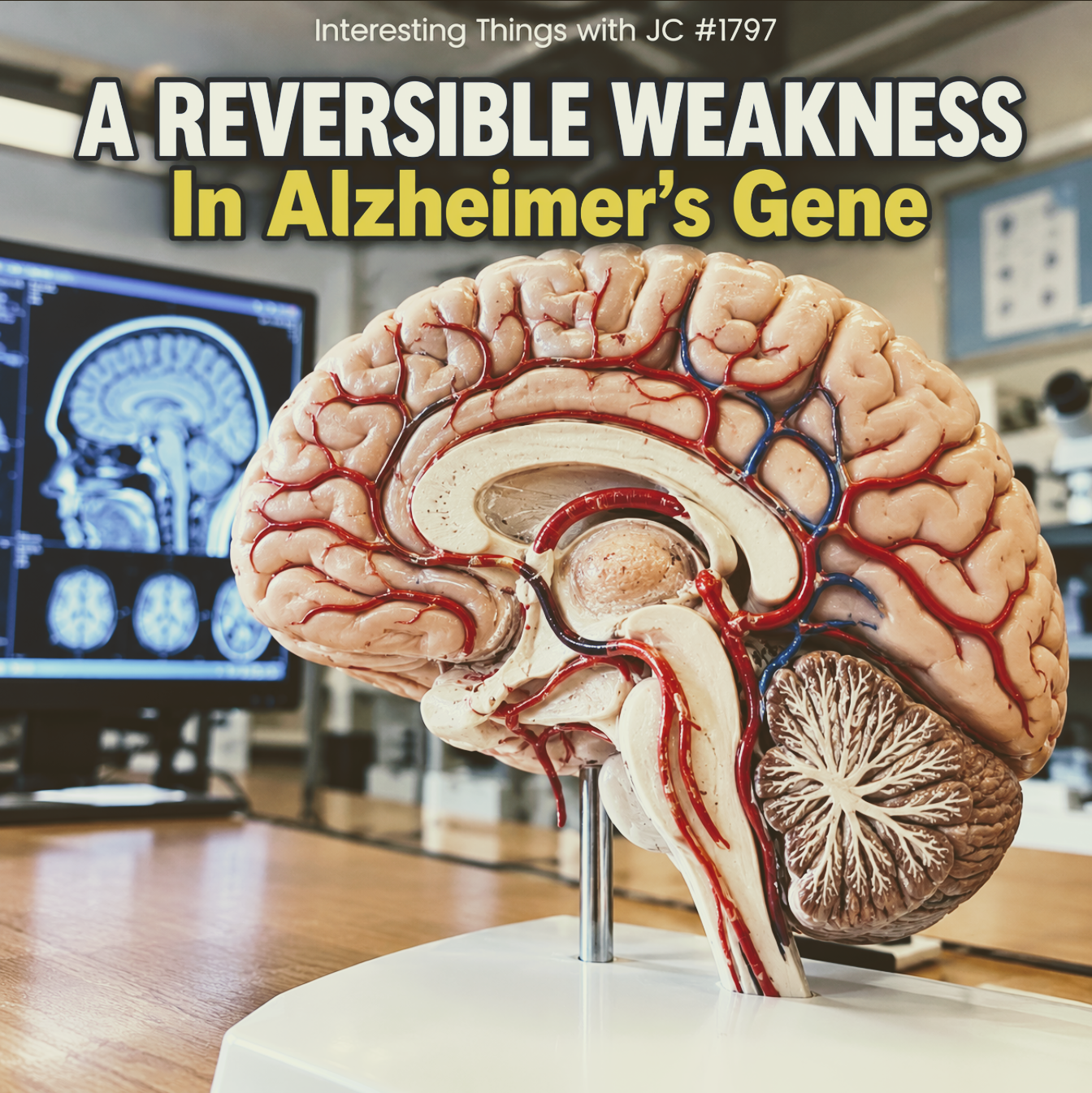
Square educational podcast cover for Interesting Things with JC #1797. A realistic anatomical brain model showing major blood vessels and internal brain structures sits on a laboratory table. A computer monitor displaying brain MRI scans appears blurred in the background. Text at the top reads, “Interesting Things with JC #1797,” followed by the episode title, “A Reversible Weakness in Alzheimer’s Gene.” The lower third is free of text.
Interesting Things with JC #1797:
“A Reversible Weakness in Alzheimer’s Gene”
Apolipoprotein E (ap-oh-LIP-oh-pro-teen E), or APOE, is a gene that comes in several versions. One of them, APOE4, is the strongest known genetic risk factor for late-onset Alzheimer’s disease. Having it doesn’t mean someone will develop Alzheimer’s, but scientists have spent decades trying to understand why this particular version raises the risk.
Researchers at the Icahn School of Medicine at Mount Sinai may have found part of the answer, and it involves the brain’s smallest blood vessels.
Those vessels do more than carry blood. They’re part of the blood-brain barrier, a tightly controlled system that lets oxygen and nutrients reach brain tissue while keeping many harmful substances out. Wrapped around those tiny vessels are support cells called pericytes (PAIR-ih-sites). Think of them as part of the maintenance crew. They help keep the vessel walls stable and the barrier working properly.
The researchers found that APOE4 can change the behavior of those cells. Some pericytes (PAIR-ih-sites) began acting more like cells involved in forming scar tissue. As that happened, there was more fibrosis (fy-BROH-sis), or thickened scar-like tissue, around the blood vessels, less normal pericyte (PAIR-ih-site) coverage, and more amyloid (AM-ih-loyd) building up along the vessel walls.
Then they tried interfering with the process.
The researchers blocked a cell-signaling pathway involving transforming growth factor beta, or TGF-beta. Cells use chemical signals like these to control things such as growth, repair, and scarring. When researchers turned down this particular signal, some of the damage began to ease. Pericyte (PAIR-ih-site) coverage improved, while fibrosis (fy-BROH-sis) and vascular amyloid (AM-ih-loyd) decreased. They saw similar results in older mice carrying APOE4.
They didn’t change the gene. They changed what the gene was causing farther down the line.
This is still laboratory and animal research, not a treatment for Alzheimer’s. But researchers now have something more specific than a genetic risk to study. They have a biological process tied to that risk that responded when they interfered with it.
APOE4 may be something a person inherits for life. The damage it sets in motion may not be as fixed.
These are interesting things, with JC.
Student Worksheet
Comprehension
What is APOE4?
Does inheriting APOE4 mean a person will definitely develop Alzheimer’s disease? Explain.
What is the blood-brain barrier?
What are pericytes, and where are they found?
What three vascular changes were associated with altered pericyte behavior in the episode?
What signaling molecule or pathway did researchers target?
What happened after researchers interfered with that signaling?
Did researchers change the APOE4 gene itself?
Analysis
Explain the difference between a genetic risk factor and a direct genetic cause.
Why might damage to small blood vessels matter to brain health even if neurons themselves are not initially being studied?
Construct the proposed mechanism described in the episode using the following terms: APOE4, pericytes, fibrosis, blood vessels, vascular amyloid.
Why is the statement “Scientists reversed Alzheimer’s” unsupported by the research described?
Why might targeting something downstream from a gene be easier or more practical than altering an inherited gene throughout a person's body?
Evidence and Scientific Literacy
Identify one observation from the research that supports the idea that the vascular changes may be modifiable.
What additional evidence would be necessary before scientists could conclude that this approach is safe and effective in humans?
Explain why successful results in mice are scientifically valuable but insufficient to establish a human treatment.
Reflection
Consider the statement: “Genetic risk is not necessarily genetic destiny.” Using evidence from the episode, explain what that means.
Difficulty Scaling
Level 1: Identify the cells, gene variant, and biological structures described.
Level 2: Explain the proposed chain connecting APOE4 with vascular abnormalities.
Level 3: Evaluate the evidence and limitations of targeting a downstream signaling pathway.
Student Output: Responses should use complete sentences and distinguish observations from conclusions.
Academic Integrity Guidance: Students should describe the evidence in their own words and clearly identify outside sources used for additional research.
Teacher Guide
Quick Start: Play or read Episode #1797 once without interruption. Ask students to identify the inherited factor, affected cells, observed damage, experimental intervention, and result.
Pacing Guide — Audio First
0–5 minutes: Listen to the episode and identify unfamiliar terminology.
5–10 minutes: Review APOE, APOE4, pericytes, and the blood-brain barrier.
10–20 minutes: Students complete comprehension questions 1–8.
20–30 minutes: Build the proposed causal chain as a class.
30–40 minutes: Complete analysis questions 9–16.
40–50 minutes: Discuss genetic risk versus genetic determinism.
50–55 minutes: Complete reflection question 17 or use it as an exit ticket.
Materials
Episode #1797 audio or transcript.
Student worksheet.
Diagram or reference image of a brain capillary and blood-brain barrier.
Optional access to the original research publication.
Suggested Board Model
APOE4 → altered pericyte state → increased fibrosis / reduced normal pericyte coverage → vascular dysfunction + increased vascular amyloid
Intervention:
TGF-beta signaling ↓ → improved pericyte coverage + reduced fibrosis + reduced vascular amyloid
Emphasize that the arrows represent a proposed biological mechanism supported by experimental evidence, not proof that every APOE4 carrier follows an identical disease pathway.
Discussion Prompts
Why is identifying a disease-associated gene only the beginning of understanding a disease?
What makes a biological mechanism potentially “druggable”?
Why are blood vessels important in diseases usually discussed primarily in terms of neurons?
How can headlines exaggerate preclinical biomedical research?
What evidence would transform this finding from an interesting mechanism into a potential therapy?
Common Misconceptions
Misconception: APOE4 causes Alzheimer’s in everyone who inherits it.
Correction: APOE4 increases risk; it is neither necessary nor sufficient by itself to guarantee late-onset Alzheimer’s disease.Misconception: Researchers repaired or removed APOE4.
Correction: The intervention targeted downstream cellular signaling.Misconception: The experiment cured Alzheimer’s disease.
Correction: The research identified reversible features of a proposed disease mechanism in experimental models.Misconception: Blood-brain barrier dysfunction means the brain has no protection from the bloodstream.
Correction: Barrier function exists along a continuum and can become impaired without disappearing entirely.
Differentiation
Additional Support: Provide students with the causal chain and ask them to explain each arrow.
Advanced Learners: Have students investigate cerebral amyloid angiopathy and compare vascular amyloid with amyloid plaques in brain tissue.
English Learners: Preteach barrier, fibrosis, inherited, pathway, vascular, and signaling using diagrams.
College Extension: Evaluate experimental design, model limitations, statistical evidence, and whether TGF-beta represents a realistic therapeutic target.
Answer Key
A version of the APOE gene associated with increased late-onset Alzheimer’s risk.
No. It increases risk but does not guarantee disease.
A selective biological system regulating movement between circulating blood and brain tissue.
Cells associated with small blood vessels that help support vascular stability and blood-brain barrier function.
Increased fibrosis, reduced normal pericyte coverage, and increased vascular amyloid.
Signaling involving TGF-beta.
Pericyte coverage improved while fibrosis and vascular amyloid decreased.
No.
A risk factor changes probability; it does not necessarily determine an outcome.
Brain tissue depends on controlled circulation, nutrient delivery, waste handling, and blood-brain barrier integrity.
Answers should accurately connect APOE4 with altered pericyte behavior and subsequent vascular abnormalities.
The work is preclinical and does not demonstrate reversal of human Alzheimer’s disease.
Downstream mechanisms may provide specific biological targets without requiring alteration of inherited DNA throughout the body.
Reducing TGF-beta-related signaling improved several measured vascular abnormalities.
Additional preclinical work followed by appropriately designed human clinical trials assessing safety, dosage, biological effects, and clinical outcomes.
Animal models allow controlled mechanistic experiments but do not perfectly reproduce human physiology or Alzheimer’s disease.
Responses should explain that inherited risk can remain permanent while some mechanisms through which that risk operates may potentially be modified.
Quiz
Multiple Choice
APOE4 is best described as:
A. A bacterium associated with dementia
B. A genetic variant associated with increased Alzheimer’s risk
C. An Alzheimer’s medication
D. A type of neuronPericytes are primarily associated with:
A. Small blood vessels
B. Bone marrow
C. Skeletal muscle fibers
D. The digestive tractThe blood-brain barrier primarily:
A. Prevents all substances from entering the brain
B. Regulates movement of substances between blood and brain tissue
C. Produces neurons
D. Stores memoriesResearchers observed increased:
A. Bone density
B. Fibrosis
C. Neuron size
D. Oxygen productionResearchers experimentally interfered with signaling involving:
A. Insulin
B. Hemoglobin
C. TGF-beta
D. DNA polymeraseAfter this intervention, researchers observed:
A. Increased fibrosis
B. Improved pericyte coverage
C. Elimination of APOE4
D. Immediate restoration of memory in humansThe experiment changed:
A. The inherited APOE4 gene
B. A biological process downstream of the gene
C. Every neuron in the brain
D. Human chromosomesThe research described is:
A. An approved Alzheimer’s treatment
B. Evidence that APOE4 has been eliminated
C. Preclinical research
D. Proof that Alzheimer’s is entirely vascularWhy is APOE4 called a risk factor?
A. Everyone carrying it develops Alzheimer’s.
B. It increases probability without guaranteeing disease.
C. It occurs only after Alzheimer’s begins.
D. It is caused by Alzheimer’s medication.The most scientifically accurate conclusion is:
A. Alzheimer’s disease has been cured.
B. APOE4 can now be removed from patients.
C. A biological process associated with APOE4-related vascular pathology responded to experimental intervention.
D. Blood vessels are the sole cause of Alzheimer’s disease.
Answer Key: 1-B, 2-A, 3-B, 4-B, 5-C, 6-B, 7-B, 8-C, 9-B, 10-C
Assessment
Performance Task
Students will create a concise evidence-based explanation answering:
How can a permanent inherited genetic variant produce biological effects that may nevertheless be modifiable?
The response must:
Define APOE4.
Explain its relationship to Alzheimer’s risk without treating the relationship as deterministic.
Describe pericytes and the blood-brain barrier.
Explain the observed vascular abnormalities.
Describe the TGF-beta-related intervention.
Distinguish changing a gene from modifying a downstream pathway.
State at least two limitations of the research.
Avoid claiming that the experiment represents an Alzheimer’s cure.
Assessment Rubric — 20 Points
Scientific Accuracy — 5 points: Correctly explains APOE4, vascular biology, and experimental findings.
Mechanistic Reasoning — 5 points: Clearly connects gene variant, cellular changes, vascular pathology, and intervention.
Evidence Interpretation — 4 points: Distinguishes observed results from broader conclusions.
Research Limitations — 3 points: Correctly identifies preclinical and translational limitations.
Communication — 3 points: Explanation is organized, concise, and understandable.
Mastery Benchmark: 16/20 points with no major misconception concerning APOE4 risk or the status of the experimental intervention.
Standards Alignment
NGSS — Science & Engineering Practices
HS-LS3-1 — Heredity: Inheritance and Variation of Traits — Students examine how inherited genetic information can influence biological outcomes while recognizing that genotype does not necessarily determine disease.
HS-LS1-2 — From Molecules to Organisms: Structures and Processes — Students analyze interactions among specialized cells, blood vessels, and biological systems involved in maintaining brain function.
HS-LS1-3 — From Molecules to Organisms: Structures and Processes — Students evaluate evidence connecting cellular processes with changes in system function.
Science and Engineering Practice: Analyzing and Interpreting Data — Students distinguish experimentally observed changes from unsupported clinical conclusions.
Crosscutting Concept: Cause and Effect — Students examine a proposed causal pathway linking genetic variation, cellular behavior, vascular pathology, and experimental intervention.
Crosscutting Concept: Systems and System Models — Students consider interactions among genes, cells, signaling pathways, blood vessels, and brain tissue.
CCSS Reading — Science and Technical Subjects
CCSS.ELA-LITERACY.RST.9-10.1 — Cite specific textual evidence to support analysis of science and technical texts — Students identify evidence supporting claims about APOE4 and vascular changes.
CCSS.ELA-LITERACY.RST.9-10.2 — Determine central ideas or conclusions of a text — Students identify the episode’s central scientific finding and distinguish it from supporting details.
CCSS.ELA-LITERACY.RST.11-12.1 — Cite specific textual evidence to support analysis of science and technical texts — Advanced students evaluate the evidence supporting mechanistic claims.
CCSS.ELA-LITERACY.RST.11-12.3 — Follow precisely a complex multistep procedure — Students reconstruct the experimental logic connecting observed pathology, pathway intervention, and resulting changes.
CCSS.ELA-LITERACY.RST.11-12.8 — Evaluate hypotheses, data, analysis, and conclusions — Students assess whether conclusions are justified by preclinical evidence.
CCSS Writing
CCSS.ELA-LITERACY.WHST.9-10.2 — Write informative/explanatory texts — Students explain the biological mechanism using accurate terminology.
CCSS.ELA-LITERACY.WHST.11-12.2 — Write informative/explanatory texts — Students communicate complex scientific relationships clearly and accurately.
CCSS.ELA-LITERACY.WHST.11-12.9 — Draw evidence from informational texts — Students support conclusions using evidence from the episode and associated research.
Career Readiness Competencies
Scientific literacy.
Evidence evaluation.
Biomedical communication.
Systems thinking.
Genetic literacy.
Distinguishing correlation, risk, mechanism, and causation.
Responsible interpretation of emerging medical research.
Show Notes
Episode Summary: APOE4 is the strongest known genetic risk factor for late-onset Alzheimer’s disease, but researchers are still determining exactly how that inherited risk produces disease. Research highlighted in Episode #1797 points toward the brain’s smallest blood vessels and the pericytes surrounding them. Researchers found that APOE4 was associated with changes in pericytes, fibrosis around blood vessels, reduced normal pericyte coverage, and increased vascular amyloid. When researchers interfered with TGF-beta-related signaling, several of those abnormalities improved.
The researchers did not change APOE4. They targeted a biological process occurring downstream from it. The work remains preclinical and should not be interpreted as an Alzheimer’s treatment or cure. Its importance lies in identifying a potentially modifiable biological mechanism associated with an inherited genetic risk.
Classroom Focus: Genetics, neuroscience, Alzheimer’s disease, blood-brain barrier biology, cell signaling, scientific interpretation, preclinical research.
Free Curriculum: Free curriculum materials available on the website, no login, no paywall.
References
Schuldt, B. R., Haworth-Staines, D., Perez-Arevalo, A., Broekaart, D. W. M., Harlock, A., Wang, L., Bright, A., Gallagher, G., Rabinowitz, G., Goate, A. M., Raj, T., Pereira, A. C., & Blanchard, J. W. (2026). A pericyte-to-myofibroblast transition links APOE4 to cerebrovascular degeneration. Cell. https://doi.org/10.1016/j.cell.2026.08.058
Icahn School of Medicine at Mount Sinai. (2026, September 24). Mount Sinai researchers identify how APOE4 gene damages brain blood vessels in Alzheimer’s disease. https://www.mountsinai.org/about/newsroom/2026/mount-sinai-researchers-identify-how-apoe4-gene-damages-brain-blood-vessels-in-alzheimers-disease
Schuldt, B. R., Haworth-Staines, D., Perez-Arevalo, A., Broekaart, D. W. M., Wang, L., Gallagher, G., Rabinowitz, G., Goate, A. M., Raj, T., Pereira, A. C., & Blanchard, J. W. (2025). APOE4 promotes cerebrovascular fibrosis and amyloid deposition via a pericyte-to-myofibroblast transition. bioRxiv. https://doi.org/10.1101/2025.09.04.674192
National Library of Medicine. (2026). A pericyte-to-myofibroblast transition links APOE4 to cerebrovascular degeneration. PubMed. https://pubmed.ncbi.nlm.nih.gov/42785300/