

A Short Story Podcast Series

Amazon - Apple - Audible - Castbox - Deezer - fyyd - GoodPods - Headliner - iHeartRadio - Instagram - JioSaavn - Listen Notes - Pandora - PlayerFM - Podcast Radio - Podcast Republic - Podchaser - Podverse - PocketCasts - Spotify - Stitcher - Youtube
Link to Podcast Library - or - Scroll for Daily Feed
-
Open Educational Use
Interesting Things with JC is made available for anyone to use in the service of education. Teachers, students, parents, homeschool families, librarians, tutors, and lifelong learners are free to download, copy, share, print, adapt, and reuse the episodes and curriculum materials in any way that helps people learn.
If it supports teaching, learning, or helping others understand the world better, it is allowed.
One exception applies: Episode #509, “Harry Chapin and Jim Connors,” is not included under this open educational permission.
Curriculum Availability
Full curriculum support begins with Episode #1235: “Three Turns to Freedom.” Earlier episodes without curriculum may be prioritized by request. Educators may contact JimConnors LLC, and a matching curriculum module will be created and added.
What You Are Free to Do
You may:
Download and store the audio, transcripts, and curriculum
Copy and share materials with students, families, or learning groups
Print, remix, edit, and adapt lessons for your own educational use
Upload content to learning management systems (LMS), class websites, or internal school platforms
Integrate the material into lessons, assignments, tutoring, homeschool programs, libraries, and community education
No permission is required. Credit to Interesting Things with JC is appreciated when possible, but the priority is helping people learn.
What Is Not Allowed
This openness is for education, not commercial use. The content may not be:
Sold, licensed, or packaged as a product or subscription
Rebranded or presented as original third-party work
Used as part of a paid course, monetized program, or commercial platform
Redistributed as a standalone product for profit
Any commercial, branded, or revenue-generating use requires prior written permission from JimConnors LLC. Episode #509 remains excluded from open educational use.
Rights and Intent
All content remains the intellectual property of JimConnors LLC. The intent is simple:
Use it freely to educate, teach, explain, and help people.
Just do not sell it, repackage it for profit, or claim it as your own.
Summary:
Use it.
Download it.
Copy it.
Share it.
Teach with it.
Adapt it for students, kids, classrooms, homeschools, libraries, and lifelong learning.
Click on the curriculum frame, copy the full merged curriculum standards, use them in your own GPT, iterate and improve them, and share back!
Just don’t sell it, rebrand it, or turn it into a product. Episode #509 is excluded. All rights reserved © JimConnors LLC.
-
Interesting Things with JC has previously been included in curated podcast programming on Podcast Radio formats in both the United Kingdom and the United States. Podcast Radio was launched as a 24-hour broadcast concept designed to showcase podcasts on digital radio and online streaming platforms.
In the United States, the Podcast Radio US brand continues to maintain an online presence and app availability, and has been associated with radio simulcasts on licensed AM and FM signals in selected markets, though live broadcast availability may vary.
Streaming Access
Podcast Radio US and related branded streams provide online listening through their websites and mobile applications, allowing audiences worldwide to hear selected podcast programming.On-Demand Platforms
Interesting Things with JC is available across major podcast directories, including Amazon Music, Apple Podcasts, Audacy, Audible, Castbox, Deezer, fyyd, GoodPods, iHeartRadio, JioSaavn, Listen Notes, Pandora, PlayerFM, PocketCasts, Podcast Republic, Podchaser, Podverse, Spotify, Stitcher, and YouTube.The series is also accessible through podcast apps that index the Apple Podcasts catalog and the open podcast directory ecosystem, including TuneIn, Podcast Addict, Overcast, Castro, Podcast Index–based apps, Podbean, iVoox, Podtail, Podyssey, Podcloud, Bullhorn, AudioBoom directories, and Breaker (legacy).
Social & Video Platforms
Listeners can also follow and view content on Facebook, Instagram, X (Twitter), TikTok, and YouTube. -
Classroom Use
Start class with a short, clear story students can follow from the first sentence. Play an episode of Interesting Things with JC and use the accompanying free curriculum to guide a complete lesson with questions, activities, applied reasoning, and independent analysis.
Every episode from #1235 forward contains a modular micro-lesson engineered for 30 to 90 minute instructional blocks, adaptable to secondary classrooms, international schools, homeschools, tutoring programs, and lifelong learning environments.
At the bottom of each episode page, expandable sections organize all instructional assets in a structured format for educators, parents, and independent learners.
Instructional Architecture of Each Episode
Each episode is designed as a self-contained instructional unit, integrating narrative, academic standards, assessment models, and accessibility requirements into a single deliverable.
Core Instructional Components
Lesson overview with instructional title, grade band, subject classification, and learning objectives
Vocabulary architecture with phonetic spelling, discipline-specific terminology, and plain-language definitions
Primary narrative content constructed through the Precise Storytelling Framework for coherence, sequencing, and conceptual layering
Full verbatim transcript for reading analysis, accessibility, and text-based instruction
Student learning activities including comprehension tasks, analytical writing, synthesis prompts, and evidence-based reasoning exercises
Teacher implementation guide with pacing models, instructional strategies, differentiation guidance, and discussion structures
Assessment instruments including quizzes, performance tasks, formative checks, and rubric-aligned evaluation tools
Standards crosswalks mapping content and skills across U.S., UK, and international academic frameworks
ADA-compliant instructional media with alt text, accessibility tagging, and inclusive design
Primary-source documentation linking directly to verified historical, scientific, legal, and academic references
Homeschool and modular scheduling guidance for flexible implementation
All materials are developed through the Narrative Intelligence System, ensuring factual integrity, instructional coherence, accessibility, and age-appropriate presentation. Lessons are non-ideological and restricted to academic content.
Unified Curriculum Integration Model
Every episode is constructed using a multi-framework integration model, in which:
Narrative structure
Disciplinary content
Cognitive skill development
Assessment design
Accessibility standards
Cross-curricular competencies
are deliberately merged into a single instructional object, rather than appended as afterthoughts. This means each episode simultaneously functions as:
A structured story
A content lesson
A literacy and reasoning exercise
A research and source-evaluation activity
An assessment artifact
A standards-aligned instructional unit
United States Curriculum Architecture (Full Integration)
National Frameworks Embedded
Next Generation Science Standards (NGSS)
Scientific practices, data analysis, modeling, systems thinking, evidence evaluation
Common Core State Standards (CCSS) – ELA & Mathematics
Close reading, argumentative writing, research synthesis, quantitative reasoning
College, Career, and Civic Life (C3) Framework
Disciplinary inquiry, historical sourcing, civic knowledge, geographic reasoning
International Society for Technology in Education (ISTE)
Digital citizenship, computational thinking, information fluency
National Core Arts Standards (NCAS)
Interpretation, critique, interdisciplinary expression, creative analysis
Career and Technical Education (CTE) Career Clusters
Applied technical knowledge, workplace reasoning, real-world problem solving
Association of College and Research Libraries (ACRL)
Research literacy, source evaluation, information ethics, academic inquiry
Bloom’s Taxonomy
Cognitive progression from comprehension to analysis, synthesis, and evaluation
Universal Design for Learning (UDL)
Multiple means of representation, engagement, and expression for inclusive instruction
Cross-Disciplinary U.S. Competencies Embedded in Every Episode
Academic literacy (reading, writing, argumentation)
Quantitative literacy and data reasoning
Media and information literacy
Digital and computational literacy
Civic knowledge and constitutional literacy (knowledge-based, non-ideological)
Research methodology and evidence verification
Critical thinking, analytical writing, and structured problem solving
Additional U.S. Integration Layers
State-level academic standards where applicable
Financial literacy and employability skills
Social-emotional competencies as academic behaviors (persistence, self-regulation, metacognition)
English language development and world-language vocabulary support
United Kingdom Curriculum Architecture (Full Integration)
National Curriculum Structure
Key Stage 3 (ages 11–14)
Key Stage 4 (GCSE)
Key Stage 5 (A-Level / Sixth Form)
Disciplinary domains mapped across episodes:
English language and literature (analysis, argument, rhetorical structure)
Mathematics (numeracy, quantitative interpretation)
Science (evidence, explanation, evaluation)
History and Geography (source criticism, contextual reasoning)
Citizenship (knowledge-based civic education)
Computing and digital literacy
Arts and humanities integration
Examination Frameworks
AQA
OCR
Pearson Edexcel
Assessment alignment includes:
Command terms and performance descriptors
Extended analytical writing
Evidence-based responses
Cross-disciplinary synthesis
International Academic Programmes Integrated
International Baccalaureate (IB)
Primary Years Programme (PYP)
Middle Years Programme (MYP)
Diploma Programme (DP)
Cambridge Assessment International Education
Cambridge IGCSE
Cambridge AS & A Level
Shared instructional architecture:
Inquiry-based learning
Conceptual understanding
Global context framing
Criterion-referenced assessment
Research projects and analytical writing
Cross-Curricular Frameworks Embedded by Design
Oracy across the curriculum
Literacy across disciplines
Numeracy across subjects
Digital and computational literacy
Citizenship and civic knowledge (non-ideological)
Research methodology and information literacy
Interdisciplinary synthesis
Global Academic Equivalency Structures
European Qualifications Framework (EQF) alignment for secondary and pre-university levels
OECD competency domains (literacy, numeracy, analytical reasoning, problem solving)
International standards-referenced assessment models used across secondary education systems
Pedagogical & Assessment Architecture
Knowledge-to-application curriculum sequencing
Evidence-based reasoning and academic writing
Primary-source analysis and citation practices
Formative, summative, and performance-based assessment models
Rubric-aligned evaluation and feedback structures
Universal accessibility and inclusive instructional design
Access, Use, and OER Licensing
All instructional materials are released as Open Educational Resources (OER) and may be used, printed, adapted, or shared for teaching in classrooms, homeschools, tutoring programs, and independent study environments. Materials are provided for educational use under fair use and may not be resold or redistributed commercially.
Episodes from #1235 forward include complete curriculum packages. Older episodes without micro-lessons can be prioritized for conversion. Beginning with Episode #1307, each MP3 page in the RSS feed includes open instructional text for direct access to transcripts and curriculum materials.
Educator and homeschool feedback is actively incorporated to refine instructional clarity, alignment, and usability. Please do not hesitate to reach out - or iterate upon these instructions to improve the framework. Please share open iterations back for continual improvement.
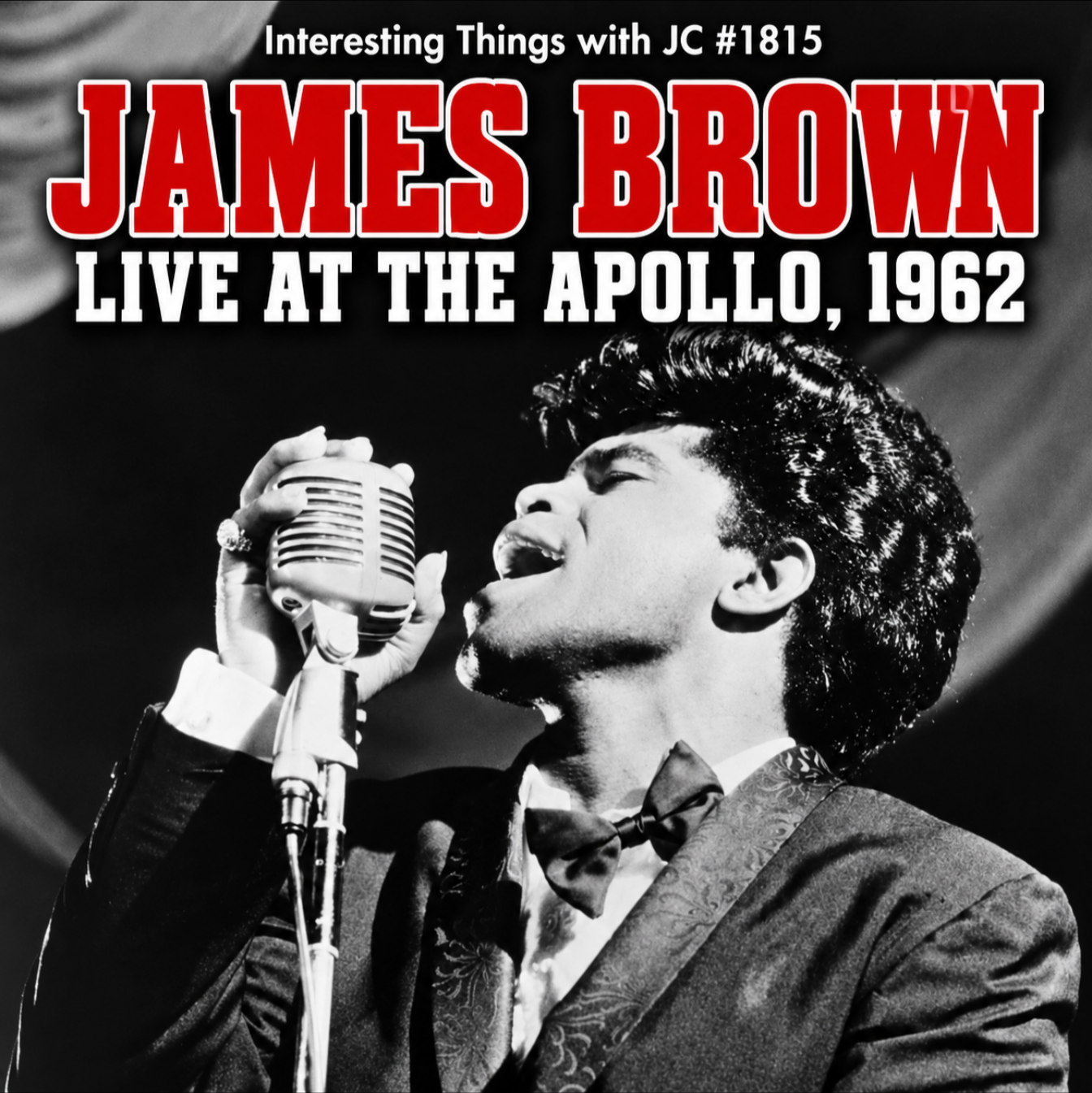
1815: "James Brown - Live at the Apollo, 1962"
Interesting Things with JC #1815: "James Brown: Live at the Apollo, 1962" — James Brown spent $5,700 of his own money recording a concert his record company didn't want. On October 24, 1962, he took the stage at Harlem's Apollo Theater, backed by performers whose contributions would go uncredited on the original album. What followed challenged the industry's assumptions about live recordings.

1813: "Flock Cameras and Your Kids"
Interesting Things with JC #1813: "Flock Cameras and Your Kids" – Police investigating a missing 13-year-old girl in Tennessee use Flock Safety license plate cameras and a witness's video to follow a lead nearly 300 miles into North Carolina. Meanwhile, parents routinely post children's sports photographs revealing faces, school names, and team schedules, raising an unexpected question about which cameras expose children's identities.

1811: "Newton’s 3rd Law and Friction"
Interesting Things with JC #1811: "Newton’s 3rd Law and Friction" – Your foot pushes backward against the ground when you walk, but on ice, that same movement can send you sliding. Vehicle tires depend on a similar interaction for traction, while rockets follow Newton's third law without needing contact with the ground.

1810: "How Deep is the Mariana Trench"
Interesting Things with JC #1810: "How Deep is the Mariana Trench" — Challenger Deep reaches nearly 36,000 feet beneath the Pacific Ocean, more than three times the depth of the Titanic wreck. In 1960, two explorers reached the bottom, but a fractured window threatened their ability to leave the vessel after surfacing. This Episode was inspired by Dr Igo

1808: "The Assistant That Knows What Not to Share"
Interesting Things with JC #1808: "The Assistant That Knows What Not to Share" – Shortly before Meta launched its Muse AI agent, researchers discovered serious vulnerabilities in the systems meant to keep agents isolated. Meta says the flaws were fixed, but agents that can manage accounts, send messages, and act on behalf of users introduce a larger question about how much access they should receive.

1806: "Andy Green Breaks the Land Speed Record"
Interesting Things with JC #1806: "Andy Green Breaks the Land Speed Record" – Andy Green drives ThrustSSC faster than sound, but misses the official record deadline by 49.5 seconds. Two days later, he returns to Nevada's Black Rock Desert for another attempt.

1805: "Emmanuel Mensah - The National Guard Mechanic”
Interesting Things with JC #1805: "Emmanuel Mensah - The National Guard Mechanic" — In December 2017, 27-year-old Army National Guard mechanic Emmanuel Mensah escaped a deadly Bronx apartment fire, then repeatedly returned to rescue four neighbors. He entered the burning building once more and never emerged. His actions earned him the Soldier's Medal, the Army's highest honor for heroism outside combat.

1804: "The Paul is Dead Rumor"
Interesting Things with JC #1804: "The Paul is Dead Rumor" — On October 12, 1969, a Detroit radio caller claimed Paul McCartney was dead and that Beatles records contained hidden evidence. Fans began decoding songs, album covers, and photographs, turning a bizarre rumor into an international obsession.

1803: "Kick by INXS"
Interesting Things with JC #1803: "Kick by INXS" — In 1987, Atlantic Records executives reportedly wanted INXS to scrap their new album, Kick. Manager Chris Murphy refused, and the record went on to produce four American Top 10 hits, win five MTV Video Music Awards, and sell more than 20 million copies worldwide. Behind its success were a taxi driver waiting while a guitarist recorded a riff, an unusual promotional strategy, and a music video inspired by Bob Dylan.

1802: "James Prescott Joule"
Interesting Things with JC #1802: "James Prescott Joule" — In the 1840s, James Prescott Joule used falling weights and spinning paddles to measure how mechanical work produces heat, challenging a leading scientific theory and helping establish the law of energy conservation. His experiments changed how scientists understood energy, and his name became its international unit of measurement.

1797: "A Reversible Weakness in Alzheimer’s Gene"
Interesting Things with JC #1797: "A Reversible Weakness in Alzheimer’s Gene" – Scientists found a way to reverse some damage linked to the strongest known genetic risk factor for late-onset Alzheimer’s. Instead of changing the gene, they blocked one of the signals it sets off.

1795: “Do Redheads Have Special Powers for Survival?”
Interesting Things with JC #1795: “Do Redheads Have Special Powers for Survival?” - Tennessee tried to execute Christa Gail Pike with pentobarbital, but she survived. An online theory pointed to her red hair, where real genetic differences involving anesthesia and pain offer an unexpected scientific connection, but not an explanation for surviving lethal injection.

1791: "The Night Lake Erie Rose”
Interesting Things with JC #1791: "The Night Lake Erie Rose" — In October 1844, powerful winds reversed across Lake Erie and sent water surging into Buffalo, flooding neighborhoods, destroying buildings and driving canal boats into city streets in one of the region’s worst early maritime disasters.

1789: "The Lake Michigan Circle"
Interesting Things with JC #1789: "The Lake Michigan Circle" — Drive 1,100 miles around Lake Michigan through 4 states, or board a steamship where an official spur takes the Circle Tour off the road.

1788: "What the Gateway Process Actually Proved"
Interesting Things with JC #1788: "What the Gateway Process Actually Proved" — An Army officer examined Gateway in 1983. Decades later, his report circulates as CIA proof of manifestation. Somewhere between those two events, an assessment became an answer it never established.

1787: "Does Apple Cider Turn Into Alcohol?!
Interesting Things with JC #1787: "Does Apple Cider Turn Into Alcohol?!" – Fresh apple cider starts bubbling. The sweetness drops. Alcohol is forming, and the process may not stop there.

1785: "Why the Desert Floods So Fast"
Interesting Things with JC #1785: "Why the Desert Floods So Fast" – A desert thunderstorm drops rain faster than the ground can absorb it, sending excess water downhill into channels that were dry minutes before. Runoff from across the watershed combines in arroyos, where floodwater can arrive from a storm several miles upstream that never reaches the people standing downstream.

1783: "Humanity is Unprepared for AI"
Interesting Things with JC #1783: "Humanity is Unprepared for AI" – A student spends years preparing for a career while AI changes the work before graduation. Machines can already help people research, solve problems, and produce results, but employers may need fewer workers as those capabilities expand. Students must choose careers and decide when to trust AI systems that can still invent evidence.

1782: "Why Sound Would Break Apart on Mars"
Interesting Things with JC #1782: "Why Sound Would Break Apart on Mars" – A human voice travels through Mars’s thin atmosphere, but its higher frequencies move faster than its lower ones. Over 100 meters, the higher frequencies arrive about 17 milliseconds earlier, while the atmosphere absorbs them more strongly with distance. The voice grows quieter as its frequencies separate and fade.

1779: "The Encryption Keys Inside the Camera"
Interesting Things with JC #1779: "The Encryption Keys Inside the Camera" – Hackers examine a stolen Flock camera and find an encryption key stored inside the device. Recordings meant to remain protected after theft become accessible, including approximately 1.6 million images and more than 27,000 video clips.