1767: "The Spider-Man of Paris"
Interesting Things with JC #1767: "The Spider-Man of Paris"
A four-year-old boy hangs from a fourth-floor balcony in Paris. Mamoudou Gassama climbs the building with his bare hands and reaches him in about 30 seconds.
Curriculum - Episode Anchor
Episode Title: The Spider-Man of Paris
Episode Number: 1767
Host: JC
Audience: Grades 9–12, introductory college, homeschool, lifelong learners
Subject Area: English Language Arts, social studies, media literacy, character education
Lesson Overview
Learning Objectives
Identify the sequence of events in Mamoudou Gassama’s 2018 rescue in Paris.
Analyze how individual action, risk, and decision-making shape a real-world narrative.
Distinguish between documented facts, descriptive language, and interpretation when evaluating a widely shared story.
Support conclusions about courage and responsibility with specific evidence from the episode.
Essential Question: What can a brief moment of individual action reveal about courage, responsibility, and the choices people make under pressure?
Success Criteria: Students can accurately reconstruct the rescue, cite at least three relevant details, explain why Gassama’s actions were significant, and distinguish evidence from interpretation.
Student Relevance Statement: People sometimes encounter situations in which there is little time to deliberate. Examining a documented rescue provides an opportunity to consider how decisions, preparation, risk, and responsibility interact.
Real-World Connection: The episode connects narrative analysis with emergency response, eyewitness evidence, viral media, civic recognition, and public perceptions of heroism.
Workforce Reality: Construction, public safety, emergency services, security, healthcare, and other fields can require situational awareness, rapid assessment, communication, teamwork, and responsible action under pressure.
Key Vocabulary
Terms
Mamoudou Gassama(mah-moo-DOO gah-SAH-mah) — Malian-born man who climbed a Paris apartment building in May 2018 to rescue a child.
Mali(MAH-lee) — Landlocked country in West Africa where Gassama grew up.
Rue Marx-Dormoy(roo marks dor-MWAH) — Street in Paris’s 18th arrondissement where the rescue occurred.
Montreuil(mohn-TRUH-yuh) — Commune east of Paris where Gassama was living.
Élysée Palace(ay-lee-ZAY pah-LISS) — Official residence and workplace of the president of France.
Civic service(SIV-ik SUR-vis) — Structured public-service work; Gassama later entered a ten-month civic-service program with the Paris Fire Brigade.
Courage(KUR-ij) — Willingness to act despite danger, difficulty, or fear.
Devotion(dih-VOH-shun) — Strong commitment to a person, responsibility, or cause.
Situational awareness(sich-oo-AY-shuh-nuhl uh-WAIR-niss) — Recognition and understanding of important conditions and risks in one’s immediate environment.
Narrative Core
Open: On May 26, 2018, people gathered beneath an apartment building on rue Marx-Dormoy in Paris. A four-year-old child was hanging outside a fourth-floor balcony. A neighbor had reached toward the child from an adjoining balcony but could not bring him to safety.
Info: Mamoudou Gassama, a young man from Mali then living in Montreuil, encountered the scene. Rather than remain at street level, he began climbing the exterior balconies with his bare hands.
Details: Video captured Gassama moving rapidly upward from balcony to balcony. Contemporary reporting described the climb as taking roughly 30 seconds. He reached the fourth floor, crossed the railing, and pulled the child onto the balcony. The rescue brought international attention, an invitation to the Élysée Palace, official recognition, and an opportunity to perform civic service with the Paris Fire Brigade.
Reflection: The event offers students a useful distinction between observing danger and deciding to intervene. It also raises questions that have no simple formula: What makes someone act? How should risk be evaluated? Why do particular acts become enduring public stories?
Closing: These are interesting things, with JC.
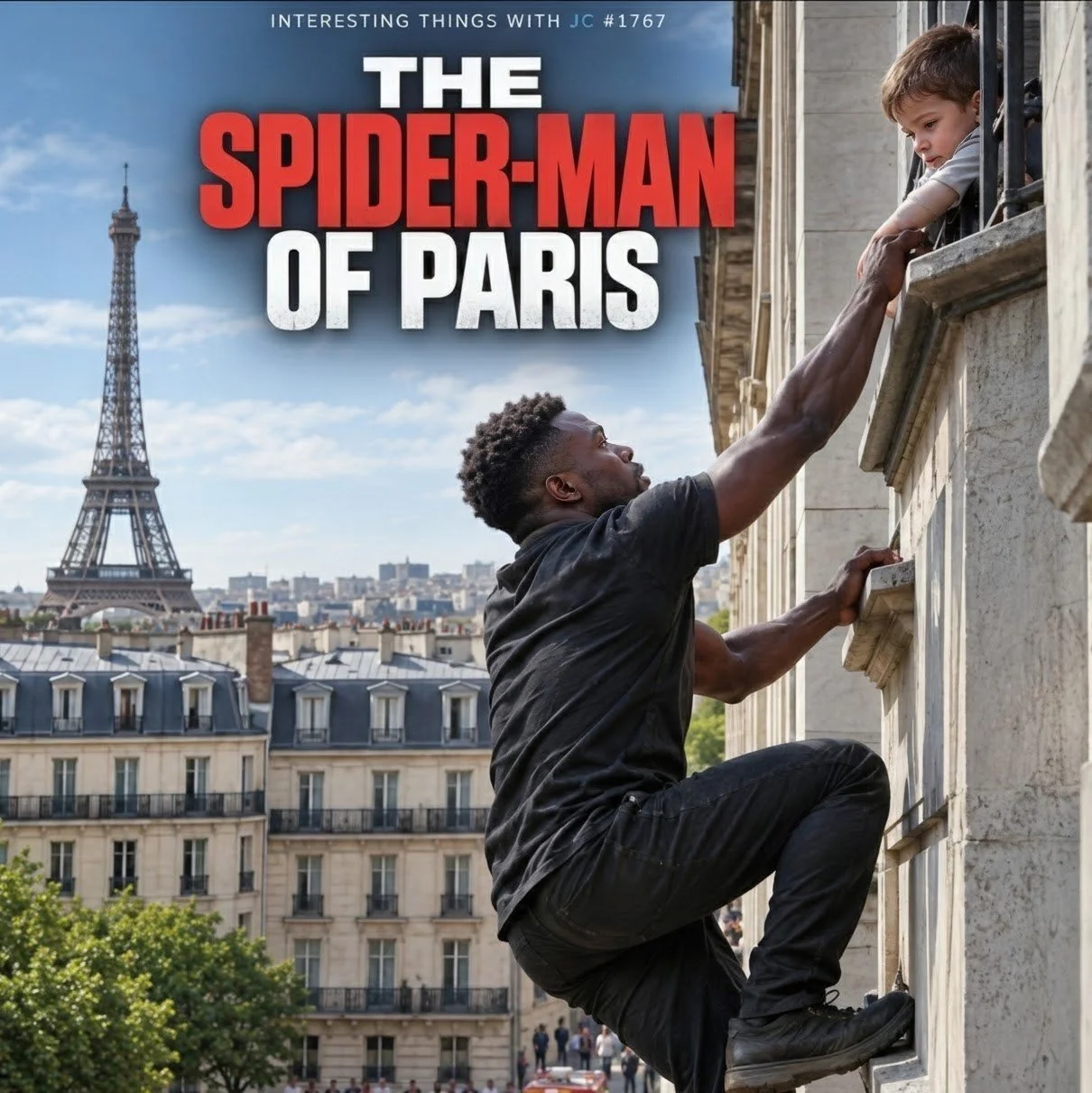
A promotional image for Interesting Things with JC #1767: The Spider-Man of Paris. A Black man in dark clothing climbs the exterior of a Paris apartment building toward a young child leaning over a balcony above him. The Eiffel Tower and Paris rooftops appear in the background. Large red and white text reads, “THE SPIDER-MAN OF PARIS,” with “INTERESTING THINGS WITH JC #1767” across the top.
Transcript
Interesting Things with JC #1767:
"The Spider-Man of Paris"
On May 26, 2018, Mamoudou Gassama (mah-moo-DOO gah-SAH-mah) was walking through Paris, France, when he came across a crowd staring up at an apartment building on rue Marx-Dormoy (roo marks dor-MWAH). Four floors above the street, a four-year-old boy was hanging outside a balcony railing. A neighbor on the adjoining balcony had managed to grab him but couldn't pull him across.
Gassama started climbing.
He had no rope, no harness and no safety equipment. Using his bare hands, he pulled himself from balcony to balcony up the outside of the building. In about 30 seconds, he reached the fourth floor, swung himself over the railing, grabbed the boy and pulled him to safety.
By the time firefighters arrived, the rescue was over.
Gassama was 22. He had grown up in Mali (MAH-lee), where he had no formal schooling and worked farming millet (MIL-it). He eventually made his way to Paris, France, where he was working construction jobs and living in a migrant hostel in Montreuil (mohn-TRUH-yuh).
Video of the rescue spread around the world. People began calling him the "Spider-Man of Paris," and two days later, French President Emmanuel Macron (eh-man-yoo-EL mah-KROHN) invited him to the Élysée Palace (ay-lee-ZAY pah-LISS). Gassama received a medal for courage and devotion and later spent ten months in civic service with the Paris Fire Brigade.
The attention eventually faded. Gassama married, became a father of two and settled into a quieter life in Montreuil (mohn-TRUH-yuh), working jobs that included security work.
But the part of his story that lasted less than a minute is the part people still remember.
There was a child hanging four floors above a street in Paris, France, a crowd watching from below, and a 22-year-old man who saw the same thing everyone else saw.
He was the one who climbed.
These are interesting things, with JC.
Student Worksheet
Comprehension
What emergency did Gassama encounter on May 26, 2018?
How did he reach the child?
Approximately how long did the climb take?
What happened after video of the rescue spread?
What public-service experience did Gassama later undertake?
Analysis
Why is the sentence “Gassama started climbing” effective in the narrative?
Identify two details that communicate the physical risk of the rescue without explicitly telling the audience how to feel.
Compare the crowd’s role with Gassama’s role. What does the contrast contribute to the story?
The episode ends with “He was the one who climbed.” Explain how that sentence develops the episode’s central idea.
Which details in the episode are factual claims, and which statements invite interpretation about courage or responsibility? Give examples.
Reflection
Does courage require acting without hesitation, or can careful preparation also demonstrate courage? Use the episode and your own reasoning.
What responsibilities should a person consider before intervening in a dangerous emergency?
Difficulty Scaling
Level 1 — Recall: Answer Questions 1–5 using direct episode evidence.
Level 2 — Analysis: Complete Questions 6–10 using evidence plus explanation.
Level 3 — Synthesis: Complete Questions 11–12 and connect the episode to a broader principle about responsible action.
Student Output: Produce complete responses to Questions 1–10 and one reflection response of 150–250 words for Question 11 or 12. Cite episode evidence by paraphrasing or using brief quotations.
Academic Integrity Guidance: Your interpretation must be your own. Clearly identify any outside information used, distinguish it from episode evidence, and do not invent details about Gassama’s thoughts or motivations that the available evidence does not establish.
Teacher Guide
Quick Start: Play or read the episode once without interruption. Ask students to record three facts and one question. Replay or reread as needed before moving into evidence-based discussion.
Pacing Guide — Audio First
0–5 minutes: Bell ringer and prediction.
5–10 minutes: Listen to the complete episode without interruption.
10–15 minutes: Individual fact reconstruction and vocabulary check.
15–25 minutes: Complete comprehension questions.
25–38 minutes: Analyze narrative construction and evidence.
38–48 minutes: Discuss courage, intervention, and responsible action.
48–55 minutes: Reflection and exit ticket.
Bell Ringer: Write for two minutes: What separates witnessing a problem from taking responsibility for responding to it?
Audio Guidance: The first listening should emphasize comprehension rather than note-taking. On a second listening, students may record chronology, specific risks, and consequences.
Audio Fallback: If audio is unavailable, read the transcript aloud or assign alternating paragraphs to readers while preserving the narrative sequence.
Time on Task: Approximately 45–55 minutes for one complete lesson; 70–90 minutes if the research extension is included.
Materials
Episode audio or transcript
Student worksheet
Notebook or digital document
Optional research access for source verification
Vocabulary Prep
Locate Mali, Paris, and Montreuil geographically.
Review courage, civic service, and situational awareness before listening.
Practice the episode’s supplied pronunciations where useful.
Misconceptions
Gassama did not use climbing equipment during the rescue.
The child was on the fourth-floor balcony level, not on the roof.
A neighboring adult was already attempting to help the child.
Civic service with the Paris Fire Brigade should not automatically be equated with becoming a career firefighter.
Public descriptions such as “Spider-Man of Paris” are media labels rather than formal titles.
Discussion Prompts
Which details make the rescue memorable without requiring exaggerated language?
Does the presence of other people make Gassama’s decision more or less striking? Explain.
What is the difference between courage and recklessness?
How can a short video influence how the public understands a person?
Why might a single event become the defining public story about someone’s life?
Formative Checkpoints
Students accurately place the rescue events in sequence.
Students identify evidence supporting the description of physical danger.
Students distinguish observable action from inferred motivation.
Students explain the significance of the final sentence using textual evidence.
Differentiation
Additional Support: Provide a five-event sequencing organizer and vocabulary bank.
Advanced Learners: Require students to compare the transcript with two independent reports and identify differences in emphasis or detail.
English Learners: Preteach geographic and emergency-response vocabulary and allow oral rehearsal before written responses.
Assessment Differentiation
Permit oral responses for students whose accommodations support verbal assessment.
Reduce written quantity while maintaining the requirement for evidence.
For advanced work, require evaluation of source reliability and corroboration.
Time Flexibility
25-minute version: Audio, Questions 1–5, one analysis question, exit ticket.
55-minute version: Complete core lesson.
90-minute version: Add independent source-verification work and discussion.
Substitute Readiness: Provide the transcript, worksheet, and answer key. Students can complete the lesson independently if episode audio is unavailable.
Engagement Strategy: Before revealing the outcome, stop after “Gassama started climbing” and ask students to identify the known risks, unknown factors, and possible responses available at that moment.
Extensions
Build a verified timeline of the rescue and its immediate aftermath.
Compare two contemporary reports for differences in wording and emphasis.
Research how professional emergency responders assess personal safety before intervention.
Write a 250-word account of the event using only independently verified facts.
Cross-Curricular Connections
ELA: Narrative structure, concise storytelling, textual evidence.
Social Studies: Geography, civic recognition, migration, public institutions.
Media Literacy: Viral video, verification, framing, and source comparison.
Career Education: Emergency response, construction safety, security, situational awareness.
SEL: Discuss empathy, awareness of others, decision-making under pressure, and the distinction between helping effectively and exposing oneself or others to unnecessary danger.
Skill Emphasis: Evidence evaluation, chronological reasoning, concise writing, discussion, source verification, and responsible decision-making.
Answer Key
A four-year-old child was hanging outside a fourth-floor balcony railing in Paris.
Gassama climbed the building’s exterior balconies using his hands and body, without climbing safety equipment.
About 30 seconds.
The rescue received widespread attention, and Gassama received public recognition.
He entered civic service with the Paris Fire Brigade.
Its brevity creates a sharp transition from observation to action and accelerates the narrative.
Acceptable evidence includes the fourth-floor height, lack of rope or harness, exterior climb, and movement from balcony to balcony.
The crowd observes the emergency while Gassama physically intervenes; the contrast emphasizes the narrative’s focus on action.
It condenses the episode’s central contrast into a single action and returns attention to the decision that changed the outcome.
Factual claims include the date, location, child’s age, climb, and subsequent recognition. Interpretations include conclusions students may draw about courage, responsibility, or motivation.
11–12. Responses will vary but should use evidence, acknowledge risk, and provide coherent reasoning.
Quiz
Multiple Choice
What caused Gassama to stop on rue Marx-Dormoy?
A. He heard firefighters giving instructions.
B. He encountered a crowd looking toward a child in danger.
C. He was working at the apartment building.
D. A neighbor asked him to retrieve equipment.How did Gassama reach the fourth floor?
A. He climbed a fire escape.
B. He used a ladder from a construction site.
C. He climbed from balcony to balcony.
D. He entered the building and used the stairs.Which detail most directly demonstrates the physical risk of the rescue?
A. Gassama lived in Montreuil.
B. A crowd had gathered below.
C. He climbed four floors without rope, harness, or safety equipment.
D. Video later circulated internationally.What happened after the rescue received widespread attention?
A. Gassama immediately left France.
B. He was invited to the Élysée Palace and received official recognition.
C. He became the owner of the apartment building.
D. He stopped appearing in public immediately.What is the primary effect of the closing line, “He was the one who climbed”?
A. It introduces a new event.
B. It explains climbing technique.
C. It emphasizes the difference between witnessing and acting.
D. It questions whether the rescue occurred.
Assessment
Open-Ended Questions
Using at least three details from the episode, explain how the narrative communicates courage primarily through actions rather than descriptive labels.
Analyze the statement “He was the one who climbed.” How does it function as both a literal description and a larger reflection on individual action?
3–2–1 Rubric
3 — Proficient: Makes a clear claim, uses multiple accurate pieces of evidence, explains their significance, and distinguishes fact from interpretation.
2 — Developing: Makes a reasonable claim and provides some evidence but offers incomplete explanation or limited distinction between evidence and inference.
1 — Beginning: Provides a general response with little accurate evidence or explanation.
Exit Ticket: In two or three sentences, identify one fact from the episode and one conclusion you can reasonably draw from that fact. Label each Fact or Inference.
Standards Alignment
NGSS — Science & Engineering Practices
Obtaining, Evaluating, and Communicating Information — Students evaluate information presented in a narrative, distinguish documented observations from interpretation, and communicate evidence-based conclusions. The connection uses an NGSS practice rather than claiming that the historical episode itself constitutes a science performance expectation.
CCSS Reading
CCSS.ELA-LITERACY.RI.9-10.1 — Cite strong and thorough textual evidence — Students select episode details to support explicit analysis and reasonable inferences.
CCSS.ELA-LITERACY.RI.11-12.1 — Cite strong and thorough textual evidence — Advanced students determine where the text leaves matters uncertain and avoid unsupported claims.
CCSS.ELA-LITERACY.RI.9-10.5 — Analyze an author’s ideas or claims and how they are developed — Students examine sequencing, sentence length, contrast, and the episode’s closing line.
CCSS Writing
CCSS.ELA-LITERACY.W.9-10.9 — Draw evidence from informational texts — Students support written analysis with specific episode evidence.
CCSS.ELA-LITERACY.W.11-12.9 — Draw evidence from informational texts — College-preparatory learners integrate evidence into analytical responses.
C3 Framework
D2.His.14.9-12 — Analyze multiple and complex causes and effects of events in the past — Students separate the immediate emergency, Gassama’s intervention, and subsequent public consequences while avoiding unsupported causal assumptions.
ISTE
1.3.b — Knowledge Constructor: Evaluate Information — In the extension, students assess the accuracy, perspective, credibility, and relevance of multiple sources describing the same event.
Career Readiness Competencies
Critical Thinking: Identify relevant information rapidly and distinguish observation from assumption.
Communication: Explain conclusions clearly using verifiable evidence.
Professional Responsibility: Evaluate the relationship between helping others, situational awareness, personal safety, and appropriate response.
Information Literacy: Compare independent sources before accepting or repeating factual claims.
Homeschool/Lifelong Learning
Learners practice source verification, geographic literacy, narrative analysis, ethical reasoning, and evidence-based communication in a self-directed format adaptable to individual pacing.
Show Notes
Mamoudou Gassama’s rapid climb up a Paris apartment building in May 2018 became an internationally recognized rescue story. This lesson uses the episode to examine chronology, courage, individual action, narrative construction, and evidence. Students move beyond simply labeling an action “heroic” by identifying what the record establishes, analyzing how the story is told, and considering how responsible action differs from passive observation or unnecessary risk. The episode provides a compact case study in close reading, media literacy, decision-making, and the lasting power of a single documented moment.
References
City of Paris. (2018, June 4). Mamoudou Gassama médaillé par la Ville de Paris. (Paris)
https://www.paris.fr/pages/mamoudou-gassama-medaille-par-la-ville-de-paris-5872Le Monde. (2018, June 2). Gassama, Italie et glyphosate : les informations à retenir de la semaine. (Le Monde.fr)
https://www.lemonde.fr/les-decodeurs/article/2018/06/02/gassama-italie-et-glyphosate-les-informations-a-retenir-de-la-semaine_5308552_4355770.htmlPascual, J., & Doucouré, S. (2018, November 7). Après sept ans de galère et le sauvetage d’un enfant, Mamoudou Gassama naturalisé français. Le Monde. (Le Monde.fr)
https://www.lemonde.fr/afrique/article/2018/11/07/apres-sept-ans-de-galere-et-le-sauvetage-d-un-enfant-mamoudou-gassama-naturalise-francais_5380283_3212.htmlTF1 Info. (2018, May 27). Paris : à mains nues, un homme escalade la façade d’un immeuble pour sauver un enfant suspendu dans le vide. (TF1 Info)
https://www.tf1info.fr/justice-faits-divers/video-paris-18e-arrondissement-un-homme-escalade-a-mains-nues-la-facade-d-un-immeuble-pour-sauver-un-enfant-suspendu-dans-le-vide-2088570.html