1768: "The Science of Jealousy"
Interesting Things with JC #1768: "The Science of Jealousy"
Jealousy can fire before there is proof: attention shifts, suspicion locks in, and the brain starts tracking details and possible rivals. The threat may not be real, but the alarm already is.
Curriculum - Episode Anchor
Episode Title: The Science of Jealousy
Episode Number: 1768
Host: JC
Audience: Grades 9–12, introductory college, homeschool, lifelong learners
Subject Area: Psychology, neuroscience, evolutionary psychology, social science, information literacy
Lesson Overview
Learning Objectives
Define jealousy as a combination of emotional, cognitive, physiological, and behavioral responses to perceived relationship threats.
Explain how brain regions associated with emotional distress, including the insula and cingulate cortex, have been implicated in jealousy research.
Compare evolutionary explanations of jealousy with findings showing that sex differences vary by measurement, population, relationship context, and other factors.
Distinguish reactive jealousy from suspicious jealousy and evaluate how evidence should influence a response to perceived threats.
Essential Question: How can understanding the psychology and neuroscience of jealousy help people distinguish an emotional alarm from evidence that a genuine threat exists?
Success Criteria: Students can accurately explain at least two mechanisms associated with jealousy, distinguish reactive from suspicious jealousy, and evaluate an evolutionary claim without treating it as established fact.
Student Relevance Statement: Jealousy can occur in romantic relationships, friendships, families, workplaces, and social groups. Understanding it provides a practical example of how emotions, interpretations, evidence, and behavior interact.
Real-World Connection: Students can apply evidence-based reasoning to ambiguous social situations by separating observations from interpretations and considering alternative explanations before drawing conclusions.
Workforce Reality: Emotional regulation, evidence evaluation, conflict management, communication, and distinguishing assumptions from verified information are transferable skills in workplaces involving teamwork, leadership, customer relations, healthcare, education, and management.
Key Vocabulary
Terms
Jealousy(JEL-uh-see) — A complex response involving thoughts, emotions, and behaviors when a valued relationship is perceived as threatened by a rival or possible rival.
Insula(IN-suh-luh) — A region of the cerebral cortex involved in processes including internal bodily awareness and emotional experience.
Cingulate cortex(SING-gyuh-lit KOR-teks) — Cortical regions involved in functions that include emotion, attention, pain-related processing, and cognitive control.
Stress response(stres ree-SPONSS) — Physiological and psychological changes that prepare an organism to respond to a perceived challenge or threat.
Evolutionary psychology(ev-uh-LOO-shuh-nair-ee sy-KOL-uh-jee) — An approach examining psychological characteristics in relation to evolutionary processes and adaptive problems.
Infidelity(in-fih-DEL-ih-tee) — Violation of a relationship's agreed expectations of sexual or emotional exclusivity.
Reactive jealousy(ree-AK-tiv JEL-uh-see) — Jealousy occurring in response to a concrete or actual relationship threat.
Suspicious jealousy(suh-SPISH-us JEL-uh-see) — Jealous thoughts and behaviors occurring without clear evidence of an actual relationship violation.
Attachment(uh-TACH-ment) — Patterns of expectations, feelings, and behavior concerning closeness, security, and relationships with others.
Rival(RY-vuhl) — A person perceived as competing for a valued relationship, attention, status, or resource.
Narrative Core
Open: Jealousy can begin before a person knows whether anything threatening has actually happened. An ambiguous look, message, or change in attention can prompt the mind to interpret incomplete information.
Info: Jealousy combines emotional and cognitive processes with bodily responses. Neuroimaging research has associated jealousy experiences with activity in regions including the insula and anterior cingulate cortex, areas also implicated in processing negative emotional states and distress.
Details: Evolutionary psychologists have proposed that jealousy could have helped humans detect threats to important relationships. One influential hypothesis predicts different average sensitivities to sexual and emotional infidelity among heterosexual men and women. Research has produced evidence both supporting and challenging aspects of this hypothesis, and results can depend on methods, samples, sexual orientation, relationship status, and other variables. Jealousy can also be distinguished by whether it responds to concrete evidence or develops primarily from suspicion.
Reflection: An emotional response can contain useful information without providing proof about its cause. Jealousy therefore offers a practical lesson in evidence evaluation: a person can recognize an emotional alarm while separately asking what observable evidence supports the interpretation.
Closing: These are interesting things, with JC.
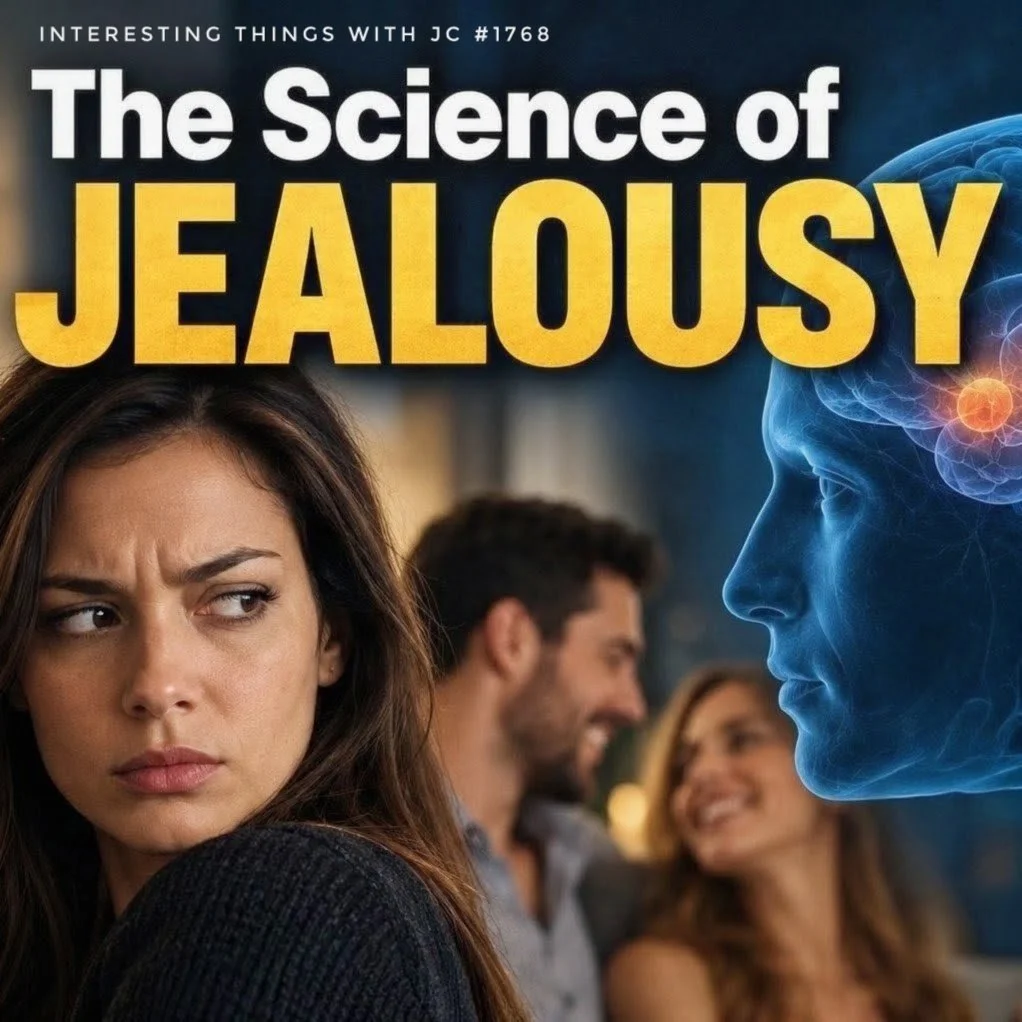
Promotional graphic for Interesting Things with JC #1768: The Science of Jealousy. A concerned woman looks sideways toward a man and woman talking in the blurred background, suggesting jealousy or suspicion. On the right, a translucent blue profile of a human head shows a glowing orange area in the brain. Large white and yellow text reads, “The Science of JEALOUSY.”
Transcript
Interesting Things with JC #1768:
"The Science of Jealousy"
Jealousy can start before anything has actually happened. A look lasts a little too long, a message comes in at an odd hour, someone’s attention shifts across a room, and your mind starts filling in the blanks. The threat may be real or imagined, but the reaction can come fast.
Jealousy mixes fear, anger, stress, and the possibility of losing someone important to you. Brain scans show that some of the areas involved in jealousy are also involved in emotional distress and pain, including the insula and parts of the cingulate cortex. Your stress response can kick in too, which helps explain why jealousy isn’t just something you think about. You can feel it physically.
And once suspicion takes hold, not knowing can keep it going. Your brain doesn’t need proof before it starts paying closer attention, remembering little details, noticing changes in behavior, and watching anyone who might be a threat.
There may be a very old reason for that. For most of human history, losing a partner could mean losing much more than a relationship. It could affect children, food, protection, shared work, social standing, and survival. Evolutionary psychologists think jealousy may have developed partly as an early warning system to protect relationships and watch for rivals.
One part of that theory says men may be more sensitive to sexual cheating because, historically, a man could never be completely certain a child was his. Women may be more sensitive to emotional cheating because a partner could shift his attention and resources elsewhere. Research has found evidence for those differences, but not consistently, and the results can change depending on how the questions are asked.
There are different kinds of jealousy, too. Reactive jealousy follows something that actually happened. Suspicious jealousy can grow without much evidence, leading to worry, checking, mistrust, and constantly being on guard. Your past experiences, trust, attachment, and the relationship itself can all affect how strongly you react.
And jealousy isn’t only romantic. It can show up between friends, siblings, coworkers, or anywhere someone feels they could lose a relationship, attention, or their place in a group.
That’s where understanding the brain chemistry and evolutionary psychology can help. Jealousy may be an alarm meant to get your attention, but hearing the alarm doesn’t prove there’s a fire. Knowing that gives you a chance to look at what’s actually happening before deciding how to respond.
These are interesting things, with JC.
Student Worksheet
Comprehension
What emotions does the episode identify as components of jealousy?
Which brain regions does the episode connect with research on jealousy and emotional distress?
What evolutionary function has been proposed for jealousy?
What is the difference between reactive jealousy and suspicious jealousy?
Identify two factors mentioned in the episode that may influence the intensity of jealousy.
Analysis
Explain the meaning of the statement, “hearing the alarm doesn’t prove there’s a fire.”
Why is the episode careful to say that research on sex differences in jealousy has not produced completely consistent results?
Consider this situation: A friend does not reply to several messages, and someone concludes that the friend is deliberately avoiding them. Separate the observation, interpretation, and evidence still needed.
Why should an evolutionary explanation be treated as a hypothesis to evaluate rather than automatic proof of why an individual behaves a particular way?
Reflection
Without describing a private personal experience, explain how distinguishing feelings from evidence could improve decision-making in a friendship, family, school, or workplace situation.
Difficulty Scaling
Level 1 — Identify: Define vocabulary and retrieve explicit information from the episode.
Level 2 — Explain: Describe relationships among jealousy, perceived threats, cognition, and behavior.
Level 3 — Evaluate: Examine competing explanations, limitations of evidence, and the difference between population-level research and conclusions about individuals.
Student Output: Complete Questions 1–10 using complete sentences. Questions 6–10 should include reasoning or episode-based evidence rather than unsupported opinions.
Academic Integrity Guidance: Write responses in your own words. Clearly distinguish information from the episode from your own interpretation. If outside sources are permitted by the teacher, identify them rather than presenting outside information as your own analysis.
Teacher Guide
Quick Start: Play or read the episode first without pre-teaching its conclusions. Ask students to listen for three categories: what jealousy feels like, what may trigger it, and what research attempts to explain.
Pacing Guide — Audio First
0–5 minutes: Bell Ringer and prediction.
5–10 minutes: First uninterrupted episode listening.
10–15 minutes: Vocabulary clarification and retrieval check.
15–27 minutes: Student Worksheet Questions 1–8.
27–38 minutes: Evidence-versus-interpretation discussion.
38–47 minutes: Questions 9–10 and assessment.
47–50 minutes: Exit Ticket.
Bell Ringer: Present the statement: “A strong feeling is evidence that the feeling exists, but not necessarily evidence that your explanation for it is correct.” Students write two sentences explaining whether they agree and why.
Audio Guidance: Play the complete episode once without interruption. On a second listening, students may record examples under “emotion,” “evidence,” “interpretation,” and “theory.”
Audio Fallback: If audio is unavailable, use the verbatim transcript as a read-aloud or silent-reading text.
Time on Task: Approximately 45–50 minutes for the core lesson; 70–90 minutes with source evaluation or extension activities.
Materials
Episode audio or transcript
Student Worksheet
Writing materials or digital document
Optional research sources supplied by the teacher
Vocabulary Prep
Pre-teach insula, cingulate cortex, reactive jealousy, and suspicious jealousy.
Reinforce that evolutionary psychology provides hypotheses about psychological traits; it does not establish a single cause for every individual's behavior.
Misconceptions
“Jealousy proves something is wrong.” A feeling can signal perceived threat without establishing that the threat is real.
“Brain activity proves one brain region causes jealousy.” Neuroimaging associations do not establish that one region independently creates a complex emotion.
“Evolutionary explanations mean behavior is unavoidable.” Evolutionary hypotheses concern possible origins and functions, not behavioral inevitability.
“All men and women experience jealousy differently.” Group-level findings cannot be automatically applied to every individual, and findings vary across methods and populations.
“Jealousy only occurs in romantic relationships.” Jealousy can involve friendships, siblings, coworkers, and other valued social relationships.
Discussion Prompts
What separates a reasonable response to evidence from an unsupported conclusion?
Why might uncertainty intensify attention to possible threats?
What makes an evolutionary explanation scientifically testable?
How can researchers investigate sex differences without turning statistical averages into stereotypes?
Formative Checkpoints
Students accurately distinguish observation from interpretation.
Students correctly classify a concrete threat as reactive rather than suspicious jealousy.
Students identify evolutionary psychology as an explanatory framework rather than established proof of an individual's motive.
Students recognize limitations when interpreting brain-imaging findings.
Differentiation
Additional Support: Provide sentence starters such as “The observation is ___, while the interpretation is ___.”
Advanced Learners: Have students compare evolutionary and social-cognitive explanations of jealousy using research evidence.
English Learners: Pair vocabulary with short definitions and concrete, nonpersonal scenarios before written analysis.
Homeschool/Lifelong Learners: Replace group discussion with a written evidence audit of three claims from the episode.
Assessment Differentiation: Permit oral responses, structured graphic organizers, or shortened written responses while retaining the requirement to distinguish claims from evidence.
Time Flexibility: For a 25-minute lesson, complete the audio, Questions 1–5, Question 8, and the Exit Ticket. For a 90-minute block, add source comparison and research evaluation.
Substitute Readiness: The lesson can be completed entirely from the transcript, worksheet, vocabulary, and answer key without specialized psychology instruction.
Engagement Strategy: Use fictional ambiguous scenarios so students can analyze jealousy without being required to disclose personal relationships or experiences.
Extensions
Compare two research studies that reach different conclusions about sex differences in jealousy.
Design a hypothetical study comparing responses to ambiguous and confirmed relationship threats.
Evaluate how question wording could alter responses in jealousy research.
Investigate how digital communication may increase exposure to ambiguous social information.
Cross-Curricular Connections
Biology: Brain function, stress, evolution.
Psychology: Emotion, cognition, attachment, social behavior.
ELA: Claims, evidence, inference, source evaluation.
Statistics: Samples, group averages, replication, measurement effects.
Media Literacy: Ambiguous digital cues and evidence evaluation.
SEL Connection: The lesson develops emotional awareness and evidence-based decision-making without asking students to diagnose themselves or classmates.
Skill Value Emphasis: Critical thinking, emotional literacy, research interpretation, communication, source evaluation, and inference control.
Answer Key
Fear, anger, stress, and concern about losing someone important are identified.
The insula and parts of the cingulate cortex.
It may have functioned partly as an early-warning response to threats involving valued relationships and rivals.
Reactive jealousy follows a concrete or actual event; suspicious jealousy occurs with little or no clear evidence of wrongdoing.
Acceptable examples include past experiences, trust, attachment, and characteristics of the relationship.
Experiencing jealousy signals that a person perceives a threat; it does not establish that the suspected threat actually exists.
Findings vary, and results can depend on research methods, including how questions are presented.
Example: Observation—messages were unanswered. Interpretation—the friend is deliberately avoiding the person. Needed evidence—additional context explaining why the messages were unanswered.
Evolutionary explanations generate hypotheses about possible adaptive functions; scientific claims still require evidence, and population patterns do not determine individual behavior.
Responses vary but should explain how separating an emotional reaction from evidence can reduce unsupported conclusions and improve reasoning.
Quiz
Multiple Choice
Which statement best describes suspicious jealousy?
A. It occurs only after confirmed infidelity.
B. It develops around perceived threats despite limited evidence.
C. It refers exclusively to physical stress symptoms.
D. It occurs only in romantic relationships.Which brain regions are specifically mentioned in the episode?
A. Cerebellum and occipital cortex
B. Hippocampus and motor cortex
C. Insula and cingulate cortex
D. Brainstem and visual cortexWhat does the evolutionary explanation presented in the episode propose?
A. Jealousy has no relationship to social behavior.
B. Jealousy may have helped monitor threats to important relationships.
C. Jealousy developed only after modern marriage systems appeared.
D. Every person experiences identical jealousy responses.Why does the episode qualify claims about sex differences?
A. No researchers have investigated them.
B. Jealousy cannot be scientifically studied.
C. Findings are inconsistent and can vary with research methods.
D. Emotional and sexual infidelity are scientifically identical.What is the central meaning of the fire-alarm analogy?
A. Emotional responses should always be ignored.
B. Jealousy always identifies genuine betrayal.
C. Suspicion is more reliable than observable evidence.
D. An emotional warning can deserve attention without proving the suspected threat is real.
Assessment
Open-Ended Questions
Explain how jealousy can involve brain processes, emotions, cognition, and behavior. Use at least three specific ideas from the episode.
Evaluate the claim that jealousy functions as an evolutionary warning system. Explain what the hypothesis proposes, identify evidence or reasoning consistent with it, and describe at least one limitation students should consider.
3–2–1 Rubric
3 — Proficient: Accurate explanation; specific evidence; distinguishes established findings, hypotheses, and limitations; reasoning is clear.
2 — Developing: Generally accurate explanation with some evidence, but connections or qualifications are incomplete.
1 — Beginning: Limited explanation, minimal evidence, or confusion between emotional responses, hypotheses, and verified facts.
Exit Ticket
Name one fact or research finding from the lesson.
Name one scientific hypothesis discussed in the lesson.
In one sentence, explain why a feeling of jealousy is not itself proof that a suspected event occurred.
Standards Alignment
NGSS — Science & Engineering Practices
Analyzing and Interpreting Data — Students evaluate what psychological and neuroimaging findings can and cannot demonstrate and distinguish observed patterns from conclusions.
Engaging in Argument from Evidence — Students evaluate competing interpretations of jealousy and support conclusions using evidence rather than intuition alone.
CCSS Reading — Science & Technical Subjects
CCSS.ELA-LITERACY.RST.11-12.1 — Cite Specific Textual Evidence — Students use episode and research evidence when analyzing scientific explanations while identifying gaps or limitations.
CCSS.ELA-LITERACY.RST.11-12.8 — Evaluate Hypotheses, Data, Analysis, and Conclusions — Students examine evolutionary claims and determine whether available evidence justifies broader conclusions.
CCSS Writing
CCSS.ELA-LITERACY.WHST.11-12.9 — Draw Evidence from Informational Texts — Assessment responses require students to support analysis and reflection with information from the episode.
C3 Framework — Psychology
D2.Psy.15.9-12 — Use Existing Evidence and Formulate Conclusions About Psychological Phenomena — Students evaluate jealousy as a psychological phenomenon using evidence and qualified conclusions.
D2.Psy.16.9-12 — Use Critical Thinking Skills to Become Better Consumers of Psychological Knowledge — Students distinguish correlations, hypotheses, individual differences, and generalized claims.
D2.Psy.18.9-12 — Apply Psychological Knowledge to Daily Lives — Students apply the evidence-versus-interpretation distinction to everyday social decision-making.
ISTE — Knowledge Constructor
ISTE 1.3.b — Evaluate Information — When completing the research extension, students evaluate the accuracy, validity, bias, origin, and relevance of digital research concerning jealousy.
Career Readiness Competencies
Critical Thinking: Students distinguish observable evidence from inference.
Communication: Students explain emotionally complex situations using precise, neutral language.
Evidence Evaluation: Students recognize uncertainty and avoid overstating research findings.
Interpersonal Effectiveness: Students apply reasoned interpretation to ambiguous social information before responding.
Homeschool/Lifelong Learning
Learners independently connect psychological concepts to everyday decision-making and demonstrate understanding through evidence-based written analysis.
Show Notes
Jealousy can feel immediate, physical, and convincing, but what does that reaction actually tell us? Episode #1768 explores jealousy through neuroscience, evolutionary psychology, relationship research, and the distinction between reactive and suspicious jealousy. In the classroom, the episode provides a practical way to examine emotion, brain research, evolutionary hypotheses, individual differences, and scientific uncertainty. Most importantly, students practice separating an emotional warning from evidence—a reasoning skill that matters in relationships, research, workplaces, and everyday decision-making.
References
Buss, D. M. (2018). Sexual and emotional infidelity: Evolved gender differences in jealousy prove robust and replicable. Perspectives on Psychological Science, 13(2), 155–160. https://pubmed.ncbi.nlm.nih.gov/29592639/
DeSteno, D. A., Bartlett, M. Y., Braverman, J., & Salovey, P. (2002). Sex differences in jealousy: Evolutionary mechanism or artifact of measurement? Journal of Personality and Social Psychology, 83(5), 1103–1116. https://pubmed.ncbi.nlm.nih.gov/12416915/
Rodriguez, L. M., DiBello, A. M., Øverup, C. S., & Neighbors, C. (2015). The price of distrust: Trust, anxious attachment, jealousy, and partner abuse. Partner Abuse, 6(3), 298–319. https://pmc.ncbi.nlm.nih.gov/articles/PMC5380380/
Rydell, R. J., & Bringle, R. G. (2007). Differentiating reactive and suspicious jealousy. Social Behavior and Personality: An International Journal, 35(8), 1099–1114. https://www.sbp-journal.com/index.php/sbp/article/view/1642
Sagarin, B. J., et al. (2012). A reproductive threat-based model of evolved sex differences in jealousy. Evolutionary Psychology, 10(3). https://pubmed.ncbi.nlm.nih.gov/22947673/
Scelza, B. A., et al. (2020). Romantic jealousy: A test of social cognitive and evolutionary models in a population-representative sample of adults. Journal of Sex Research, 57(4), 498–507. https://pubmed.ncbi.nlm.nih.gov/31090451/