1769: "Football Brain Injury Cover Up"
Interesting Things with JC #1769: "Football Brain Injury Cover Up"
Dr. Bennet Omalu found CTE in Mike Webster’s brain, and the NFL’s concussion committee challenged the published finding and called for its retraction. More former players were diagnosed after death, and twelve years later researchers found CTE in 110 of 111 donated brains from former NFL players.
Episode Anchor
Episode Title: Football Brain Injury Cover Up
Episode Number: 1769
Host: JC
Audience: Grades 9–12, introductory college, homeschool, lifelong learners
Subject Area: Biology, health science, sports medicine, U.S. history, media literacy, information literacy
Lesson Overview
Learning Objectives
Explain chronic traumatic encephalopathy (CTE) and the role of abnormal tau protein in its postmortem diagnosis.
Trace major developments from Mike Webster’s 2002 death through the 2017 study of donated brains from former football players.
Distinguish association, causation, prevalence, and sampling bias when interpreting scientific evidence.
Evaluate how scientific findings, institutional responses, litigation, and public communication interacted during the NFL concussion controversy.
Essential Question: How should scientific evidence about possible long-term harm be evaluated and communicated when the evidence is developing and powerful institutions have a stake in the outcome?
Success Criteria: Students can accurately summarize the Webster case, explain why 110 of 111 does not establish a 99% prevalence rate among NFL players, identify evidence of changing scientific and institutional positions, and support conclusions with specific evidence.
Student Relevance Statement: Decisions about athletics, health, workplace safety, and public policy often depend on evidence that develops gradually rather than arriving as a single definitive discovery.
Real-World Connection: The history of football and CTE illustrates how medical research, professional sports, litigation, journalism, and risk communication can intersect.
Workforce Reality: Researchers, physicians, athletic trainers, journalists, attorneys, safety professionals, and organizational leaders must distinguish strong evidence from incomplete evidence and communicate uncertainty accurately.
Key Vocabulary
Terms
Chronic traumatic encephalopathy (CTE)(KRAH-nik traw-MAT-ik en-sef-uh-LOP-uh-thee) — A neurodegenerative disease associated with exposure to repeated head impacts and identified by characteristic abnormal phosphorylated tau pathology.
Tau protein(tow PRO-teen) — A protein normally found in neurons that can accumulate abnormally in characteristic patterns in several neurodegenerative diseases, including CTE.
Neuropathology(nur-oh-puh-THOL-uh-jee) — The study of disease-related changes in nervous-system tissue.
Concussion(kun-KUSH-un) — A type of traumatic brain injury caused by a bump, blow, or jolt that disrupts normal brain function.
Repeated head impacts(ri-PEE-tid hed IM-pakts) — Recurring impacts to the head, including impacts that produce symptoms and impacts that do not produce an obvious concussion.
Postmortem(post-MOR-tum) — Occurring or performed after death.
Convenience sample(kun-VEEN-yens SAM-pul) — A research sample assembled from subjects or materials that are available rather than randomly selected from the population.
Prevalence(PREV-uh-lens) — The proportion of a population that has a particular condition at a specified time.
Association(uh-soh-see-AY-shun) — A statistical or observational relationship between variables that does not, by itself, establish causation.
Narrative Core
Open: Mike Webster died in 2002 at age 50 after a 17-season NFL career. His post-football difficulties and the examination of his brain became central to an emerging scientific controversy.
Info: Forensic pathologist Dr. Bennet Omalu reported neuropathological changes consistent with chronic traumatic encephalopathy in Webster’s brain. Omalu and colleagues published the case in Neurosurgery in 2005. Members of the NFL’s Mild Traumatic Brain Injury Committee challenged the findings and urged the authors to retract the paper; it was not retracted.
Details: Omalu subsequently reported CTE in former Pittsburgh Steeler Terry Long. Research increasingly examined repeated head impacts rather than only diagnosed concussions. Litigation also intensified: thousands of retired players alleged that the NFL had concealed information about neurological risks. A proposed 2013 settlement was initially valued at $765 million and did not constitute an admission of wrongdoing. In 2016, NFL health and safety executive Jeff Miller acknowledged at a congressional roundtable that research showed a link between football and CTE.
Reflection: A 2017 JAMA case series reported CTE in 110 of 111 former NFL players whose donated brains were examined. That striking figure cannot be interpreted as evidence that 99% of all NFL players develop CTE because the brain-bank population was a convenience sample and was not representative of all former players. The episode therefore provides both a history-of-science case study and a lesson in interpreting research design.
Closing: These are interesting things, with JC.
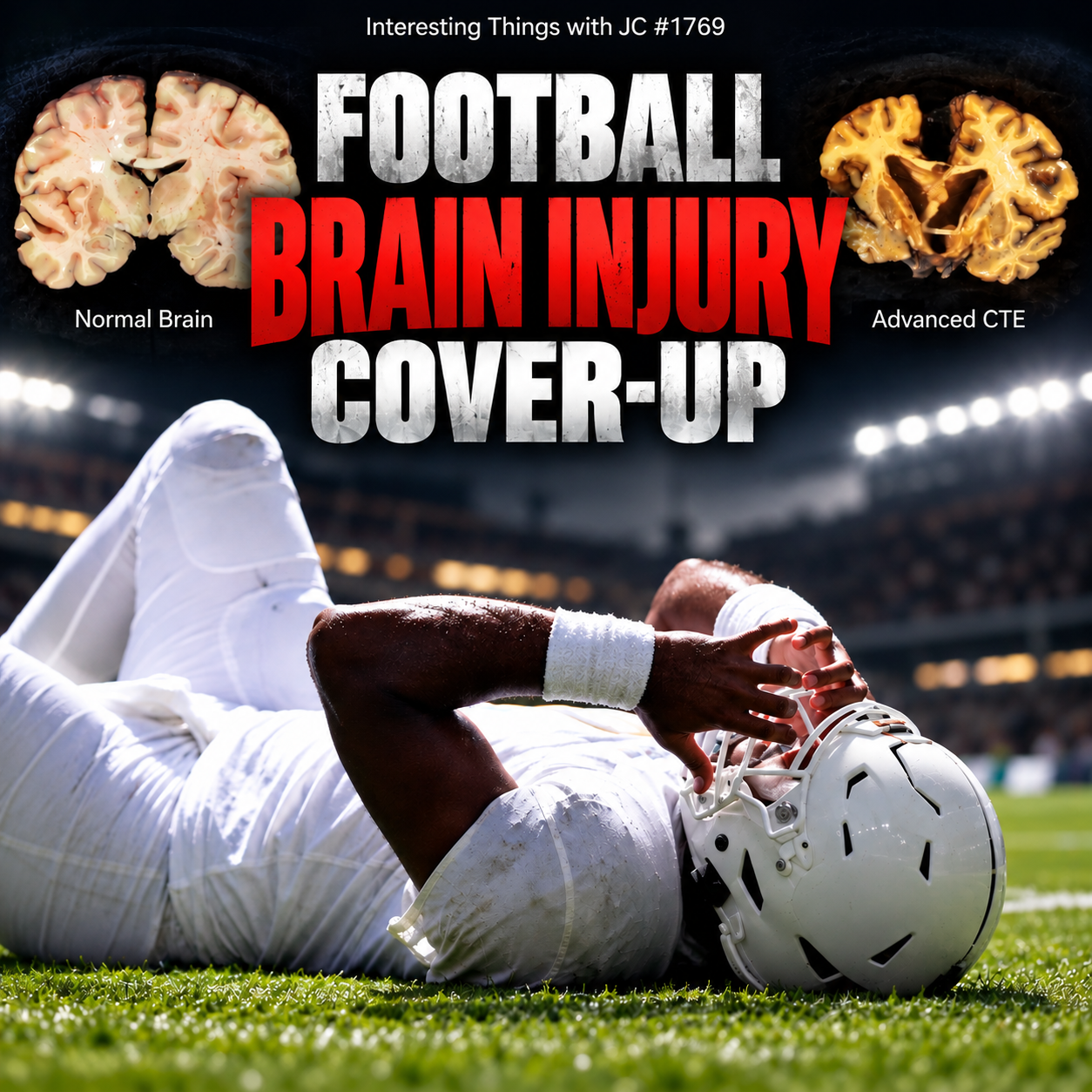
Promotional graphic for Interesting Things with JC #1769: Football Brain Injury Cover-Up. A football player in a white uniform lies on a stadium field holding his helmeted head. Above him, large distressed text reads “FOOTBALL BRAIN INJURY COVER-UP.” At the top left is a brain cross-section labeled “Normal Brain,” and at the top right is a darker, visibly deteriorated brain cross-section labeled “Advanced CTE.” Stadium lights and a blurred crowd appear in the background.
Transcript
Interesting Things with JC #1769:
"Football Brain Injury Cover Up"
When Mike Webster died in 2002, he was only 50 years old. The former Pittsburgh Steelers center had played 17 seasons in the NFL, won four Super Bowls, and made the Pro Football Hall of Fame. But after football, things went downhill. Webster struggled with memory loss, depression, confusion, chronic pain, and major changes in his behavior.
After his death, forensic pathologist Dr. Bennet Omalu examined his brain.
Under the microscope, Omalu found abnormal accumulations of tau protein associated with repeated head trauma. The disease had been seen before, particularly in boxers. But in 2005, Omalu and his colleagues published the first reported case of chronic traumatic encephalopathy, or CTE, in an NFL player.
The NFL's concussion committee challenged the paper and called for it to be retracted. It wasn't.
That same year, former Pittsburgh Steeler Terry Long died at 45. Omalu examined his brain and found CTE again.
And more cases followed.
Researchers were looking beyond the single hard hit and toward the cumulative effect of repeated impacts over a career. Each one could accelerate and rotate the brain inside the skull. Some caused obvious concussions. Plenty didn't.
Repeated head impacts are associated with the abnormal tau pattern that defines CTE. And because CTE can still only be definitively diagnosed after death, much of what researchers were learning came from the brains of former players.
Meanwhile, thousands of former players sued the NFL, accusing the league of concealing the long-term dangers of head injuries. In 2013, the NFL agreed to a concussion settlement initially valued at $765 million without admitting wrongdoing. That same year, Commissioner Roger Goodell was still saying the neurological conditions affecting former players weren't necessarily caused by football.
Then, in 2016, NFL executive Jeff Miller was asked during a congressional roundtable whether research showed a connection between football and CTE.
His answer was, "certainly yes."
The following year, researchers led by Dr. Ann McKee at Boston University published findings from the donated brains of 111 former NFL players.
They found CTE in 110.
Now, that doesn't mean 99 percent of NFL players develop CTE. This wasn't a random sample. Many of the brains were donated because families already suspected something was wrong.
But think about where this started.
In 2005, Mike Webster was one case, and the NFL's own concussion committee wanted the paper retracted.
Twelve years later, researchers had found the same disease in 110 of 111 donated brains from former NFL players.
Somewhere between one and 110, the question had changed.
These are interesting things, with JC.
Student Worksheet
Comprehension
Who was Mike Webster, and why did examination of his brain become scientifically significant?
What did Dr. Bennet Omalu report finding in Webster’s brain?
How did members of the NFL concussion committee respond to Omalu’s published research?
What did Jeff Miller acknowledge in 2016?
What result did the 2017 study report among the 111 former NFL players examined?
Analysis
Why does finding CTE in 110 of 111 donated brains not demonstrate that 99% of all NFL players develop CTE?
Compare the evidence available in 2005 with the evidence described in 2017. What changed, and what limitations remained?
Explain the difference between an association between repeated head impacts and CTE and proof that a particular individual’s symptoms were caused by football.
Why is the fact that CTE currently requires postmortem confirmation important when researchers attempt to estimate its frequency or study its progression?
Identify one example from the episode in which scientific evidence and institutional communication came into conflict.
Reflection
At what point should an organization warn people about a potential risk when scientific evidence is serious but still incomplete? Support your position with at least two pieces of evidence from the episode.
Difficulty Scaling
Level 1: Identify people, dates, definitions, and findings directly stated in the transcript.
Level 2: Explain research limitations and compare evidence across time.
Level 3: Evaluate competing claims while distinguishing evidence, uncertainty, association, and causation.
Student Output: Complete questions 1–10 in 1–3 sentences each and question 11 in one evidence-supported paragraph of approximately 150–250 words.
Academic Integrity Guidance: Use the episode and assigned sources as evidence. Paraphrase in your own words, identify the source of factual claims when required by your instructor, and do not present AI-generated or another person’s analysis as your own.
Teacher Guide
Quick Start: Introduce the essential question, conduct the bell ringer, play or read the episode without interruption, check comprehension, then move students from factual reconstruction to research-method analysis.
Pacing Guide — Audio First
0–5 minutes: Bell ringer and prior-knowledge check.
5–10 minutes: Introduce CTE, tau protein, postmortem, and repeated head impacts.
10–15 minutes: Listen to the complete episode.
15–25 minutes: Complete comprehension questions.
25–38 minutes: Analyze the 110-of-111 finding and sampling limitation.
38–48 minutes: Discuss institutional response, evidence, and uncertainty.
48–55 minutes: Reflection and exit ticket.
Bell Ringer: A study finds a disease in 99 of 100 people whose families specifically donated their bodies because they suspected that disease. Can researchers conclude that 99% of the entire population has it? Explain.
Audio Guidance: Play the episode once without interruption. On a second listening, allow students to record dates, evidence, institutional responses, and limitations.
Audio Fallback: If audio is unavailable, read the supplied transcript aloud or have students alternate reading short passages while maintaining the original sequence.
Time on Task: Approximately 55 minutes for one class period; 75–90 minutes with the extension activity.
Materials
Episode audio or transcript
Student worksheet
Vocabulary list
Board or shared display
Optional copies of the 2005 and 2017 research abstracts
Vocabulary Prep
Contrast concussion with the broader category repeated head impacts.
Emphasize that postmortem means after death.
Preview convenience sample, prevalence, and association before students interpret 110 of 111.
Misconceptions
“110 of 111 means 99% of NFL players have CTE.” The sample was not randomly selected and cannot establish population prevalence.
“Only diagnosed concussions matter.” Research on CTE also examines exposure to repetitive head impacts that may not produce recognized concussion symptoms.
“CTE can be definitively diagnosed in living patients.” Current confirmation requires neuropathological examination after death.
“Association automatically proves individual causation.” Association is evidence of a relationship but does not independently establish the cause of every individual outcome.
“The 2013 settlement proved the allegations in court.” The agreement did not constitute an admission of wrongdoing.
Discussion Prompts
What made Webster’s case scientifically important even though it involved only one person?
Why can a small or nonrandom sample still produce valuable scientific evidence?
How should the phrase “110 of 111” be communicated without misleading an audience?
What responsibilities do sports organizations have when credible evidence of long-term risk begins to accumulate?
Formative Checkpoints
Students correctly define CTE and postmortem.
Students place Webster, Long, Miller, and the 2017 study in chronological order.
Students explain why convenience sampling prevents a population-prevalence conclusion.
Students distinguish an allegation in litigation from a scientifically or legally established fact.
Differentiation
Additional Support: Provide a four-column organizer labeled Date, Evidence, Response, Limitation.
Advanced Learners: Ask students to distinguish case reports, case series, population studies, and prospective cohort studies.
English Learners: Preteach vocabulary with short definitions and allow paired oral rehearsal before written responses.
Assessment Differentiation
Permit oral responses for students whose accommodations require them.
Allow a timeline or evidence map to supplement written analysis.
Require advanced learners to identify what additional research design would better estimate prevalence.
Time Flexibility: For a 30-minute lesson, complete the audio, questions 1–7, and exit ticket. For a 90-minute block, add source comparison and research-design activities.
Substitute Readiness: Students can complete the lesson from the transcript, vocabulary, worksheet, and answer key without requiring specialized sports or neuroscience knowledge from the instructor.
Engagement Strategy: Write 1 → 110/111 on the board before explaining it. Ask students what conclusions the two numbers permit—and what conclusions they do not permit.
Extensions
Compare the 2005 case report with the 2017 case series.
Design a hypothetical study intended to estimate CTE prevalence among former professional football players.
Create a timeline separating scientific findings, NFL responses, litigation, and public statements.
Cross-Curricular Connections
Biology: Nervous-system pathology and protein abnormalities.
Statistics: Sampling, selection bias, prevalence, and generalizability.
History: Changing institutional responses to emerging scientific evidence.
English Language Arts: Evidence evaluation and source-based argument.
Career Education: Sports medicine, neuropathology, epidemiology, journalism, law, and risk management.
SEL Connection: Discuss how students can evaluate health risks without sensationalizing individual experiences or dismissing uncertainty.
Skill Value Emphasis: Evidence literacy is transferable to medicine, journalism, law, business, public safety, research, and everyday decision-making.
Answer Key
Webster was a Hall of Fame NFL center whose postmortem brain examination became the basis of Omalu and colleagues’ 2005 reported NFL CTE case.
Omalu reported neuropathological changes including abnormal tau accumulation consistent with CTE.
Members of the NFL concussion committee challenged the research and urged retraction; the paper remained published.
Miller acknowledged that research showed a connection between football and CTE.
CTE was diagnosed in 110 of the 111 former NFL players in the donated-brain sample.
The brains came from a convenience sample rather than a representative random sample; therefore, the percentage cannot establish NFL-wide prevalence.
Evidence expanded from individual cases to a much larger case series, but selection bias and the lack of a representative comparison population limited prevalence and risk estimates.
Association establishes a relationship between variables; proving that football caused a specific person’s condition requires additional evidence and consideration of other factors.
Researchers cannot simply screen a representative living population using definitive neuropathological diagnosis, complicating prevalence and longitudinal research.
Accept evidence-supported examples, particularly the challenge to Omalu’s research or the contrast between developing scientific evidence and institutional statements.
Answers will vary but should establish a defensible threshold for warning, use at least two episode-specific facts, and acknowledge scientific uncertainty.
Quiz
Questions
What was significant about Omalu and colleagues’ 2005 publication?
A. It established the prevalence of CTE among every NFL player.
B. It reported CTE in an NFL player based on examination of Mike Webster’s brain.
C. It provided a clinical test for diagnosing CTE in living athletes.
D. It proved that every concussion causes CTE.
Why is postmortem examination important to the episode?
A. CTE currently requires brain examination after death for definitive confirmation.
B. Concussions can never be studied in living people.
C. Tau protein exists only after death.
D. Football injuries cannot be documented during life.
What was significant about Jeff Miller’s 2016 statement?
A. He announced that the NFL concussion settlement was canceled.
B. He said CTE had never been identified in football players.
C. He acknowledged a research-supported connection between football and CTE.
D. He announced a method for curing CTE.
Why should the 110-of-111 result not be interpreted as a 99% prevalence rate for all NFL players?
A. The researchers examined no NFL players.
B. The sample was a nonrandom brain-donation convenience sample.
C. CTE was found in only one brain.
D. The study examined only living players.
Which statement best represents careful scientific reasoning?
A. One case can establish population prevalence.
B. Association and causation always mean the same thing.
C. A nonrandom sample has no scientific value.
D. Strong findings can be important while still having limitations on what conclusions they support.
Assessment
Open-Ended Questions
Trace the development of the CTE evidence described in the episode from Mike Webster’s death through the 2017 study. Explain how the quantity and type of evidence changed.
Evaluate the statement: “CTE was found in 110 of 111 former NFL players, so approximately 99% of NFL players develop CTE.” Explain precisely what is wrong with this reasoning and what the study legitimately demonstrated.
3–2–1 Rubric
3 — Proficient: Uses accurate episode evidence, explains sampling limitations, distinguishes association from prevalence or causation, and communicates reasoning clearly.
2 — Developing: Uses relevant evidence but provides incomplete explanation of sampling, prevalence, association, or uncertainty.
1 — Beginning: Provides minimal evidence, treats the sample as representative, or makes unsupported causal claims.
Exit Ticket: In two sentences, state one conclusion supported by the 2017 study and one conclusion the study could not establish.
Standards Alignment
NGSS — Science & Engineering Practices
Analyzing and Interpreting Data — Students interpret the 110-of-111 result while identifying limitations created by the study population and sampling method.
Engaging in Argument from Evidence — Students construct claims about CTE research and institutional response using specific evidence while acknowledging uncertainty.
Obtaining, Evaluating, and Communicating Information — Students distinguish scientific findings from broader claims about prevalence and causation.
CCSS Reading
CCSS.ELA-LITERACY.RI.9-10.1 — Cite strong and thorough textual evidence — Students support explanations about the development of CTE research with episode evidence.
CCSS.ELA-LITERACY.RI.11-12.8 — Delineate and evaluate reasoning in seminal U.S. texts — Students examine claims, supporting evidence, limitations, and institutional responses as components of argument.
CCSS Writing
CCSS.ELA-LITERACY.W.9-10.9 — Draw evidence from informational texts — Students construct evidence-supported responses about scientific findings and sampling limitations.
C3 Framework
D2.His.12.9-12 — Use questions generated about multiple historical sources to pursue further inquiry — Students examine how scientific evidence and institutional positions developed over time.
D4.1.9-12 — Construct arguments using precise and knowledgeable claims — Students defend conclusions while recognizing counterclaims and evidentiary limitations.
ISTE — Knowledge Constructor
3b — Evaluate the accuracy, perspective, credibility and relevance of information — Students evaluate what a scientific statistic demonstrates and identify interpretations that exceed the evidence.
Career Readiness Competencies
Critical Thinking: Evaluate evidence before drawing conclusions.
Communication: Explain technical findings accurately to a nonspecialist audience.
Professionalism: Separate documented evidence, allegations, uncertainty, and interpretation.
Information Literacy: Assess sample design, source quality, and generalizability before using research to support a claim.
Homeschool/Lifelong Learning
Learners practice evaluating health claims, interpreting statistics, recognizing sampling bias, and distinguishing scientific evidence from institutional or media interpretation—skills applicable to independent research and informed decision-making.
Show Notes
Football Brain Injury Cover Up follows the scientific and institutional history surrounding chronic traumatic encephalopathy in professional football, beginning with Dr. Bennet Omalu’s examination of Mike Webster and extending through the 2017 report of CTE in 110 of 111 donated brains from former NFL players. For classrooms, the episode provides an unusually clear opportunity to connect neuroscience with statistics, history, information literacy, and evidence-based reasoning. Its importance extends beyond football: students must learn that dramatic research findings can be meaningful without supporting every conclusion people may draw from them.
References
Omalu, B. I., DeKosky, S. T., Minster, R. L., Kamboh, M. I., Hamilton, R. L., & Wecht, C. H. (2005). Chronic traumatic encephalopathy in a National Football League player. Neurosurgery, 57(1), 128–134.
https://pubmed.ncbi.nlm.nih.gov/15987548/Omalu, B. I., DeKosky, S. T., Hamilton, R. L., Minster, R. L., Kamboh, M. I., Shakir, A. M., & Wecht, C. H. (2006). Chronic traumatic encephalopathy in a National Football League player: Part II. Neurosurgery, 59(5), 1086–1092.
https://pubmed.ncbi.nlm.nih.gov/17143242/Mez, J., Daneshvar, D. H., Kiernan, P. T., et al. (2017). Clinicopathological evaluation of chronic traumatic encephalopathy in players of American football. JAMA, 318(4), 360–370.
https://jamanetwork.com/journals/jama/fullarticle/2645104Centers for Disease Control and Prevention. (2024). About repeated head impacts.
https://www.cdc.gov/traumatic-brain-injury/about/repeated-head-impacts.htmlU.S. House of Representatives. (2016). Concussions in youth sports: Evaluating prevention and research.
https://www.congress.gov/114/chrg/CHRG-114hhrg21158/CHRG-114hhrg21158.pdfBreslow, J. M. (2013). NFL reaches $765 million settlement in concussion lawsuit. FRONTLINE.
https://www.pbs.org/wgbh/frontline/article/nfl-reaches-765-million-settlement-in-concussion-lawsuit/FRONTLINE. (2013). Timeline: The NFL’s concussion crisis. PBS.
https://www.pbs.org/wgbh/pages/frontline/sports/league-of-denial/timeline-the-nfls-concussion-crisis/FRONTLINE. (2015). Meet the real Dr. Bennet Omalu. PBS.
https://www.pbs.org/wgbh/frontline/article/meet-the-real-dr-bennet-omalu/Pro Football Hall of Fame. (2002). Mike Webster, 1952–2002.
https://www.profootballhof.com/news/mike-webster-1952-2002