Interesting Things with JC #1755: "How Do Dogs Know How to Herd?"
A Border Collie can crouch, stare, and move around sheep before learning herding commands. Selective breeding reshaped parts of the canine hunting sequence into herding behavior.
Curriculum - Episode Anchor
Episode Title: How Do Dogs Know How to Herd?
Episode Number: 1755
Host: JC
Audience: Grades 9–12, introductory college, homeschool, lifelong learners
Subject Area: Biology, animal behavior, genetics, evolution, agriculture
Lesson Overview
Learning Objectives
Explain how herding behavior relates to components of the canine predatory behavioral sequence.
Describe how selective breeding can alter the frequency and intensity of inherited behavioral tendencies across generations.
Distinguish genetic predisposition from learned behavior and training.
Interpret evidence showing that complex working behavior results from interactions among genetics, development, experience, and human handling.
Essential Question: How can a dog display useful herding behaviors before receiving formal herding training?
Success Criteria: Students can identify components of the predatory sequence, explain how selection reshaped those components in herding breeds, and use evidence to reject the idea of a single “herding gene.”
Student Relevance Statement: Dogs provide an accessible example of how inherited tendencies and experience interact to produce complex behavior.
Real-World Connection: Understanding working-dog behavior connects genetics and behavioral science with livestock management, animal welfare, breeding, and training.
Workforce Reality: Animal scientists, veterinarians, livestock producers, geneticists, breeders, trainers, and animal-behavior professionals must distinguish inherited tendencies from skills developed through experience and training.
Key Vocabulary
Terms
Predatory sequence(PRED-uh-tor-ee SEE-kwens) — An organized series of behaviors associated with locating, pursuing, capturing, and consuming prey.
Orienting(OR-ee-en-ting) — Directing attention and the body toward a relevant stimulus.
Eye(eye) — The intense visual fixation on livestock especially characteristic of Border Collie working behavior.
Stalking(STAW-king) — Controlled, often lowered movement toward or around another animal.
Selective breeding(suh-LEK-tiv BREE-ding) — Human-directed reproduction favoring particular inherited characteristics.
Inhibition(in-huh-BISH-un) — Suppression or restraint of a behavioral response.
Phenotype(FEE-no-type) — Observable characteristics resulting from interactions between genetic and environmental influences.
Haplotype(HAP-lo-type) — A group of genetic variants inherited together in a region of DNA.
EPHB1(E-P-H-B-one) — A gene involved in neuronal functions, including pathways related to spatial memory, identified as a candidate associated with selection and behavioral variation in herding dogs.
Narrative Core
Open: A young Border Collie may encounter sheep and immediately crouch, stare, reposition itself, and respond to flock movement despite having never learned formal herding commands. The behavior raises a biological question: where does that apparent knowledge come from?
Info: Herding behavior can be understood partly through the canine predatory sequence. Wild canids exhibit components including orientation, visual fixation, stalking, chasing, grabbing, and later stages of predation. Selective breeding altered the relative expression of components of this sequence in domestic working dogs.
Details: Border Collies characteristically emphasize orientation, “eye,” stalking, and chasing while later predatory components are comparatively restrained. Australian Cattle Dogs were selected for a different livestock task and can use heel-directed biting to move resistant cattle. Genomic research provides evidence that selection also left detectable signatures associated with nervous-system, cognitive, and behavioral functions. EPHB1 is one candidate identified in Border Collies, but herding is not controlled by one gene.
Reflection: Genetics supplies predispositions rather than a complete finished job. Research with young Border Collies demonstrates that working performance can also vary with factors including owner experience, conditions of initial livestock contact, and the livestock with which the dog is accustomed to working.
Closing: These are interesting things, with JC.
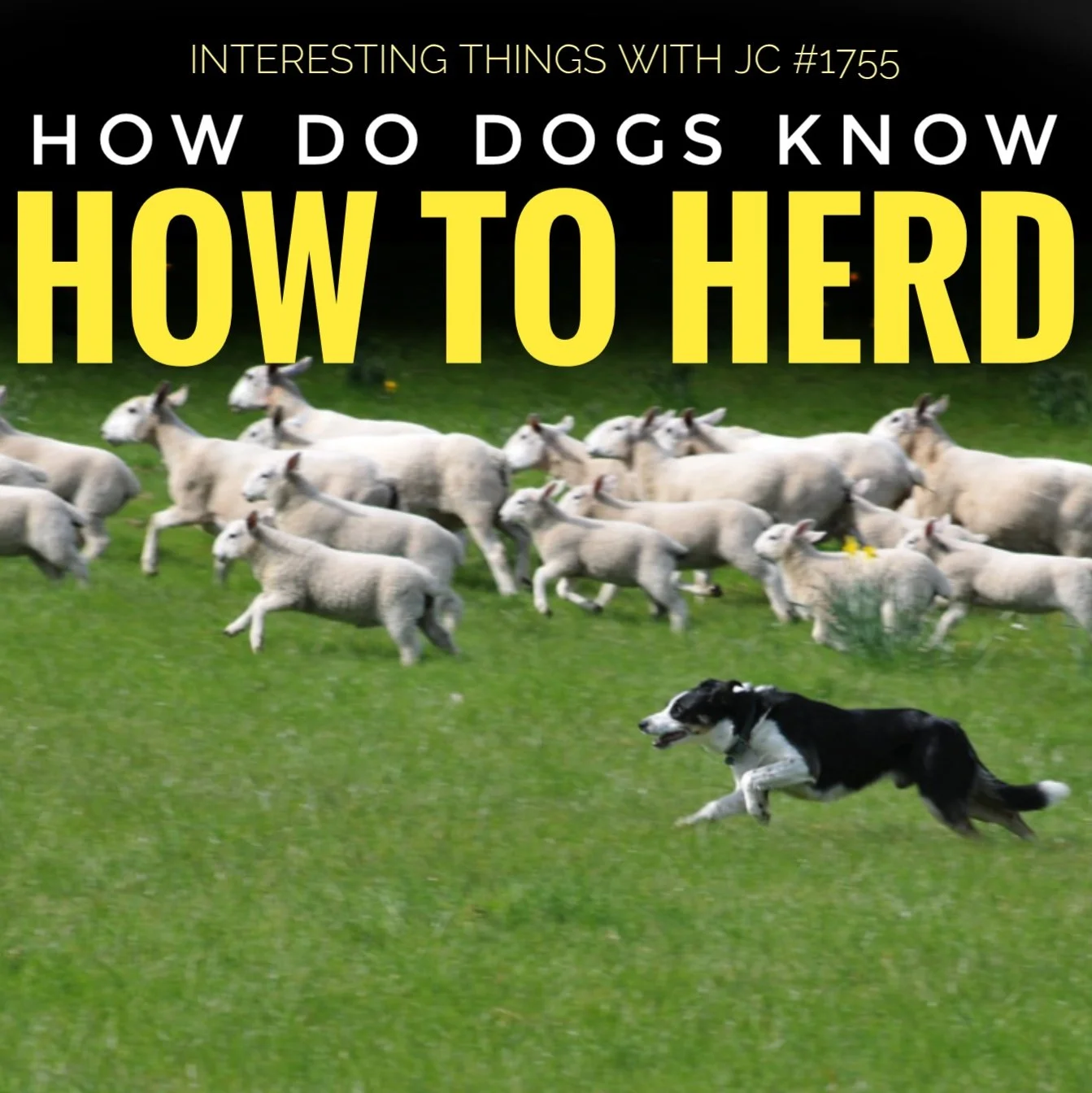
A black-and-white herding dog runs beside a flock of sheep moving across a green field. Large text reads, “How Do Dogs Know How to Herd,” with “Interesting Things with JC #1755” above.
Transcript
Interesting Things with JC #1755:
"How Do Dogs Know How to Herd?"
Put a young Border Collie in front of sheep for the first time, and it may begin doing things nobody taught it. It lowers its body, watches the flock, moves around its edge, and reacts when the sheep change direction. The dog doesn't know the commands yet, but some of the behavior is already there.
The science begins with predation. In wild canids, hunting follows a behavioral sequence that includes orienting toward prey, staring, stalking, chasing, grabbing, and eventually killing. Herding breeds retain some parts of that sequence more strongly than others. Border Collies are especially known for the intense visual fixation called "eye," along with stalking and chasing, while the later parts of the predatory sequence are inhibited.
Humans didn't create those behaviors from scratch. Through selective breeding, they changed their balance. Dogs showing useful combinations of attention, movement, responsiveness, and restraint produced the next generations. Different jobs favored different combinations. Australian Cattle Dogs, for example, were selected to work stubborn cattle and may nip at their heels, while Border Collies rely much more on position, movement, and visual pressure.
That selection has left evidence in the genome. Studies of herding dogs have identified genetic regions associated with neurological and cognitive functions. Research on Border Collies has also identified EPHB1, a gene involved in neuronal function and spatial memory, as one candidate associated with working behavior. There isn't a single "herding gene." Herding is a complex package involving many genes, development, and experience.
Training still matters. Research on young Border Collies has found that performance can be affected by the handler's experience, the dog's first encounter with livestock, and the kind of livestock it knows.
So when a Border Collie crouches and fixes its eyes on sheep before anyone has taught it the finished job, it isn't remembering a lesson it never had. You're watching an old canine behavioral sequence that humans selectively reshaped over generations, until parts of the hunt became the beginnings of a partnership.
These are interesting things, with JC.
Student Worksheet
Comprehension
What behaviors might a young Border Collie display when first encountering sheep?
Identify four components of the canine predatory sequence described in the episode.
What does the term “eye” mean in Border Collie behavior?
How does the working behavior of an Australian Cattle Dog differ from the pattern emphasized in Border Collies?
Why does the episode reject the idea of a single “herding gene”?
Analysis
Explain how selective breeding could increase stalking behavior while decreasing later predatory behavior toward livestock.
Why does finding a genetic association with EPHB1 not prove that EPHB1 alone causes herding?
What evidence from the episode demonstrates an interaction between inherited predisposition and environment?
Construct a cause-and-effect explanation connecting predatory behavior, selective breeding, inherited tendencies, training, and successful herding.
Reflection
If a dog displays herding tendencies before formal training, what does that tell us—and what does it not tell us—about the relationship between genes and behavior?
Difficulty Scaling
Level 1 — Identify: Recognize vocabulary and describe observed herding behaviors.
Level 2 — Explain: Connect selective breeding with differences in behavioral patterns.
Level 3 — Evaluate: Use genetic and behavioral evidence to construct a multifactor explanation of herding.
Student Output: Complete questions 1–10 using complete sentences. For questions 6–10, support each response with evidence or reasoning from the episode.
Academic Integrity Guidance: Use the episode and assigned sources to develop your own explanations. Clearly distinguish evidence from your interpretation; do not present copied or AI-generated language as original analysis.
Teacher Guide
Quick Start: Play or read the episode once without interruption. Ask students to identify which behaviors appear before formal training and which require learning. Use those observations to introduce genetics, selection, and environmental influence.
Pacing Guide — Audio First
0–5 minutes: Bell Ringer and prediction.
5–10 minutes: First episode listen; students record observations.
10–18 minutes: Vocabulary and predatory-sequence discussion.
18–30 minutes: Student Worksheet comprehension and analysis.
30–40 minutes: Evidence discussion: genes versus experience.
40–47 minutes: Quiz or assessment response.
47–50 minutes: Exit Ticket.
Bell Ringer: A dog encounters sheep for the first time and immediately begins crouching, staring, and circling. List two possible explanations for its behavior.
Audio Guidance: On the first listen, students should focus on the central explanation rather than taking detailed notes. Replay the genetics and training paragraphs for evidence collection.
Audio Fallback: If audio is unavailable, use the verbatim transcript and have students annotate references to inherited behavior, selective breeding, genetics, and experience.
Time on Task: Approximately 45–50 minutes for a standard lesson; 70–90 minutes with the extension activity.
Materials
Episode audio or transcript
Student Worksheet
Writing materials or digital document
Optional diagram space for the predatory sequence
Vocabulary Prep
Contrast predatory sequence with the everyday assumption that predation means only killing.
Clarify that phenotype describes observable characteristics and does not mean “genetic only.”
Introduce EPHB1 as a candidate associated with behavioral variation, not as a deterministic herding switch.
Misconceptions
Herding dogs do not arrive knowing human herding commands.
Inherited behavioral tendencies are not equivalent to a completely trained working skill.
Herding is not controlled by one gene.
Selective breeding does not require humans to create entirely new behaviors.
Predatory-derived behavioral components do not mean a trained herding dog is simply attempting to kill livestock.
Discussion Prompts
What is the difference between inheriting a behavioral tendency and knowing how to perform a complete task?
Why might different livestock species favor different working styles in dogs?
What evidence would scientists need before claiming that a particular gene causes a complex behavior?
Formative Checkpoints
Students correctly sequence several predatory components.
Students can explain selection without saying an individual dog changes genetically during training.
Students identify both biological inheritance and environmental experience in their explanations.
Students describe EPHB1 as a candidate or association rather than a single cause.
Differentiation
Additional Support: Provide cards containing individual predatory-sequence behaviors for students to arrange.
Advanced Learners: Ask students to distinguish genetic association, biological mechanism, and behavioral causation.
English Learners: Pair vocabulary with simple behavior descriptions and observable examples.
Assessment Differentiation
Permit an oral explanation or labeled concept map in place of extended writing when appropriate.
Require advanced students to address limitations of gene-behavior association evidence.
Time Flexibility: For a 25-minute lesson, use the episode, questions 1–5 and 10, and the Exit Ticket. For a block period, add genomic-evidence analysis.
Substitute Readiness: The transcript, vocabulary, worksheet, quiz, and answer key allow the lesson to operate without specialized background knowledge.
Engagement Strategy: Before revealing the explanation, have students vote among “training,” “instinct,” “both,” or “not enough information,” then revisit the vote after the lesson.
Extensions
Compare working styles of Border Collies and Australian Cattle Dogs.
Create a diagram showing which components of the predatory sequence are emphasized or restrained in herding.
Examine how scientists move from genomic associations to hypotheses about behavioral mechanisms.
Cross-Curricular Connections
Biology: Genetics, inheritance, behavior, selection.
Agriculture: Livestock management and working animals.
Psychology: Innate predispositions, learning, and environmental effects.
Statistics: Association versus causation in behavioral-genetics research.
SEL: Discuss how successful human-animal partnerships depend on observation, communication, responsiveness, and appropriate behavioral control.
Skill Emphasis: Evidence-based reasoning, causal explanation, source interpretation, and distinguishing correlation from causation.
Answer Key
Crouching/lowering the body, watching or fixing its eyes on the flock, moving around the flock, and responding to changes in sheep movement.
Acceptable examples include orienting, staring/eye, stalking, chasing, grabbing, and killing.
An intense visual fixation used by Border Collies when working livestock.
Australian Cattle Dogs may use heel-directed nipping to move resistant cattle; Border Collies rely more heavily on position, movement, visual fixation, stalking, and pressure.
Herding is a complex behavior involving multiple genetic influences together with development and experience.
Humans repeatedly bred dogs displaying useful early predatory components and restraint of unwanted later components, changing the prevalence of those traits across generations.
Association identifies a relationship worth investigating; it does not establish that one gene independently produces the complete behavior.
Owner/handler experience, initial livestock-contact conditions, and familiar livestock type can influence performance.
Strong answers connect ancestral behavioral components → human selection → inherited predispositions → development and training → controlled working behavior.
Early behavior supports an inherited predisposition, but it does not show that the dog possesses complete trained knowledge or that genes alone determine performance.
Quiz
Questions
Which behavior is especially associated with Border Collie “eye”?
A. Intense visual fixation
B. Retrieving livestock
C. Scent marking
D. Guarding foodWhich explanation best describes the relationship between herding and the predatory sequence?
A. Herding dogs lack all predatory behaviors.
B. Herding developed independently of earlier canine behavior.
C. Selection altered the expression of components of an existing behavioral sequence.
D. Training creates the entire predatory sequence.Why are Australian Cattle Dogs useful for comparison with Border Collies?
A. They demonstrate that all herding breeds work identically.
B. They illustrate how different working tasks favored different behavioral combinations.
C. They have no inherited working tendencies.
D. They require no training.What is the strongest conclusion supported by the EPHB1 research discussed in the episode?
A. EPHB1 is the single gene responsible for herding.
B. Every Border Collie carries an identical herding genotype.
C. EPHB1 is a candidate associated with selection and aspects of working behavior.
D. Training changes EPHB1 into a herding gene.Which observation best demonstrates an environmental influence on herding performance?
A. Dogs possess DNA.
B. Border Collies can display “eye.”
C. Performance varies with handler experience and livestock exposure.
D. Canids have a predatory sequence.
Assessment
Open-Ended Questions
Explain how humans could transform components of predatory behavior into useful herding tendencies through selective breeding. Include at least three specific behavioral components.
Evaluate the statement: “A Border Collie herds because it has herding genes.” Explain why this statement is incomplete using evidence about genetics, development, experience, and training.
3–2–1 Rubric
3 — Proficient: Accurate explanation; integrates specific episode evidence; clearly connects selection, inherited tendencies, and environmental influences; avoids genetic determinism.
2 — Developing: Generally accurate explanation with some evidence but incomplete connections or minor misconceptions.
1 — Beginning: Limited evidence, major conceptual gaps, or treats herding as entirely genetic or entirely learned.
Exit Ticket: In two sentences, explain why a young Border Collie can show herding-like behavior before training while still needing training to become an effective working dog.
Standards Alignment
NGSS — Science & Engineering Practices
SEP — Constructing Explanations and Designing Solutions — Students construct an evidence-based explanation for how selection and experience contribute to herding behavior.
SEP — Engaging in Argument from Evidence — Students evaluate whether genomic association evidence supports the claim of a single genetic cause for herding.
NGSS — Disciplinary Core Ideas
HS-LS3-2 — Inheritance and Variation of Traits — Students explain that observable behavioral characteristics reflect genetic influences interacting with environmental factors.
HS-LS4-4 — Natural Selection and Adaptation — Students use the analogous mechanism of human-directed selection to analyze how differential reproduction can change trait prevalence across generations while distinguishing artificial from natural selection.
CCSS Reading
CCSS.ELA-LITERACY.RST.9-10.1 — Cite Specific Textual Evidence — Students identify episode evidence supporting explanations of inherited and learned behavior.
CCSS.ELA-LITERACY.RST.11-12.2 — Determine Central Ideas or Conclusions — Students identify and summarize the episode's multifactor explanation of herding behavior.
CCSS Writing
CCSS.ELA-LITERACY.WHST.9-10.2 — Write Informative/Explanatory Texts — Students explain biological relationships using accurate terminology and evidence.
CCSS.ELA-LITERACY.WHST.11-12.9 — Draw Evidence from Informational Texts — Students use episode evidence to support analysis and reflection.
C3 Framework
D2.Sci.3.9-12 — Evaluate Scientific Explanations — Students examine evidence connecting inherited behavioral predispositions, selective breeding, and environmental experience.
ISTE / CTE
Knowledge Constructor — Students evaluate scientific claims and distinguish evidence of genetic association from claims of direct causation.
Agriculture/Animal Systems Connection — Students apply animal-behavior and genetics concepts to livestock handling and working-dog selection.
Career Readiness Competencies
Evidence Evaluation: Distinguish observation, association, and causal explanation.
Systems Thinking: Analyze behavior as an outcome of interacting biological and environmental factors.
Communication: Explain technical concepts using precise scientific vocabulary.
Applied Problem Solving: Connect behavioral science to livestock management and working-animal performance.
Homeschool/Lifelong Learning
Learners can independently observe canine behavior, map behaviors to episode concepts, and evaluate popular claims about “instinct” using evidence rather than assuming either complete genetic determination or complete learning.
Show Notes
Why can a Border Collie seem to know what to do around sheep before anyone teaches it? This episode explores how herding behavior draws on components of an older canine predatory sequence that humans reshaped through selective breeding. From the Border Collie's famous “eye” to genetic evidence involving candidates such as EPHB1, students examine how inheritance can create behavioral predispositions without supplying a complete trained skill. The topic provides a practical classroom example of genetics, selection, animal behavior, environmental influence, and the critical distinction between biological predisposition and genetic determinism.
References
Hekman, J. P., Johnson, J. L., & Kukekova, A. V. (2025). Genomic evidence for behavioral adaptation of herding dogs. Science Advances. https://pmc.ncbi.nlm.nih.gov/articles/PMC12042896
Leroy, G., et al. (2024). Testing and characterization of herding dogs' behaviors. Journal of Animal Science. https://pubmed.ncbi.nlm.nih.gov/38902885
Spady, T. C., & Ostrander, E. A. (2008). Canine behavioral genetics: Pointing out the phenotypes and herding up the genes. American Journal of Human Genetics. https://pmc.ncbi.nlm.nih.gov/articles/PMC2253978
Starling, M. J., Branson, N., Thomson, P. C., & McGreevy, P. D. (2020). Sequential analysis of livestock herding dog and sheep interactions. Animals. https://pubmed.ncbi.nlm.nih.gov/32098372
American Kennel Club. (n.d.). Why does my dog herd my kids? Tips to channel herding behavior. https://www.akc.org/expert-advice/advice/why-does-my-dog-herd-my-kids/