Interesting Things with JC #1754: "Jose Alberto Gutierrez"
Bogotá garbage collector José Alberto Gutiérrez keeps pulling discarded books from the trash until his home becomes a free library and the books begin reaching communities across Colombia.
Curriculum - Episode Anchor
Episode Title: Jose Alberto Gutierrez
Episode Number: 1754
Host: JC
Audience: Grades 9–12, introductory college, homeschool, lifelong learners
Subject Area: English Language Arts, social studies, information literacy, community studies, career readiness
Lesson Overview
Learning Objectives: Students will:
Summarize the development of José Alberto Gutiérrez’s book-rescue project using accurate chronological evidence.
Analyze how individual initiative, family participation, and community networks contributed to the project’s growth.
Distinguish documented outcomes from broader causal claims that available evidence does not establish.
Evaluate how discarded resources can acquire new value when redirected toward a community need.
Essential Question: How can an ordinary action develop into sustained community service, and how should we evaluate claims about its impact?
Success Criteria: Students can identify at least three verified details from the episode, explain the project’s development, distinguish evidence from inference, and support an interpretation with specific evidence.
Student Relevance Statement: Students encounter claims about individuals making a difference through news, social media, school assignments, and community organizations. Learning to appreciate meaningful work while still checking what evidence proves is an important information-literacy skill.
Real-World Connection: Gutiérrez’s experience connects resource reuse, literacy access, community organization, logistics, and responsible evaluation of public claims.
Workforce Reality: Community projects require consistent work, resource management, collaboration, communication, logistics, judgment, and the discipline to continue routine tasks over long periods.
Key Vocabulary
José Alberto Gutiérrez(hoh-SEH al-BEHR-toh goo-TYEH-rrez) — Bogotá garbage-truck driver who became known for rescuing discarded books and helping redistribute them.
Bogotá(boh-goh-TAH) — Capital city of Colombia and the setting of Gutiérrez’s story.
La Nueva Gloria(lah NWEH-vah GLOH-ree-ah) — Bogotá neighborhood where the Gutiérrez family home and community library were located.
La Fuerza de las Palabras(lah FWEHR-sah deh lahs pah-LAH-brahs) — “The Strength of Words,” the name associated with the family’s library and foundation.
Redistribute(ree-dih-STRIB-yoot) — To collect resources and distribute them to new recipients.
Literacy(LIT-er-uh-see) — The ability to read and write effectively and use written information.
Causation(kaw-ZAY-shun) — A relationship in which evidence demonstrates that one factor produced a particular result.
Evidence(EV-ih-dens) — Information used to support or test a factual claim or conclusion.
Resource reuse(REE-sors ree-YOOS) — Giving an existing material a new purpose rather than treating it as waste.
Narrative Core
Open: In 1997, José Alberto Gutiérrez was driving a garbage truck through Bogotá when a discarded book caught his attention. One early rescue he remembered was Leo Tolstoy’s Anna Karenina.
Info: Having grown up with limited access to books, Gutiérrez recognized value in books other people discarded. He began taking usable novels, textbooks, encyclopedias, and children’s books home.
Details: His family helped transform the growing collection into La Fuerza de las Palabras. By 2017, reporting described roughly 25,000 books in the home library. Other reporting documented more than 50,000 books recovered and distributed and a reach exceeding 22,000 people.
Reflection: The story illustrates resourcefulness and sustained community effort, but it also offers an information-literacy lesson. Evidence that books reached thousands of people is not the same as evidence that one person directly caused measurable literacy gains among those people.
Closing: These are interesting things, with JC.
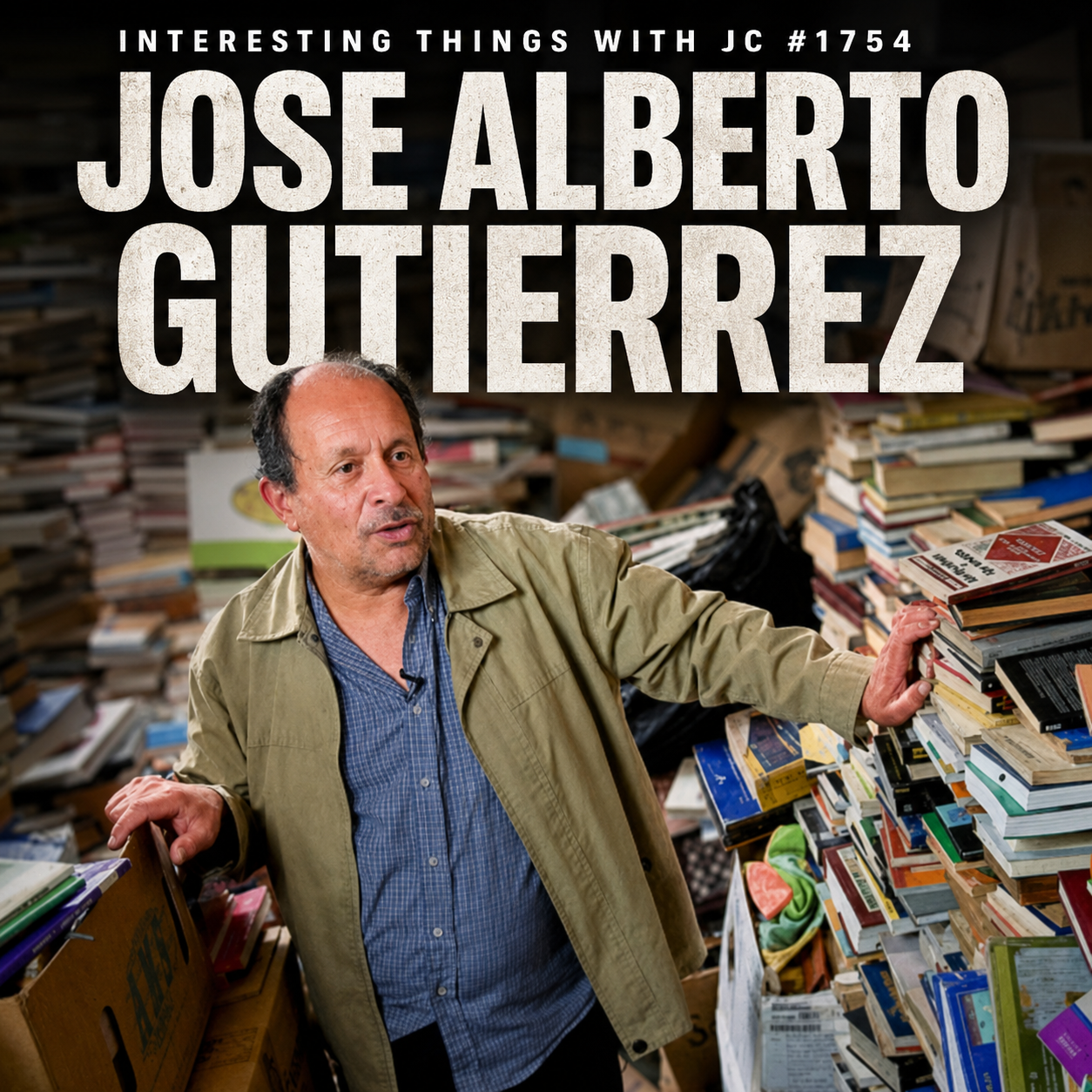
José Alberto Gutiérrez stands among large stacks of books in a crowded room. Large text reads, “Jose Alberto Gutierrez,” with “Interesting Things with JC #1754” above. For educational and informational purposes only. Images are used under applicable fair use principles; no ownership is claimed, and all rights remain with their respective copyright holders.
Transcript
Interesting Things with JC #1754:
"Jose Alberto Gutierrez"
In 1997, José Alberto Gutiérrez (hoh-SEH al-BEHR-toh goo-TYEH-rrez) was driving a garbage truck through Bogotá, Colombia, when he noticed a book mixed in with the trash. One of the first he remembers saving was Leo Tolstoy’s Anna Karenina. He took it home, and after that, he started watching for others.
Gutiérrez had grown up poor in Bogotá, where his mother read stories to him even though the family had little money for books. So when novels, textbooks, encyclopedias and children’s books began appearing along his garbage route, he had trouble leaving them behind. He brought them home instead, sometimes dozens at a time.
Eventually, the books began taking over the family home in the working-class neighborhood of La Nueva Gloria. Gutiérrez, his wife Luz Mary, and their family turned part of the house into a free community library called La Fuerza de las Palabras — “The Strength of Words.” Neighborhood children came to borrow books, do homework, or simply sit and read, and by 2017, the collection had grown to roughly 25,000 volumes.
Then the books began moving beyond the house. As people heard about the project, donations arrived, and books were sent to schools and communities elsewhere in Colombia. By 2021, reporting on Gutiérrez’s work put the number of books recovered and redistributed at more than 50,000, reaching more than 22,000 people.
He became known as El Señor de los Libros — “The Lord of the Books,” but the work was never his alone. His wife and children helped turn one man’s habit of rescuing books into a family foundation, and there’s no reliable evidence that he personally raised the literacy rate of thousands of children, as the story is sometimes told.
What the record gives us is simpler. A garbage collector kept finding books other people had thrown away, and he understood that being discarded wasn’t the same as being useless. He carried them home until his home became a library, and then kept carrying them outward to people who still had a use for them.
These are interesting things, with JC.
Student Worksheet
Comprehension
What book does Gutiérrez remember as one of his first rescued books?
What childhood experience may help explain his interest in books?
What was La Fuerza de las Palabras?
Approximately how many books were reported in the home collection by 2017?
How did the project eventually extend beyond Gutiérrez’s neighborhood?
Analysis
6. Identify three stages in the development of the project. For each stage, provide one detail from the transcript.
7. Why is the distinction between “reaching more than 22,000 people” and “raising the literacy rate of more than 22,000 people” important?
8. Identify at least three people or groups besides Gutiérrez whose participation contributed to the project.
9. Explain the meaning of the statement, “being discarded wasn’t the same as being useless.” Address both its literal and broader significance.
Reflection
10. Identify an underused or discarded resource in your school, home, workplace, or community. Explain one realistic way it could be redirected toward a useful purpose.
Difficulty Scaling
Level 1: Answer Questions 1–5 using direct transcript evidence.
Level 2: Complete Questions 6–9 using specific supporting evidence.
Level 3: Evaluate the limits of the evidence and develop a feasible resource-reuse proposal.
Student Output: Write complete sentences for Questions 1–5 and 3–5 sentence evidence-based responses for Questions 6–9. The reflection should be one developed paragraph of approximately 100–150 words.
Academic Integrity Guidance: Base factual answers on the episode. Clearly distinguish information stated in the transcript from your own interpretations, predictions, or proposals.
Teacher Guide
Quick Start: Begin by playing the complete podcast episode without front-loading the story. Ask students to listen for three things: what Gutiérrez did, how the effort expanded, and which claims the narrator deliberately limits.
Pacing Guide — Audio First
0–5 minutes: Bell ringer and initial prediction.
5–10 minutes: Play podcast from beginning to end.
10–15 minutes: Students record key facts and vocabulary.
15–27 minutes: Complete comprehension and analysis questions.
27–40 minutes: Evidence-versus-causation discussion.
40–50 minutes: Reflection and resource-reuse application.
50–55 minutes: Exit ticket.
Bell Ringer: “When does an object stop being useful?” Students write 2–3 sentences and identify one item commonly discarded that could still have value.
Audio Guidance: On the first listen, students should focus on the story rather than taking continuous notes. On a second listen, pause after the home-library paragraph and after the 22,000-person figure to identify changes in scale and evidence.
Audio Fallback: If audio is unavailable, read the supplied transcript aloud before allowing students to reread it independently. Preserve the audio-first sequence by having students listen rather than read during the first exposure.
Time on Task: Approximately 55 minutes for a standard class; 75–90 minutes with the extension activity.
Materials
Podcast episode/audio
Full transcript
Student worksheet
Paper or digital note-taking tool
Optional local resource-reuse information for extension work
Vocabulary Preparation: Introduce redistribute, evidence, and causation. Ask students to explain why “people reached” describes a different measurement from “literacy increased.”
Common Misconceptions
The project was not solely the work of one individual; Gutiérrez’s family participated.
Finding and distributing books demonstrates increased access, but does not by itself prove increased literacy rates.
The roughly 25,000-book figure describes the home collection reported in 2017; the larger 50,000-plus figure concerns books recovered and distributed over time.
Reuse does not automatically make every discarded resource safe or useful; condition, need, and practical distribution matter.
Discussion Prompts
Which mattered more to the project’s development: the first rescued book or Gutiérrez’s continued routine afterward? Defend your answer.
How did the project change when it moved from individual collection to family and community participation?
Why might an inspirational story become less accurate as it is repeatedly retold?
Can correcting an exaggerated claim make the underlying story more meaningful rather than less meaningful? Explain.
Formative Checkpoints
After first listen: Students record three facts they can directly support with the transcript.
During analysis: Students classify one statement as evidence, inference, or unsupported claim and justify the classification.
Before assessment: Students explain the difference between access to books and demonstrated improvement in literacy.
Differentiation
Additional Support: Provide a chronological organizer with the headings 1997, Home Library, and Expansion.
Advanced Learners: Compare two reports about the project and identify differences in claims, measurements, and attribution.
English Learners: Preview proper nouns and key vocabulary and allow a first-pass chronology before analytical writing.
Assessment Differentiation: Students may demonstrate analysis through a written paragraph, structured oral response, or evidence chart while maintaining the same evidence requirements.
Time Flexibility: For a 30-minute class, complete the audio, Questions 1–7, one discussion prompt, and the exit ticket. For a block period, add source comparison and the extension.
Substitute Readiness: The transcript, worksheet, answer key, and audio fallback allow the lesson to run without specialized subject knowledge.
Engagement Strategy: After listening, present three labels—documented fact, reasonable inference, and unsupported claim. Students classify statements about the story and defend each classification with evidence.
Extensions
Investigate a local book-reuse, library, recycling, or redistribution program.
Design a small-scale resource-redistribution proposal that identifies the resource, intended users, collection method, storage requirements, and distribution process.
Compare Gutiérrez’s project with another documented example of community resource reuse.
Cross-Curricular Connections
English Language Arts: Evidence, central ideas, source evaluation, explanatory writing.
Social Studies: Community organization, civic participation, access to resources.
Environmental Science: Reuse and extending the useful life of materials.
Mathematics: Comparing quantities, scale, and what numerical measurements can and cannot demonstrate.
Career Education: Logistics, collaboration, resource management, communication, and judgment.
SEL: Students consider persistence, responsibility, cooperation, and the relationship between individual initiative and family or community support.
Skill Emphasis: Critical thinking, evidence evaluation, communication, problem solving, information literacy, professional judgment, and responsible decision making.
Answer Key
Anna Karenina by Leo Tolstoy.
His mother read stories to him despite the family having little money for books.
A free community library created in the Gutiérrez family home, later associated with the family foundation.
Roughly 25,000 volumes.
Donations increased and books were distributed to schools and communities elsewhere in Colombia.
Acceptable stages include rescuing discarded books, building the home collection/community library, and expanding redistribution beyond the neighborhood.
“Reached” documents contact or access; it does not establish that literacy rates increased or that Gutiérrez caused such an increase.
Examples include his wife Luz Mary, his children/family, donors, schools, communities, and neighborhood participants.
Literally, discarded books could still be read and used. More broadly, the statement suggests that loss of value in one setting does not necessarily mean loss of usefulness in another.
Answers will vary but should identify a realistic resource, need, and redistribution method.
Quiz
Multiple Choice
What first prompted Gutiérrez to begin collecting books from the garbage?
A. A school requested donated textbooks
B. He noticed a discarded book while working his garbage route
C. His family opened a bookstore
D. A library asked him to collect damaged booksWhat was La Fuerza de las Palabras?
A. A publishing company
B. A municipal recycling program
C. A community library created in the family home
D. A Bogotá bookstoreApproximately how many volumes were reported in the home collection by 2017?
A. 2,500
B. 10,000
C. 25,000
D. 50,000Which statement best reflects the episode’s treatment of evidence?
A. Every person receiving a book became fully literate
B. Gutiérrez personally taught more than 22,000 people to read
C. Book distribution proves national literacy rates increased
D. Documented book distribution should not be confused with proof of literacy gainsWhich factor helped the project expand beyond one person collecting books?
A. Family involvement, donations, and wider distribution
B. A commercial publishing contract
C. Mandatory government participation
D. The sale of the original collection
Assessment
Open-Ended Questions
Explain how Gutiérrez’s actions developed from an individual habit into a broader community effort. Use at least three specific pieces of evidence from the episode.
Why does the episode distinguish between documented book distribution and claims about improved literacy? Explain what this distinction teaches about evaluating evidence.
3–2–1 Rubric
3 — Proficient: Makes a clear claim, uses multiple accurate pieces of evidence, distinguishes fact from inference or causation, and explains reasoning.
2 — Developing: Demonstrates general understanding and uses some relevant evidence, but reasoning or evidence evaluation is incomplete.
1 — Beginning: Provides limited understanding, minimal supporting evidence, or makes conclusions not supported by the episode.
Exit Ticket
Write one documented fact from the episode.
Write one reasonable inference supported by the episode.
Write one claim that would require additional evidence before you could accept it as fact.
Standards Alignment
NGSS — Science & Engineering Practices
SEP: Engaging in Argument from Evidence — Students distinguish documented book distribution from unsupported causal claims about literacy outcomes. Measurable Outcome: Students construct a claim supported by transcript evidence and identify what additional evidence would be needed to establish causation. Justification: Worksheet Question 7 and Assessment Question 2 explicitly require evidence-based reasoning.
SEP: Obtaining, Evaluating, and Communicating Information — Students extract factual information, assess its limits, and communicate conclusions. Measurable Outcome: Students accurately classify information as documented evidence, inference, or unsupported claim. Justification: The formative checkpoints and exit ticket directly assess information evaluation.
CCSS Reading
CCSS.ELA-LITERACY.RI.9-10.1 — Cite strong and thorough textual evidence — Students use specific transcript details to support analysis. Measurable Outcome: Students provide multiple relevant details in Worksheet Questions 6–9 and Assessment Question 1. Justification: Evidence citation is required throughout the lesson’s analytical work.
CCSS.ELA-LITERACY.RI.11-12.2 — Determine two or more central ideas of a text and analyze their development — Students examine resource reuse, community action, and responsible evidence evaluation. Measurable Outcome: Students explain how the project develops from individual action to broader distribution. Justification: The chronology task and first assessment directly measure development of central ideas.
CCSS.ELA-LITERACY.RI.11-12.8 — Delineate and evaluate reasoning in seminal U.S. texts — Applied here as a transferable informational-reading skill rather than a direct text match. Measurable Outcome: Students examine the relationship between claims and supporting evidence. Justification: The evidence-versus-causation exercise practices the underlying reasoning skill while recognizing that the episode itself is not a seminal U.S. text.
CCSS Writing
CCSS.ELA-LITERACY.W.9-10.2 — Write informative/explanatory texts — Students explain the development and significance of the project. Measurable Outcome: Students produce organized explanatory responses using accurate evidence. Justification: Worksheet analysis and Assessment Question 1 require explanatory writing.
CCSS.ELA-LITERACY.W.11-12.9 — Draw evidence from literary or informational texts — Students support written analysis with episode evidence. Measurable Outcome: Students integrate at least three accurate details into an analytical response. Justification: The assessment explicitly requires textual support.
CCSS Speaking & Listening
CCSS.ELA-LITERACY.SL.9-10.1 — Initiate and participate effectively in collaborative discussions — Students discuss evidence, causation, community participation, and resource reuse. Measurable Outcome: Students respond to peers and support at least one contribution with episode evidence. Justification: Teacher Guide discussion prompts require collaborative evidence-based reasoning.
C3 Framework
D1.5.9-12 — Determine the kinds of sources that will be helpful in answering compelling and supporting questions — Students identify when existing evidence is insufficient to answer a causal question. Measurable Outcome: Students specify what additional information would be required to establish literacy improvement. Justification: Assessment Question 2 and the exit ticket require students to identify evidentiary limits.
D4.1.9-12 — Construct arguments using precise and knowledgeable claims with evidence from multiple sources — Students practice constructing defensible claims and, in the extension, can compare external reports. Measurable Outcome: Students separate verified information from stronger conclusions requiring further evidence. Justification: This skill is directly developed through the evidence-classification activity and source-comparison extension.
ISTE Standards
ISTE 1.3 — Knowledge Constructor — Students evaluate the accuracy and relevance of information used to construct knowledge. Measurable Outcome: Students differentiate reported measurements from unsupported interpretations. Justification: Information literacy is a central objective, worksheet task, and assessment criterion.
Career Readiness Competencies
Analytical Thinking — Students separate observation, evidence, inference, and causal claims. Outcome: Accurately classify claims and justify classifications. Connection: Formative checkpoints and Assessment Question 2.
Communication — Students present evidence-supported explanations orally and in writing. Outcome: Communicate a defensible conclusion using relevant details. Connection: Discussion and assessment tasks.
Problem Solving — Students develop a feasible method for redirecting an underused resource. Outcome: Identify a resource, need, and workable distribution method. Connection: Reflection and extension activities.
Adaptability — Students examine how an informal personal practice developed as circumstances, donations, and participation changed. Outcome: Explain how a project can adapt as its scale increases. Connection: Worksheet Question 6.
Professional Judgment — Students avoid overstating conclusions beyond available evidence. Outcome: Distinguish what is known from what still requires verification. Connection: Worksheet Question 7, Quiz Question 4, and Assessment Question 2.
Homeschool / Lifelong Learning Alignment
Independent Learning — Learners can complete the podcast, transcript, worksheet, and reflection independently. Outcome: Produce a self-directed evidence-based analysis.
Information Literacy — Learners evaluate claims according to the strength of available evidence. Outcome: Identify unsupported or insufficiently supported causal claims.
Real-World Application — Learners connect resource reuse with a need in their own surroundings. Outcome: Develop one realistic redistribution proposal.
Self-Directed Inquiry — Learners identify questions requiring further investigation. Outcome: State what additional evidence would be needed to test a claim about project impact.
Transferable Life Skills — Learners practice judgment, communication, resourcefulness, and responsible decision making. Outcome: Apply evidence evaluation and problem-solving strategies beyond the episode.
Show Notes
José Alberto Gutiérrez’s story gives students a compact case study in persistence, resource reuse, family and community participation, and responsible evidence evaluation. Beginning with a discarded book found during an ordinary work shift, the episode follows the development of a home library and wider book-redistribution effort while carefully distinguishing documented reach from unsupported claims about literacy outcomes. The lesson matters because students learn that meaningful accomplishments do not need exaggeration to be worth studying—and that disciplined attention to evidence is part of understanding real-world impact.
References
Associated Press. (2017). Colombian garbage collector rescues books and creates library. AP News. https://apnews.com/article/4f6f64ed6583488c8b4e7f9bb8720a0a
BBC News. (2017). The Colombian garbage collector who has a library of discarded books. https://www.bbc.com/news/world-latin-america-40154268