Interesting Things with JC #1756:
"What Happens When You Skip Sleep?"
Stay awake long enough and adenosine signaling increases sleep pressure while caffeine can temporarily block the feeling of it. Attention, judgment, and memory become less reliable, and eventually the brain can force seconds-long microsleeps into wakefulness even while you are still functioning.
Curriculum - Episode Anchor
Episode Title: What Happens When You Skip Sleep?
Episode Number: 1756
Host: JC
Audience: Grades 9–12, introductory college, homeschool, lifelong learners
Subject Area: Biology, neuroscience, health science, psychology, information literacy
Lesson Overview
Learning Objectives
Explain how adenosine signaling and circadian rhythms contribute to sleepiness and alertness.
Analyze how sleep deprivation affects attention, memory, judgment, and self-assessment.
Describe physiological effects of inadequate sleep involving metabolism, immune function, and inflammation.
Apply knowledge of microsleeps and impaired reaction time to real-world safety decisions.
Essential Question: What happens to the brain and body when a person remains awake instead of getting needed sleep?
Success Criteria
Distinguish sleep pressure from circadian alerting signals.
Explain why caffeine can reduce perceived sleepiness without eliminating the biological need for sleep.
Connect sleep deprivation to measurable changes in cognition, memory, metabolism, and safety.
Use evidence from the episode to evaluate a real-world situation involving fatigue.
Student Relevance Statement: Sleep affects learning, memory, reaction time, emotional regulation, and decision-making—abilities students use every day in school, work, athletics, and transportation.
Real-World Connection: Fatigue can become a safety issue during driving, shift work, equipment operation, studying, and other tasks requiring sustained attention.
Workforce Reality: Healthcare, transportation, manufacturing, emergency response, aviation, public safety, and other industries manage fatigue because lapses in attention and judgment can affect both workers and the public.
Key Vocabulary
Terms
Adenosine(uh-DEN-uh-seen) — A signaling molecule involved in sleep regulation; adenosine signaling contributes to increasing sleep pressure during prolonged wakefulness.
Sleep Pressure(sleep PRESH-er) — The homeostatic drive for sleep that generally increases the longer a person remains awake.
Circadian Rhythm(sur-KAY-dee-un RITH-um) — An approximately 24-hour biological rhythm that helps regulate cycles of sleepiness and alertness.
Prefrontal Cortex(pree-FRUN-tuhl KOR-teks) — A brain region important for executive functions including judgment, working memory, planning, and decision-making.
Hippocampus(hip-uh-KAM-pus) — A brain structure with a major role in learning and the formation of new memories.
Microsleep(MY-kroh-sleep) — A brief, involuntary episode of sleep occurring during a period when a person appears to be awake.
Insulin Sensitivity(IN-suh-lin sen-suh-TIV-uh-tee) — How effectively cells respond to insulin in regulating blood glucose.
Inflammation(in-fluh-MAY-shun) — A biological response involving immune signaling that can be altered by insufficient sleep.
Narrative Core
Open: Remaining awake creates biological pressure that cannot simply be overcome through determination. As wakefulness continues, processes involved in sleep regulation increasingly influence attention, cognition, and physical functioning.
Info: Sleep regulation involves interacting systems. Adenosine signaling contributes to homeostatic sleep pressure, while the circadian system produces a separate daily rhythm in sleepiness and alertness. Caffeine antagonizes adenosine receptors and can temporarily reduce the sensation of sleepiness, but it does not substitute for sleep.
Details: With increasing sleep loss, sustained attention becomes less reliable, executive functioning deteriorates, and learning and memory suffer. Brief involuntary microsleeps can occur without the person recognizing them. Sleep deficiency also affects metabolic and immune processes, including glucose regulation, insulin response, and inflammatory signaling.
Reflection: A particularly important consequence is that sleep deprivation can impair both performance and a person's ability to recognize that performance has deteriorated. Feeling capable is therefore not necessarily evidence that a sleep-deprived person is functioning normally.
Closing: These are interesting things, with JC.
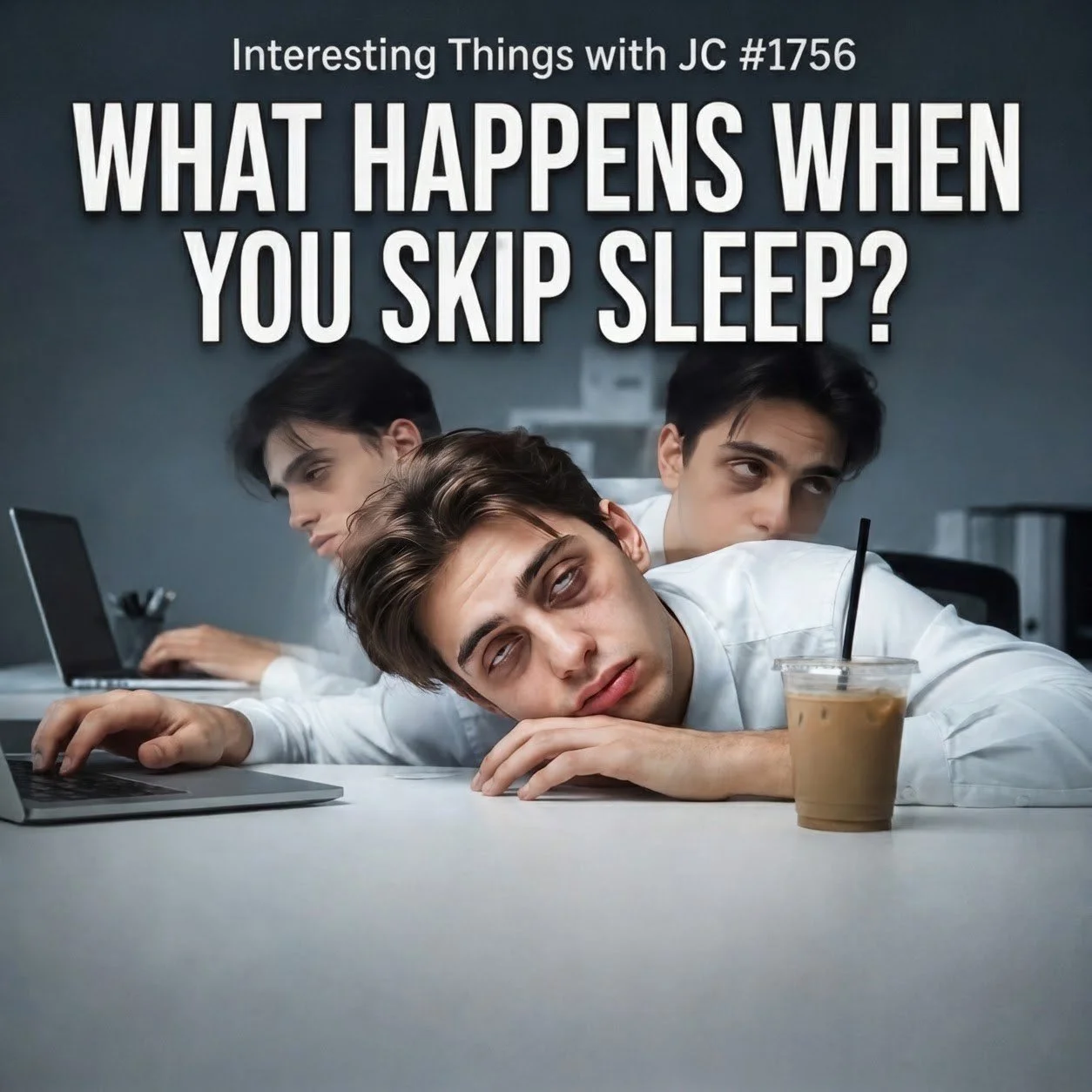
Three exhausted office workers struggle to stay awake at a desk with laptops and an iced coffee. Large text reads, “What Happens When You Skip Sleep?” with “Interesting Things with JC #1756” above.
Transcript
Interesting Things with JC #1756:
"What Happens When You Skip Sleep?"
Stay awake long enough, and something begins building inside your brain. You can't see it, and caffeine can temporarily hide part of it, but the longer you're awake, the harder your nervous system has to work to keep you functioning normally.
One part of that process involves adenosine. As wakefulness continues, adenosine signaling contributes to sleep pressure, the biological drive that makes sleep increasingly difficult to resist. Caffeine blocks adenosine receptors, so it can reduce the feeling of sleepiness for a while without removing the underlying need for sleep.
At the same time, your circadian clock controls a separate daily rhythm of alertness. That's why exhaustion doesn't simply increase in a straight line. You can feel terrible in the middle of the night and then catch a second wind after sunrise, even though you've been awake longer.
As sleep pressure rises, attention becomes unstable. The prefrontal cortex, involved in judgment, working memory, and decision-making, becomes less reliable, while sleep loss also interferes with the hippocampus and the formation of new memories.
Eventually, the brain can force brief episodes of sleep into wakefulness. These microsleeps may last only a few seconds without you realizing they've happened. At 60 miles per hour, or 97 kilometers per hour, a five-second lapse carries a car about 440 feet, or 134 meters.
Sleep loss reaches the rest of the body too, altering glucose regulation, insulin sensitivity, stress-hormone activity, immune signaling, and inflammation. With severe, prolonged deprivation, perception can begin to break down, and hallucinations and disordered thinking have been documented after extended periods awake.
The problems begin well before that. Sleep deprivation affects some of the same brain systems you use to judge how well you're functioning. You can be awake, talking, working, and making decisions while becoming progressively worse at recognizing your own impairment.
You can choose to skip sleep. What you can't choose is how your brain and body respond to it.
These are interesting things, with JC.
Student Worksheet
Comprehension
What role does adenosine signaling play as wakefulness continues?
How does caffeine affect adenosine signaling, and what does caffeine not accomplish?
How is the circadian clock different from sleep pressure?
Name two cognitive abilities described as becoming less reliable during sleep deprivation.
What is a microsleep, and why can it be dangerous?
Analysis
Explain why someone might experience a temporary "second wind" despite having been awake longer.
At 60 miles per hour, the episode states that a five-second lapse moves a vehicle about 440 feet. Explain why this example makes microsleep a practical safety issue rather than merely a sleep-science concept.
Why might self-assessment become unreliable during sleep deprivation?
Compare caffeine's effect on perceived sleepiness with the underlying biological need for sleep.
Reflection
Identify one situation in school, work, transportation, or daily life in which understanding sleep deprivation could change a person's decision. Explain your reasoning with evidence from the episode.
Difficulty Scaling
Level 1 — Identify: Define vocabulary and locate explicit information in the transcript.
Level 2 — Explain: Describe relationships among sleep pressure, circadian rhythm, cognition, and behavior.
Level 3 — Apply and Evaluate: Use evidence to analyze safety, performance, or decision-making scenarios.
Student Output: Answer Questions 1–9 in 1–3 complete sentences each and Question 10 in one evidence-supported paragraph.
Academic Integrity Guidance: Use the episode and assigned sources to construct your own explanations. Clearly distinguish direct episode evidence from your own inference. Do not present copied or AI-generated explanations as original analysis when course rules require independent work.
Teacher Guide
Quick Start: Play or read the episode first without pre-teaching the scientific explanation. Ask students to record one brain effect and one body effect they notice, then use those observations to begin instruction.
Pacing Guide — Audio First
0–5 minutes: Bell ringer and prediction.
5–10 minutes: Play the episode without interruption.
10–18 minutes: Clarify adenosine, sleep pressure, caffeine, and circadian rhythm.
18–30 minutes: Students complete comprehension and analysis questions.
30–40 minutes: Discuss microsleeps, memory, judgment, and self-assessment.
40–48 minutes: Complete reflection and formative check.
48–55 minutes: Quiz or exit ticket.
Bell Ringer: "If caffeine makes someone feel more awake, does that necessarily mean the effects of lost sleep have been reversed? Explain your prediction."
Audio Guidance: Have students listen for cause-and-effect relationships rather than attempting to record every fact.
Audio Fallback: If audio is unavailable, use the verbatim transcript and have students mark references to brain function, body function, and safety.
Time on Task: Approximately 45–55 minutes for one class period; 70–90 minutes with extension activities.
Materials
Episode audio or transcript
Student worksheet
Writing materials or digital response platform
Optional diagram of sleep-wake regulation
Vocabulary Prep
Introduce adenosine, sleep pressure, and circadian rhythm before detailed analysis.
Reinforce the distinction between feeling sleepy and objectively performing well.
Connect prefrontal cortex with executive function and hippocampus with memory formation.
Misconceptions
"Caffeine replaces sleep." Caffeine can temporarily reduce perceived sleepiness through adenosine-receptor antagonism; it does not provide the biological functions of sleep.
"Fatigue always increases smoothly." Circadian alerting signals interact with accumulating sleep pressure, so subjective alertness can fluctuate.
"You always know when you microsleep." Microsleeps may occur without awareness.
"If I feel okay, I must be functioning normally." Sleep deficiency can reduce performance while people underestimate their impairment.
Discussion Prompts
Why is subjective alertness an imperfect measure of performance?
Which consequences of sleep deprivation would matter most in driving or safety-sensitive work?
Why is the distinction between masking sleepiness and eliminating sleep need scientifically important?
Formative Checkpoints
Students accurately distinguish sleep pressure from circadian rhythm.
Students explain caffeine without describing it as removing accumulated sleep need.
Students connect microsleeps with loss of attention and safety risk.
Students identify both cognitive and physiological consequences of sleep deficiency.
Differentiation
Additional Support: Provide a two-column organizer labeled "Brain Effects" and "Body Effects."
Advanced Learners: Have students distinguish homeostatic sleep regulation from circadian regulation and evaluate how their interaction explains changing alertness.
English Learners: Pair vocabulary with plain-language definitions and labeled diagrams; allow verbal rehearsal before written responses.
Assessment Differentiation: Permit supported students to demonstrate understanding through an annotated concept map or brief oral explanation while preserving the same scientific learning targets.
Time Flexibility: For a 30-minute lesson, complete Questions 1–7 and the exit ticket. For an extended period, add source evaluation or a fatigue-risk scenario.
Substitute Readiness: Provide the transcript, worksheet, vocabulary list, and answer key. No specialized laboratory materials are required.
Engagement Strategy: Ask students to map the episode's progression from molecular signaling → brain performance → microsleep → whole-body effects → impaired self-assessment.
Extensions
Calculate distances traveled during 2-, 5-, and 10-second attention lapses at different highway speeds.
Research recommended sleep duration by age and compare recommendations with common school or work schedules.
Create a concept map showing interactions among adenosine, caffeine, circadian rhythm, cognition, and behavior.
Cross-Curricular Connections
Biology: Nervous-system regulation, metabolism, immune function.
Psychology: Attention, memory, perception, and decision-making.
Physics/Mathematics: Speed-distance-time calculations involving microsleeps.
Career Education: Fatigue management in safety-sensitive occupations.
SEL: Use the lesson to strengthen self-management and evidence-based recognition of physical limits without asking students to disclose personal sleep habits.
Skill Emphasis: Cause-and-effect reasoning, scientific literacy, evidence evaluation, quantitative application, and risk assessment.
Answer Key
Adenosine signaling contributes to increasing sleep pressure as wakefulness continues.
Caffeine blocks adenosine receptors and can temporarily reduce perceived sleepiness, but it does not remove the underlying need for sleep.
Sleep pressure generally builds with time awake, while the circadian clock produces an approximately daily rhythm that influences when alertness and sleepiness rise and fall.
Acceptable responses include attention, judgment, working memory, decision-making, and new-memory formation.
A microsleep is a brief involuntary sleep episode during apparent wakefulness; it is dangerous because awareness and responsiveness can disappear during activities such as driving.
Circadian alerting signals can temporarily increase alertness even though homeostatic sleep pressure remains high.
A few seconds without effective awareness allows a fast-moving vehicle to travel a substantial distance without normal monitoring or response.
Sleep deprivation affects cognitive systems involved in judgment and self-monitoring, making subjective confidence an unreliable indicator of actual performance.
Caffeine can mask part of the sensation of sleepiness, whereas the biological consequences and underlying need for sleep remain.
Answers will vary but should identify a realistic situation, explain a decision, and support the reasoning with episode evidence.
Quiz
Questions
Which substance discussed in the episode contributes to sleep pressure during prolonged wakefulness?
A. Insulin
B. Adenosine
C. Melatonin receptor protein
D. HemoglobinWhat does caffeine primarily do in the mechanism described in the episode?
A. Eliminates the biological need for sleep
B. Creates new memories in the hippocampus
C. Blocks adenosine receptors
D. Stops the circadian clockWhy can a sleep-deprived person experience a "second wind"?
A. Sleep pressure disappears after sunrise
B. Circadian alerting varies across the daily cycle
C. The hippocampus stores additional energy
D. Microsleeps restore normal cognitionWhich statement best describes a microsleep?
A. A deliberate short nap
B. A brief involuntary episode of sleep during apparent wakefulness
C. A period of unusually strong memory formation
D. A normal increase in circadian alertnessWhich conclusion is most consistent with the episode?
A. People can always accurately judge their impairment.
B. Caffeine reverses the physiological consequences of sleep deprivation.
C. Sleep deprivation affects cognition before extreme symptoms appear.
D. Sleep deprivation affects the brain but not the rest of the body.
Assessment
Open-Ended Questions
Explain how homeostatic sleep pressure and circadian rhythm can produce changing levels of alertness during extended wakefulness. Include adenosine and caffeine in your explanation.
Evaluate the statement: "If a sleep-deprived person feels capable of performing a task, that feeling is sufficient evidence that the task is safe." Use at least three ideas from the episode.
3–2–1 Rubric
3 — Proficient: Scientifically accurate explanation; integrates multiple episode concepts; uses relevant evidence and clear cause-and-effect reasoning.
2 — Developing: Mostly accurate; includes relevant concepts but connections or supporting evidence are incomplete.
1 — Beginning: Demonstrates partial understanding; contains major omissions, unclear reasoning, or unsupported conclusions.
Exit Ticket: In 2–3 sentences, explain the difference between reducing the feeling of sleepiness and eliminating the biological need for sleep.
Standards Alignment
NGSS — Science & Engineering Practices
SEP — Developing and Using Models — Students construct or interpret a conceptual model connecting wakefulness, adenosine signaling, circadian regulation, cognition, and physiological effects.
SEP — Analyzing and Interpreting Data — Students use the speed-and-time microsleep example to interpret the practical consequences of a brief lapse in attention.
SEP — Engaging in Argument from Evidence — Students evaluate claims about caffeine, alertness, and performance using evidence from the lesson.
CCSS Reading
CCSS.ELA-LITERACY.RST.9-10.1 — Cite specific textual evidence to support analysis of science and technical texts — Students support explanations of sleep deprivation with specific episode evidence.
CCSS.ELA-LITERACY.RST.11-12.3 — Follow precisely a complex multistep procedure when carrying out experiments, taking measurements, or performing technical tasks — Students trace interacting biological processes and apply quantitative reasoning to the microsleep scenario.
CCSS Writing
CCSS.ELA-LITERACY.WHST.9-10.2 — Write informative/explanatory texts — Students explain biological mechanisms using accurate terminology and cause-and-effect relationships.
CCSS.ELA-LITERACY.WHST.11-12.9 — Draw evidence from informational texts to support analysis, reflection, and research — Students integrate episode evidence into assessment responses.
C3 Framework — Inquiry
D1.5.9-12 — Determine the kinds of sources that will be helpful in answering compelling and supporting questions — Students distinguish subjective impressions of alertness from evidence appropriate for evaluating sleep-related performance and safety claims.
ISTE / CTE — Applied Learning
ISTE Knowledge Constructor — 1.3 — Students evaluate scientific information and use credible evidence to construct knowledge about sleep and performance.
CTE Applied Science and Safety Skills — Students apply biological knowledge and quantitative reasoning to fatigue-related workplace and transportation risks.
Career Readiness Competencies
Critical Thinking: Evaluate whether subjective alertness reliably indicates performance.
Safety Awareness: Recognize fatigue as a potential hazard in transportation and safety-sensitive work.
Scientific Literacy: Interpret biological mechanisms and distinguish temporary symptom masking from physiological recovery.
Decision-Making: Apply evidence about sleep loss when evaluating risk.
Homeschool / Lifelong Learning
Learners connect neuroscience to everyday decisions involving learning, work, transportation, and health.
Learners practice evaluating familiar claims about caffeine and fatigue against scientific evidence.
Learners demonstrate understanding through written, oral, or concept-map formats.
Show Notes
What happens when you keep choosing wakefulness over sleep? Episode 1756 explores the interacting biology of sleep pressure and the circadian clock, including adenosine signaling, caffeine, attention, memory, microsleeps, metabolism, immune activity, and the surprising difficulty people can have recognizing their own impairment. For classrooms, the episode provides an accessible entry point into neuroscience, biology, psychology, quantitative reasoning, and real-world safety. It matters because the effects of lost sleep begin long before the most dramatic symptoms appear.
References
National Heart, Lung, and Blood Institute. (2022). Sleep deprivation and deficiency: What makes you sleep? https://www.nhlbi.nih.gov/health/sleep-deprivation/body-clock
National Heart, Lung, and Blood Institute. (2022). Sleep deprivation and deficiency: How sleep affects your health. https://www.nhlbi.nih.gov/health/sleep-deprivation/health-effects
National Heart, Lung, and Blood Institute. (2022). How sleep works: Why is sleep important? https://www.nhlbi.nih.gov/health/sleep/why-sleep-important
National Institute for Occupational Safety and Health. (2024). Driver fatigue on the job. https://www.cdc.gov/niosh/motor-vehicle/driver-fatigue/index.html
Reichert, C. F., Deboer, T., & Landolt, H.-P. (2022). Adenosine, caffeine, and sleep-wake regulation: State of the science and perspectives. Journal of Sleep Research, 31(4), e13597. https://pubmed.ncbi.nlm.nih.gov/35575450/
National Heart, Lung, and Blood Institute. (2022). Sleep deprivation and deficiency: How much sleep is enough? https://www.nhlbi.nih.gov/health/sleep-deprivation/how-much-sleep
National Heart, Lung, and Blood Institute. (2022). NIH-funded study shows sound sleep supports immune function. https://www.nhlbi.nih.gov/news/2022/nih-funded-study-shows-sound-sleep-supports-immune-function