1765: "The FBI Surveillance of Martin Luther King Jr."
Interesting Things with JC #1765:
"The FBI Surveillance of Martin Luther King Jr."
The FBI wiretapped Martin Luther King Jr. without a criminal charge and failed to establish that he or the SCLC was controlled by communists. The surveillance expanded into hotel microphones and private recordings, and FBI officials began using what they collected in efforts to discredit King and weaken his influence.
Curriculum - Episode Anchor
Episode Title: The FBI Surveillance of Martin Luther King Jr.
Episode Number: 1765
Host: JC
Audience: Grades 9–12, introductory college, homeschool, lifelong learners
Subject Area: U.S. history, civics, civil rights, government, information literacy
Lesson Overview
Learning Objectives
Explain why the FBI began investigating Martin Luther King Jr. and the Southern Christian Leadership Conference (SCLC).
Trace how the investigation expanded from concerns about alleged communist influence into surveillance and efforts to discredit King.
Distinguish intelligence gathering from counterintelligence actions intended to influence individuals, organizations, or public opinion.
Evaluate government surveillance using evidence from the episode and later congressional and Justice Department reviews.
Essential Question: How can a government investigation change when its original justification is not supported by the evidence?
Success Criteria: Students can construct an evidence-based timeline, identify at least three surveillance or counterintelligence methods, distinguish the FBI's stated justification from later findings, and explain why oversight of intelligence agencies matters.
Student Relevance Statement: Digital communications, privacy, government authority, national security, and the use of personal information remain important civic issues. Understanding this historical case gives students a framework for evaluating the relationship between security powers and civil liberties.
Real-World Connection: The King surveillance case demonstrates how records, authorization procedures, internal oversight, congressional investigations, courts, and archival preservation can later reveal how government power was exercised.
Workforce Reality: Historians, journalists, attorneys, intelligence analysts, archivists, investigators, and public-policy professionals must distinguish allegations from verified evidence, evaluate primary sources, establish timelines, and document conclusions accurately.
Key Vocabulary
Terms
Surveillance(ser-VAY-luhns) — Systematic observation or monitoring used to gather information about people, organizations, or activities.
Wiretap(WYRE-tap) — Interception or monitoring of telephone communications.
SCLC(ess-see-el-SEE) — Southern Christian Leadership Conference, a civil rights organization led by Martin Luther King Jr.
COINTELPRO(koyn-TEL-proh) — Short for Counterintelligence Program; FBI programs that used covert techniques intended to disrupt, expose, discredit, or otherwise counter targeted organizations and individuals.
Communist Party USA (CPUSA)(KOM-yuh-nist PAR-tee) — American political organization whose connections to some people around King became part of the FBI's stated national-security justification for surveillance.
Informant(in-FOR-muhnt) — A person who secretly provides information to investigators or authorities.
Counterintelligence(kown-ter-in-TEL-uh-juhns) — Activities designed to identify, counter, disrupt, or manipulate perceived threats or adversaries.
Domestic security(duh-MESS-tik sih-KYOOR-uh-tee) — Protection of a nation from security threats originating or operating within its borders.
Church Committee(CHURCH kuh-MIT-ee) — U.S. Senate committee that investigated intelligence-agency activities and abuses during the 1970s.
Narrative Core
Open: In October 1963, Attorney General Robert F. Kennedy approved an FBI request to wiretap Martin Luther King Jr. The authorization grew from an investigation centered on alleged communist influence around King and the SCLC.
Info: King had advisers, particularly Stanley Levison, with past Communist Party connections. In the Cold War environment, FBI Director J. Edgar Hoover viewed those associations as a potential security concern. Yet investigations did not establish that King was a communist or that the SCLC was controlled by the Communist Party.
Details: After the 1963 March on Washington, FBI official William C. Sullivan described King as standing “head and shoulders” above other Black leaders in his ability to influence large numbers of people and called him “the most dangerous Negro of the future in this Nation.” Surveillance expanded through telephone wiretaps, informants, physical surveillance, and hidden microphones. Information about King's private life was subsequently incorporated into efforts to damage his reputation. An anonymous package containing a recording and hostile letter was sent to King; King and his associates interpreted its message about there being “one way out” as pressure for him to commit suicide.
The campaign also involved distributing derogatory information and considering methods of weakening King's standing. The FBI's broader COINTELPRO campaign against organizations it categorized as “Black Nationalist–Hate Groups” included the SCLC. In 1968, King was specifically named in COINTELPRO planning that sought to prevent the emergence of a “messiah” capable of unifying and energizing the movement.
Reflection: Later investigations documented a significant difference between the original security rationale and the activities that followed. Congressional investigators concluded that FBI actions extended beyond gathering intelligence into attempts to discredit King and diminish his influence. A Justice Department review found no evidence that King himself had been a communist and criticized the continuation of the security investigation.
Closing: These are interesting things, with JC.
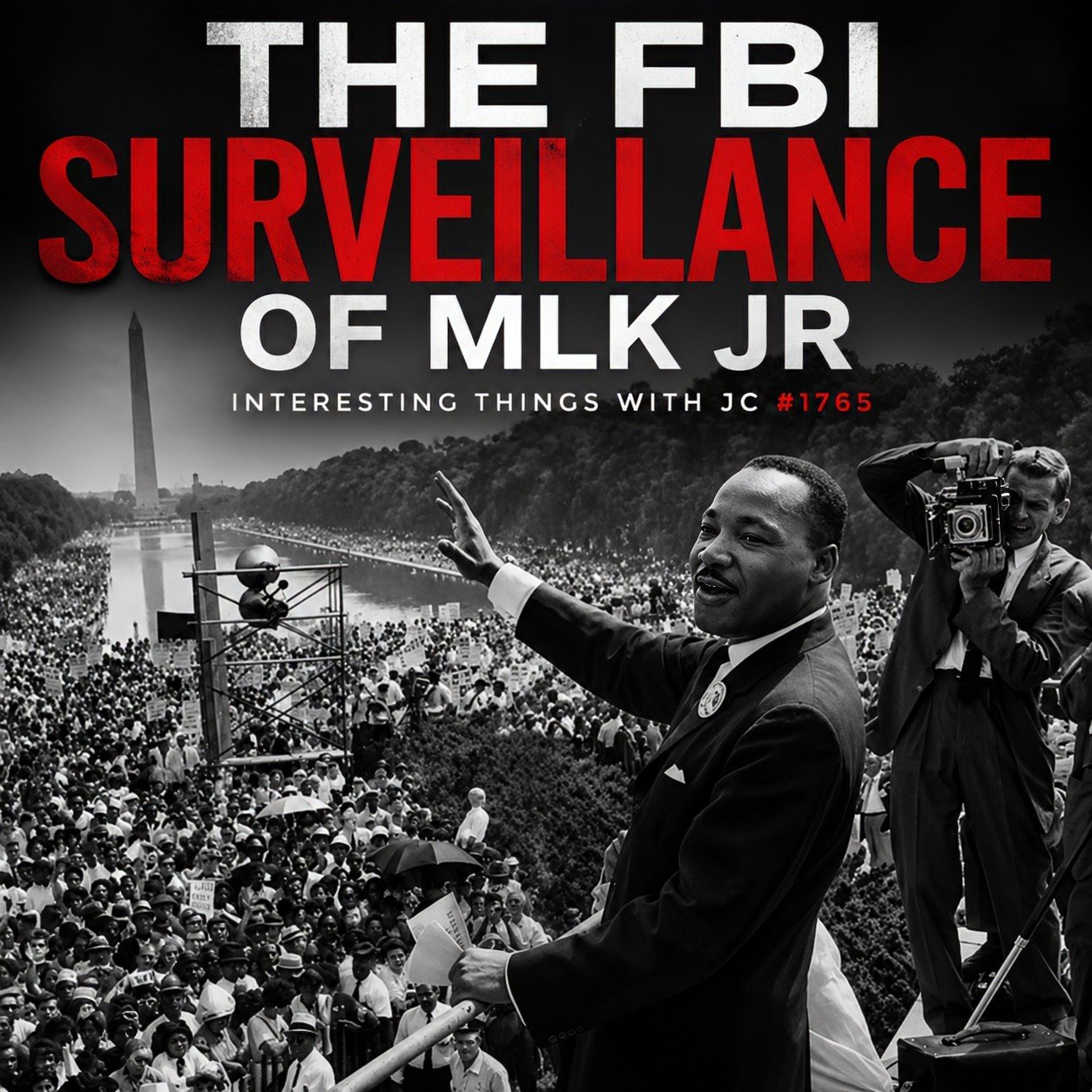
Square black-and-white episode artwork for Interesting Things with JC #1765. The top half contains large text reading “THE FBI SURVEILLANCE OF MLK JR,” with “SURVEILLANCE” in red and the remaining headline in white. Beneath it appears “INTERESTING THINGS WITH JC #1765.” The lower portion shows Martin Luther King Jr. at the March on Washington, standing above a densely packed crowd and raising one hand while holding papers in the other. The Reflecting Pool and Washington Monument extend into the background, and a cameraman with a large film camera is positioned at the right side of the image.
Transcript
Interesting Things with JC #1765:
"The FBI Surveillance of Martin Luther King Jr."
In October of 1963, a five-sentence memorandum crossed J. Edgar Hoover’s desk at the FBI and went to Attorney General Robert F. Kennedy. It asked for permission to wiretap Martin Luther King Jr. There was no criminal charge against King, no time limit proposed for the surveillance, and no geographic limit. Kennedy approved it, and soon the FBI was listening to the telephone in King’s Atlanta home and the lines used by the Southern Christian Leadership Conference.
The concern was communism. The FBI had been investigating the SCLC since 1962 because King had advisers with past Communist Party connections, particularly Stanley Levison. In the Cold War atmosphere of the early 1960s, Hoover argued that those relationships could represent communist influence inside the civil rights movement. But the investigation kept producing a problem for the Bureau: it couldn’t establish that King was a communist, that the SCLC was controlled by communists, or that King’s political program had been directed by the Communist Party. A later Justice Department review concluded that King posed no threat to domestic security and that the investigation should have ended with what the FBI had learned by 1963.
Instead, 1963 was when it intensified.
Two days after the March on Washington, where King delivered his “I Have a Dream” speech to a massive national audience, William C. Sullivan, the head of the FBI’s Domestic Intelligence Division, wrote an internal memorandum about what the Bureau had just witnessed. King, he wrote, stood “head and shoulders” above other Black leaders in his ability to influence large numbers of people. Sullivan concluded that the FBI needed to mark King as “the most dangerous Negro of the future in this Nation.”
That memorandum helps explain what happened next, because the FBI’s attention increasingly moved beyond King’s political associations and into his private life. Agents used telephone wiretaps, physical surveillance, informants, and hidden microphones placed in hotel rooms. The recordings produced evidence of alleged extramarital relationships, and rather than treating that information as irrelevant to the original national-security investigation, officials began looking for ways to use it against him.
Hoover’s hostility toward King eventually became public. In November 1964, Hoover called him “the most notorious liar in the country.” By then, the Bureau had already accumulated private recordings of King, and within weeks part of that material would be used in a much more direct way.
An anonymous package was prepared for King containing a recording made from the surveillance along with a typewritten letter. The writer attacked him as a fraud and a moral failure, then told him that he was finished and that there was only “one way out.” King and those around him interpreted the message as an attempt to pressure him into suicide. The package had been designed to conceal where it came from, but the campaign was eventually traced back to the FBI operation directed against him.
The package wasn’t an isolated act. The Bureau circulated derogatory information about King to government officials, approached members of the press and religious figures, and considered ways of weakening his standing within the civil rights movement. FBI records even document an effort to identify another Black leader who might replace King as the movement’s dominant national figure.
By 1967, the FBI had begun a broader COINTELPRO campaign against organizations it classified as “Black Nationalist–Hate Groups,” a category that included the SCLC despite King’s commitment to nonviolence. In February 1968, the Bureau expanded the program with another objective: prevent the emergence of a “messiah” capable of unifying and electrifying the movement. King was specifically discussed as someone who could become that figure, and in March, barely a month before his assassination, he was formally named as a COINTELPRO target.
The surveillance continued until King’s death in Memphis on April 4, 1968.
Years later, congressional investigators gained access to the internal records behind the operation. The Church Committee found that the FBI’s activity had moved far beyond intelligence gathering. The Bureau had tried to discredit King, reduce his influence, manipulate public opinion around him, and interfere with his position as a civil rights leader. A later Justice Department review concluded that continuing the investigation had been unwarranted.
And after years of wiretaps, microphones, informants, reports, private recordings, and attempts to damage him, the original national-security case still wasn’t there. Investigators found no evidence that King had been a communist, that the SCLC was a communist organization, or that his advisers had turned his civil rights work into a Communist Party program.
Much of the most sensitive electronic-surveillance material still hasn’t entered the public record. A 1977 court order sealed tapes, transcripts, and related records for fifty years. Under that order, those materials are scheduled to remain sealed until 2027.
The surviving record leaves a fairly clear progression. The FBI began by asking whether people around Martin Luther King Jr. were influencing him on behalf of the Communist Party. As the evidence failed to establish that case, the investigation didn’t simply disappear. It changed purpose. The government learned more about the private life of the man it was watching, and parts of the government then tried to turn what they had learned into a weapon against him.
The microphones had been installed to discover who was influencing Martin Luther King Jr. What the files ultimately documented was how far the FBI itself was willing to go to influence what America thought of him.
These are interesting things, with JC.
Student Worksheet
Comprehension
What concern did the FBI initially give for investigating King and the SCLC?
Who was Stanley Levison, and why was his relationship with King important to the FBI investigation?
What did William C. Sullivan write about King after the March on Washington?
Identify four methods the FBI used to monitor King or his associates.
What did the anonymous package sent to King contain, and how did King and his associates interpret its message?
What was COINTELPRO, and how did King become connected to the program?
Analysis
Create a two-column comparison labeled Intelligence Gathering and Attempts to Influence or Discredit. Place at least three episode examples in each column.
Why is Sullivan's August 1963 memorandum significant for understanding the development of the investigation?
Compare the FBI's original stated concern with the conclusions reached by later investigators. What changed between the beginning and later stages of the operation?
Explain why evidence that is discovered during an investigation may raise questions about relevance, privacy, and appropriate government use even when the information itself is accurate.
Reflection
What safeguards should exist when a government agency conducts surveillance for national-security purposes? Support your response with at least two pieces of evidence from the episode.
Which part of this case most clearly demonstrates the importance of later oversight and access to government records? Explain.
Difficulty Scaling
Level 1 — Recall: Complete Questions 1–6 using specific episode details.
Level 2 — Analysis: Complete Questions 7–10 and distinguish claims, evidence, purposes, and outcomes.
Level 3 — Evaluation: Complete Questions 11–12 and develop an evidence-based judgment about government power and oversight.
Student Output: Answer Questions 1–6 in 1–2 complete sentences each; Questions 7–10 in 3–5 sentences or an equivalent organizer; Questions 11–12 in one evidence-based paragraph each.
Academic Integrity Guidance: Base responses on the episode and assigned sources. Clearly distinguish documented facts from your own conclusions. Do not present unsupported claims as established evidence.
Teacher Guide
Quick Start: Begin with the Bell Ringer, play or read the episode without interruption, have students construct a timeline, then move from factual comprehension to analysis of how the investigation's purpose changed.
Pacing Guide — Audio First
0–5 minutes: Bell Ringer and introduction.
5–17 minutes: Listen to the episode; students record names, dates, surveillance methods, and turning points.
17–25 minutes: Build a class timeline from 1962 through 1968.
25–38 minutes: Complete Worksheet Questions 1–10.
38–48 minutes: Discuss Questions 11–12 using episode evidence.
48–55 minutes: Complete the Exit Ticket.
Bell Ringer: In 3–4 sentences, explain what evidence you think a government agency should need before monitoring someone's private communications.
Audio Guidance: During the first listen, students should focus on sequence rather than trying to record every detail. Ask them to mark moments when the investigation appears to change purpose.
Audio Fallback: If audio is unavailable, read the transcript aloud or assign alternating paragraphs to students while preserving the episode sequence.
Time on Task: Approximately 55 minutes for the core lesson; 75–90 minutes with source analysis or extensions.
Materials
Episode audio or transcript
Student Worksheet
Timeline paper or digital organizer
Access to selected historical documents for extension work
Vocabulary Prep
Preteach surveillance, wiretap, COINTELPRO, and counterintelligence.
Clarify the difference between investigating an allegation and establishing it as fact.
Reinforce the distinction between SCLC and Communist Party USA.
Misconceptions
Misconception: FBI investigation proves King was a communist. Correction: Investigation and proof are not equivalent; later government reviews did not establish that King was a communist.
Misconception: All surveillance described in the episode was part of one unchanged operation. Correction: The record shows evolving investigative and counterintelligence purposes.
Misconception: COINTELPRO began specifically to target King. Correction: It encompassed broader categories of organizations and individuals; King was later specifically identified within the program.
Misconception: Later investigations concluded that the FBI caused King's assassination. Correction: The episode concerns surveillance and efforts to discredit King, not evidence establishing FBI responsibility for his assassination.
Discussion Prompts
At what point in the episode does intelligence gathering appear to become an effort to influence events or perceptions?
Why does the distinction between suspicion and evidence matter in government investigations?
What role should relevance play in deciding how information gathered through surveillance may be used?
How do congressional investigations, courts, and archival records contribute to accountability?
Formative Checkpoints
Students accurately identify the FBI's original stated rationale.
Students distinguish surveillance methods from counterintelligence actions.
Students correctly place the March on Washington before the Sullivan memorandum.
Students explain that later reviews challenged the justification for continuing the investigation.
Differentiation
Additional Support: Provide a partially completed timeline with 1962, August 1963, October 1963, 1964, 1967, March 1968, and April 1968.
Advanced Learners: Compare episode claims with excerpts from congressional findings and identify where primary records strengthen, complicate, or qualify the narrative.
English Learners: Pair vocabulary with plain-language definitions and allow timeline responses before paragraph construction.
Assessment Differentiation: Students may demonstrate analysis through a written response, annotated timeline, evidence chart, or short oral explanation while maintaining the same evidence requirements.
Time Flexibility: For a 30-minute lesson, use Questions 1–6, 8, and 11. For a 90-minute block, add primary-source comparison and the extension activity.
Substitute Readiness: Provide the transcript, worksheet, and instruction: “Students should identify why surveillance began, how it expanded, and what later investigators concluded.”
Engagement Strategy: Create an Original Purpose → Evidence Found → Methods Used → New Actions → Later Findings chain on the board. Students add evidence as the episode progresses.
Extensions
Compare Sullivan's 1963 memorandum with later congressional findings.
Examine the language of the 1967–1968 COINTELPRO directives and identify stated objectives.
Research how the Church Committee affected later debates about intelligence oversight.
Examine the history and legal status of the records placed under court seal.
Cross-Curricular Connections
History: Cold War politics and the civil rights movement.
Civics: Government authority, oversight, and civil liberties.
ELA: Primary-source interpretation and rhetorical analysis.
Media Literacy: Government efforts to influence news coverage and public perceptions.
Law: Surveillance authorization, privacy, and institutional accountability.
SEL: Encourage students to discuss sensitive historical material without speculation about private individuals. Emphasize evidence-based disagreement and respectful examination of institutional conduct.
Skill Emphasis: Source evaluation, chronology, claim-evidence reasoning, distinguishing allegation from proof, and civic analysis.
Answer Key
The FBI stated that it was concerned about possible communist influence on King and the SCLC.
Stanley Levison was a King adviser with past Communist Party connections; the FBI viewed their relationship as possible evidence of communist influence.
Sullivan described King as exceptionally influential and wrote that the FBI should mark him as “the most dangerous Negro of the future in this Nation.”
Examples include telephone wiretaps, hidden microphones, physical surveillance, and informants.
It contained a surveillance recording and anonymous hostile letter. King and his associates interpreted the “one way out” language as pressure for King to commit suicide.
COINTELPRO was an FBI counterintelligence program using covert measures against targeted groups and individuals. SCLC was included within a targeted category, and King was specifically named as a target in March 1968.
Intelligence-gathering examples include wiretapping, informants, physical surveillance, and microphones. Influence/discrediting examples include distributing derogatory information, approaching media and religious figures, sending the anonymous package, and considering a replacement for King.
It shows the Bureau focusing explicitly on King's extraordinary influence immediately after the March on Washington, providing important evidence for understanding the subsequent intensification.
The original concern was communist influence. Later investigations did not establish that King was a communist or that the SCLC was communist-controlled, while FBI activity expanded into efforts to discredit him.
Information obtained during authorized surveillance can extend beyond the purpose for which surveillance began. Its collection does not automatically establish that using it for unrelated purposes is justified.
Strong answers may discuss evidence thresholds, defined scope, time limits, independent review, authorization requirements, minimization of irrelevant information, and legislative or judicial oversight.
Answers will vary but must identify a specific example and explain how later access to internal records allowed investigators to compare official purposes with actual conduct.
Quiz
What was the FBI's stated initial concern regarding King and the SCLC?
A. Campaign-finance violations
B. Possible communist influence
C. Interstate tax fraud
D. Military espionage by King
What happened shortly after the 1963 March on Washington?
A. The FBI closed its investigation of King.
B. King joined the Communist Party.
C. William C. Sullivan wrote a memorandum emphasizing King's influence and describing him as a future danger.
D. Congress prohibited FBI surveillance of civil rights organizations.
Which technique was used in the FBI surveillance described in the episode?
A. Satellite imaging
B. Hidden hotel-room microphones
C. Drone surveillance
D. Facial-recognition software
What did later investigations conclude about the FBI's activity toward King?
A. It remained exclusively an ordinary criminal investigation.
B. It expanded into efforts to discredit King and reduce his influence.
C. It ended immediately after the March on Washington.
D. It established that the SCLC was controlled by the Communist Party.
Why is the Church Committee important to this history?
A. It organized the March on Washington.
B. It authorized the original wiretap.
C. It investigated intelligence-agency activities and documented FBI efforts against King.
D. It created the SCLC.
Assessment
Open-Ended Questions
Using at least four specific pieces of evidence, explain how the FBI operation involving Martin Luther King Jr. changed between its original national-security investigation and later efforts to affect his reputation and influence.
Evaluate the statement: Government surveillance should be judged not only by why it begins but also by how collected information is later used. Support your position with at least three episode examples.
3–2–1 Rubric
3 — Proficient: Presents a clear claim, uses accurate and specific evidence, distinguishes original investigative purposes from later counterintelligence activity, and explains the significance of the evidence.
2 — Developing: Presents a reasonable claim and some accurate evidence but provides limited explanation or incompletely distinguishes different stages of the investigation.
1 — Beginning: Provides minimal or inaccurate evidence, relies primarily on unsupported opinion, or does not explain how the investigation developed.
Exit Ticket
State the FBI's original stated reason for investigating King.
Identify one action that demonstrates how the operation later moved beyond gathering intelligence.
In one sentence, explain why the distinction matters.
Standards Alignment
NGSS — Science & Engineering Practices
SEP — Engaging in Argument from Evidence — Students construct conclusions from documentary and narrative evidence while distinguishing substantiated findings from allegations.
SEP — Analyzing and Interpreting Data — Students organize dates, actions, and findings into a chronological evidence sequence and identify changes over time.
CCSS Reading
CCSS.ELA-LITERACY.RH.11-12.1 — Cite specific textual evidence to support analysis of primary and secondary sources — Students support conclusions about the FBI investigation with specific episode and documentary evidence.
CCSS.ELA-LITERACY.RH.11-12.6 — Evaluate authors' differing points of view on the same historical event or issue — Students compare FBI descriptions of perceived security concerns with findings from later government investigations.
CCSS.ELA-LITERACY.RH.11-12.9 — Integrate information from diverse sources — Students connect the episode narrative with memoranda, congressional findings, and later reviews.
CCSS Writing
CCSS.ELA-LITERACY.WHST.11-12.1 — Write arguments focused on discipline-specific content — Students construct evidence-based arguments concerning surveillance, government authority, and oversight.
CCSS.ELA-LITERACY.WHST.11-12.9 — Draw evidence from informational texts — Assessment responses require students to select and explain relevant historical evidence.
C3 Framework
D2.His.1.9-12 — Evaluate how historical events and developments were shaped by unique circumstances of time and place — Students connect FBI concerns about communism to the Cold War context while examining how the investigation evolved.
D2.Civ.4.9-12 — Explain how the U.S. Constitution establishes a system of government that has powers, responsibilities, and limits — Students evaluate surveillance and oversight as questions of governmental authority and institutional restraint.
D4.1.9-12 — Construct arguments using precise and knowledgeable claims — Students develop conclusions supported by specific historical evidence.
ISTE / CTE
ISTE Knowledge Constructor — 1.3.b — Students evaluate the accuracy, perspective, credibility, and relevance of historical information and documentary sources.
CTE Applied Research Skill — Students separate allegation, evidence, inference, and conclusion when evaluating institutional records.
Career Readiness Competencies
Critical Thinking: Evaluate whether evidence supports an institutional claim.
Information Literacy: Compare primary records, later investigations, and narrative accounts.
Communication: Present a concise evidence-based conclusion.
Ethical Reasoning: Examine the responsibilities associated with collecting and using sensitive information.
Homeschool/Lifelong Learning
Learners can independently construct a documented chronology, compare government sources, and develop an evidence-based response to the Essential Question.
Mastery is demonstrated through accurate sourcing, clear differentiation between allegation and established evidence, and reasoned evaluation rather than agreement with a predetermined conclusion.
Show Notes
Interesting Things with JC #1765 examines the FBI surveillance of Martin Luther King Jr., beginning with concerns about alleged communist influence and following the investigation as it expanded into monitoring King's private life and efforts to weaken his public standing. For classroom use, the episode provides a focused case study in Cold War history, the civil rights movement, government surveillance, counterintelligence, civil liberties, and institutional oversight. Students can use the surviving documentary record to examine a fundamental historical and civic question: what happens when an investigation continues after its original justification fails to produce the evidence investigators expected?
References
Federal Bureau of Investigation. (1967–1968). COINTELPRO: Black Nationalist–Hate Groups, File 100-448006, Section 1.https://blackfreedom.proquest.com/cointelpro-black-extremist-100-448006-section-1-august-1967-april-1968-2/
National Archives and Records Administration. (n.d.). Findings on the Martin Luther King, Jr. assassination: FBI investigation of Dr. King.https://www.archives.gov/research/jfk/select-committee-report/part-2e.html
National Archives and Records Administration. (n.d.). Findings on the Martin Luther King, Jr. assassination: COINTELPRO and the Lorraine Motel issue.https://www.archives.gov/research/jfk/select-committee-report/part-2d.html
National Archives and Records Administration. (2022). Transparency plan for FBI postponements within the JFK Records Collection.https://www.archives.gov/files/research/jfk/releases/2022docs/FBI_2022_JFK_Review_Documentation_Signed.pdf
Stanford University, Martin Luther King, Jr. Research and Education Institute. (n.d.). Federal Bureau of Investigation (FBI).https://kinginstitute.stanford.edu/federal-bureau-investigation-fbi
United States Department of Justice, Task Force to Review the FBI Martin Luther King, Jr., Security and Assassination Investigations. (1977). Report of the Department of Justice Task Force to Review the FBI Martin Luther King, Jr., security and assassination investigations.https://books.google.com/books?id=LY9AAAAAIAAJ
United States House Select Committee on Assassinations. (1979). Investigation of the assassination of Martin Luther King, Jr.: FBI records concerning King and SCLC.https://www.archives.gov/files/research/jfk/releases/docid-32989751.pdf