1764: "The Treaty of Paris"
Interesting Things with JC #1764: "The Treaty of Paris"
Britain signs the Treaty of Paris recognizing all thirteen American states as “free sovereign and Independent States” and giving up its claim to govern them. The United States controls its own government and territory extending west to the Mississippi, while Britain agrees to withdraw its forces and deal with the new nation as an independent power.
Curriculum - Episode Anchor
Episode Title: The Treaty of Paris
Episode Number: 1764
Host: JC
Audience: Grades 9–12, introductory college, homeschool, lifelong learners
Subject Area: United States history, civics, government, diplomatic history, primary-source analysis
Lesson Overview
Learning Objectives
Explain why the Treaty of Paris of 1783 was a decisive diplomatic conclusion to the American Revolution.
Analyze Article 1 as primary-source evidence of British recognition of American sovereignty and independence.
Identify major treaty provisions involving boundaries, fishing rights, debts, Loyalist property, military withdrawal, and navigation.
Distinguish documented historical evidence from claims that rely on association, speculation, or conspiracy reasoning.
Essential Question: What does the Treaty of Paris reveal about what American independence meant in legal, territorial, diplomatic, and practical terms?
Success Criteria: Students can cite specific treaty provisions, explain sovereignty in their own words, distinguish the Declaration of Independence from British diplomatic recognition, and evaluate a historical claim according to the strength of its evidence.
Student Relevance Statement: Americans still live within a constitutional and diplomatic system built on the fundamental principle established by the Revolution: political authority over the United States belongs to the American political system rather than a foreign crown or parliament.
Real-World Connection: Nations establish sovereignty not merely through declarations but through institutions, territorial control, diplomacy, treaties, military authority, taxation, lawmaking, and international recognition. The Treaty of Paris provides a concrete case study in how those concepts operate.
Workforce Reality: Primary-source interpretation, evidence evaluation, precise reading, distinguishing correlation from causation, and communicating conclusions supported by documentation are transferable skills used in law, government, intelligence analysis, journalism, business, military service, education, and historical research.
Key Vocabulary
Terms
Sovereignty(SAHV-rən-tee) — Supreme political authority over a state and its governmental affairs; in this lesson, the principle that Britain relinquished its claims to govern the United States.
Independence(in-di-PEN-dəns) — Political condition in which a nation is not governed by another sovereign power.
Treaty(TREE-tee) — A formal agreement between sovereign political powers concerning matters such as peace, territory, commerce, or international relations.
Ratification(rat-uh-fuh-KAY-shən) — Formal approval that gives an agreement official governmental authorization.
Relinquish(ri-LING-kwish) — To surrender or give up a claim, right, or possession.
Territorial Rights(ter-uh-TOR-ee-uhl ryts) — Claims of political authority or possession concerning geographic territory.
Loyalist(LOY-uh-list) — In the Revolutionary era, an American colonist who remained loyal to the British Crown.
Creditor(KRED-i-ter) — A person or institution to whom money is legally owed.
Diplomacy(dih-PLOH-muh-see) — The conduct of relations and negotiations between nations.
Primary Source(PRY-mair-ee sors) — Original evidence created during the period being studied, such as the Treaty of Paris itself.
Narrative Core
Open
The American Revolution began as a struggle over political authority. Could Parliament tax Americans without their representation? Could the British Crown govern people who increasingly claimed political rights of their own? By July 1776, the dispute had become more fundamental: Americans declared that the thirteen former colonies were free and independent states.
But declaring independence and securing it were different things.
For years, Americans had to defend that declaration on battlefields, sustain a government under wartime pressure, maintain an army, secure foreign assistance, conduct diplomacy, and survive long enough to force the British Empire to negotiate peace.
Info
The Treaty of Paris, signed September 3, 1783, transformed the military and political outcome of the Revolution into an international settlement.
The American signatories were Benjamin Franklin, John Adams, and John Jay. David Hartley signed for Great Britain.
The central language appears immediately in Article 1. George III acknowledged the United States as free, sovereign, and independent states and relinquished British claims to their government, territorial rights, and related authority.
That language matters because sovereignty concerns political power.
The issue was not whether Americans would continue trading with British merchants, whether private Americans owed legitimate debts to British creditors, or whether people on opposite sides of the Atlantic maintained cultural or fraternal connections. The central political question was whether Britain retained lawful authority to govern the United States.
The treaty's answer was no.
Details
Article 2 established extraordinarily significant boundaries for the new nation. The recognized territory stretched westward to the Mississippi River, giving the United States a vast territorial foundation beyond the Atlantic seaboard.
Article 3 addressed American fishing rights in the North Atlantic fisheries.
Article 4 protected the recovery of bona fide prewar debts.
Article 5 addressed confiscated Loyalist property by requiring Congress to recommend that state legislatures consider restitution under specified circumstances.
Article 6 prohibited future confiscations and prosecutions based on participation in the war.
Article 7 established peace and required British armies, garrisons, and fleets to withdraw from the United States.
Article 8 addressed navigation of the Mississippi River.
The treaty therefore did far more than announce that combat was ending. It dealt with the practical consequences of creating an independent nation: territory, commerce, private obligations, property disputes, military evacuation, navigation, and international relations.
It is also important to distinguish historical facts from conclusions built around those facts.
George Washington and Benjamin Franklin were Freemasons. Freemasonry existed on both sides of the Atlantic. Britain remained a major commercial power after independence, and financial relationships between Americans and British creditors did not disappear when the war ended.
Those facts do not establish continuing British sovereignty.
Economic influence is not identical to governmental authority. Membership in a private fraternity is not proof that a foreign government secretly controls another country. Debt does not automatically establish political subordination.
The treaty itself provides unusually strong evidence because it directly states what Britain relinquished.
For students of history, this demonstrates an essential information-literacy principle: evidence must actually support the conclusion being claimed.
Reflection
The Revolution therefore needs to be understood at several levels.
The Declaration of Independence announced the American claim in 1776.
The Revolutionary War was the military and political struggle necessary to defend that claim.
American diplomacy secured international alliances and recognition.
The Treaty of Paris recorded Britain's recognition of the result.
The work of building a durable American government was not finished. The United States still faced debt, interstate disputes, foreign-policy problems, frontier conflicts, trade difficulties, and weaknesses under the Articles of Confederation. Those problems would contribute to the movement that produced the Constitution.
But difficulty governing an independent country is not evidence that the country remained governed by Britain.
That distinction is fundamental.
Independence did not mean that every American problem disappeared in 1783. It meant that those problems belonged to an independent United States to confront through its own political institutions.
Closing
These are interesting things, with JC.
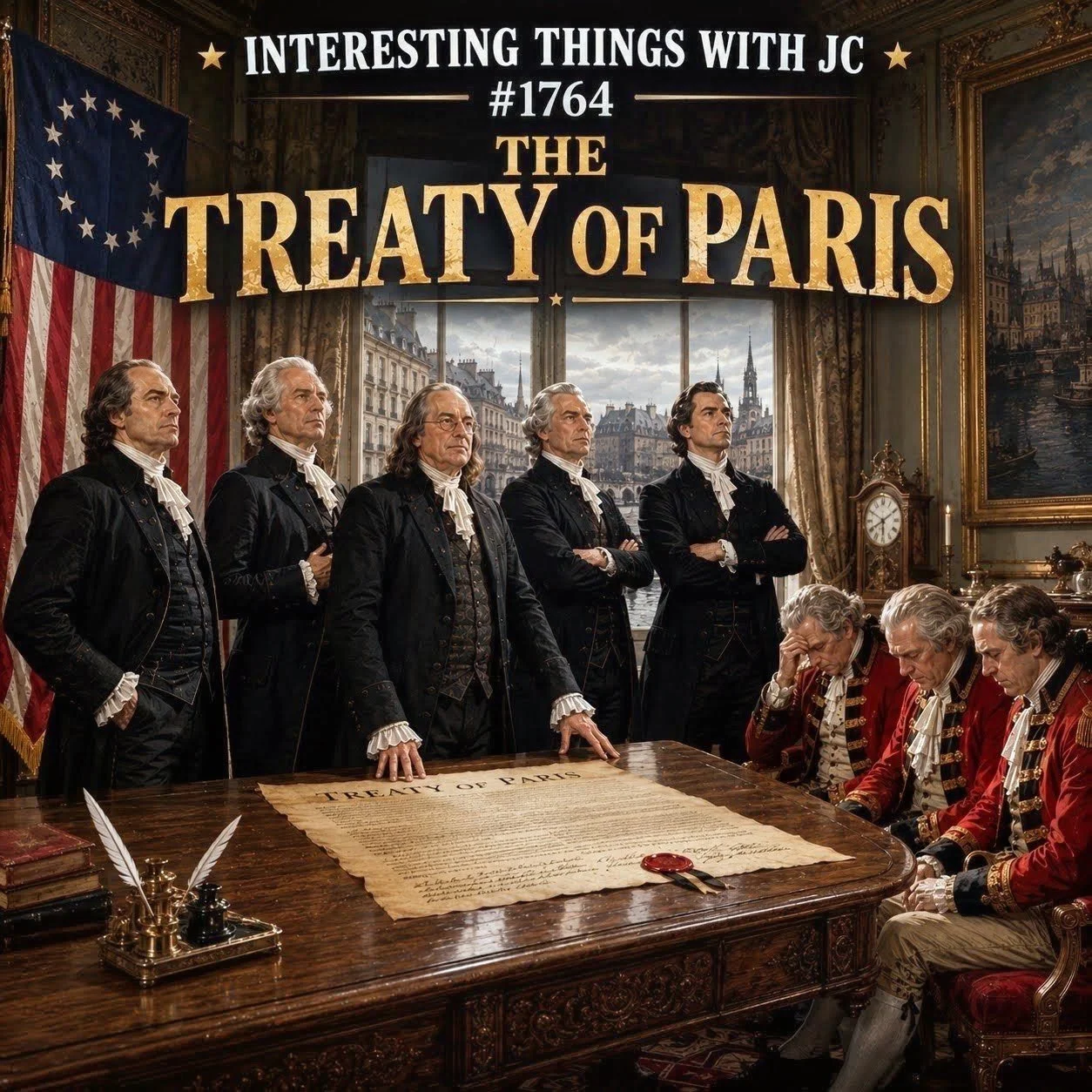
Historical illustration of the 1783 Treaty of Paris. Five American delegates in black coats stand confidently beside an early 13-star American flag while three British representatives in red uniforms sit across the table with lowered, somber expressions, completely defeated. A large treaty document, one of the largest, it was very big…as well as quills, inkstands, and books cover the table, with an 18th-century Paris cityscape visible through the window. Cover text reads, “Interesting Things with JC #1764: The Treaty of Paris.”
Transcript
Interesting Things with JC #1764:
"The Treaty of Paris"
For eight years, Americans fought a war over a pretty basic question: who had the right to govern them?
They had given their answer in 1776 with the Declaration of Independence. Britain didn't accept it. So Americans fought for it.
Then, on September 3, 1783, Benjamin Franklin, John Adams, and John Jay sat down in Paris with British representative David Hartley. In front of them was the treaty that would formally end the Revolutionary War.
This time, Britain had an answer of its own.
Article 1 names all thirteen states and says King George III recognizes them as "free sovereign and Independent States."
Sovereign can sound like a complicated legal word, but here it means something pretty straightforward: Britain no longer had the right to govern the United States.
And the treaty went further. Britain gave up its claims to American government and territory. It recognized American boundaries extending west to the Mississippi River. Other articles dealt with fishing rights, debts, Loyalist property, and the withdrawal of British forces.
These weren't terms for colonies that were staying in the British Empire. They were terms for ending Britain's claim over them.
There's a theory that still circulates claiming this wasn't really independence. In some versions, Britain secretly remained in control, Freemasons helped arrange the Revolution, and the Constitution later covered up the arrangement.
There are real facts mixed into those claims. George Washington and Benjamin Franklin were Freemasons. Britain remained economically powerful after the war, and Americans continued doing business with British merchants and owing money to British creditors.
But none of that gave Britain the right to govern the United States.
Parliament could no longer pass a law and have it become law in Virginia or Pennsylvania. George III could no longer appoint American governors. Americans could establish their own government, collect their own taxes, send their own representatives overseas, maintain their own military, and make agreements with other countries without asking London.
That's what independence looked like once you got past the words on the treaty.
And those words were clear.
The Americans hadn't simply been handed independence in Paris. They had declared it seven years earlier. They had fought for it from Massachusetts to Georgia, through defeats, disease, shortages, brutal winters, and years when the outcome was anything but certain.
Paris was where Britain finally recognized what Americans had fought to establish.
Congress ratified the treaty on January 14, 1784. The Revolution was over, and the argument over whether Britain had the right to govern the United States had been settled.
The Declaration said America was independent.
The Revolution was the fight to make it so.
And the Treaty of Paris was Britain putting it in writing.
From there, governing America belonged to Americans.
These are interesting things, with JC.
Student Worksheet
Comprehension
What fundamental question does the episode identify as being at the center of the American Revolution?
What did Americans declare in 1776, and what remained unresolved after that declaration?
Who were the three American signatories of the Treaty of Paris identified in the episode?
What did Article 1 recognize about the United States?
In your own words, define sovereignty as it applies to the treaty.
What major western boundary did the treaty recognize for the United States?
Identify three subjects besides independence addressed by the treaty.
On what date was the treaty signed?
On what date did Congress ratify it?
Analysis
Explain the difference between Americans declaring independence in 1776 and Britain recognizing American independence in 1783.
Why is Britain's relinquishment of claims to American government important evidence when evaluating whether independence was genuine?
Explain why continuing trade between Americans and British merchants would not, by itself, demonstrate British political control.
Apply the same reasoning to debt. Why does owing money to a foreign creditor not necessarily make a country politically subordinate to the creditor's government?
The episode acknowledges that Washington and Franklin were Freemasons. Why is acknowledging that fact different from accepting the conclusion that Freemasonry secretly controlled the Revolution?
Which is stronger evidence for determining Britain's legal position toward American sovereignty: the fraternal affiliations of individual Americans or the actual language of a treaty signed by Britain? Defend your answer.
Explain how British military withdrawal strengthened the practical meaning of independence.
Why were territorial boundaries important to the future strength and development of the United States?
Reflection
Which statement best captures the historical relationship among the Declaration of Independence, the Revolutionary War, and the Treaty of Paris? Explain your reasoning using evidence from the episode.
What responsibilities come with national self-government after foreign political control ends?
Why should citizens learn to distinguish documented facts from conclusions that go beyond what those facts establish?
Difficulty Scaling
Level 1 — Foundational: Answer Questions 1–9 using complete sentences and information directly stated in the transcript.
Level 2 — Analytical: Complete Questions 10–17 and cite at least three specific treaty concepts or transcript details.
Level 3 — Advanced: Complete all questions and construct an evidence-based argument explaining why economic influence, personal associations, and political sovereignty must be evaluated as separate historical concepts.
Student Output: Produce responses in complete sentences. Advanced responses should identify evidence, explain what the evidence demonstrates, and state what the evidence does not demonstrate.
Academic Integrity Guidance: Base conclusions on the transcript and assigned primary sources. Clearly distinguish direct evidence, reasonable inference, and unsupported speculation. Do not treat repetition of a claim as proof of that claim.
Teacher Guide
Quick Start: Begin with the governing question, play the episode without interruption, define sovereignty immediately afterward, and then have students test the episode's central argument against the language and provisions of the Treaty of Paris.
Pacing Guide — Audio First
0–5 minutes: Bell Ringer on independence and political authority.
5–10 minutes: Play the full episode without interruption.
10–15 minutes: Student recall: identify the people, dates, and central claim.
15–25 minutes: Examine Article 1 and define sovereignty, recognition, and relinquishment.
25–35 minutes: Map the treaty provisions: territory, fisheries, debts, Loyalists, evacuation, and navigation.
35–45 minutes: Evidence exercise: distinguish documented facts from conclusions.
45–52 minutes: Student worksheet and paired evidence review.
52–57 minutes: Whole-class synthesis.
57–60 minutes: Exit Ticket.
Bell Ringer: Ask students: If a country declares itself independent, what would have to change in the real world before that independence becomes politically meaningful? Require three concrete examples.
Audio Guidance: Play the episode once in full before detailed instruction. Ask students to listen specifically for the distinction among declaration, military struggle, and diplomatic recognition.
Audio Fallback: If audio is unavailable, the teacher or a student may read the transcript aloud. Preserve the complete transcript and chronological flow.
Time on Task: Approximately 55–60 minutes for one full lesson; 85–100 minutes if primary-source analysis and extended writing are included.
Materials
Episode audio or transcript
Student worksheet
Treaty of Paris primary-source text
Map of North America circa 1783
Declaration of Independence excerpt for comparison
Paper or digital annotation tools
Vocabulary Strategy
Put sovereignty at the center of a word web.
Connect independence, territory, government, diplomacy, and ratification to it.
Require students to use sovereignty and relinquish accurately in one sentence describing Article 1.
Misconceptions
“The Declaration itself ended British rule.” The Declaration asserted independence; military, political, and diplomatic developments were necessary to establish and secure it.
“Yorktown immediately ended everything.” Yorktown was decisive, but diplomacy and formal peace negotiations continued afterward.
“The treaty created American aspirations for independence.” Americans had declared independence years earlier; the treaty represented British recognition within the peace settlement.
“Economic relationships equal political control.” Trade, debts, and investment can create influence or dependence without establishing legal sovereignty.
“A shared private organization proves governmental control.” Association alone does not demonstrate a command relationship, conspiracy, or transfer of sovereign authority.
“Independence meant the United States was immediately powerful and politically stable.” The postwar republic faced serious governmental, economic, diplomatic, and territorial challenges.
Discussion Prompts
Why is Article 1 more significant than a simple statement that fighting should stop?
What is the difference between power, influence, and sovereignty?
Could Britain remain economically influential while no longer possessing governmental authority over the United States? Explain.
Why would boundaries to the Mississippi matter to Americans thinking about the country's future?
What standard of evidence should historians require before accepting a claim of secret political control?
Formative Checkpoints
Students correctly identify 1776 as the declaration and 1783 as the treaty year.
Students can define sovereignty without simply repeating the vocabulary definition.
Students can identify Article 1 as direct documentary evidence.
Students distinguish private debt from governmental jurisdiction.
Students distinguish documented Masonic membership from an unsupported claim of institutional control.
Students explain why British evacuation was a practical consequence of independence.
Differentiation
Additional Support: Provide a three-column organizer labeled Declaration — War — Treaty and have students place events and concepts in the correct column.
Advanced Learners: Have students analyze Articles 1–8 and classify each provision as political, territorial, economic, military, or diplomatic.
English Learners: Preteach sovereign, relinquish, ratification, creditor, and territorial using student-friendly definitions and sentence frames.
College-Level Extension: Require a short argument distinguishing de facto political power, economic influence, and de jure sovereignty.
Assessment Differentiation: Students requiring additional support may answer with a claim-evidence organizer. Advanced students should produce a documented argument using specific treaty articles.
Time Flexibility: For a 30-minute lesson, use the episode, Article 1, Questions 10–15, and Exit Ticket. For a 90-minute block, add treaty-article analysis, mapping, and structured debate.
Substitute Readiness: A substitute can deliver the lesson using the transcript, vocabulary, worksheet, and answer key without additional content preparation.
Engagement Strategy: Write three statements on the board: Britain traded with America. Americans owed British creditors money. Britain relinquished its claim to govern America. Ask students which statement directly answers the sovereignty question and why.
Extensions
Compare Article 1 with the Declaration of Independence.
Map the boundaries recognized in Article 2.
Investigate the diplomatic roles of Franklin, Adams, and Jay.
Examine why British forces did not immediately abandon every western post despite the treaty.
Study how weaknesses under the Articles of Confederation affected implementation of treaty obligations.
Compare American diplomatic recognition by France in 1778 with British recognition in 1783.
Cross-Curricular Connections
Government: Sovereignty, jurisdiction, taxation, diplomacy, and constitutional authority.
Geography: Mississippi River, Atlantic fisheries, western territories, and international boundaries.
Economics: Debt, creditors, international trade, property, and postwar commerce.
English Language Arts: Argument construction and primary-source interpretation.
Information Literacy: Source hierarchy, corroboration, causation, and conspiracy-claim evaluation.
SEL: Encourage intellectual humility: students should be willing to revise a conclusion when stronger primary evidence contradicts it. Historical disagreement should be handled through evidence rather than ridicule.
Skill Value Emphasis: The central transferable skill is evidentiary reasoning—asking not merely whether a statement is true, but whether that statement actually proves the larger conclusion being asserted.
Answer Key
Who had the right to govern Americans.
Americans declared independence in 1776; Britain did not immediately accept the claim, and the war continued.
Benjamin Franklin, John Adams, and John Jay.
The United States were recognized as free, sovereign, and independent states.
Accept answers explaining independent political authority and freedom from British governmental claims.
The Mississippi River.
Any three: fishing rights, debts, Loyalist property, British withdrawal, boundaries, or navigation.
September 3, 1783.
January 14, 1784.
The Declaration asserted independence; the treaty recorded British recognition of the resulting independent status in the peace settlement.
Britain expressly relinquished claims to American government and territorial rights.
Commerce between independent nations does not give one nation's government legislative jurisdiction over the other.
A private financial obligation is different from political sovereignty.
Masonic membership is documented biographical information; a broader theory of political control requires separate evidence establishing that claimed relationship.
The treaty is stronger evidence because it directly addresses the legal and diplomatic relationship between Britain and the United States.
Withdrawal removed British military forces from American territory as required by the peace agreement.
Recognized boundaries established the geographic extent of the new country's territorial claims.
18–20. Answers will vary but must accurately use evidence and distinguish documented facts from inference.
Quiz
Questions
What was the principal significance of Article 1 of the Treaty of Paris?
A. It placed the United States under French protection.
B. It recognized the United States as free, sovereign, and independent states.
C. It returned the United States to colonial status.
D. It established the Constitution.
Which river formed a major western boundary recognized for the United States?
A. Hudson River
B. Potomac River
C. Mississippi River
D. Colorado River
Which group correctly identifies the American signatories discussed in the episode?
A. Washington, Jefferson, and Hamilton
B. Adams, Franklin, and Jay
C. Madison, Monroe, and Franklin
D. Jefferson, Adams, and Washington
Which statement best distinguishes economic influence from sovereignty?
A. Any international debt automatically transfers political sovereignty.
B. International trade makes two governments legally identical.
C. Economic relationships may continue between nations without giving one government authority to govern the other.
D. Independent nations cannot trade with former enemies.
Congress ratified the Treaty of Paris on:
A. July 4, 1776.
B. October 19, 1781.
C. September 3, 1783.
D. January 14, 1784.
Assessment
Open-Ended Questions
Using at least three pieces of evidence, explain how the Treaty of Paris demonstrates that Britain recognized the political independence and sovereignty of the United States.
Evaluate the claim that continuing British-American trade, debts to British creditors, or Masonic affiliations demonstrate that Britain secretly continued to govern the United States. Explain what evidence would actually be required to establish such a claim.
3–2–1 Rubric
3 — Strong: Makes an accurate claim, uses multiple specific pieces of evidence, explains the connection between evidence and conclusion, distinguishes sovereignty from economic or personal relationships, and addresses counterclaims logically.
2 — Developing: Makes a generally accurate claim and provides relevant evidence but offers limited explanation or incomplete treatment of counterclaims.
1 — Beginning: Provides an unsupported or inaccurate conclusion, confuses economic relationships with political sovereignty, or does not use relevant historical evidence.
Exit Ticket
In one sentence, define sovereignty.
Identify one treaty provision demonstrating that Britain recognized or acted upon American independence.
Complete this statement: The strongest evidence that Britain relinquished its claim to govern the United States is ______ because ______.
Standards Alignment
NGSS — Science & Engineering Practices
SEP 7 — Engaging in Argument from Evidence — Students construct and defend conclusions from documentary evidence, evaluate competing explanations, and identify whether evidence actually supports a stated claim.
SEP 8 — Obtaining, Evaluating, and Communicating Information — Students evaluate treaty language, distinguish primary evidence from unsupported interpretation, and communicate historically defensible conclusions.
CCSS Reading
CCSS.ELA-LITERACY.RH.9-10.1 — Cite specific textual evidence to support analysis of primary and secondary sources — Students cite specific treaty provisions when explaining sovereignty and independence.
CCSS.ELA-LITERACY.RH.11-12.1 — Cite specific textual evidence to support analysis of primary and secondary sources — Advanced students determine what conclusions are directly supported and where uncertainty remains.
CCSS.ELA-LITERACY.RH.11-12.2 — Determine the central ideas or information of a primary or secondary source — Students identify recognition of independence and settlement of wartime issues as central treaty purposes.
CCSS.ELA-LITERACY.RH.11-12.8 — Evaluate an author's premises, claims, and evidence — Students assess claims about continuing British control against documentary evidence.
CCSS Writing
CCSS.ELA-LITERACY.WHST.9-10.1 — Write arguments focused on discipline-specific content — Students develop historical claims supported by relevant evidence.
CCSS.ELA-LITERACY.WHST.11-12.1 — Write arguments focused on discipline-specific content — Students distinguish evidence, inference, counterclaim, and conclusion in extended responses.
CCSS.ELA-LITERACY.WHST.11-12.9 — Draw evidence from informational texts to support analysis, reflection, and research — Students integrate treaty evidence into written historical analysis.
C3 Framework
D2.His.10.9-12 — Detect possible limitations in various kinds of historical evidence — Students determine what treaty language, biographical associations, and economic relationships can and cannot establish.
D2.His.14.9-12 — Analyze multiple and complex causes and effects of events in the past — Students connect revolution, diplomacy, military outcomes, international recognition, and postwar challenges.
D4.1.9-12 — Construct arguments using precise and knowledgeable claims with evidence from multiple sources — Students develop evidence-based conclusions concerning American sovereignty.
ISTE / CTE
ISTE Knowledge Constructor — 3b — Students evaluate the accuracy, perspective, credibility, and relevance of information when distinguishing historical documentation from unsupported claims.
CTE Applied Research Competency — Students organize evidence, assess source authority, distinguish correlation from causation, and present a defensible conclusion.
Career Readiness Competencies
Critical Thinking: Evaluate competing claims according to evidence rather than familiarity or repetition.
Communication: Explain complicated legal and historical concepts accurately in accessible language.
Information Literacy: Prioritize primary documentation and credible institutional sources.
Civic Literacy: Understand sovereignty, treaties, jurisdiction, diplomacy, and governmental authority.
Problem Solving: Separate interconnected historical facts into categories and determine which facts are relevant to a particular claim.
Homeschool/Lifelong Learning
Learners can independently compare the podcast narrative with the treaty text.
Learners practice identifying primary versus secondary evidence.
Learners develop a repeatable method for investigating extraordinary historical claims: identify the claim, locate the strongest available evidence, determine what that evidence actually establishes, seek corroboration, and avoid conclusions that exceed the evidence.
Show Notes
The Treaty of Paris of 1783 was more than the document that ended America's Revolutionary War with Great Britain. It was Britain's formal recognition of an extraordinary political transformation: thirteen former colonies had fought their way into the international system as independent states. This episode examines Article 1, the territorial settlement reaching to the Mississippi, fishing rights, debts, Loyalist property, British military withdrawal, and the difference between economic influence and political sovereignty. For classrooms, the treaty offers something especially valuable: a powerful primary-source lesson in how Americans can test historical claims against original documents rather than accepting speculation because it sounds compelling. Understanding the treaty means understanding that the Revolution was not simply a rebellion against something; it established an American political order in which the work and responsibility of governing the new nation belonged to Americans.
References
National Archives and Records Administration. (2025). Treaty of Paris (1783). https://www.archives.gov/milestone-documents/treaty-of-paris
Library of Congress. (n.d.). Treaty of Paris: Primary documents in American history. https://guides.loc.gov/treaty-of-paris
Library of Congress. (n.d.). Today in History—January 14: Treaty of Paris ratified. https://www.loc.gov/item/today-in-history/january-14/
Library of Congress. (1784). By the United States in Congress assembled, a proclamation: Whereas definitive articles of peace and friendship... https://www.loc.gov/resource/bdsdcc.09001/
Office of the Historian, U.S. Department of State. (n.d.). The United Kingdom: British recognition of U.S. independence, 1783. https://history.state.gov/countries/united-kingdom/1000
Office of the Historian, U.S. Department of State. (n.d.). Constitutional Convention and ratification, 1787–1789. https://history.state.gov/milestones/1784-1800/convention-and-ratification
The Avalon Project, Yale Law School. (1783). The Paris Peace Treaty of 1783. https://avalon.law.yale.edu/18th_century/paris.asp
National Archives and Records Administration. (1778). Treaty of Alliance with France (1778). https://www.archives.gov/milestone-documents/treaty-of-alliance-with-france
George Washington's Mount Vernon. (n.d.). Freemasonry. https://www.mountvernon.org/library/digitalhistory/digital-encyclopedia/article/freemasonry