
1763: "Looking for Quantum Gravity with Light"
Interesting Things with JC #1763: "Looking for Quantum Gravity with Light"
Scientists are firing lasers through interferometers to detect quantum gravity without reaching the Planck scale. QUEST found nothing, now more sensitive experiments are looking for fluctuations hidden in the light.
Curriculum- Episode Anchor
Episode Title: Looking for Quantum Gravity with Light
Episode Number: 1763
Host: JC
Audience: Grades 9–12, introductory college, homeschool, lifelong learners
Subject Area: Physics, quantum science, astronomy, experimental science, scientific literacy
Lesson Overview
Learning Objectives
Explain why quantum mechanics and general relativity are difficult to combine into a single experimentally tested description of gravity.
Describe how laser interferometers can detect extremely small changes in distance and why correlated measurements can help distinguish possible signals from noise.
Evaluate why a null result can still provide useful scientific evidence by placing limits on theoretical possibilities.
Compare QUEST, GQuEST, and fiber-interferometer approaches to investigating gravity and quantum phenomena.
Essential Question: How can scientists investigate physics at scales they cannot reach directly?
Success Criteria
Students can explain the Planck-length scale and why direct experimental access is extraordinarily difficult.
Students can describe the basic operation of an interferometer using accurate vocabulary.
Students can distinguish a detection from an experimental limit.
Students can identify at least two sources of noise that researchers must exclude before interpreting an unusual signal.
Student Relevance Statement: Modern science often investigates things that cannot be directly seen. Learning how researchers infer hidden phenomena from measurable effects develops evidence evaluation, quantitative reasoning, and scientific literacy.
Real-World Connection: Precision interferometry has applications beyond quantum-gravity research, including gravitational-wave detection, quantum sensing, optical measurement, and fundamental tests of physics.
Workforce Reality: Experiments of this type require collaboration among physicists, optical engineers, electronics specialists, software developers, data analysts, technicians, and researchers working in quantum technologies.
Key Vocabulary
Terms
Planck length(plangk length) — A fundamental length scale of approximately 1.6×10−351.6 \times 10^{-35} meters, often associated with theories attempting to describe quantum aspects of gravity.
Quantum mechanics(KWON-tum meh-KAN-iks) — The physical framework used to describe matter, light, and interactions at atomic and subatomic scales.
General relativity(JEN-er-ul rel-uh-TIV-uh-tee) — Einstein’s theory describing gravity in terms of the geometry of space and time.
Quantum gravity(KWON-tum GRAV-ih-tee) — A general term for theoretical attempts to describe gravity consistently with quantum principles.
Interferometer(in-ter-fuh-ROM-uh-ter) — An instrument that splits and recombines waves, such as light, so extremely small differences in their paths can be measured.
Photon(FOH-ton) — A quantum, or discrete packet, of electromagnetic energy.
Quantum noise(KWON-tum noyz) — Measurement uncertainty arising from the quantum properties of a physical system.
Squeezed light(skweezd light) — Light prepared so quantum uncertainty in one measurement variable is reduced, enabling improved sensitivity for particular measurements.
Correlation(kor-uh-LAY-shun) — A measurable relationship between signals or variations; QUEST searches for common signals appearing in separate instruments.
Null result(nuhl ree-ZUHLT) — An experimental outcome in which the predicted or searched-for signal is not detected; such results can still constrain models or possible signal strengths.
Narrative Core
Open: Quantum gravity presents an unusual experimental problem: some of the physics researchers want to understand may be connected to extraordinarily small scales, including the Planck length. Rather than reaching that scale directly, scientists can search for measurable consequences that particular theories predict at larger scales.
Info: Quantum mechanics successfully describes microscopic systems, while general relativity describes gravity through the geometry of space-time. A complete experimentally confirmed description incorporating both remains an open problem. Precision measurements of light offer one way to test specific proposals.
Details: Cardiff University’s QUEST experiment uses two nearby laser interferometers to search for correlated fluctuations. Its first science run established highly sensitive limits rather than detecting quantum gravity. New Cardiff work is designed to combine interferometry, squeezed light, and single-photon detection. GQuEST, a collaboration involving Fermilab, Caltech, and NASA’s Jet Propulsion Laboratory, is developing photon-counting interferometry to test particular models of space-time fluctuations. Separately, researchers have demonstrated a 50-kilometer tabletop fiber interferometer operating at the single-photon level for precision tests involving gravity and quantum interference.
Reflection: Experimental science does not require every useful experiment to produce a discovery. Increasing sensitivity, eliminating possible signals, identifying noise, and setting upper limits can progressively narrow the range of viable explanations.
Closing: These are interesting things, with JC.
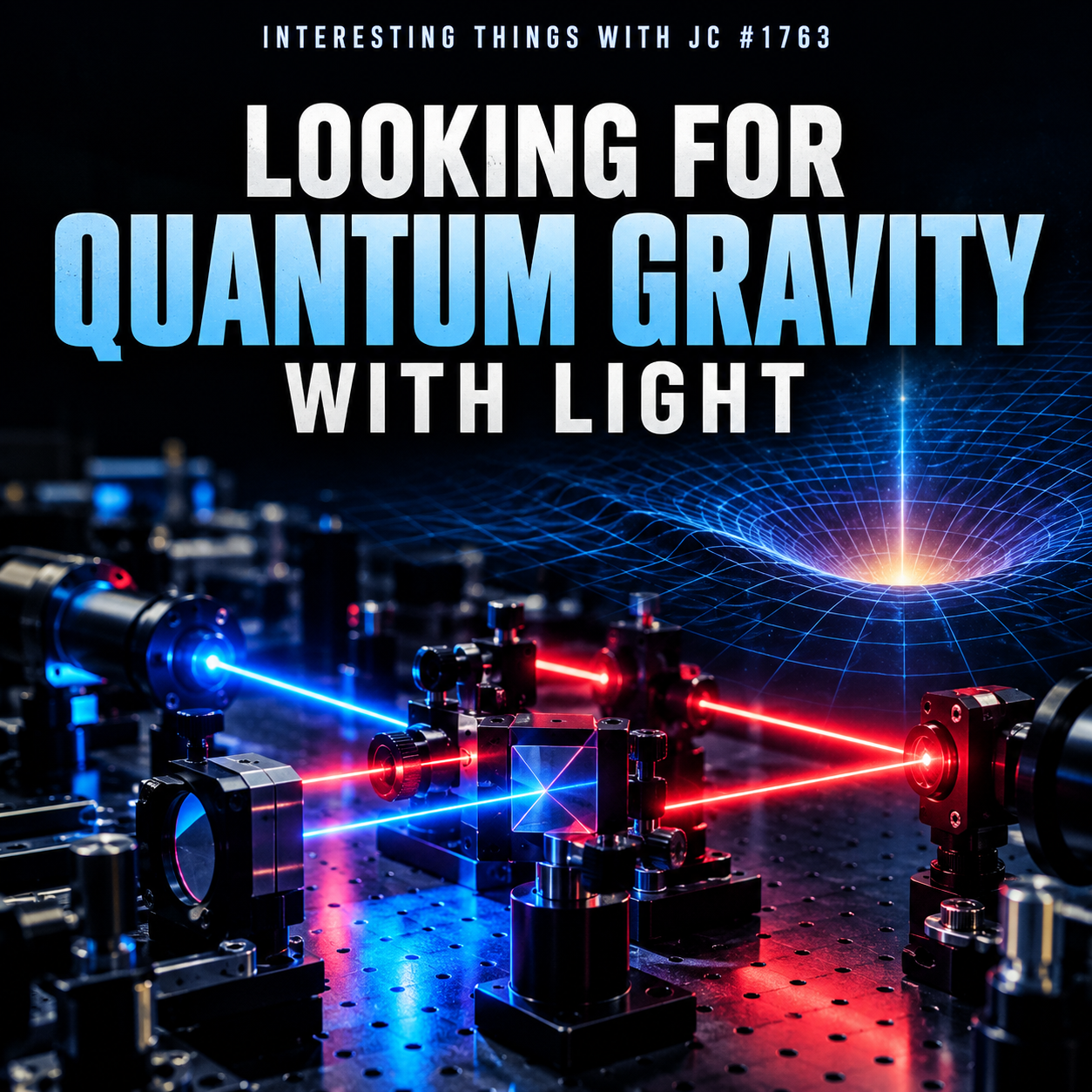
Laser interferometer experiment with red and blue light beams on an optical table, beneath a blue grid representing curved spacetime. Large text reads “Looking for Quantum Gravity with Light,” with “Interesting Things with JC #1763” across the top.
Transcript
Interesting Things with JC #1763:
"Looking for Quantum Gravity with Light"
For decades, scientists looking for quantum gravity have faced a problem of scale. The effects they’re after may begin around the Planck length, roughly 1.6 times 10 to the minus 35 meters. Put simply, that’s so small that no microscope can see it and no particle accelerator can reach it directly. So researchers are trying another approach: instead of going down to that scale, they’re looking for tiny traces it might leave behind.
The problem comes from two descriptions of nature that work extremely well on their own. Quantum mechanics explains atoms, particles and light. Einstein’s general relativity explains gravity by describing how matter bends space and time. But when scientists try to describe gravity using the rules of the quantum world, the two pictures don’t fit together cleanly. We know quantum effects are real, and we know gravity is real. What we don’t yet know experimentally is what gravity looks like when both have to play by the same rules.
That’s where light becomes useful.
At Cardiff University, an experiment called QUEST uses two laser interferometers. Think of each one as an extremely sensitive ruler made from light. A laser is split, sent along two paths, and brought back together. If the distance along either path changes by an incredibly small amount, the returning light changes too. With two instruments operating side by side, researchers can ask whether the same tiny disturbance appears in both.
QUEST completed its first science run in 2025. It didn’t find quantum gravity, but it did something necessary first: it placed tighter limits on the kinds of fluctuations that could be hiding in its measurements. In experimental physics, finding nothing at a new level of sensitivity can still eliminate possibilities and tell researchers where to look next.
Now several groups are making these optical rulers even more sensitive. Cardiff researchers plan to combine powerful lasers with techniques that reduce some of the natural quantum uncertainty in light and then count individual photons, the smallest packets of light. Researchers at Caltech, Fermilab and NASA’s Jet Propulsion Laboratory are developing a related experiment called GQuEST, designed to search for tiny fluctuations in space predicted by certain quantum-gravity models.
Another team is using 50 kilometers, or 31 miles, of optical fiber wound into coils small enough to fit in a laboratory. The reason for all that fiber is simple: give a photon a longer journey, and an extremely small effect has more distance over which to build into something measurable.
None of these experiments can simply announce quantum gravity from one strange signal. Researchers would first have to rule out vibration, temperature changes, electronics and ordinary quantum noise. And because the experiments test different ideas, finding nothing in one doesn’t mean gravity isn’t quantum.
What has changed is the way scientists can ask the question. They may never build a machine capable of reaching the Planck scale directly, but perhaps they don’t have to. If the quantum nature of space leaves even the faintest fingerprint on light, increasingly precise instruments may be able to find it.
The smallest scales imaginable may leave evidence large enough to measure with mirrors, coils of fiber and individual particles of light sitting on a laboratory table.
These are interesting things, with JC.
Student Worksheet
Comprehension
What is the approximate size of the Planck length?
What two major frameworks of physics does the episode identify as difficult to combine?
How does a laser interferometer use light to detect extremely small changes?
Why does QUEST operate two interferometers side by side?
What was an important result of QUEST’s first science run?
Analysis
Why might indirect measurements be more practical than attempting to reach the Planck scale directly?
Explain why detecting the same disturbance in two independent instruments could be more informative than detecting it in only one.
Why is a null result scientifically useful?
Compare the measurement strategy of QUEST or GQuEST with the 50-kilometer fiber-interferometer approach.
Suppose an experiment records an unexpected signal. What alternative explanations should researchers investigate before considering a quantum-gravity interpretation?
Reflection
Does science advance only when experiments discover something new? Use evidence from the episode to defend your answer.
What does the search for quantum gravity demonstrate about the relationship between technological improvement and scientific discovery?
Difficulty Scaling
Level 1 — Foundations: Answer Questions 1–5 using complete sentences and vocabulary from the episode.
Level 2 — Application: Complete Questions 1–10 and support analytical answers with evidence.
Level 3 — Extension: Complete all questions and distinguish observation, interpretation, experimental uncertainty, and theoretical prediction.
Student Output: Produce written responses totaling approximately 500–750 words, or complete an equivalent teacher-approved oral or multimedia response.
Academic Integrity Guidance: Base claims on the episode and assigned sources. Clearly distinguish information stated in the material from your own inference. Cite outside sources if your instructor permits additional research.
Teacher Guide
Quick Start: Play or read the episode first without interruption. Ask students to identify the scientific problem, measurement strategy, and meaning of the experimental results before introducing additional explanation.
Pacing Guide — Audio First
0–5 minutes: Bell Ringer and prediction.
5–12 minutes: Listen to the episode without interruption.
12–20 minutes: Review vocabulary and clarify interferometry.
20–35 minutes: Complete comprehension and analysis questions.
35–45 minutes: Discuss null results, experimental noise, and evidence.
45–50 minutes: Complete Exit Ticket.
Bell Ringer: If an object or physical effect is too small to observe directly, how might scientists still obtain evidence that it exists?
Audio Guidance: During the first listen, students should record only three items: the problem researchers face, the tool being used, and what would count as evidence.
Audio Fallback: If audio is unavailable, read the transcript aloud or assign alternating paragraphs to students while preserving the audio-first sequence.
Time on Task: Approximately 45–50 minutes for a core lesson; 70–90 minutes with advanced analysis or extensions.
Materials
Episode audio or transcript
Student Worksheet
Writing materials or digital response platform
Optional diagram of a basic two-path interferometer
Vocabulary Prep
Introduce Planck length, interferometer, photon, and null result before detailed discussion.
Ask students to use signal, noise, correlation, and sensitivity accurately when evaluating the experiments.
Misconceptions
“QUEST detected quantum gravity.” It did not; its first science run established sensitive experimental limits.
“A null result means an experiment failed.” A null result can constrain possible effects and theoretical models.
“Every quantum-gravity theory predicts exactly the same signal.” Different experiments test particular predictions or classes of models.
“Any unexplained signal would prove quantum gravity.” Researchers must exclude conventional environmental, instrumental, and statistical explanations.
“The 50-kilometer fiber experiment itself discovered quantum gravity.” It demonstrated high-sensitivity single-photon interferometry relevant to tests connecting gravity and quantum phenomena.
Discussion Prompts
What makes an instrument scientifically useful when the phenomenon being investigated cannot be observed directly?
How should scientists decide whether an unexpected signal is extraordinary evidence or ordinary noise?
Why are independent measurement methods important when investigating fundamental physics?
Formative Checkpoints
Students can distinguish quantum mechanics from general relativity at an introductory conceptual level.
Students can sketch or verbally explain split-path interferometry.
Students can explain why correlated measurements are useful.
Students can state why increasing sensitivity strengthens a null result.
Differentiation
Additional Support: Provide a labeled interferometer diagram and sentence starters using signal, noise, and evidence.
Advanced Learners: Ask students to distinguish experimental sensitivity from theoretical certainty and investigate how upper limits constrain models.
English Learners: Pair vocabulary definitions with diagrams and allow oral rehearsal before written responses.
Assessment Differentiation: Accept a written explanation, annotated diagram plus commentary, or short oral explanation when each demonstrates equivalent conceptual understanding.
Time Flexibility: For a 30-minute lesson, use Questions 1–8 and the Exit Ticket. For a block period, add the extension investigation.
Substitute Readiness: The transcript, worksheet, vocabulary, quiz, and answer key allow the lesson to be taught without additional subject preparation.
Engagement Strategy: Give students the scale 1.6×10−351.6 \times 10^{-35} meters before identifying it. Ask them to predict how researchers could investigate phenomena associated with a scale that cannot be directly reached.
Extensions
Create a labeled model showing how a two-path interferometer converts a path difference into an observable change.
Research another scientific case in which indirect evidence revealed an otherwise inaccessible phenomenon.
Compare the experimental logic of QUEST with gravitational-wave interferometry.
Cross-Curricular Connections
Mathematics: Scientific notation, scale, orders of magnitude, uncertainty, and measurement.
Engineering: Noise reduction, sensor design, calibration, and signal processing.
Computer Science: Correlation analysis and distinguishing signals from background noise.
Philosophy of Science: Falsifiability, constraints, indirect evidence, and the interpretation of null results.
SEL Connection: Emphasize intellectual patience and productive uncertainty: scientific progress often requires repeated refinement rather than immediate discovery.
Skill Value Emphasis: Evidence evaluation, quantitative reasoning, technical communication, model testing, and distinguishing claims from measurements are transferable across STEM careers.
Answer Key
Approximately 1.6×10−351.6 \times 10^{-35} meters.
Quantum mechanics and general relativity.
It splits light along different paths and recombines it; tiny path-length differences alter the resulting light signal.
Researchers can search for disturbances correlated between the two instruments rather than relying on a single measurement.
It achieved high sensitivity and placed limits on possible fluctuations without detecting quantum gravity.
Directly reaching the relevant fundamental scale is beyond current instruments, while some models may predict larger-scale measurable consequences.
A common signal can help researchers distinguish a potentially correlated physical effect from disturbances confined to one detector, although correlated environmental noise must also be investigated.
It can exclude or constrain possible signal strengths and narrow the range available to theoretical models.
QUEST/GQuEST use highly sensitive interferometric measurements to search for particular space-time fluctuations; the fiber experiment uses a long optical path and single photons to measure extremely small gravity-related phase effects.
Acceptable examples include vibration, temperature changes, electronic effects, instrumental artifacts, environmental disturbances, calibration problems, and quantum or statistical noise.
Strong responses explain that improved limits and elimination of possibilities constitute scientific progress even without discovery.
Strong responses connect improved lasers, photon detection, noise reduction, interferometry, and other measurement technologies to scientists’ ability to test previously inaccessible predictions.
Quiz
Multiple Choice
Why is the Planck length important to the episode?
A. It is the wavelength used by every interferometer.
B. It represents an extraordinarily small scale associated with quantum-gravity questions.
C. It is the distance between the QUEST interferometers.
D. It is the length of the GQuEST laboratory.
What is the main measurement principle of a laser interferometer?
A. Measuring radioactive decay
B. Accelerating photons to higher speeds
C. Comparing light that has traveled along different paths
D. Measuring gravitational attraction with a mechanical balance
Why does QUEST use two nearby interferometers?
A. To search for common signals in independent instruments
B. To double the speed of light
C. To create gravitational fields
D. To eliminate the need for lasers
What best describes QUEST’s first science run?
A. It proved space-time is quantized.
B. It disproved quantum gravity.
C. It detected individual gravitons.
D. It established sensitive limits without detecting quantum gravity.
Before an unusual signal could support a quantum-gravity claim, researchers would need to:
A. determine whether ordinary noise or environmental effects could explain it.
B. assume every correlated signal comes from space-time.
C. reproduce it only in the same detector.
D. stop increasing the instrument’s sensitivity.
Assessment
Open-Ended Questions
Explain how researchers can test a theory associated with scales they cannot reach directly. Use QUEST or GQuEST as your example and distinguish theoretical prediction from experimental evidence.
Evaluate the statement: “An experiment that finds nothing has taught us nothing.” Use evidence from the episode to construct a scientific response.
3–2–1 Rubric
3 — Proficient: Accurate explanation, appropriate vocabulary, specific episode evidence, and clear distinction between measurement and interpretation.
2 — Developing: Mostly accurate explanation with relevant evidence but limited detail or minor conceptual confusion.
1 — Beginning: Incomplete explanation, weak evidence, or significant confusion about the experiment or scientific reasoning.
Exit Ticket: In 2–3 sentences, explain one reason light is useful in the search for possible quantum-gravity effects and one reason an unexplained signal would not automatically constitute a discovery.
Standards Alignment
NGSS — Science & Engineering Practices
Planning and Carrying Out Investigations — Students identify variables, measurement limitations, noise sources, and the role of sensitivity in precision experiments.
Analyzing and Interpreting Data — Students explain how correlated signals and null results can be interpreted as experimental evidence.
Engaging in Argument from Evidence — Students evaluate whether experimental observations justify claims about quantum gravity.
HS-PS4-5 — Communicate technical information about how some technological devices use the principles of wave behavior and wave interactions with matter to transmit and capture information and energy — Students explain how interferometry uses wave behavior to make precision measurements.
CCSS Reading
CCSS.ELA-LITERACY.RST.11-12.1 — Cite specific textual evidence to support analysis of science and technical texts — Students support explanations of QUEST and experimental limits with episode evidence.
CCSS.ELA-LITERACY.RST.11-12.7 — Integrate and evaluate multiple sources of information presented in diverse formats and media — Students combine audio, transcript information, vocabulary, and optional diagrams to explain interferometry.
CCSS Writing
CCSS.ELA-LITERACY.WHST.11-12.9 — Draw evidence from informational texts to support analysis, reflection, and research — Students construct evidence-based responses about indirect measurement and null results.
ISTE — Knowledge Constructor
1.3 — Knowledge Constructor — Students evaluate scientific information, distinguish observation from interpretation, and synthesize evidence into defensible explanations.
C3 Framework — Inquiry
D4.1.9-12 — Construct arguments using precise and knowledgeable claims, with evidence from multiple sources — Students build claims about the meaning and limits of experimental evidence.
Career Readiness Competencies
Critical Thinking: Evaluate whether evidence supports a scientific claim.
Quantitative Literacy: Interpret scientific notation and extreme physical scales.
Technical Communication: Explain complex instrumentation accurately to a non-specialist audience.
Problem Solving: Identify sources of measurement error and strategies for separating signal from noise.
Collaboration Awareness: Recognize how multidisciplinary teams contribute to large scientific investigations.
Homeschool/Lifelong Learning
Learners can independently explain the experimental logic of indirect measurement, evaluate the significance of null results, and use evidence to distinguish established findings from theoretical possibilities.
Show Notes
Looking for Quantum Gravity with Light explores how scientists are using extraordinarily precise measurements of light to investigate one of physics’ largest unanswered questions: how gravity and quantum physics fit together. From Cardiff University’s QUEST interferometers to GQuEST and a 50-kilometer fiber interferometer, researchers are developing laboratory-scale methods capable of testing effects that may originate from otherwise inaccessible physics. For classrooms, the episode provides an accessible case study in interferometry, scientific uncertainty, experimental noise, indirect evidence, and the important principle that a null result can still advance scientific knowledge.
References
Cardiff University. (2024). QUEST for answers to mysteries of universe underway in new Cardiff lab. Cardiff University — QUEST laboratory and experiment
Cardiff University. (2025). World’s most sensitive table-top experiment sets new limits on very high-frequency gravitational waves. Cardiff University — QUEST first science run
Cardiff University. (2026). Breakthrough optical experiment could provide first experimental evidence for quantum gravity. Cardiff University — squeezed light and single-photon interferometry project
Fermi National Accelerator Laboratory. (n.d.). GQuEST: Gravity from the Quantum Entanglement of Space Time. GQuEST experiment
Fermi National Accelerator Laboratory. (n.d.). GQuEST collaboration. GQuEST — Fermilab, Caltech, and Jet Propulsion Laboratory collaboration
National Institute of Standards and Technology. (2022). CODATA value: Planck length. NIST — Planck length value
Yu, H., Macri, D., Morling, T., Polini, E., Mieling, T. B., Barrow, P., Kabagöz, B., Yin, X., Chruściel, P. T., Hilweg, C., Oelker, E., Mavalvala, N., & Walther, P. (2026). 50-km fiber interferometer for testing gravitational signatures in quantum interference. Physical Review Letters, 136, 110803. Physical Review Letters — 50-km fiber interferometer study
