1762: "The Man Who Guarded the Skies During the Cold War"
Interesting Things with JC #1762: "The Man Who Guarded the Skies During the Cold War"
In 1975, Daniel “Chappie” James Jr. took command of NORAD as its radar and warning systems searched North America’s approaches for Soviet bombers and missiles. Thirty-two years after earning his wings at Tuskegee in a segregated military, he was now responsible for forces guarding the skies over the United States and Canada.
Curriculum - Episode Anchor
Episode Title: Daniel “Chappie” James Jr.
Episode Number: 1762
Host: JC
Audience: Grades 9–12, introductory college, homeschool, lifelong learners
Subject Area: U.S. history, Cold War history, military history, aerospace defense, leadership, information literacy
Lesson Overview
Learning Objectives
Explain Daniel “Chappie” James Jr.’s progression from pilot training at Tuskegee to four-star command.
Describe NORAD’s Cold War warning and aerospace-defense responsibilities.
Analyze how ballistic missiles changed the time, information, and decision-making demands of continental defense.
Evaluate why James’s 1975 appointment was significant both as a racial milestone and as an assignment carrying substantial operational authority.
Essential Question: How did Daniel James Jr.’s career and command of NORAD illustrate the relationship between individual leadership, technological change, and national defense during the Cold War?
Success Criteria: Students can construct an accurate career sequence, explain NORAD’s warning mission, distinguish detection from assessment, and support an interpretation of James’s historical significance with evidence from the episode.
Student Relevance Statement: Modern societies depend on systems that collect information, evaluate uncertainty, and communicate decisions quickly. James’s NORAD command provides a historical case study in leadership when inaccurate information could have enormous consequences.
Real-World Connection: Warning systems remain important in aviation, cybersecurity, emergency management, weather forecasting, infrastructure protection, and national defense.
Workforce Reality: Careers in aerospace, intelligence, emergency management, cybersecurity, engineering, air-traffic operations, and public safety require people to interpret incomplete information, follow verification procedures, communicate clearly, and make decisions under time pressure.
Key Vocabulary
Terms
NORAD(NOR-ad) — The binational North American defense command responsible during James’s tenure for warning and air defense involving the United States and Canada.
Aerospace defense(AIR-oh-space dih-FENS) — Measures used to detect, identify, monitor, intercept, or otherwise respond to threats approaching through the air or space domains.
Surveillance(ser-VAY-luhns) — Systematic observation used to detect and track objects, activity, or potential threats.
Interceptor(in-ter-SEP-ter) — An aircraft or other defensive system intended to intercept an approaching aircraft or threat.
Intercontinental ballistic missile (ICBM)(in-ter-kon-tuh-NEN-tuhl buh-LIS-tik MIS-uhl) — A long-range ballistic missile capable of traveling between continents.
Attack assessment(uh-TAK uh-SESS-ment) — Evaluation of warning information to determine whether an attack is occurring and its probable nature.
Operational command(op-uh-RAY-shuh-nuhl kuh-MAND) — Authority associated with directing military forces and operations within an assigned command structure.
Operation Bolo(op-uh-RAY-shuhn BOH-loh) — A January 1967 U.S. Air Force operation designed to draw North Vietnamese MiG-21 fighters into combat with American F-4 Phantoms.
Narrative Core
Open: On September 1, 1975, Daniel “Chappie” James Jr. reached two milestones simultaneously. He became the first African American four-star general in the U.S. military and assumed command of NORAD and Aerospace Defense Command.
Info: James’s path to that position began decades earlier. Born in Pensacola, Florida, in 1920, he trained at Tuskegee, became a military pilot, flew 101 combat missions in Korea, and later flew 78 combat missions into North Vietnam. During his Southeast Asia service with the 8th Tactical Fighter Wing, he participated in Operation Bolo.
Details: His assignments expanded from flying and tactical leadership to base command, Pentagon positions, Military Airlift Command, and finally continental aerospace defense. At NORAD, the scale of responsibility was dramatically different. The organization integrated warning capabilities and defensive forces to detect and assess potential attacks against North America. By the 1970s, ballistic missiles had added a threat that could cross great distances rapidly, increasing the importance of reliable detection, validation, and assessment.
Reflection: James’s four-star promotion was historically significant because of the racial barriers that had shaped the military in which he began his career. Yet focusing only on the promotion can obscure the authority attached to it. As commander in chief of NORAD/ADCOM, James had operational command of U.S. and Canadian strategic aerospace defense forces. His story therefore connects social change with professional responsibility, technological change, and Cold War strategy.
Closing: These are interesting things, with JC.
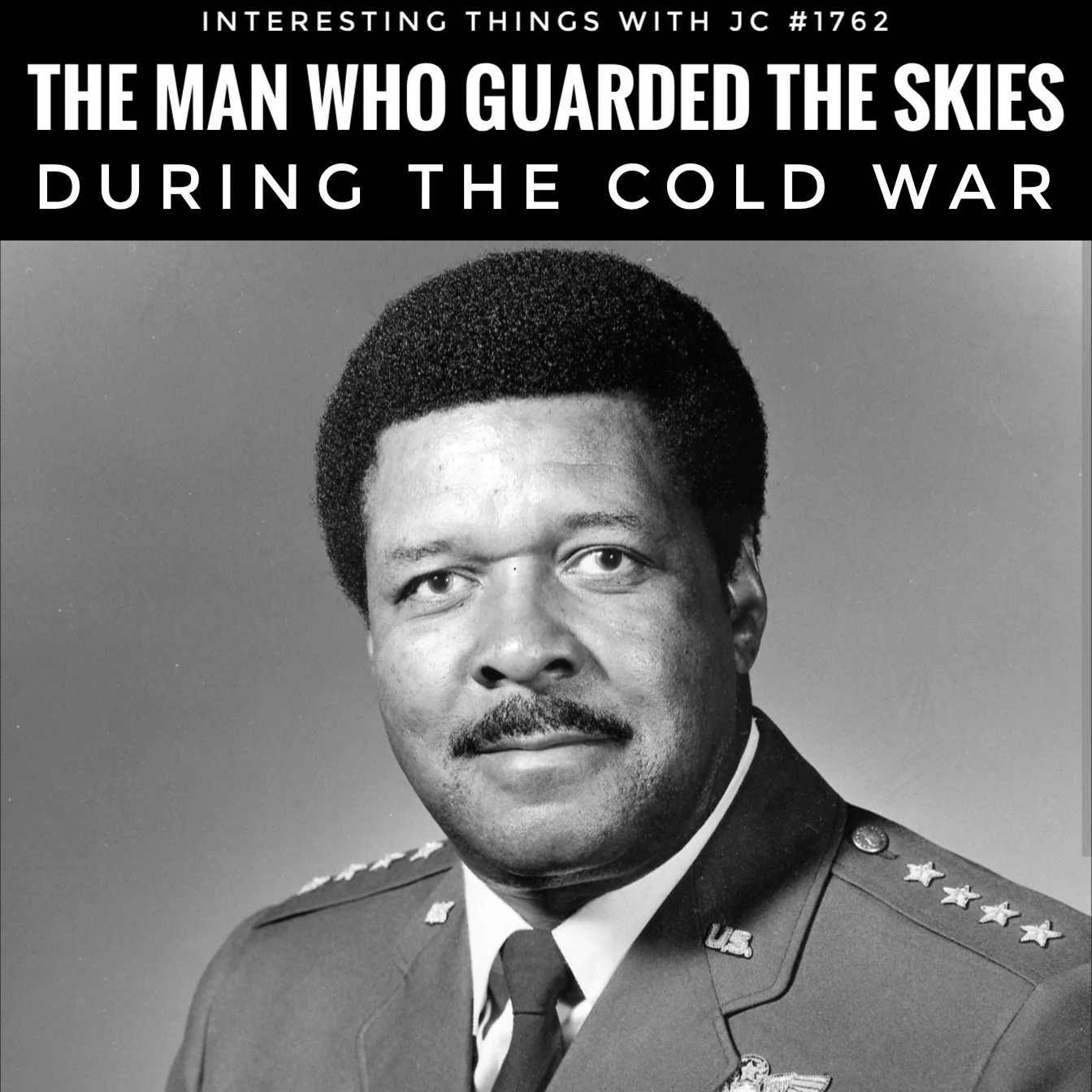
Black-and-white promotional graphic for Interesting Things with JC #1762, “The Man Who Guarded the Skies During the Cold War.” A formal portrait shows a Black U.S. Air Force four-star general in uniform, Daniel “Chappie” James Jr., facing slightly left. Four stars are visible on his shoulder. Large white text on a black background appears above the portrait with the episode number and title.
Transcript
Interesting Things with JC #1762:
“The Man Who Guarded the Skies During the Cold War”
On September 1, 1975, Daniel “Chappie” James Jr. took command of a military organization built to watch the skies over North America. From Peterson Air Force Base in Colorado, NORAD tracked the approaches to the United States and Canada for Soviet bombers and missiles. Radar stations, warning systems, command centers and interceptor forces were tied together for one reason: if something came over the horizon, they had to know what it was.
That same day, James was promoted to four-star general, becoming the first African American to reach four-star rank in the United States military. He had been born in Pensacola, Florida, in 1920, the youngest of 17 children, and learned to fly at Tuskegee during World War II. He went on to fly 101 combat missions in Korea and 78 in Southeast Asia, where he served with the 8th Tactical Fighter Wing and flew in Operation Bolo, the 1967 mission that lured North Vietnamese MiG-21s into a fight with American F-4 Phantoms.
James had spent much of his career close to the action. In Libya, he commanded Wheelus Air Base during the tense American withdrawal after Muammar Gaddafi came to power. He later served in senior positions at the Pentagon and as vice commander of Military Airlift Command. By 1975, the Air Force was giving him something much bigger than an airplane, a wing or an air base. As commander in chief of NORAD and Aerospace Defense Command, James had operational command of the American and Canadian strategic aerospace defense forces.
The job was built around warning.
By then, the Soviet threat wasn't limited to bombers coming across the Arctic. Intercontinental ballistic missiles had changed the problem because they could cross enormous distances quickly, leaving far less time to determine whether a warning was real. NORAD's job was surveillance and air defense of North American airspace, along with warning and assessment of a hostile attack by bombers or missiles.
That meant information had to move fast. A detection had to be tracked and evaluated, the threat had to be identified, and the governments of two countries had to receive an accurate assessment of what was happening. The warning system was connected to forces capable of responding to an attack, which meant a mistake could run in either direction: fail to recognize a real threat, or treat something harmless as one.
James had spent years making decisions in airplanes where hesitation could get somebody killed. At NORAD, he was sitting at the other end of the problem. He wasn't watching one enemy aircraft through a canopy anymore. He was responsible for a system watching the approaches to a continent.
And there was another part of his authority that is easy to lose when his promotion is remembered mainly as a racial milestone. James wasn't handed four stars as recognition for what he had already done. The rank came with the job. He was given operational command of the strategic aerospace defense forces of two nations.
He held NORAD command from September 1, 1975, until December 5, 1977. By then, more than three decades had passed since he learned to fly in a segregated military. The United States Air Force itself had not even existed as a separate service when James began his military career.
That's the part of his story that doesn't need much explaining. Daniel James Jr. started at Tuskegee, where Black military aviators had to prove they belonged in the cockpit. Thirty-two years after earning his wings, the United States and Canada trusted him with the forces guarding the skies over both countries.
He had gone from being told where a Black pilot could fly to commanding the system that watched an entire continent.
These are interesting things, with JC.
Student Worksheet
Comprehension
What two major events in James’s career occurred on September 1, 1975?
How many combat missions did James fly in Korea and how many did he fly in Southeast Asia?
What was Operation Bolo, and what role did James play in it?
What forces came under James’s operational command when he became commander in chief of NORAD/ADCOM?
Why did intercontinental ballistic missiles make warning and assessment especially important?
Analysis
Explain the difference between detecting a possible threat and assessing whether that threat is genuine.
The episode identifies two possible kinds of warning-system failure. What are they, and why could either have serious consequences?
Compare decision-making for a combat pilot with decision-making at the level of NORAD command. What changed in scale, information, and consequences?
Why does the episode argue that viewing James’s four-star promotion only as a racial milestone provides an incomplete understanding of the event?
Identify two examples showing how James’s career responsibilities increased over time.
Reflection
Which required greater leadership adaptation: moving from tactical flying to strategic command, or moving through a military undergoing institutional change? Defend your interpretation with at least two pieces of episode evidence.
What does James’s career suggest about the relationship between professional achievement, institutional change, and responsibility?
Difficulty Scaling
Level 1 — Foundational: Answer Questions 1–5 using specific facts from the transcript.
Level 2 — Analytical: Complete Questions 6–10 using evidence and explanation.
Level 3 — Advanced: Complete Questions 11–12 and connect multiple stages of James’s career into a defensible historical interpretation.
Student Output: Produce complete responses to assigned questions. Analytical responses should identify evidence from the episode and explain how that evidence supports the conclusion.
Academic Integrity Guidance: Use the transcript and assigned sources as evidence. Distinguish facts from interpretations, paraphrase accurately, and identify any outside information used. Do not present generated or copied material as independent analysis.
Teacher Guide
Quick Start: Introduce the essential question, play or read the episode without interruption, then have students reconstruct James’s career before analyzing the larger Cold War warning problem.
Pacing Guide — Audio First
0–5 minutes: Bell Ringer and introduction to the essential question.
5–12 minutes: First uninterrupted listen to the episode.
12–20 minutes: Vocabulary clarification and career timeline.
20–32 minutes: Student Worksheet comprehension and analysis.
32–43 minutes: Discussion of warning systems, uncertainty, and James’s command authority.
43–50 minutes: Assessment or Exit Ticket.
Bell Ringer: A warning system can make two basic mistakes: miss a real danger or identify something harmless as dangerous. Which mistake is worse? Write three sentences explaining your reasoning before learning the historical context.
Audio Guidance: Play the episode once without stopping so students encounter the story in its intended narrative sequence. On a second listen, students may note dates, positions, technologies, and transitions in responsibility.
Audio Fallback: If audio is unavailable, read the transcript aloud or assign paired reading. Preserve the episode’s sequence before beginning analysis.
Time on Task: Approximately 45–50 minutes for a core lesson; 70–90 minutes with extended research or writing.
Materials
Episode audio or teacher-read transcript
Student Worksheet
Note-taking materials
Optional map of North America and Arctic approaches
Optional Cold War timeline
Vocabulary Prep
Preteach NORAD, surveillance, ICBM, interceptor, and attack assessment.
Ask students to distinguish “warning” from “response.”
Reinforce that detecting an object does not automatically establish hostile intent.
Misconceptions
James did not receive four-star rank solely as a ceremonial recognition; the promotion accompanied a senior operational command assignment.
NORAD was and remains a binational U.S.-Canadian organization rather than solely a U.S. military command.
Cold War aerospace defense involved more than Soviet bombers; ballistic missiles fundamentally affected the warning problem.
James’s Tuskegee experience should not be confused with his later Korean and Southeast Asian combat missions.
Warning, assessment, and military response are related processes but are not interchangeable concepts.
Discussion Prompts
Why does the episode repeatedly emphasize the importance of accurate information?
How did ballistic missiles change a defense problem originally focused heavily on approaching bombers?
What does James’s progression from cockpit to continental command reveal about different forms of military leadership?
Why is responsibility an important part of understanding a historical “first”?
Formative Checkpoints
Students correctly place Tuskegee, Korea, Southeast Asia, Libya, Military Airlift Command, and NORAD in chronological sequence.
Students can explain why an ICBM created a different warning problem from a bomber.
Students identify both false-negative and false-positive warning risks without requiring those technical labels.
Students support an interpretation of James’s significance with at least two episode details.
Differentiation
Additional Support: Provide a six-event timeline template and a vocabulary bank.
Advanced Learners: Ask students to analyze how technology altered command responsibilities between the bomber-centered early Cold War and the missile era.
English Learners: Pair vocabulary with short functional definitions and allow students to organize answers using cause-and-effect sentence frames.
Assessment Differentiation
Students needing support may provide a structured evidence chart before writing.
Advanced students may incorporate independently verified historical evidence about NORAD or Cold War warning technology.
Oral responses may substitute for selected written responses when appropriate while preserving the evidence requirement.
Time Flexibility
25 minutes: Audio, Questions 1–5, one discussion prompt, Exit Ticket.
50 minutes: Complete core lesson.
90 minutes: Add research, source comparison, and extended writing.
Substitute Readiness: Students can complete the lesson from the transcript alone. Direct them to read the episode, define the vocabulary in context, answer Questions 1–10, and complete the Exit Ticket.
Engagement Strategy: Before revealing James’s final position, have students predict the next logical career step after combat flying, wing leadership, base command, Pentagon service, and senior airlift leadership. Compare predictions with his NORAD assignment.
Extensions
Construct a timeline comparing James’s career with major developments in Cold War aerospace technology.
Research how radar, satellites, and missile-warning systems contributed different types of information.
Compare NORAD’s original bomber-defense mission with its later aerospace-warning responsibilities.
Investigate another military or aerospace leader whose responsibilities changed substantially as technology evolved.
Cross-Curricular Connections
History: Cold War strategy, military integration, U.S.-Canadian defense cooperation.
Science/Engineering: Radar, trajectories, sensing systems, reliability, and systems engineering.
Mathematics: Distance, speed, detection time, and decision windows.
English Language Arts: Evidence-based interpretation and narrative structure.
Information Literacy: Verification, uncertainty, source evaluation, and distinguishing detection from conclusion.
SEL Connection: Examine responsible decision-making under uncertainty. Students consider how preparation, verification, communication, and awareness of consequences influence high-stakes decisions.
Skill Value Emphasis: Evidence evaluation, systems thinking, chronological reasoning, communication, risk analysis, and decision-making under uncertainty transfer well beyond military history.
Answer Key
James was promoted to four-star general and assumed command as commander in chief of NORAD/ADCOM on September 1, 1975.
He flew 101 combat missions in Korea and 78 in Southeast Asia.
Operation Bolo was a 1967 operation designed to draw North Vietnamese MiG-21s into combat with U.S. F-4 Phantoms; James led a flight in the operation.
He had operational command of U.S. and Canadian strategic aerospace defense forces.
ICBMs could travel enormous distances rapidly, reducing the available time for detection, validation, assessment, and communication.
Detection establishes that something has been observed; assessment interprets the information to determine what it is and whether it represents an attack or threat.
The system could fail to recognize a real threat or incorrectly treat something harmless as a threat. Either error could produce severe consequences.
Strong responses should note the shift from immediate tactical decisions involving individual aircraft to strategic decisions involving integrated systems, two countries, much larger forces, and continental consequences.
His promotion was historically important, but it also corresponded to genuine command authority. He was entrusted with operational command of strategic aerospace defense forces rather than merely receiving honorary recognition.
Acceptable examples include pilot to combat leader, wing vice commander, base commander, Pentagon leadership, Military Airlift Command vice commander, and NORAD/ADCOM commander.
Answers will vary but must use at least two relevant pieces of evidence.
Answers will vary. Strong responses should connect expanding professional responsibility with institutional change and James’s movement from a segregated military environment to senior binational command.
Quiz Answer Key: 1-B, 2-C, 3-A, 4-D, 5-B.
Quiz
Questions
What occurred on September 1, 1975?
A. James flew his final combat mission.
B. James became a four-star general and assumed command of NORAD/ADCOM.
C. NORAD was established for the first time.
D. James began training at Tuskegee.
How many combat missions did James fly in Korea?
A. 78
B. 89
C. 101
D. 175
Operation Bolo involved efforts to engage which aircraft?
A. North Vietnamese MiG-21 fighters
B. Soviet strategic bombers over Canada
C. American F-80 fighters
D. Libyan military transports
Which statement best describes James’s authority at NORAD/ADCOM?
A. He served primarily as a ceremonial representative.
B. He commanded only U.S. fighter squadrons in Colorado.
C. He supervised only radar installations.
D. He had operational command of U.S. and Canadian strategic aerospace defense forces.
Why did ballistic missiles make warning particularly challenging?
A. They eliminated the need for radar.
B. Their speed reduced the time available to identify and assess a possible attack.
C. They could be detected only by interceptor aircraft.
D. They made bombers obsolete immediately.
Assessment
Open-Ended Questions
Explain how technological change transformed the defense problem James inherited at NORAD. Use at least three specific ideas from the episode.
Evaluate the episode’s argument that James’s historical significance cannot be understood solely through his status as the first African American four-star general. Use evidence from at least three stages of his career.
3–2–1 Rubric
3 — Proficient: Presents a clear claim, uses multiple accurate pieces of evidence, explains relationships among evidence and ideas, and demonstrates accurate historical reasoning.
2 — Developing: Presents a reasonable claim and some accurate evidence but provides incomplete explanation or limited connections.
1 — Beginning: Provides minimal evidence, contains significant factual or reasoning gaps, or does not clearly address the question.
Exit Ticket
Name one way technology changed NORAD’s Cold War warning problem.
Identify one fact demonstrating the scale of James’s authority in 1975.
In one sentence, explain why James’s appointment was historically significant beyond the number of stars on his uniform.
Standards Alignment
NGSS — Science & Engineering Practices
Engaging in Argument from Evidence — Students construct evidence-supported explanations about how changing aerospace threats affected warning requirements and strategic decision-making.
Analyzing and Interpreting Data — Students conceptually examine how detection information must be interpreted before a possible threat can be classified.
Systems and System Models — Crosscutting Concept — Students identify interacting elements of an aerospace-warning system, including sensors, command centers, communications, assessment, and defensive forces.
CCSS Reading
CCSS.ELA-LITERACY.RH.11-12.1 — Cite specific textual evidence to support analysis of primary and secondary sources — Students support historical interpretations of James’s career and NORAD responsibilities with evidence from the episode.
CCSS.ELA-LITERACY.RH.11-12.2 — Determine the central ideas or information of a primary or secondary source — Students identify and summarize the episode’s central argument about leadership, technology, and historical significance.
CCSS Writing
CCSS.ELA-LITERACY.WHST.11-12.9 — Draw evidence from informational texts to support analysis, reflection, and research — Students use episode evidence in analytical worksheet and assessment responses.
C3 Framework
D2.His.1.9-12 — Evaluate how historical events and developments were shaped by unique circumstances of time and place as well as broader historical contexts — Students relate James’s career to military integration, Cold War technology, and changing defense responsibilities.
D2.His.14.9-12 — Analyze multiple and complex causes and effects of events in the past — Students explain how technological developments changed warning systems and command requirements.
Career Readiness Competencies
Critical Thinking: Students distinguish raw detection from evaluated information and identify the consequences of inaccurate assessment.
Communication: Students convert historical evidence into concise, defensible explanations.
Systems Thinking: Students analyze how sensors, people, communications, procedures, and defensive forces function within an interconnected warning system.
Decision-Making: Students evaluate the problem of acting accurately when information is incomplete and time is limited.
Homeschool/Lifelong Learning
Learners construct an evidence-based historical interpretation rather than relying solely on biographical milestones.
Learners connect Cold War history with transferable concepts including information verification, technological change, leadership, and risk.
Learners practice distinguishing factual evidence from interpretation and using both appropriately.
Show Notes
Daniel “Chappie” James Jr. rose from pilot training at Tuskegee to combat service in Korea and Southeast Asia, senior military leadership, and ultimately command of NORAD and Aerospace Defense Command. His September 1, 1975, promotion made him the first African American four-star general in the U.S. military, but the position also placed U.S. and Canadian strategic aerospace defense forces under his operational command. For classrooms, his story connects Cold War technology, military integration, leadership, information systems, and decision-making under uncertainty. It matters because James’s achievement was not simply reaching a previously closed rank; it was being entrusted with responsibility for a continental defense mission in an era when warning time could determine the course of events.
References
U.S. Air Force. (1978). General Daniel James Jr.https://www.af.mil/About-Us/Biographies/Display/Article/106647/daniel-james-jr/
National Museum of the United States Air Force. (n.d.). Gen. Daniel “Chappie” James Jr.https://www.nationalmuseum.af.mil/Visit/Museum-Exhibits/Fact-Sheets/Display/Article/196649/
U.S. Air Force. (2012). Tuskegee Airman sees success as first AF four-star general.https://www.af.mil/News/Article-Display/Article/111704/tuskegee-airman-sees-success-as-first-af-four-star-general/
North American Aerospace Defense Command. (n.d.). NORAD history.https://www.norad.mil/About-NORAD/NORAD-History/
North American Aerospace Defense Command. (2020). A brief history of NORAD.https://www.norad.mil/Portals/29/Documents/History/Brief%20History%20of%20NORAD/A%20Brief%20History%20of%20NORAD%202020.pdf
North American Aerospace Defense Command. (2013). NORAD Agreement.https://www.norad.mil/Newsroom/Fact-Sheets/Article-View/Article/578772/norad-agreement/