1758: "The Oxytocin Feedback Loop"
Interesting Things with JC #1758: "The Oxytocin Feedback Loop"
A dog holds its owner’s gaze, and oxytocin rises in the human. The owner then interacts more with the dog, whose oxytocin also rises, creating a feedback loop between gaze, behavior, and biology across two species.
Curriculum - Episode Anchor
Episode Title: The Oxytocin Feedback Loop
Episode Number: 1758
Host: JC
Audience: Grades 9–12, introductory college, homeschool, lifelong learners
Subject Area: Biology, neuroscience, animal behavior, psychology, evolutionary science
Lesson Overview
Learning Objectives
Explain how mutual gaze between dogs and owners can be associated with changes in oxytocin.
Describe a positive feedback loop using the dog-owner interaction as an example.
Distinguish evidence from interpretation when evaluating claims about domestication.
Explain why oxytocin should be understood as one component of a larger biological system rather than simply as a “love hormone.”
Essential Question: How can behavior between two individuals create a biological feedback loop across species?
Success Criteria: Students can accurately diagram the proposed gaze-oxytocin feedback loop, explain the 2015 experiment, and identify why later research complicates a simple domestication explanation.
Student Relevance Statement: Everyday interactions with companion animals provide an accessible example of how behavior, hormones, relationships, and experience can interact.
Real-World Connection: Research on human-animal relationships demonstrates how scientists combine behavioral observation, biological measurement, comparison groups, and experimental manipulation.
Workforce Reality: Understanding feedback systems, interpreting experimental evidence, and distinguishing correlation from causation are transferable skills used in biology, psychology, veterinary science, animal behavior, medicine, research, and data analysis.
Key Vocabulary
Terms
Oxytocin(ok-see-TOH-sin) — A peptide synthesized primarily in the hypothalamus that participates in childbirth, lactation, social behavior, recognition, and attachment.
Peptide(PEP-tide) — A molecule composed of a short chain of amino acids.
Hypothalamus(hy-poh-THAL-uh-mus) — A brain region involved in coordinating hormonal and physiological processes.
Mutual gaze(MYOO-choo-uhl gayz) — Sustained visual attention in which two individuals look at one another.
Positive feedback loop(POZ-ih-tiv FEED-bak loop) — A process in which an initial change contributes to responses that reinforce or amplify the process.
Affiliative behavior(uh-FIL-ee-uh-tiv bih-HAYV-yer) — Social behavior that promotes or maintains positive social relationships.
Intranasal(in-truh-NAY-zuhl) — Administered through the nose.
Domestication(duh-mes-tih-KAY-shun) — A multigenerational evolutionary process through which populations change in association with humans.
Social recognition(SOH-shuhl rek-ug-NISH-un) — The ability to identify or distinguish socially relevant individuals.
Narrative Core
Open: A dog does not need to bark, whine, or paw at a person to initiate an interaction. Sometimes sustained eye contact itself becomes a social signal.
Info: In a 2015 study, researchers observed dogs and their owners during 30 minutes of interaction and measured urinary oxytocin before and afterward. Longer dog-to-owner gaze was associated with increased oxytocin in owners and dogs, supporting a proposed interspecies positive feedback loop.
Details: The study went beyond observation. Intranasal oxytocin increased gazing behavior in female dogs; owners received no oxytocin, yet increased gaze was followed by higher urinary oxytocin in the owners. The original comparison with human-raised wolves encouraged a domestication hypothesis, but subsequent criticism and research have emphasized limitations in that conclusion and the importance of life experience, individual differences, socialization, and relationship history.
Reflection: The research illustrates an important scientific distinction: evidence can support a biological mechanism without establishing a single evolutionary explanation for why that mechanism exists. Oxytocin also should not be treated as a chemical equivalent of love; it operates within broader neural, hormonal, behavioral, and social systems.
Closing: These are interesting things, with JC.
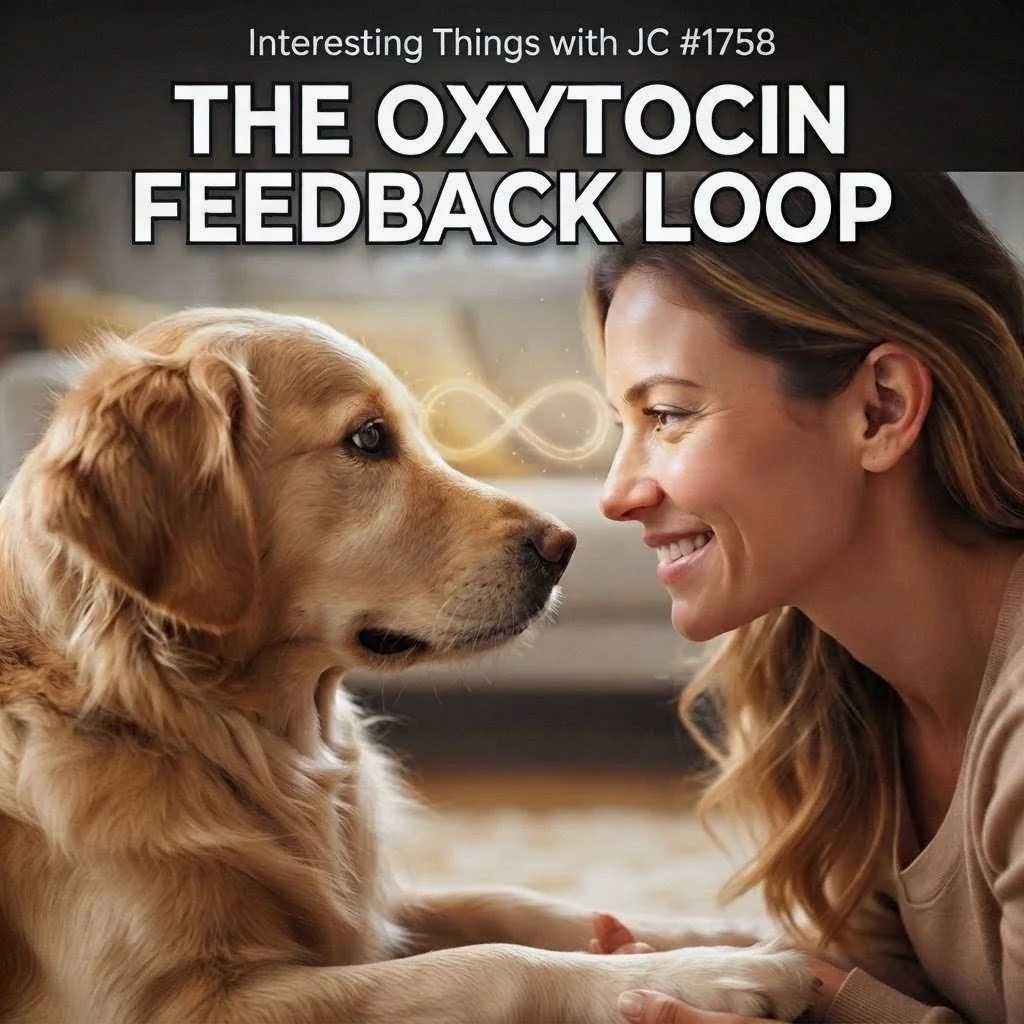
A square promotional image for Interesting Things with JC #1758: “The Oxytocin Feedback Loop.” A golden retriever and a smiling woman face each other at close range and maintain direct eye contact. The woman gently holds the dog’s front paw. A subtle glowing loop symbol appears between them, visually representing the reciprocal oxytocin feedback loop discussed in the episode. Large white text across the top reads, “Interesting Things with JC #1758 — THE OXYTOCIN FEEDBACK LOOP.”
Transcript
Interesting Things with JC #1758:
"The Oxytocin Feedback Loop"
A dog can ask for something without making a sound. Sometimes it’s a paw on your leg or a nose under your hand, but sometimes the dog simply looks at you and holds your gaze. You look back, and that exchange can produce a measurable change inside both of you.
In 2015, researchers in Japan observed dogs and their owners during 30 minutes of interaction and measured oxytocin before and afterward. When dogs spent more time gazing at their owners, oxytocin increased in the humans. Those owners then interacted more with their dogs, whose oxytocin also increased. The researchers described a positive feedback loop, with gaze, social contact, and oxytocin reinforcing one another.
Oxytocin is a peptide made primarily in the hypothalamus. It’s involved in childbirth and nursing, but also plays roles in social recognition, attachment, stress, and affiliative behavior. The familiar nickname “love hormone” makes the chemistry sound simpler than it is. Oxytocin doesn’t create love by itself. It works as part of a much larger system responding to social relationships.
The researchers also tested whether oxytocin could move the loop in the other direction. After receiving oxytocin intranasally, female dogs spent more time gazing at their owners. The owners received no oxytocin, yet their oxytocin levels increased following that additional gaze. A change in one animal’s biology had altered its behavior, which was then associated with a biological change in another species.
Human-raised wolves in the original study didn’t show the same gaze-linked pattern, leading researchers to suggest that dogs may have developed this behavior during domestication. Later research has made that explanation less certain, with upbringing, individual behavior, and the relationship with a particular human also appearing to matter.
Mutual gaze and oxytocin are also involved in human caregiver-infant bonding. A dog-owner relationship isn’t the same thing, but dogs appear able to engage some of the same mammalian biology humans use in close social attachment.
So when your dog holds your eyes and you hold theirs, something physical can accompany that familiar look. One animal affects the other, the response comes back, and the loop can begin again.
These are interesting things, with JC.
Student Worksheet
Comprehension
What behavior did researchers associate with increased oxytocin in dog owners?
Describe the proposed positive feedback loop between a dog and its owner.
Where is oxytocin primarily produced, and what are two functions associated with it?
What happened after female dogs received intranasal oxytocin?
How did the results involving human-raised wolves differ from those involving dogs?
Analysis
Why did administering oxytocin to dogs provide different evidence from simply observing dog-owner interactions?
Why would calling oxytocin the “love hormone” give an incomplete picture of its biological function?
What evidence supported the original domestication hypothesis, and why should that interpretation be treated cautiously?
Create a four-stage diagram showing how dog behavior, owner biology, owner behavior, and dog biology could form a feedback loop.
Reflection
What does this research suggest about the relationship between behavior and physiology? Support your answer with at least two details from the episode.
Difficulty Scaling
Level 1: Identify the major behavior, hormone, and experimental findings.
Level 2: Explain causal pathways and distinguish observational from experimental evidence.
Level 3: Evaluate competing explanations involving domestication, upbringing, individual variation, and relationship history.
Student Output: Complete Questions 1–10 using full sentences for Questions 6–10 and a labeled diagram for Question 9. Cite specific evidence from the transcript when explaining conclusions.
Academic Integrity Guidance: Base answers on your own interpretation of the episode and assigned evidence. Clearly identify outside information if your instructor permits additional research.
Teacher Guide
Quick Start: Introduce positive feedback, play or read the episode, have students construct the feedback loop, and conclude by examining the difference between a research result and an evolutionary interpretation.
Pacing Guide — Audio First
0–5 minutes: Bell Ringer and prediction.
5–10 minutes: Introduce oxytocin and positive feedback.
10–15 minutes: Listen to the episode without interruption.
15–25 minutes: Complete comprehension questions and feedback-loop diagram.
25–35 minutes: Analyze the dog-versus-wolf comparison and experimental manipulation.
35–45 minutes: Discussion, formative check, and Exit Ticket.
Bell Ringer: Give one example of a biological or behavioral response that might cause another response and then reinforce the original interaction.
Audio Guidance: Ask students during the first listen to identify the sequence of events rather than record every scientific term.
Audio Fallback: Use the complete transcript and have students underline behavioral observations once and biological measurements twice.
Time on Task: Approximately 45 minutes for a core lesson; 60–75 minutes with extended discussion or research evaluation.
Materials
Episode audio or transcript
Student worksheet
Paper or digital diagramming tool
Optional highlighters for evidence classification
Vocabulary Prep
Contrast positive feedback with an ordinary one-way cause-and-effect sequence.
Review the distinction between a hormone or neuropeptide and the behavior associated with it.
Introduce intranasal before discussing the experimental manipulation.
Misconceptions
Oxytocin is not simply a chemical that “creates love.”
An association between gaze and oxytocin does not mean every dog-owner gaze produces the same response.
Dogs and human infants are not biologically or socially equivalent because some bonding mechanisms overlap.
The original wolf comparison does not by itself prove that domestication produced the feedback loop.
Positive feedback means reinforcement of a process, not that the process is necessarily beneficial.
Discussion Prompts
Which part of the proposed loop is behavioral, and which part is physiological?
Why is experimentally changing one variable useful when investigating causation?
What alternative explanations should researchers consider when comparing dogs with wolves?
How does later evidence change the strength of the domestication claim without making the original experiment meaningless?
Formative Checkpoints
Students correctly sequence gaze → owner oxytocin/interaction → dog response.
Students distinguish observation from oxytocin administration.
Students identify the wolf comparison as evidence rather than definitive proof.
Students explain at least one reason individual experience could affect results.
Differentiation
Additional Support: Provide four labeled cards—dog gaze, owner oxytocin, owner interaction, dog oxytocin—for students to arrange.
Advanced Learners: Ask students to identify possible confounding variables in dog-wolf comparisons.
English Learners: Pair vocabulary definitions with short behavioral or biological examples.
Assessment Differentiation: Allow students to demonstrate the feedback loop through a written explanation, annotated diagram, or brief oral explanation while retaining the same evidence requirements.
Time Flexibility: For a 25-minute lesson, use Questions 1–5 and 9 plus the Exit Ticket. For an extended lesson, add evaluation of the original study and later critiques.
Substitute Readiness: The transcript, worksheet, answer key, and pacing sequence allow completion without additional subject-matter preparation.
Engagement Strategy: Begin with the familiar experience of a dog making eye contact, then ask students to predict what researchers could measure objectively.
Extensions
Design a hypothetical follow-up study controlling dogs’ upbringing and relationship history.
Compare positive feedback with a negative-feedback system such as thermoregulation.
Evaluate how scientists could operationally define and measure “gaze.”
Investigate why replication, larger samples, and comparison-group design matter.
Cross-Curricular Connections
Biology: Hormonal signaling and feedback systems.
Psychology: Attachment, social behavior, and experimental design.
Animal Science: Domestication and human-animal interaction.
Statistics: Correlation, sample size, confounding variables, and causal inference.
SEL Connection: Students can consider how nonverbal signals contribute to social interaction while recognizing that biological responses vary among individuals.
Skill Value Emphasis: Evidence evaluation, systems thinking, causal reasoning, experimental interpretation, and scientific communication.
Answer Key
Longer dog-to-owner gazing was associated with increased urinary oxytocin in owners.
Dog gaze was associated with increased owner oxytocin and affiliation; owner interaction was then associated with increased oxytocin in the dog, potentially reinforcing further interaction.
Oxytocin is produced primarily in the hypothalamus; acceptable functions include childbirth, lactation, social recognition, attachment, and affiliative behavior.
Female dogs spent more time gazing at their owners, and the owners subsequently showed increased urinary oxytocin despite receiving no oxytocin themselves.
The wolves did not show the same gaze-linked pattern reported for dogs in the original study.
Manipulating oxytocin allowed researchers to test whether changing biology could alter gaze behavior and subsequently affect the untreated partner.
Oxytocin has multiple context-dependent physiological and behavioral roles and functions within larger biological systems.
Dogs but not wolves showed the reported gaze-linked pattern, supporting a domestication hypothesis; later methodological criticism and controlled research indicate that life experience and other variables can also matter.
A valid diagram should represent dog gaze → owner response/oxytocin → increased owner affiliation → dog oxytocin/interaction, with reinforcement back into the cycle.
Answers should explain reciprocal relationships between behavior and physiology using at least two accurate examples from the episode.
Quiz
Multiple Choice
What variable was especially associated with increased oxytocin in owners in the 2015 study?
A. Dog body size
B. Duration of dog-to-owner gaze
C. Owner age
D. Frequency of feedingWhy is the interaction described as a positive feedback loop?
A. Every interaction produces an identical hormonal response.
B. Oxytocin permanently changes the dog’s personality.
C. Responses between dog and owner can reinforce further responses.
D. The interaction prevents future hormonal changes.What happened when female dogs received intranasal oxytocin?
A. They gazed longer at their owners.
B. They avoided their owners.
C. Their owners also received oxytocin.
D. They behaved identically to the wolves.Why is the phrase “love hormone” scientifically incomplete?
A. Oxytocin functions only during childbirth.
B. Oxytocin is unrelated to social behavior.
C. Oxytocin has multiple functions and operates within larger biological systems.
D. Oxytocin is found only in dogs.Which conclusion best reflects the evidence discussed in the episode?
A. Domestication has been proven to be the sole cause of dog-owner mutual gaze.
B. Dog-owner gaze has no measurable biological association.
C. Wolves and dogs always respond identically to humans.
D. Evidence supports a gaze-linked oxytocin interaction, while its evolutionary origin remains more uncertain.
Assessment
Open-Ended Questions
Explain the proposed oxytocin-gaze positive feedback loop. Include at least four stages and distinguish behavioral events from physiological changes.
Evaluate the statement: “The dog-wolf comparison proves that domestication created the oxytocin-gaze feedback loop.” Use evidence from the episode to explain why this conclusion is stronger than the available evidence supports.
3–2–1 Rubric
3 — Proficient: Accurately explains the mechanism, uses specific evidence, distinguishes observation from interpretation, and recognizes uncertainty in the domestication hypothesis.
2 — Developing: Identifies the central mechanism and relevant evidence but provides incomplete causal reasoning or limited discussion of uncertainty.
1 — Beginning: Identifies isolated facts but does not accurately explain the feedback loop or evaluate the evidence.
Exit Ticket: In two sentences, explain one finding that the 2015 experiment supports strongly and one conclusion that remains less certain.
Standards Alignment
NGSS — Science & Engineering Practices
SEP 4 — Analyzing and Interpreting Data — Students distinguish behavioral observations, biological measurements, and experimental outcomes when interpreting the dog-owner interaction.
SEP 6 — Constructing Explanations and Designing Solutions — Students construct an evidence-based explanation of the proposed feedback loop and identify variables for a stronger follow-up study.
SEP 7 — Engaging in Argument from Evidence — Students evaluate whether the evidence warrants the claim that domestication produced the gaze-oxytocin mechanism.
CCSS Reading
CCSS.ELA-LITERACY.RST.9-10.1 — Cite specific textual evidence to support analysis of science and technical texts — Students support explanations with details from the transcript.
CCSS.ELA-LITERACY.RST.11-12.8 — Evaluate hypotheses, data, analysis, and conclusions in a science or technical text — Students evaluate the relationship between experimental findings and the domestication interpretation.
CCSS Writing
CCSS.ELA-LITERACY.WHST.9-10.2 — Write informative/explanatory texts — Students explain the feedback loop using accurate sequencing and scientific vocabulary.
CCSS.ELA-LITERACY.WHST.11-12.9 — Draw evidence from informational texts — Students use episode evidence when evaluating competing explanations.
C3 Framework
D2.His.12.9-12 — Use questions generated about multiple historical sources to pursue further inquiry — Applied here to domestication as students identify what additional evidence would be needed to evaluate an evolutionary explanation.
ISTE / CTE
Knowledge Constructor — Evidence Evaluation — Students organize information from scientific evidence and distinguish supported findings from broader interpretations.
CTE — Scientific Reasoning and Communication — Students translate experimental observations into a causal model and communicate limitations precisely.
Career Readiness Competencies
Critical Thinking: Evaluate claims according to the strength and limitations of evidence.
Systems Thinking: Model reciprocal interactions among biological and behavioral variables.
Communication: Explain scientific mechanisms accurately without overstating conclusions.
Research Literacy: Recognize comparison groups, experimental manipulation, confounding variables, and alternative explanations.
Homeschool/Lifelong Learning
Learners connect an observable everyday behavior to neuroscience and experimental methodology while practicing evidence-based reasoning applicable to evaluating scientific claims.
Show Notes
A familiar look between a dog and its owner provides an entry point into neuroscience, animal behavior, and experimental reasoning. This episode examines research suggesting that mutual gaze can participate in an oxytocin-mediated feedback loop across species while showing why oxytocin is more complex than its popular “love hormone” nickname implies. For the classroom, the research offers a particularly useful case for distinguishing correlation from experimental evidence and a scientific finding from a broader evolutionary interpretation.
References
Nagasawa, M., Mitsui, S., En, S., Ohtani, N., Ohta, M., Sakuma, Y., Onaka, T., Mogi, K., & Kikusui, T. (2015). Social evolution: Oxytocin-gaze positive loop and the coevolution of human-dog bonds. Science, 348(6232), 333–336. https://pubmed.ncbi.nlm.nih.gov/25883356/
Kekecs, Z., Szollosi, A., Palfi, B., Szaszi, B., Kovacs, K. J., Dienes, Z., & Aczel, B. (2016). Commentary: Oxytocin-gaze positive loop and the coevolution of human-dog bonds. Frontiers in Neuroscience, 10, 155. https://pmc.ncbi.nlm.nih.gov/articles/PMC4826871/
Marshall-Pescini, S., Schaebs, F. S., Gaugg, A., Meinert, A., Deschner, T., & Range, F. (2021). Life experience rather than domestication accounts for dogs’ increased oxytocin release during social contact with humans. Scientific Reports, 11. https://pmc.ncbi.nlm.nih.gov/articles/PMC8277847/
Young, L. J., & Wang, Z. (2009). Oxytocin and the neural mechanisms regulating social cognition and affiliative behavior. Frontiers in Neuroendocrinology, 30(4), 534–547. https://pmc.ncbi.nlm.nih.gov/articles/PMC2748133/
Feldman, R. (2012). Oxytocin and social affiliation in humans. Hormones and Behavior, 61(3), 380–391. https://pubmed.ncbi.nlm.nih.gov/22285934/