Interesting Things with JC #1774: "Uncle Sam Day"
Samuel Wilson is supplying beef to American troops in barrels marked “U.S.” when people begin connecting the initials with the Troy businessman they call Uncle Sam. The nickname spreads beyond the barrels, becomes a name for the U.S. government, and eventually turns Wilson’s September 13 birthday into an officially designated Uncle Sam Day.
Curriculum - Episode Anchor
Episode Title: Uncle Sam Day
Episode Number: 1774
Host: JC
Audience: Grades 9–12, introductory college, homeschool, lifelong learners
Subject Area: U.S. history, civics, visual culture, media literacy, information literacy
Lesson Overview
Learning Objectives
Explain the traditional connection between Samuel Wilson, military supply barrels, and the name “Uncle Sam.”
Trace how Uncle Sam developed from a nickname into a recognizable national personification.
Distinguish between documented historical evidence, traditional accounts, and later official recognition.
Analyze how visual symbols can shape public understanding of governments and national identity.
Essential Question: How does a historical story become a national symbol, and how should we evaluate that story when some details remain uncertain?
Success Criteria: Students can construct an accurate chronology, identify which elements of the Uncle Sam story are documented versus disputed, analyze the role of visual imagery, and support conclusions with evidence.
Student Relevance Statement: Students encounter symbols, logos, memes, mascots, and visual shorthand every day. Uncle Sam provides a historical example of how an image can accumulate meaning until audiences recognize an idea almost instantly.
Real-World Connection: Governments, organizations, businesses, and social movements use visual symbols to communicate complex identities quickly. Understanding how such symbols develop strengthens historical and media literacy.
Workforce Reality: Researchers, journalists, educators, designers, marketers, archivists, and communications professionals must distinguish verified facts from repeated claims while understanding how words and images influence audiences.
Key Vocabulary
Terms
Personification (per-son-uh-fi-KAY-shun) — Representation of an abstract idea, institution, or nation as a human figure.
Progenitor (proh-JEN-ih-ter) — A person or source regarded as an originator or predecessor.
Symbol (SIM-buhl) — An image, object, person, or sign that represents a broader idea.
Nickname (NIK-naym) — An informal name used in place of or alongside a formal name.
Military supplier (MIL-ih-ter-ee suh-PLY-er) — A person or business providing goods or materials to armed forces.
Political cartoon (puh-LIT-ih-kuhl kar-TOON) — An illustration that comments on political events, institutions, or ideas.
Recruiting poster (rih-KROO-ting POH-ster) — A public notice designed to encourage people to join an organization, particularly the armed forces.
Bicentennial (bye-sen-TEN-ee-uhl) — A 200th anniversary.
Historical evidence (his-TOR-ih-kuhl EV-ih-dens) — Sources and information used to investigate and support conclusions about the past.
Narrative Core
Open: Before Uncle Sam became the familiar white-haired figure pointing at the viewer, the name was associated by tradition with a real businessman: Samuel Wilson of Troy, New York.
Info: Wilson supplied beef during the War of 1812. The traditional account connects barrels marked “U.S.” for United States with Wilson's nickname, “Uncle Sam,” helping explain how the expression became associated with government supplies and eventually the federal government itself.
Details: The name developed independently of the familiar image. During the nineteenth century, illustrators including Thomas Nast helped shape Uncle Sam's appearance. James Montgomery Flagg's famous World War I image, first appearing in 1916 and adapted for the 1917 Army recruiting poster, gave the character the pointing pose recognized today. Congress formally saluted Samuel Wilson as the progenitor of the national symbol in 1961. Public Law 100-645 later designated September 13, 1989—Wilson's birthday and the year of Troy's bicentennial—as “Uncle Sam Day.”
Reflection: The Wilson story demonstrates why historical literacy requires both narrative and qualification. The traditional explanation became influential enough to receive congressional recognition, yet the precise origin of “Uncle Sam” remains disputed. Official recognition and historical certainty are not necessarily the same thing.
Closing: These are interesting things, with JC.
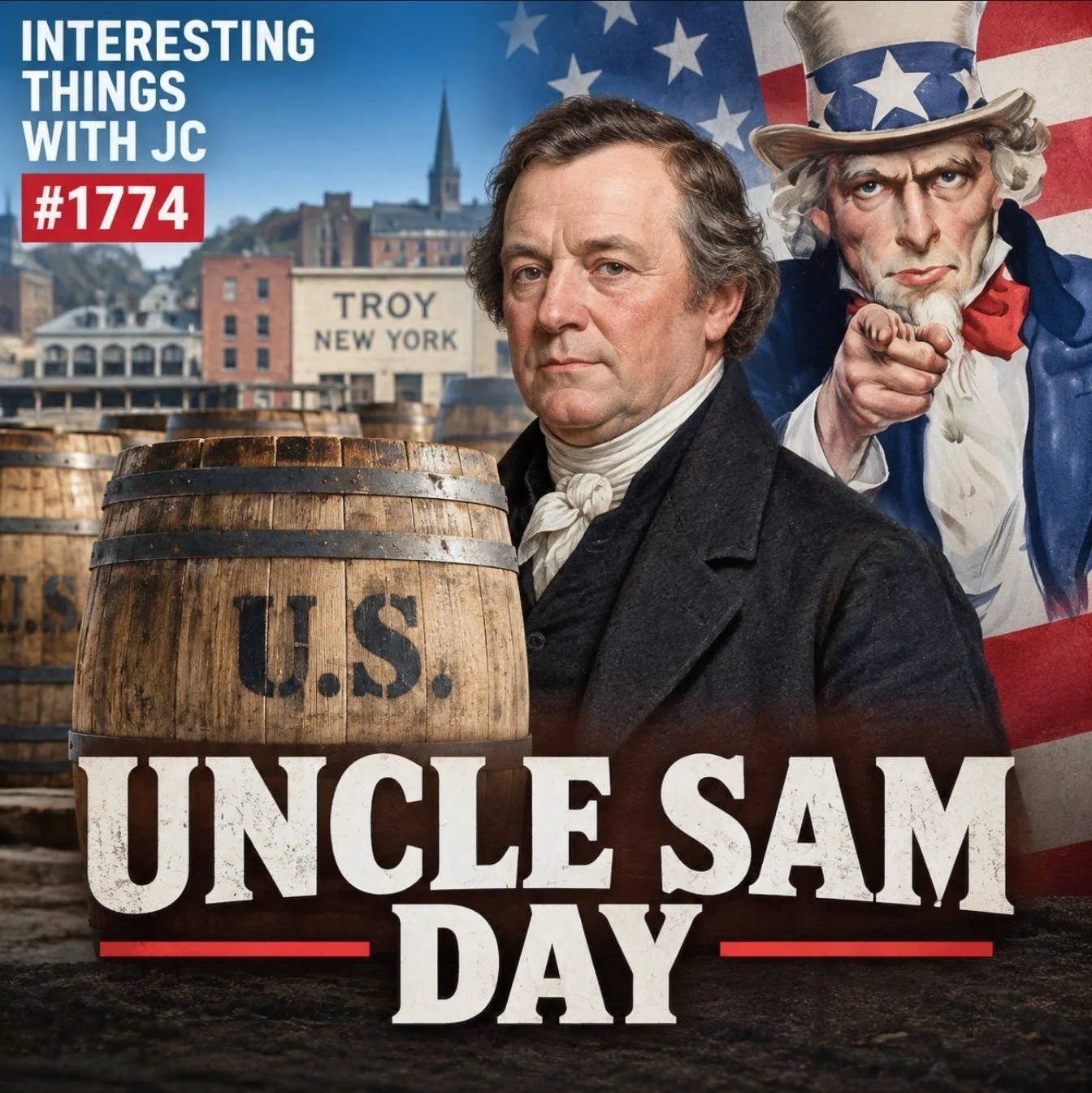
Promotional artwork for Interesting Things with JC episode #1774, “Uncle Sam Day.” A historical-looking portrait of Samuel Wilson stands beside a wooden barrel marked “U.S.” against a backdrop labeled “Troy New York.” To the right, the familiar Uncle Sam figure, wearing a star-spangled top hat and red, white, and blue clothing, points directly toward the viewer in front of an American flag. Large white text across the bottom reads “UNCLE SAM DAY.”
Transcript
Interesting Things with JC #1774:
"Uncle Sam Day"
Long before Uncle Sam had the white goatee, star-spangled top hat, and that famous finger pointed straight at you, there was a real Sam living in Troy, New York. His name was Samuel Wilson, and during the War of 1812, he was in the meat business.
Wilson was born on September 13, 1766, and became an established businessman in Troy. During the war, his company supplied beef for American troops in barrels marked with the letters “U.S.” The letters meant United States, but according to the story that grew around Wilson, people who knew him as Uncle Sam began connecting the initials with his nickname. From there, “Uncle Sam” became associated with government supplies and eventually the government itself.
The name was already appearing in print during the War of 1812, but the familiar figure developed over generations. Political cartoonist Thomas Nast helped shape Uncle Sam during the nineteenth century, and in 1917 illustrator James Montgomery Flagg created the version that became famous: white hair, pointed beard, stern expression, and a finger aimed directly at the viewer above the words, “I Want YOU for U.S. Army.”
By then, a nickname associated with a meat supplier in Troy had become part of the country's visual language. In 1961, Congress formally recognized Samuel Wilson as the progenitor of America's national symbol of Uncle Sam.
Then Congress returned to his story in 1988, passing Public Law 100-645 and designating September 13, 1989, as “Uncle Sam Day.” The date was Wilson's birthday, and 1989 also marked Troy's bicentennial.
The old story about those barrels isn't certain in every detail, and historians have identified other theories about the name's origin. But Samuel Wilson's connection became strong enough to enter the official record, linking a man who supplied beef to American soldiers with one of the most recognizable personifications of the United States.
And on his birthday in 1989, the country officially gave Uncle Sam a day of his own.
These are interesting things, with JC.
Student Worksheet
Comprehension
Who was Samuel Wilson, and what business activity connected him to the War of 1812?
What did the letters “U.S.” on the supply barrels officially mean?
According to the traditional story, how did those initials become associated with “Uncle Sam”?
What roles did Thomas Nast and James Montgomery Flagg play in the development of Uncle Sam?
Why was September 13, 1989, significant?
Analysis
Explain the difference between the origin of the name “Uncle Sam” and the development of the familiar visual character.
Why is the statement that the barrel story “isn't certain in every detail” important to an accurate historical account?
Does congressional recognition in 1961 prove that every detail of the traditional origin story occurred exactly as later described? Explain.
Analyze why Flagg's direct-pointing composition could have been effective as a recruiting image.
Create a five-event timeline showing the development of Uncle Sam from Samuel Wilson through Uncle Sam Day.
Reflection
Choose a familiar modern symbol. What allows people to understand its meaning without an explanation?
Which is more important when studying a national symbol: determining its exact origin or understanding how its meaning developed? Defend your position with evidence.
Difficulty Scaling
Level 1 — Recall: Complete Questions 1–5 using details from the episode.
Level 2 — Analysis: Complete Questions 6–10 using evidence and historical reasoning.
Level 3 — Synthesis: Complete Questions 11–12 and connect Uncle Sam to a second symbol or personification.
Student Output: Submit complete responses to Questions 1–10 plus one reflection response. Analysis answers should include specific evidence rather than unsupported conclusions. The timeline must distinguish the War of 1812, nineteenth-century visual development, 1917 poster, 1961 congressional recognition, and 1989 Uncle Sam Day.
Academic Integrity Guidance: Use the episode and assigned sources as evidence. Paraphrase in your own words, place directly borrowed language in quotation marks, identify sources when required, and do not present generated or copied material as your own analysis.
Teacher Guide
Quick Start: Play or read the episode once without interruption. Ask students to identify three stages in the story: person, name, and image. Replay or reread as students gather evidence distinguishing documented events from the traditional origin account.
Pacing Guide — Audio First
0–5 minutes: Bell Ringer and prediction.
5–10 minutes: First uninterrupted episode listen.
10–15 minutes: Vocabulary and chronology check.
15–25 minutes: Second listen/read with evidence notes.
25–40 minutes: Worksheet comprehension and analysis.
40–50 minutes: Discussion and source-evaluation activity.
50–55 minutes: Exit Ticket.
Bell Ringer: Display or describe the familiar pointing Uncle Sam figure without identifying Samuel Wilson. Ask students to write what the figure represents and how they learned that meaning.
Audio Guidance: On the first listen, students should focus on the overall story. On the second, have them record dates, people, and qualifying phrases such as “according to the story” and “isn't certain in every detail.”
Audio Fallback: Provide the transcript for silent reading, partner reading, or teacher read-aloud if audio is unavailable.
Time on Task: Approximately 45–55 minutes for a standard lesson; 70–90 minutes with primary-source analysis.
Materials
Episode audio and transcript
Student Worksheet
Notebook or digital response document
Projected or printed copy of Flagg's 1917 recruiting poster
Optional historical-source excerpts for comparison
Vocabulary Prep
Introduce personification, progenitor, and historical evidence before listening.
Have students use symbol, personification, and historical evidence in their analysis responses.
Misconceptions
The letters “U.S.” officially meant “United States,” not “Uncle Sam.”
Samuel Wilson did not create Flagg's familiar Uncle Sam appearance.
Flagg's famous recruiting poster dates from World War I, not the War of 1812.
Congressional recognition of Wilson does not eliminate scholarly questions about the term's exact origin.
The 1988 law designated September 13, 1989, specifically; it did not establish a permanent annual federal holiday.
Discussion Prompts
Why can a compelling origin story survive even when historians qualify parts of it?
How did words, political cartoons, and recruiting imagery contribute differently to Uncle Sam's development?
What is the difference between recognizing a historical tradition and proving its origin conclusively?
Could a new national personification become as recognizable today? Why or why not?
Formative Checkpoints
Students correctly identify Wilson's occupation and wartime role.
Students separate the “U.S.” marking from its later nickname association.
Students distinguish Wilson, Nast, and Flagg.
Students recognize uncertainty as part of responsible historical interpretation.
Students place 1961 and 1989 correctly in the chronology.
Differentiation
Additional Support: Provide a partially completed timeline and vocabulary bank.
Advanced Learners: Compare the Wilson tradition with evidence suggesting earlier uses of “Uncle Sam.”
English Learners: Preteach vocabulary with image-word pairings and allow oral rehearsal before written responses.
Lifelong Learners: Focus discussion on how repeated cultural images acquire authority over time.
Assessment Differentiation: Permit oral responses, annotated timelines, or short written arguments while preserving the requirement that students identify evidence and uncertainty.
Time Flexibility: For a 30-minute lesson, use the audio, Questions 1–8, and Exit Ticket. For an extended block, add primary-source comparison and visual analysis.
Substitute Readiness: The transcript, worksheet, vocabulary, quiz, answer key, and pacing sequence permit completion without additional subject preparation.
Engagement Strategy: Reveal the famous Flagg image first and ask students to work backward: Who designed this version? What existed before it? Was there actually an Uncle Sam?
Extensions
Compare multiple nineteenth- and twentieth-century representations of Uncle Sam.
Research another U.S. personification or national symbol and document how its meaning changed.
Investigate how primary sources can complicate a popular origin story.
Redesign Uncle Sam for a contemporary nonpartisan public-information campaign and justify each visual choice.
Cross-Curricular Connections
History: War of 1812, World War I, public memory.
Civics: National personification and congressional recognition.
English Language Arts: Evidence, qualification, and source comparison.
Visual Arts: Composition, symbolism, costume, gesture, and audience.
Media Literacy: Persuasive imagery and repeated cultural messages.
SEL Connection: Students practice intellectual humility by recognizing that uncertainty does not prevent meaningful historical inquiry.
Skill Value Emphasis: Source evaluation, chronological reasoning, visual literacy, evidence-based writing, and differentiation between fact, tradition, and interpretation.
Answer Key
Samuel Wilson was a Troy businessman involved in the meat trade who supplied beef for American troops during the War of 1812.
“U.S.” meant United States.
Tradition holds that people connected “U.S.” with Wilson's nickname, “Uncle Sam,” and the expression expanded to government property and the government itself.
Nast contributed to the nineteenth-century visual development of Uncle Sam; Flagg created the famous pointing version used for World War I recruiting.
September 13 was Wilson's birthday; September 13, 1989, was designated Uncle Sam Day, and 1989 was Troy's bicentennial.
The nickname developed before the standardized visual character; artists gradually shaped the recognizable appearance.
The qualification prevents a traditional explanation from being presented as conclusively established history.
No. Congressional recognition establishes an official acknowledgment of Wilson's connection but does not independently prove every element of the origin tradition.
Strong responses should discuss direct address, eye contact, pointing gesture, simplicity, urgency, or the impression that the viewer is personally being called to act.
Expected sequence: War of 1812 tradition → nineteenth-century visual development/Nast → Flagg's World War I image → 1961 congressional recognition → 1989 Uncle Sam Day.
11–12. Answers will vary but should contain a defensible claim, relevant example, and explanation.
Quiz
Questions
Samuel Wilson's connection to the Uncle Sam tradition developed primarily from his role as a:
A. newspaper publisher
B. military supplier
C. political cartoonist
D. Army generalWhat did “U.S.” officially indicate on the supply barrels?
A. United States
B. Uncle Samuel
C. United Supplies
D. Union SoldiersWhich artist is associated with the famous pointing Uncle Sam recruiting image?
A. Norman Rockwell
B. Thomas Cole
C. James Montgomery Flagg
D. John TrumbullWhat did Congress do in 1961?
A. Created the first Uncle Sam recruiting poster
B. Saluted Samuel Wilson as the progenitor of America's national symbol of Uncle Sam
C. Declared Uncle Sam a military rank
D. Designated September 13 as a permanent federal holidayWhy is historical uncertainty important to the Uncle Sam story?
A. It proves Samuel Wilson never existed.
B. It means the recruiting poster cannot be dated.
C. It distinguishes a widely repeated traditional account from conclusions that can be established with greater certainty.
D. It establishes that “U.S.” never meant United States.
Assessment
Open-Ended Questions
Trace the development of Uncle Sam from Samuel Wilson's War of 1812 connection to James Montgomery Flagg's World War I image. Explain how the meaning of the symbol expanded over time.
Evaluate this claim: “Congressional recognition settled the historical question of exactly where the name Uncle Sam originated.” Use evidence from the lesson to support, reject, or qualify the statement.
3–2–1 Rubric
3 — Proficient: Accurate claim; multiple relevant details; clearly distinguishes documented history, traditional account, and interpretation; reasoning is coherent.
2 — Developing: Generally accurate claim with some supporting evidence; demonstrates partial understanding of historical uncertainty or chronology.
1 — Beginning: Limited or inaccurate evidence; chronology or central concepts are unclear; conclusion is unsupported.
Exit Ticket
Identify one fact about Uncle Sam that is well documented.
Identify one element of the origin story that should be presented with qualification.
In one sentence, explain why that distinction matters to historians.
Standards Alignment
NGSS — Science & Engineering Practices
SEP — Obtaining, Evaluating, and Communicating Information — Students evaluate the strength and limits of evidence surrounding a historical origin account and communicate a qualified conclusion.
SEP — Engaging in Argument from Evidence — Students construct and defend claims about what congressional recognition does and does not establish historically.
CCSS Reading
CCSS.ELA-LITERACY.RI.11-12.1 — Cite strong and thorough textual evidence — Students support analysis of the Wilson tradition, visual development, and historical uncertainty with episode evidence.
CCSS.ELA-LITERACY.RI.11-12.7 — Integrate and evaluate multiple sources of information presented in different media or formats — Students connect narrative information with visual evidence from historical Uncle Sam imagery.
CCSS Writing
CCSS.ELA-LITERACY.W.11-12.9 — Draw evidence from informational texts to support analysis, reflection, and research — Students use episode and source evidence in worksheet and assessment responses.
C3 Framework
D2.His.10.9-12 — Detect possible limitations in various kinds of historical evidence and differing secondary interpretations — Students examine why the familiar Wilson story requires qualification.
D2.His.14.9-12 — Analyze multiple and complex causes and effects of events in the past — Students trace how wartime language, political illustration, recruiting imagery, and official recognition contributed to Uncle Sam's cultural development.
ISTE — Knowledge Constructor
1.3.b — Evaluate the accuracy, perspective, credibility and relevance of information, media, data or other resources — Students compare historical claims with the strength and character of their supporting evidence.
Career Readiness Competencies
Critical Thinking: Evaluate competing explanations instead of treating repetition as proof.
Communication: Present historical conclusions with precise language reflecting the strength of available evidence.
Information Literacy: Separate primary evidence, later interpretation, cultural tradition, and official recognition.
Homeschool/Lifelong Learning
Learners independently construct a chronology, evaluate historical claims, interpret visual media, and communicate evidence-based conclusions applicable to future encounters with cultural symbols and popular historical narratives.
Show Notes
Uncle Sam Day traces one of America's most recognizable symbols back to Samuel Wilson, a Troy, New York, businessman traditionally associated with military supply barrels during the War of 1812. The episode follows the transformation of “Uncle Sam” from a nickname into a national personification shaped by nineteenth-century illustration, James Montgomery Flagg's famous World War I recruiting image, congressional recognition in 1961, and the designation of September 13, 1989, as Uncle Sam Day. For classrooms, the story offers a compact case study in historical evidence, visual literacy, chronology, public memory, and the important distinction between a widely accepted tradition and a conclusively documented origin.
References
Library of Congress. (n.d.). Introduction—John Bull and Uncle Sam: Four centuries of British-American relations. https://www.loc.gov/exhibits/british/britintr.html
Library of Congress. (n.d.). I want you for U.S. Army: Nearest recruiting station / James Montgomery Flagg. https://www.loc.gov/item/96507165/
Library of Congress. (n.d.). I Want You: Raising an Army. https://www.loc.gov/exhibitions/world-war-i-american-experiences/about-this-exhibition/over-here/raising-an-army/i-want-you/
United States Congress. (1961, September 15). Congressional Record—Senate: Senate Concurrent Resolution 14, “Uncle Sam” Wilson. https://www.congress.gov/87/crecb/1961/09/15/GPO-CRECB-1961-pt15-2-1.pdf
United States Congress. (1988, November 9). Public Law 100-645: Designating September 13, 1989, as “Uncle Sam Day.” https://www.congress.gov/100/statute/STATUTE-102/STATUTE-102-Pg3340.pdf