Interesting Things with JC #1773: "The Clock Behind Instant Replay"
Two instant-replay feeds showing the same moment can reach officials milliseconds apart. Every step through processing, switching, transmission, encoding, and decoding can add hidden latency, so replay has to determine when each frame actually occurred instead of trusting when it arrived.
Curriculum - Episode Anchor
Episode Title: The Clock Behind Instant Replay
Episode Number: 1773
Host: JC
Audience: Grades 9–12, introductory college, homeschool, lifelong learners
Subject Area: Physics, engineering, broadcast technology, sports technology, information literacy
Lesson Overview
Learning Objectives
Distinguish synchronization from latency in digital video and replay systems.
Explain why two camera feeds can represent the same instant even when their signals arrive at different times.
Analyze how common timing references help officials compare events recorded by multiple cameras.
Evaluate how small timing discrepancies can become significant when a decision occurs near a whole-second boundary.
Essential Question: How can an instant-replay system determine whether different cameras and clocks are showing the same moment?
Success Criteria: Students can accurately define latency and synchronization, explain the purpose of a common timing reference, interpret a multi-camera replay scenario, and identify the limits of what synchronization alone establishes.
Student Relevance Statement: Video calls, livestreams, online gaming, sports broadcasts, security cameras, and networked media all depend on systems that manage timing and delay.
Real-World Connection: Professional broadcasting requires cameras, audio equipment, replay systems, graphics, and other devices to maintain precise timing relationships even when signals travel through different processing and network paths.
Workforce Reality: Broadcast engineers, network engineers, video technicians, replay operators, systems engineers, and live-production specialists routinely work with synchronization, latency, signal routing, and time-sensitive media.
Key Vocabulary
Terms
Latency (LAY-tuhn-see) — The delay between an event or signal entering a system and its corresponding information reaching another point in that system.
Synchronization (sing-kruh-nuh-ZAY-shuhn) — Coordinating devices or media so their timing relationships correspond to a common reference.
Signal Path (SIG-nuhl path) — The route a video, audio, or data signal follows through equipment and networks.
Frame (fraym) — One individual image within a video sequence.
Strobe (strohb) — A brief flash that can provide cameras with a shared visible timing reference.
Encoding (en-KOH-ding) — Converting information into a form suitable for storage, processing, or transmission.
Decoding (dee-KOH-ding) — Converting encoded information into a form that downstream equipment can use.
Precision Time Protocol (PTP) (pree-SIZH-uhn tyme PROH-tuh-kawl) — A network protocol used to distribute precise timing information among connected devices.
Replay System (REE-play SIS-tuhm) — Hardware and software used to record, retrieve, synchronize, and examine video for review.
Narrative Core
Open: Two cameras can record the same moment without their pictures reaching a replay system at exactly the same moment. That apparent contradiction introduces one of the central engineering problems behind modern instant replay.
Info: Latency describes delay through a system; synchronization establishes the timing relationship among signals. A useful analogy is two letters mailed simultaneously along different routes. Their arrival times can differ even though their sending times were the same.
Details: Before the 2026 Michigan–Western Michigan game, the Big Ten stated that broadcast cameras used by its replay system, including the camera directed at the game clock, were synchronized with a strobe 85 minutes before the game. More broadly, professional IP broadcasting can use precise network timing such as IEEE 1588 Precision Time Protocol and SMPTE ST 2059 to keep equipment referenced to common timing. Sony Hawk-Eye technology is also used in sports replay applications to present multiple time-synchronized camera angles. The Michigan–Western Michigan finish illustrates why the distinction matters: the Big Ten's replay review restored one second after using its synchronized replay view, while the broadcast presentation showed 0:00. The episode uses latency and synchronization to explain how differing visual timing presentations can arise; subsequent reporting also raised a separate rules/protocol dispute over which timing feed should have governed the decision.
Reflection: Synchronization does not mean that every signal travels through identical equipment or experiences identical delay. It means a system has a method for establishing which recorded information belongs to the same point on a timeline. Students should therefore distinguish the engineering question, how signals are timed, from the officiating question, what source or procedure the rules require officials to use.
Closing: These are interesting things, with JC.
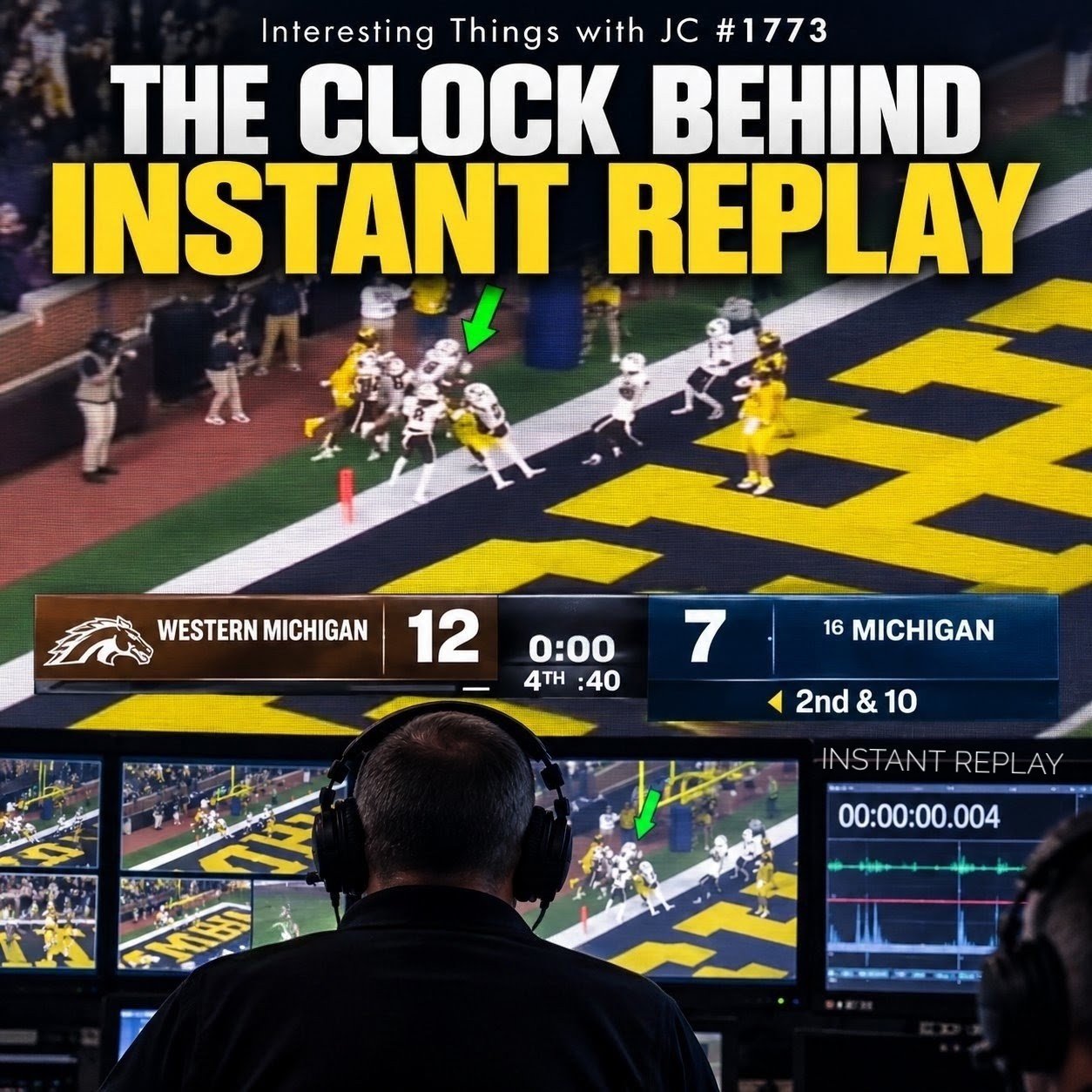
Promotional graphic for Interesting Things with JC #1773: “The Clock Behind Instant Replay.” Large white and yellow title text overlays a football game image showing Western Michigan and Michigan near the end zone. A broadcast scoreboard displays Western Michigan 12, Michigan 7, and 0:00 in the fourth quarter. A green arrow points toward players near the goal line. Below, a replay official wearing headphones faces several video monitors showing multiple angles of the play. A monitor labeled “Instant Replay” displays a timing measurement of 00:00:00.004, emphasizing the episode’s focus on milliseconds, synchronization, and latency in instant-replay decisions.
Transcript
Interesting Things with JC #1773:
"The Clock Behind Instant Replay"
When instant replay officials compare two camera angles, those pictures didn’t necessarily reach the system at the same time. Different processing and signal paths can separate them by milliseconds. That matters when a call depends on the exact frame a knee hits the ground or a ball crosses a line.
Think of two letters mailed at the same moment but taking different routes. One arrives Tuesday, the other Wednesday. The delivery times differ, but the postmark shows they were sent together.
That’s the difference between latency and synchronization. Replay has to know when the pictures belong together, not simply when they arrived.
The Big Ten handles the first part before the game. Eighty-five minutes before kickoff, every broadcast camera used for replay is synchronized with a strobe, including a dedicated camera on the stadium clock. The flash gives them a common visual reference.
But synchronization does not remove latency. Every step after the camera, including processing, switching, transmission, encoding, and decoding, adds delay, and different feeds can take different paths.
Modern IP systems can carry precise timing information with the video so downstream equipment can keep frames on a common timeline instead of assuming that signals arriving together were captured together. Exact compensation methods are not fully disclosed.
Sony’s Hawk-Eye then lets officials advance multiple synchronized angles together, comparing the same instant from different views.
The game clock adds another timing source. A residual latency of only a few milliseconds, four thousandths of a second for example, can be enough. When one feed reaches true zero, a feed carrying that small extra delay still shows time remaining. On a clock that displays only whole seconds, the difference registers as one second left.
That is what happened in Michigan’s 2026 game against Western Michigan. NBC’s clock hit 0:00. The dedicated stadium-clock feed available to Big Ten replay still showed one second. Officials restored it.
Signals can take different amounts of time to travel. Instant replay still has to preserve one common definition of when each frame occurred.
Because the job is not only seeing what happened. It is making sure every camera and every clock agrees on when it happened.
These are interesting things, with JC.
Student Worksheet
Comprehension
What is latency?
What is synchronization?
Why does the episode compare video signals to two letters traveling along different routes?
What purpose does the pregame strobe serve?
Name three stages in a signal path that can introduce delay.
Analysis
Two cameras capture an event simultaneously, but Camera A's signal arrives 12 milliseconds after Camera B's. Does that prove Camera A recorded the event later? Explain.
Why would comparing frames according to arrival time be unreliable in a multi-camera replay system?
Explain how a small timing difference near the transition between one displayed second and the next can produce apparently different whole-second clock readings.
Distinguish the technical question of synchronization from the rules question of which timing source officials should use.
Reflection
Should viewers expect a television presentation and an officiating replay system always to display identical timing information? Explain what evidence you would need before deciding that a discrepancy represents an error.
Difficulty Scaling
Level 1: Define latency and synchronization and identify examples from the transcript.
Level 2: Explain how different signal paths can affect when information arrives.
Level 3: Evaluate a disputed replay scenario by separating capture time, signal delay, synchronization, display behavior, and officiating procedure.
Student Output: Complete Questions 1–10 using full sentences. For Questions 6–10, support each response with technical reasoning or evidence from the episode.
Academic Integrity Guidance: Use the episode and assigned sources to develop your own explanation. Clearly distinguish documented facts from assumptions about equipment or procedures that have not been publicly established.
Teacher Guide
Quick Start: Play or read the episode once without interruption. On a second pass, have students identify every reference to time, delay, synchronization, cameras, and clocks.
Pacing Guide — Audio First
0–5 minutes: Bell ringer and introduction.
5–10 minutes: Listen to the episode without interruption.
10–18 minutes: Define vocabulary and diagram the letter analogy.
18–30 minutes: Complete comprehension and analysis questions.
30–40 minutes: Discuss the Michigan–Western Michigan example and separate engineering claims from officiating-protocol claims.
40–47 minutes: Complete reflection and assessment.
47–50 minutes: Exit ticket.
Bell Ringer: Two cameras record a light flashing at exactly noon. One video reaches a computer 20 milliseconds later than the other. Did the cameras necessarily record different moments? Explain your initial reasoning.
Audio Guidance: Ask students to listen first for the central distinction between when information is captured and when it arrives.
Audio Fallback: If audio is unavailable, read the transcript aloud or have students alternate paragraphs while marking references to timing and signal movement.
Time on Task: Approximately 45–50 minutes for a standard lesson; 60–75 minutes with the extension activity.
Materials
Episode audio or transcript
Student worksheet
Paper or digital diagramming tool
Stopwatch or timing application for optional demonstration
Two devices capable of recording video for the extension
Vocabulary Prep
Introduce latency and synchronization before discussing the game example.
Reinforce that delay and lack of synchronization are not synonyms.
Have students use frame, signal path, and timing reference in technical sentences.
Misconceptions
“Signals that arrive together must have been captured together.” Arrival time and capture time are different concepts.
“Synchronization eliminates latency.” Synchronization establishes timing relationships; it does not make every processing or transmission delay disappear.
“A one-second display difference necessarily means one full second of latency.” A small difference near a whole-second display boundary can produce different displayed integers.
“The technical explanation automatically settles the officiating controversy.” It does not. Reporting after the Michigan–Western Michigan game included a separate dispute over the timing source required by replay protocol.
“The public evidence reveals every internal compensation method.” Students should not infer undocumented implementation details.
Discussion Prompts
Why is capture time more useful than arrival order when comparing multiple cameras?
What information would engineers need to determine whether two video frames represent the same instant?
Why can a technically synchronized system still contain delayed signals?
What additional evidence would be necessary to determine whether a replay procedure complied with governing rules?
Formative Checkpoints
Students correctly distinguish latency from synchronization.
Students can diagram capture → processing → transmission → reception.
Students recognize that different paths can produce different delays.
Students distinguish a documented technical fact from an inference about the Michigan–Western Michigan decision.
Differentiation
Additional Support: Use the two-letter analogy and a simple two-path diagram.
Advanced Learners: Investigate PTP, IEEE 1588, and SMPTE ST 2059 and explain why networked broadcasting requires precise timing.
English Learners: Pair vocabulary terms with diagrams and sentence frames such as “Latency describes ___, while synchronization describes ___.”
Assessment Differentiation: Allow students to demonstrate understanding through a written response, annotated diagram, or short oral explanation while maintaining the same conceptual requirements.
Time Flexibility: For a 25-minute lesson, use Questions 1–8 and the exit ticket. For a 75-minute lesson, add the two-device experiment and source evaluation.
Substitute Readiness: Provide the transcript, worksheet, vocabulary list, and answer key. No specialized technical knowledge is required if the instructor follows the sequence.
Engagement Strategy: Ask students to predict what happens when two videos of the same event travel through different digital paths before revealing the distinction between synchronization and latency.
Extensions
Record the same visible event with two devices and compare corresponding frames.
Research how professional broadcasting uses PTP.
Create a signal-path diagram showing possible sources of processing and transmission delay.
Compare reporting about the 2026 replay decision and identify which claims concern technology and which concern officiating rules.
Cross-Curricular Connections
Physics: Time measurement, propagation, and precision.
Computer Science: Networks, timestamps, data transmission, and processing.
Mathematics: Milliseconds, decimal seconds, intervals, and display boundaries.
Media Literacy: Differences between broadcast presentation and underlying technical systems.
Sports Studies: Replay evidence, rules, and officiating procedures.
SEL Connection: Encourage students to evaluate controversial events by separating observable evidence, technical explanations, assumptions, and emotional reactions.
Skill Value Emphasis: The lesson develops systems thinking, quantitative reasoning, evidence evaluation, technical communication, and source literacy.
Answer Key
Latency is the delay experienced as information moves through processing, transmission, or other stages of a system.
Synchronization establishes a common timing relationship among devices or media.
The letters illustrate that different arrival times do not necessarily mean different starting times.
The strobe provides a common visible reference for aligning cameras used by the replay system.
Accept any three supported examples: processing, switching, transmission, encoding, decoding.
No. Different latency can cause signals captured simultaneously to arrive at different times.
Arrival time reflects the signal path as well as the event itself, so it cannot by itself establish capture time.
A small offset occurring near the instant a display changes from one integer to another can place two representations on opposite sides of that display boundary.
Synchronization concerns establishing timing relationships among signals; the rules question concerns which source or procedure officials are authorized or required to use.
Answers should recognize that identical displays should not be assumed without knowing how each presentation is generated and synchronized. Strong responses request information about capture timing, signal paths, timestamps, display generation, synchronization, and governing replay procedures.
Quiz
Multiple Choice
Which statement best defines latency?
A. The number of cameras recording an event
B. Delay as information passes through a system
C. The frame rate of a video
D. The brightness of a timing strobeWhat is the primary purpose of synchronization in a multi-camera replay system?
A. To make every camera use the same lens
B. To eliminate every transmission delay
C. To establish which images correspond to the same points in time
D. To increase the resolution of every cameraWhy can two signals captured simultaneously arrive at different times?
A. Their signal paths can introduce different amounts of delay.
B. Simultaneous recording is impossible.
C. Every camera operates in a different time zone.
D. Video frames cannot contain timing information.Why can a very small timing difference matter near a whole-second clock transition?
A. It can change the stadium's physical clock speed.
B. It can place two observations on opposite sides of the displayed-second boundary.
C. It automatically adds a second to the game.
D. It prevents cameras from recording frames.Which conclusion best reflects careful analysis of the Michigan–Western Michigan example?
A. Synchronization proves that every officiating procedure was correct.
B. A broadcast display must always be the official replay timing source.
C. Technical synchronization and compliance with replay rules are related but distinct questions.
D. Latency makes accurate replay impossible.
Assessment
Open-Ended Questions
Using the letter analogy and at least four vocabulary terms, explain why arrival time cannot automatically be treated as capture time in an instant-replay system.
A television presentation shows 0:00 while another synchronized replay view appears to preserve time. Identify at least three technical questions and one rules/procedure question that should be investigated before drawing a conclusion.
3–2–1 Rubric
3 — Proficient: Accurately distinguishes synchronization, latency, capture time, and arrival time; applies the concepts to replay; uses evidence and clearly separates documented facts from inference.
2 — Developing: Shows general understanding but contains an incomplete distinction, weak application, or limited evidence.
1 — Beginning: Confuses major concepts or provides conclusions without sufficient technical reasoning.
Exit Ticket: In two or three sentences, explain why “when a picture arrives” and “when the picture was captured” are not necessarily the same thing.
Standards Alignment
NGSS — Science & Engineering Practices
Analyzing and Interpreting Data — Students interpret multiple observations of a time-sensitive event and determine what additional timing information is needed to compare them meaningfully.
Using Mathematics and Computational Thinking — Students reason with milliseconds, temporal offsets, and whole-second display boundaries to explain how small differences can affect displayed information.
CCSS Reading
CCSS.ELA-LITERACY.RST.11-12.7 — Integrate and evaluate multiple sources of information presented in diverse formats and media — Students combine verbal explanation, timing concepts, and replay evidence to address a technical question.
CCSS.ELA-LITERACY.RST.11-12.9 — Synthesize information from a range of sources into a coherent understanding of a process, phenomenon, or concept — Students distinguish established broadcast-timing principles from claims about a specific replay event.
CCSS Writing
CCSS.ELA-LITERACY.WHST.11-12.2 — Write informative/explanatory texts, including the narration of historical events, scientific procedures/experiments, or technical processes — Students construct a technically accurate explanation of latency and synchronization using appropriate vocabulary and evidence.
ISTE
1.3 Knowledge Constructor — Students critically examine digital information and multiple sources to build an evidence-based understanding of a real-world technical problem.
C3 Framework
D4.2.9-12 — Construct explanations using sound reasoning, correct sequence, examples, and details with significant and pertinent information and data — Students construct an evidence-based explanation while distinguishing engineering evidence from procedural claims.
Career Readiness Competencies
Critical Thinking: Analyze a complex technical system by separating inputs, processes, outputs, and timing relationships.
Technical Communication: Explain synchronization and latency accurately to a non-specialist audience.
Information Literacy: Distinguish documented facts, technical principles, disputed interpretations, and unsupported assumptions.
Systems Thinking: Trace how cameras, processing equipment, networks, clocks, and replay systems interact.
Homeschool/Lifelong Learning
Learners can reproduce the core concept with ordinary recording devices, evaluate competing explanations, and connect precise timing to broadcasting, computing, telecommunications, and other networked technologies.
Show Notes
“The Clock Behind Instant Replay” examines a hidden technical problem inside modern sports broadcasting: different video signals can experience different delays even when cameras record the same instant. Using instant replay and the disputed ending of Michigan’s 2026 game against Western Michigan as a case study, the episode distinguishes latency from synchronization and introduces the importance of common timing references in networked video. For classrooms, the topic connects physics, computer networking, engineering, mathematics, media literacy, and evidence evaluation while demonstrating why milliseconds can matter when technology is being used to reconstruct precisely when an event occurred.
References
Big Ten Conference. (2026). Statement regarding the results of the Michigan–Western Michigan game and synchronized replay review. https://x.com/bigten/status/1964540977684209909
McMann, A. (2026, September 6). Big Ten explains why final second was added to Michigan-WMU game clock. MLive/Yahoo Sports. https://sports.yahoo.com/articles/big-ten-explains-why-final-053715615.html
Reuters. (2026, September 8). MAC asks for WMU to be credited with win over Michigan; NCAA clarifies rule. https://www.reuters.com/sports/mac-petitions-cfp-count-w-michigan-loss-michigan-win-its-rankings--flm-2026-09-08/
Society of Motion Picture and Television Engineers. (2021, July 19). Precision Time Protocol for synchronization in broadcast-over-IP. https://www.smpte.org/blog/precision-time-protocol-for-synchronization-in-broadcast-over-ip
Society of Motion Picture and Television Engineers. (2024, October 1). Keeping time with Precision Time Protocol (PTP). https://www.smpte.org/past-events/keeping_time-precision_time_protocol
Kero, N., & Kernen, T. (2021). A multipronged approach to effectively secure SMPTE ST 2059 time transfer. SMPTE Motion Imaging Journal, 130(6). https://journal.smpte.org/periodicals/SMPTE%20Motion%20Imaging%20Journal/130/6/14/