Interesting Things with JC #1772: "Staten Island Remembers"
At Staten Island’s Postcards memorial, 274 individual plaques face across New York Harbor toward the place where the Twin Towers once stood. Many families represented there received no identifiable remains, making the waterfront memorial the closest thing they had to a gravesite, while a second memorial records first responders who died years later from illnesses associated with World Trade Center rescue and recovery work.
Curriculum - Episode Anchor
Episode Title: Staten Island Remembers
Episode Number: 1772
Host: JC
Audience: Grades 9–12, introductory college, homeschool, lifelong learners
Subject Area: U.S. history, social studies, English Language Arts, public history, memorial studies, information literacy
Lesson Overview
Learning Objectives
Explain how Staten Island experienced and commemorates the losses of September 11, 2001.
Analyze how the design of the Postcards memorial transforms individual biographical information into public memory.
Distinguish between a large historical statistic and the individual human experiences represented within it.
Use evidence from an audio narrative to explain how memorials preserve community history across generations.
Essential Question: How can a public memorial preserve individual lives while also helping a community remember a major historical event?
Success Criteria
Students can identify at least three significant features of the Postcards memorial.
Students can explain the significance of at least two individuals discussed in the episode.
Students can support an interpretation of the memorial with specific evidence from the narrative.
Students can explain how design, location, names, and biographies contribute to public remembrance.
Student Relevance Statement: Students encounter monuments, plaques, named buildings, photographs, archives, and memorials in their own communities. Understanding how these forms of public memory are created helps students examine how communities preserve history and communicate it to people who did not personally experience the events being remembered.
Real-World Connection: Memorials combine history, architecture, biography, art, research, public planning, and community participation. Postcards demonstrates how physical space can become a historical record as well as a place for personal remembrance.
Workforce Reality: Historians, educators, architects, museum professionals, archivists, journalists, researchers, preservation specialists, public officials, designers, and emergency-service organizations all work with historical evidence and public communication. These careers require accurate research, careful source evaluation, clear writing, and sensitivity when presenting human experiences.
Key Vocabulary
Terms
Memorial (muh-MOR-ee-uhl) — A structure, place, object, or observance created to preserve the memory of a person or event.
Commemoration (kuh-mem-uh-RAY-shuhn) — An act of formally remembering and honoring people or historical events.
Silhouette (sil-oo-ET) — An outline or profile showing the shape of a person or object, often without interior detail.
First responder (furst ree-SPON-der) — A trained professional, such as a firefighter, police officer, paramedic, or emergency medical worker, who responds to an emergency.
Plaque (plak) — A flat marker displaying information about a person, place, or event.
Public memory (PUB-lik MEM-uh-ree) — The ways a community or society collectively remembers and interprets the past.
Rescue and recovery (RES-kyoo and ree-KUV-uh-ree) — Emergency work focused first on saving lives and subsequently on searching, recovering, securing, and responding to the aftermath of a disaster.
Identifiable remains (eye-den-tuh-FYE-uh-buhl ree-MAYNZ) — Human remains that can be reliably associated with a particular deceased person.
Narrative Core
Open: On Staten Island's waterfront near St. George, two white structures open toward New York Harbor and lower Manhattan. Their orientation connects a present-day place of remembrance with the location where the World Trade Center's Twin Towers once stood.
Info: Postcards is Staten Island's September 11 memorial. Designed by architect Masayuki Sono and dedicated in 2004, it commemorates the borough's losses through individual granite plaques containing names, birth dates, workplaces, and profile silhouettes.
Details: The episode focuses on four people: firefighters Michael Cammarata and Lieutenant Michael Quilty of Ladder Company 11, Aon employee Philip Miller, and Fiduciary Trust vice president Alan Jensen. Their biographies demonstrate how a historical event measured in hundreds or thousands of deaths was simultaneously experienced as the loss of distinct individuals with families, occupations, interests, and personal histories. The memorial's profiles face toward Manhattan, connecting those individual lives visually to the historical site.
Reflection: Postcards functions as both public history and personal remembrance. For families who received no identifiable remains, its significance can extend beyond that of a conventional monument. The nearby remembrance of responders who later died from World Trade Center-related illnesses also illustrates how consequences associated with rescue and recovery continued beyond September 11, 2001.
Closing: These are interesting things, with JC.
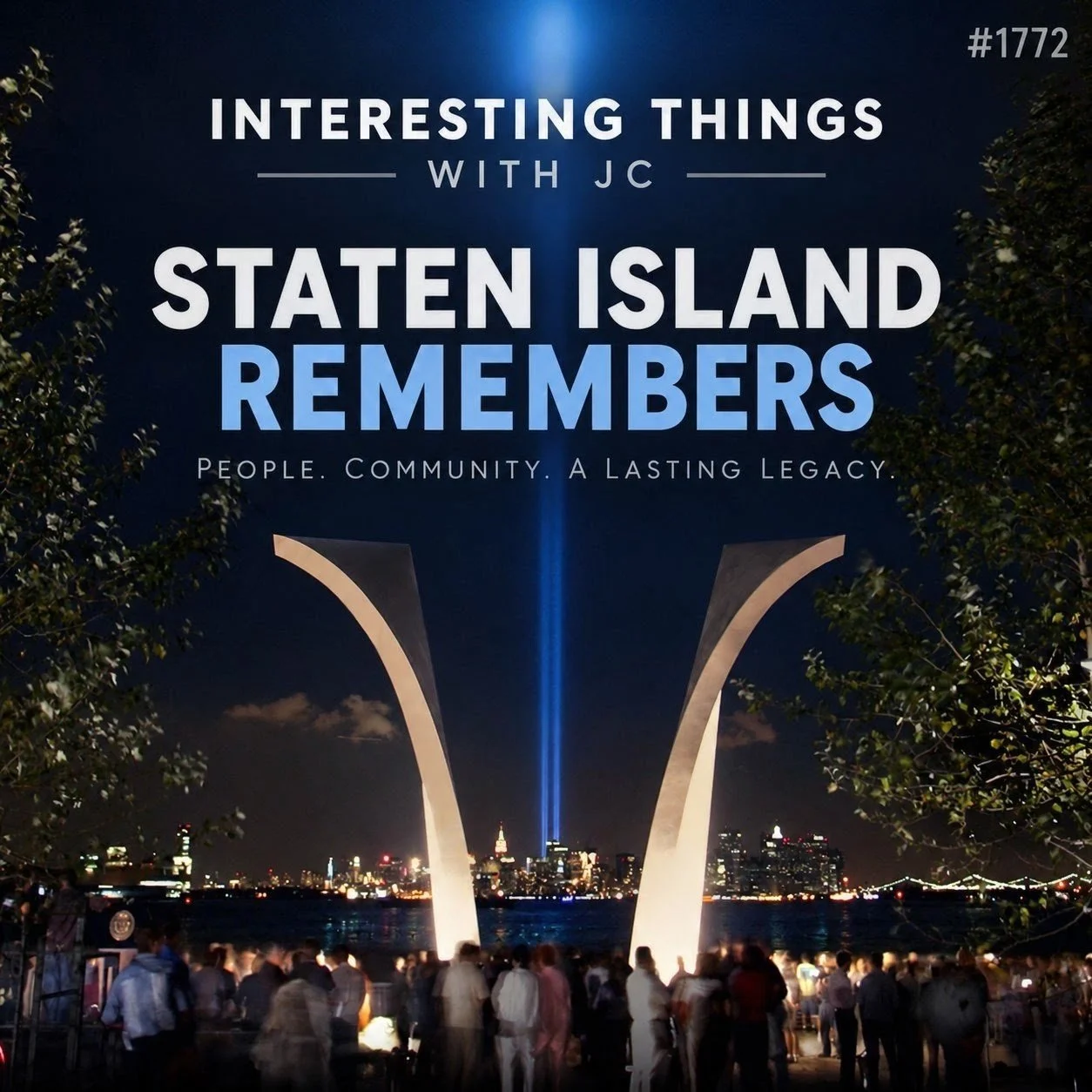
Nighttime view of Staten Island’s Postcards September 11 memorial, with two illuminated white structures framing the Manhattan skyline and twin blue beams of light rising into the sky. Visitors gather along the waterfront. The episode artwork reads “Interesting Things with JC,” “Staten Island Remembers,” “People. Community. A Lasting Legacy,” and “#1772.” This image is reproduced for educational purposes as part of the Interesting Things with JC curriculum / non-commercial use. Use is intended for teaching, scholarship, commentary, and historical discussion under the fair use provisions of U.S. copyright law, 17 U.S.C. § 107. Copyright remains with the respective rights holder. No ownership of third-party copyrighted material is claimed.
Transcript
Interesting Things with JC #1772:
"Staten Island Remembers"
On the Staten Island waterfront, not far from the ferry terminal at St. George, two white walls rise toward the sky and open toward lower Manhattan. Between them, across New York Harbor, is the place where the Twin Towers once stood.
This is Postcards, Staten Island's September 11th memorial.
On September 11th, 2001, Staten Island lost 274 people. In a borough known for close-knit neighborhoods, including generations of Italian-American families who helped build New York, so many residents worked for the city or commuted into Manhattan each morning that the loss reached into firehouses, police families, offices, schools, neighborhoods, and ordinary homes across the island.
Michael Cammarata was 22 years old. He grew up on Staten Island, played in the 1991 Little League World Series, and earned a perfect score on his FDNY firefighter exam. He'd only been with the department a few months when he responded to the World Trade Center with Ladder Company 11. He was the youngest of the 343 FDNY members killed that day.
Lieutenant Michael Quilty, also of Ladder 11, was 42 and had already served 20 years with the FDNY. He lived on Staten Island with his wife and two teenagers. Away from the firehouse, he was a licensed pilot, a certified scuba diver, and a man who enjoyed carpentry, kayaking, and fishing.
There were also Staten Islanders working inside the towers. Philip Miller was 53, a husband and father who ran marathons, played golf, and worked for Aon Corporation on the 102nd floor of the South Tower. Alan Jensen, 49, was a Staten Island native and vice president at Fiduciary Trust. He had made it out of the World Trade Center during the 1993 bombing. On September 11, he was lost in the South Tower.
Four people among 274, each with a family, a history, a job, and people expecting them home.
Staten Island built Postcards so those individual lives wouldn't disappear into a number.
Designed by architect Masayuki Sono and dedicated in 2004, the memorial consists of two soaring white structures, about 50 feet, or 15 meters, high. Inside are individual granite plaques measuring 9 by 11 inches, about 23 by 28 centimeters. Each bears a person's name, birth date and workplace, along with a silhouette created from a photograph supplied by the family.
The profiles face Manhattan.
For many families, Postcards also became the closest thing they had to a gravesite. Former Staten Island Borough President James Molinaro estimated that roughly 60 percent of the families represented there received no identifiable remains of the person they lost. He called the memorial their cemetery.
And September 11 continued taking Staten Islanders long after that morning. Beside Postcards is another memorial honoring first responders who died in the years afterward from illnesses associated with their exposure during the rescue and recovery work at the World Trade Center.
Twenty-five years have passed.
The ferry still moves across the harbor. People still stand on its decks looking toward Manhattan, and every day Staten Islanders still make that familiar trip back and forth.
But at St. George, 274 names remain along the waterfront, each one belonging to a person whose life was larger than what happened to them on September 11.
Their families remember them.
Their neighbors remember them.
And Staten Island made sure there would always be a place where the rest of us could remember them too.
These are interesting things, with JC.
Student Worksheet
Comprehension
What is the name of Staten Island's September 11 memorial?
Where is the memorial located, and what important historical site does it face?
Identify two details from Michael Cammarata's life before September 11, 2001.
What experience and interests described in the episode help establish Michael Quilty as a person beyond his FDNY role?
What information appears on the individual granite plaques at Postcards?
Why did James Molinaro describe the memorial as a cemetery for some families?
Analysis
Why does the episode move from the number 274 to the individual stories of Cammarata, Quilty, Miller, and Jensen?
Analyze the significance of the sentence, “The profiles face Manhattan.” Why might the memorial's orientation matter?
How does the physical location of Postcards contribute to its meaning?
Compare a memorial containing only a list of names with the approach used at Postcards. What additional information do the silhouettes, birth dates, and workplaces communicate?
The episode ends by describing the continuing ferry journey between Staten Island and Manhattan. How does that image connect everyday life, historical memory, and the memorial?
Reflection
What responsibilities, if any, do communities have when preserving the stories of people affected by major historical events? Support your response with evidence from the episode.
Difficulty Scaling
Level 1 — Recall: Answer Questions 1–6 using direct evidence from the episode.
Level 2 — Interpretation: Complete Questions 7–10 using evidence plus explanation.
Level 3 — Synthesis: Complete Questions 11–12 and connect the memorial to a broader concept of public memory.
Student Output: Produce complete written responses to Questions 1–12. For Questions 7–12, include at least one specific detail from the episode and explain how that detail supports your interpretation.
Academic Integrity Guidance: Use the episode as your primary evidence. Paraphrase information in your own words unless directly quoting a short phrase. Clearly identify any outside source used for additional research. Do not present generated, copied, or externally written analysis as your own work.
Teacher Guide
Quick Start: Distribute the worksheet before playing the episode. Introduce only the essential vocabulary needed for comprehension, play the audio without interruption, allow students two minutes to record immediate observations, and then replay selected portions as evidence becomes necessary.
Pacing Guide — Audio First
0–5 minutes: Bell Ringer and brief historical orientation.
5–12 minutes: First uninterrupted audio listening.
12–17 minutes: Individual note capture and vocabulary clarification.
17–27 minutes: Second listening or targeted replay for evidence.
27–42 minutes: Student Worksheet comprehension and analysis.
42–52 minutes: Discussion and formative evidence check.
52–60 minutes: Reflection or Exit Ticket.
Bell Ringer: Ask students to identify a memorial, monument, plaque, named building, cemetery, or other commemorative site they have encountered. In two or three sentences, explain what information the site communicates and what it asks visitors to remember.
Audio Guidance: Play the episode once without stopping so students experience the narrative structure as intended. During a second listening, students may record names, dates, design details, and phrases related to remembrance.
Audio Fallback: If audio is unavailable or unsuitable, read the transcript aloud or assign paired reading. Preserve the narrative sequence and avoid providing worksheet answers before students encounter the complete story.
Time on Task: Approximately 55–60 minutes for one complete lesson. Extended analysis or memorial-design work can expand the lesson to two class periods.
Materials
Episode audio
Transcript
Student Worksheet
Notebook or digital response document
Optional image of Postcards for post-listening visual analysis
Optional map showing Staten Island, New York Harbor, and lower Manhattan
Vocabulary Prep
Preteach memorial, commemoration, silhouette, and public memory.
Allow students to infer plaque, first responder, and rescue and recovery from context before confirming definitions.
Reinforce the distinction between remembering a historical event and preserving information about individual people.
Misconceptions
Students may assume a memorial is simply decorative; emphasize that memorial design can communicate historical information and interpretation.
Students may treat 274 only as a statistic; redirect attention to how the episode deliberately connects the number to individual biographies.
Students may assume the consequences for responders ended in 2001; the episode identifies later deaths associated with World Trade Center-related illnesses.
Students may assume all families had conventional burial sites; the episode explains why Postcards acquired additional significance for families who received no identifiable remains.
Students should not assume that every memorial uses the same count or commemorates precisely the same group; memorials can change over time or include people associated with related events.
Discussion Prompts
What can a biography communicate that a statistic cannot?
How does the direction in which a memorial faces affect a visitor's interpretation?
Why might a workplace be included alongside a person's name and birth date?
What is gained when families contribute photographs used to create individual silhouettes?
How can a memorial serve both private grief and public education?
Formative Checkpoints
Students correctly identify St. George and lower Manhattan as important geographic elements.
Students distinguish the four individual biographies from the larger community loss.
Students identify at least three design features of Postcards.
Students support an interpretation with evidence rather than relying only on personal reaction.
Students can explain public memory in relation to the memorial.
Differentiation
Additional Support: Provide a note organizer with columns for person, occupation, personal details, and connection to September 11.
Advanced Learners: Ask students to analyze how architecture can function as historical argument rather than merely as physical decoration.
English Learners: Provide vocabulary definitions before listening and permit a transcript-supported second listening.
Auditory Learners: Emphasize repeated listening and oral discussion.
Visual Learners: After the first audio encounter, provide a photograph or diagram of the memorial and ask students to match physical features with narrative descriptions.
Assessment Differentiation: Students may demonstrate understanding through a written response, recorded oral explanation, annotated memorial diagram, or teacher-approved multimedia response, provided each format requires evidence and analysis.
Time Flexibility: For a 30-minute period, complete the Bell Ringer, first listening, Questions 1–8, and Exit Ticket. For a 90-minute block, add visual analysis, research verification, and the memorial-design extension.
Substitute Readiness: Provide the transcript, worksheet, vocabulary list, and pacing sequence. The lesson can be completed without prior specialist knowledge because the Answer Key supplies the central evidence.
Engagement Strategy: After the first listening, ask students to select one detail they expect to remember a week later. Compare selections before discussing why certain details make historical narratives memorable.
Extensions
Research another local or national memorial and identify how its design communicates historical meaning.
Create a proposal for a small memorial to a locally significant person or event using location, material, text, and symbolism intentionally.
Compare Postcards with another September 11 memorial, focusing on how each balances individual names with collective remembrance.
Investigate how historians verify biographical details used in memorials and museum exhibits.
Cross-Curricular Connections
History: September 11, 2001, community history, historical memory, primary and secondary sources.
English Language Arts: Narrative structure, evidence, characterization through biographical detail, rhetorical effect.
Architecture and Art: Scale, orientation, symbolism, silhouette, spatial experience.
Geography: Staten Island, New York Harbor, commuting patterns, St. George, lower Manhattan.
Career Education: Emergency services, architecture, museums, archives, historic preservation, journalism.
SEL: Approach the subject with respect and allow students to engage analytically without requiring personal disclosure about grief, trauma, or family experiences. Emphasize empathy through evidence-based examination of individual lives.
Skill Emphasis: Evidence selection, listening comprehension, historical interpretation, spatial reasoning, source evaluation, concise explanatory writing, and respectful discussion.
Answer Key
Postcards.
It is on the Staten Island waterfront at St. George near the ferry terminal and faces across New York Harbor toward lower Manhattan and the former World Trade Center site.
Acceptable details include that Cammarata grew up on Staten Island, played in the 1991 Little League World Series, earned a perfect firefighter-exam score, was 22, and had joined the FDNY only months before September 11.
Quilty had served 20 years with the FDNY and was also described as a licensed pilot, certified scuba diver, carpenter, kayaker, and fisherman. These details portray interests and abilities outside his profession.
The episode describes each plaque as containing a name, birth date, workplace, and silhouette based on a family-supplied photograph.
The episode states that many represented families received no identifiable remains, making the memorial function for some as the closest equivalent to a gravesite.
The individual stories transform an abstract casualty number into identifiable human lives with families, occupations, interests, and histories.
Strong responses should explain that facing Manhattan physically connects each represented person with the location of the World Trade Center and makes orientation part of the memorial's meaning.
The harbor setting provides a direct visual relationship between Staten Island and lower Manhattan while also connecting the memorial to the commuting route familiar to many residents.
Names identify people, while silhouettes, birth dates, and workplaces provide additional biographical identity and emphasize individuality.
Strong responses should recognize the ferry as an image of continuity: ordinary movement between Staten Island and Manhattan continues while the memorial preserves the memory of people who once participated in that community life.
Answers will vary. Strong responses establish a position, use episode evidence, and explain why individual stories, accurate records, physical sites, or community remembrance matter.
Quiz
Questions
What is Postcards?
A. A ferry terminal exhibit
B. Staten Island's September 11 memorial
C. A former FDNY station
D. A museum inside the World Trade Center
Who designed Postcards?
A. Michael Quilty
B. James Molinaro
C. Masayuki Sono
D. Philip Miller
Which feature appears on the individual plaques described in the episode?
A. A profile silhouette
B. A handwritten letter
C. A photograph of the World Trade Center
D. A map of Staten Island
What did Michael Cammarata and Michael Quilty have in common?
A. Both worked for Aon Corporation.
B. Both were pilots.
C. Both served with Ladder Company 11.
D. Both survived the 1993 bombing.
Why is the orientation of Postcards important to the episode's interpretation of the memorial?
A. It directs visitors toward the ferry parking area.
B. It positions the profiles toward Manhattan and the former World Trade Center site.
C. It marks the geographic center of Staten Island.
D. It identifies the location of Ladder Company 11.
Assessment
Open-Ended Questions
Explain how Postcards uses architecture and biographical information together to preserve public memory. Use at least three details from the episode.
The episode states, “Four people among 274, each with a family, a history, a job, and people expecting them home.” Explain how the rest of the narrative develops this idea.
3–2–1 Rubric
3 — Proficient: Uses accurate and specific episode evidence, clearly explains the relationship between evidence and interpretation, and demonstrates understanding of individual and collective remembrance.
2 — Developing: Uses some relevant evidence and demonstrates general understanding, but explanation or connections are incomplete.
1 — Beginning: Provides limited or inaccurate evidence, summarizes without analysis, or does not clearly connect the response to the episode.
Exit Ticket: In 2–3 sentences, identify one design choice at Postcards and explain what that choice communicates about remembrance.
Standards Alignment
NGSS — Science & Engineering Practices
Obtaining, Evaluating, and Communicating Information — Students extract information from an audio narrative, distinguish factual evidence from interpretation, and communicate an evidence-based explanation of how a designed structure conveys information. Measurable outcome: students cite at least three accurate details in an explanatory response.
CCSS Reading
CCSS.ELA-LITERACY.RI.9-10.1 — Cite strong and thorough textual evidence — Students identify evidence from the transcript to support analysis of memorial design and public memory. Measurable outcome: students incorporate specific transcript evidence in analytical responses.
CCSS.ELA-LITERACY.RI.11-12.2 — Determine two or more central ideas of a text and analyze their development — Students examine the relationship between individual biography and collective remembrance. Measurable outcome: students identify and trace at least two central ideas through the narrative.
CCSS Writing
CCSS.ELA-LITERACY.W.9-10.9 — Draw evidence from informational texts to support analysis, reflection, and research — Students use the episode transcript as evidence in worksheet and assessment responses. Measurable outcome: students connect factual details to an explicit analytical claim.
CCSS.ELA-LITERACY.W.11-12.2 — Write informative/explanatory texts — Students explain how location, design, biography, and symbolism communicate historical meaning. Measurable outcome: students produce an organized evidence-based explanation.
C3 Framework — History
D2.His.14.9-12 — Analyze multiple and complex causes and effects of events in the past — Students distinguish the immediate September 11 losses discussed in the episode from continuing consequences associated with rescue and recovery exposure. Measurable outcome: students identify immediate and longer-term dimensions of historical impact.
C3 Framework — Historical Sources and Evidence
D3.1.9-12 — Gather relevant information from multiple sources while using origin, authority, structure, context, and corroborative value to guide selection — In the extension activity, students verify memorial or biographical information using authoritative sources. Measurable outcome: students explain why a selected source is appropriate for a factual claim.
ISTE — Knowledge Constructor
1.3.b — Evaluate the accuracy, perspective, credibility, and relevance of information, media, data, or other resources — Students distinguish narrative interpretation from verifiable factual claims and evaluate outside sources during extension research. Measurable outcome: students justify the credibility and relevance of at least one research source.
Career Readiness Competencies
Communication: Students present concise evidence-based explanations suitable for academic and public audiences.
Critical Thinking: Students interpret how architectural choices communicate meaning rather than merely identifying physical features.
Information Literacy: Students distinguish claims requiring verification from interpretations supported by narrative evidence.
Professional Responsibility: Students practice accurate and respectful communication about identifiable people and historically sensitive events.
Homeschool/Lifelong Learning
Learners can use the episode independently to practice listening comprehension, historical inquiry, source verification, and analysis of public spaces.
A local memorial study can transfer the lesson to the learner's own community by requiring observation, research, evidence collection, and interpretation.
Show Notes
“Staten Island Remembers” examines Postcards, the September 11 memorial on the waterfront at St. George, through the individual lives represented there and the architecture created to preserve their memory. The episode introduces Michael Cammarata, Michael Quilty, Philip Miller, and Alan Jensen before exploring how names, silhouettes, workplaces, location, and orientation transform a memorial into a form of public history. For classrooms, the episode provides an accessible way to study historical memory, biography, architecture, evidence, community impact, and the challenge of ensuring that individuals remain visible within the statistics of major historical events. It matters because each generation must learn not only what happened in history, but how and why communities choose to remember the people who experienced it.
References
National Fallen Firefighters Foundation. (n.d.). Michael F. Cammarata.
https://www.firehero.org/fallen-firefighter/michael-f-cammarata/National Fallen Firefighters Foundation. (n.d.). Michael T. Quilty.
https://www.firehero.org/fallen-firefighter/michael-t-quilty/National September 11 Memorial & Museum. (n.d.). Wristwatch, recovered: Michael T. Quilty.
https://collection.911memorial.org/Detail/objects/77435/rel/1National September 11 Memorial & Museum. (n.d.). Sharing the Memorials Registry: Postcards, 2004, Staten Island, NY.
https://m.911memorial.org/connect/blog/sharing-memorials-registry-postcards-2004-staten-island-nyLittle League International. (2020). Remembering Number 11: Michael Cammarata.
https://www.littleleague.org/news/remembering-number-11-michael-cammarata/Voices Center for Resilience. (n.d.). Staten Island 9/11 Postcards Memorial.
https://voicesofsept11.org/living-memorial/memorials/staten-island-911-postcards-memorialFire Department of the City of New York. (2026). September 11th remembrance events.
https://www.nyc.gov/site/fdny/about/resources/calendar/september-11th-remembrance.pageFire Department of the City of New York. (2026, September 9). Overlooking Lower Manhattan, the Department holds 2026 FDNY World Trade Center Memorial Service on Staten Island.
https://www.nyc.gov/site/fdny/news/SE2626/overlooking-lower-manhattan-department-holds-2026-fdny-world-trade-center-memorial-service-on