Interesting Things with JC #1775: "The Signal Einstein Thought We Might Never Hear"
Two LIGO detectors register the same gravitational-wave signal seven milliseconds apart as two black holes merge 1.3 billion light-years away. The signal lasts about two-tenths of a second, while the instruments measure changes smaller than the width of a proton after decades of attempts failed to detect one.
Curriculum - Episode Anchor
Episode Title: The Signal Einstein Thought We Might Never Hear
Episode Number: 1775
Host: JC
Audience: Grades 9–12, introductory college, homeschool, lifelong learners
Subject Area: Physics, astronomy, engineering, scientific literacy, English Language Arts
Lesson Overview
Learning Objectives
Explain gravitational waves as distortions in spacetime produced by accelerating masses.
Describe how observations of the Hulse–Taylor binary pulsar provided indirect evidence for gravitational-wave energy loss.
Explain how LIGO uses laser interferometry to measure extraordinarily small changes in distance.
Analyze how the detection of GW150914 illustrates the relationship among scientific theory, evidence, engineering, and technological advancement.
Essential Question: How can scientists detect a phenomenon whose physical effect is far smaller than anything humans can directly perceive?
Success Criteria: Students can accurately describe the evidence leading to the first direct detection of gravitational waves, explain the operating principle of LIGO, identify key quantitative details of GW150914, and distinguish prediction, indirect evidence, and direct measurement.
Student Relevance Statement: Gravitational-wave astronomy shows how ideas that initially seem impossible to test can become measurable when mathematics, engineering, computing, and experimentation advance together.
Real-World Connection: LIGO combines lasers, precision optics, vibration isolation, vacuum technology, data analysis, modeling, and international scientific collaboration to observe events billions of light-years away.
Workforce Reality: Gravitational-wave research depends on physicists, astronomers, mechanical and optical engineers, computer scientists, data analysts, technicians, software developers, and specialists in instrumentation and controls.
Key Vocabulary
Terms
Gravitational wave (grav-ih-TAY-shuh-nuhl wayv) — A propagating distortion in spacetime produced by accelerating masses and predicted by general relativity.
Spacetime (SPAYS-tym) — The unified framework of three spatial dimensions and time used in relativity.
General relativity (JEN-er-uhl rel-uh-TIV-ih-tee) — Einstein's theory describing gravity as the curvature of spacetime produced by mass and energy.
Neutron star (NOO-tron star) — An extremely dense stellar remnant formed when certain massive stars collapse.
Binary system (BY-nuh-ree SIS-tuhm) — Two astronomical objects gravitationally bound and orbiting a common center of mass.
Interferometer (in-ter-feh-ROM-uh-ter) — An instrument that combines light waves to detect extremely small differences in distance or optical path length.
Black hole (blak hohl) — A region of spacetime whose gravity is sufficiently strong that, beyond its event horizon, nothing can escape.
Inspiral (IN-spy-ruhl) — The stage in which two compact objects orbit progressively closer together while losing orbital energy.
Frequency (FREE-kwen-see) — The number of wave cycles occurring per unit time; increasing gravitational-wave frequency produced the rising pitch associated with GW150914.
Solar mass (SOH-ler mass) — A unit of mass equal to the mass of the Sun and commonly used for stars, neutron stars, and black holes.
Narrative Core
Open: In 1916, Einstein's general theory of relativity led to a remarkable prediction: accelerating masses could generate disturbances that travel through spacetime. The predicted effect was so small that detecting it directly posed an extraordinary experimental challenge.
Info: Evidence accumulated long before scientists could measure a gravitational wave passing Earth. In 1974, Russell Hulse and Joseph Taylor discovered a binary pulsar containing two neutron stars. Subsequent measurements showed its orbital period decreasing at a rate closely matching the energy loss predicted from gravitational radiation.
Details: Direct detection required laser interferometers capable of sensing changes vastly smaller than an atomic nucleus. LIGO's observatories in Washington and Louisiana use perpendicular four-kilometer arms, suspended mirrors, lasers, extreme vacuum systems, and isolation from environmental vibrations. On September 14, 2015, the two Advanced LIGO detectors recorded GW150914, with the signal reaching Livingston approximately seven milliseconds before Hanford. Analysis indicated that black holes of roughly 36 and 29 solar masses merged about 1.3 billion light-years away, leaving a black hole of about 62 solar masses and radiating roughly three solar masses of energy as gravitational waves.
Reflection: GW150914 demonstrates that scientific discovery can require generations of work. A theoretical prediction became indirectly testable through astronomy, then directly measurable only after major advances in precision engineering, optics, computing, and noise control.
Closing: These are interesting things, with JC.
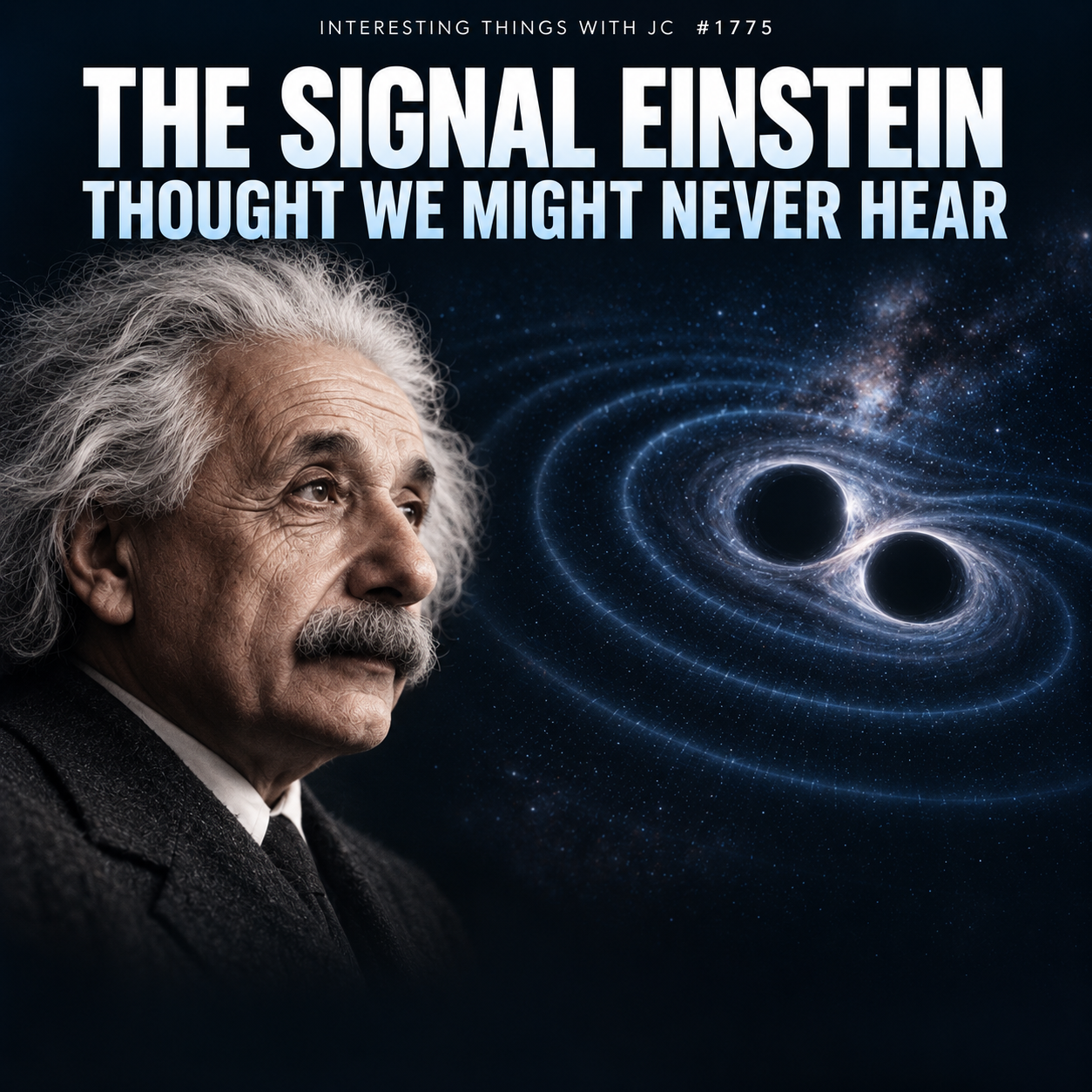
Dark blue space-themed episode graphic for “Interesting Things with JC #1775: The Signal Einstein Thought We Might Never Hear.” An elderly white-haired man with a mustache appears in profile on the left, while two merging black holes surrounded by glowing gravitational-wave ripples appear against a star-filled sky on the right.
Transcript
Interesting Things with JC #1775:
"The Signal Einstein Thought We Might Never Hear"
In 1916, Albert Einstein's new theory of gravity produced a strange prediction. When massive objects move and accelerate, they can send tiny ripples through space itself. Those are gravitational waves. Think of ripples spreading across a pond, except what's rippling is space and time, and the waves travel at the speed of light.
For decades, nobody could measure them. Then, in 1974, Russell Hulse and Joseph Taylor discovered two extremely dense neutron stars circling each other. Their orbit was slowly shrinking, losing energy at almost exactly the rate Einstein's theory predicted if gravitational waves were carrying it away.
But measuring one passing Earth required something extraordinary.
LIGO uses two L-shaped instruments in Washington and Louisiana, each with arms 2.5 miles, or 4 kilometers, long. Lasers travel down those arms and reflect from mirrors. When a gravitational wave passes, the distance between the mirrors changes by less than the width of a proton.
The first LIGO operated from 2002 to 2010 without success. Scientists rebuilt it with better lasers, mirrors and protection from vibrations.
On September 14, 2015, both instruments picked up the same signal, seven milliseconds apart.
It lasted about two-tenths of a second. Two black holes roughly 1.3 billion light-years away were spiraling together faster and faster, causing the signal to rise in pitch before they merged.
One was about 36 times the mass of our Sun, the other about 29. The black hole left behind was about 62 solar masses. Roughly three Suns' worth of mass had been converted into energy, released largely as gravitational waves in a fraction of a second.
At its peak, the merger produced more power in gravitational waves than all the stars in the observable universe were producing as light at that moment.
Those waves crossed the universe for about 1.3 billion years before making LIGO's mirrors move less than the width of a proton.
Einstein had the mathematics in 1916. It took nearly another century to build something sensitive enough to hear it.
These are interesting things, with JC.
Student Worksheet
Comprehension
What did Einstein's theory predict could be produced when massive objects accelerate?
What did Hulse and Taylor discover in 1974, and why did the system become important to tests of general relativity?
How long is each arm of a LIGO detector?
What measurement does LIGO make when a gravitational wave passes?
On what date was GW150914 detected?
Approximately how much time separated the signal's arrival at the two LIGO observatories?
What were the approximate masses of the two black holes before they merged?
What was the approximate mass of the final black hole?
Analysis
Explain why the Hulse–Taylor observations are considered indirect evidence for gravitational waves while GW150914 is considered a direct detection.
The initial black holes had a combined mass of about 65 solar masses, while the final black hole was about 62 solar masses. Explain what happened to the difference.
Why were two geographically separated LIGO observatories valuable for confirming the detection?
Explain why improvements in vibration isolation, lasers, mirrors, and measurement technology were essential to LIGO's success.
The GW150914 signal rose in frequency before merger. What does this suggest about the motion of the two black holes during their final orbits?
Reflection
What does the nearly century-long path from Einstein's prediction to LIGO's detection suggest about the relationship between scientific ideas and technological capabilities?
Identify one modern scientific question that may require instruments not yet sensitive enough to answer. Explain why improved measurement could matter.
Difficulty Scaling
Level 1 — Recall: Complete Questions 1–8 using evidence from the episode.
Level 2 — Explanation: Complete Questions 1–13 and support analytical responses with specific episode evidence.
Level 3 — Synthesis: Complete all questions and connect the episode to a broader example of theory, instrumentation, or scientific uncertainty.
Student Output: Produce complete-sentence responses. Analytical answers should normally include a claim, supporting evidence, and reasoning connecting the evidence to the claim.
Academic Integrity Guidance: Use the episode and assigned sources to construct your own explanations. If outside information is permitted, identify the source and distinguish outside research from information contained in the episode.
Teacher Guide
Quick Start: Play or read the episode once without interruption. Ask students to identify the central scientific problem. Play or read it a second time while students record three pieces of evidence showing how gravitational-wave science progressed from prediction to measurement.
Pacing Guide — Audio First
0–5 minutes: Bell Ringer and initial prediction.
5–10 minutes: First uninterrupted listening.
10–15 minutes: Vocabulary clarification and student summary.
15–22 minutes: Second listening with evidence collection.
22–35 minutes: Student Worksheet comprehension and analysis.
35–45 minutes: Discussion of theory, evidence, and instrumentation.
45–52 minutes: Open-ended assessment or extension.
52–55 minutes: Exit Ticket.
Bell Ringer: Ask students: "How could scientists prove that something exists if its effect is too small to see directly?" Students write for two minutes and identify at least one measurement strategy.
Audio Guidance: Have students listen first for the narrative rather than attempting to record every number. During the second pass, direct attention to dates, measurements, masses, and the sequence from theory to indirect evidence to direct detection.
Audio Fallback: If audio is unavailable, read the transcript aloud or assign alternating paragraphs to readers while preserving the original sequence.
Time on Task: Approximately 45–55 minutes for a standard lesson; 25–30 minutes for a shortened version.
Materials
Episode audio or transcript
Student Worksheet
Writing materials or digital response platform
Optional diagram of a Michelson-style interferometer
Optional calculator for mass-difference and scale activities
Vocabulary Prep
Preteach spacetime, interferometer, inspiral, and solar mass.
Emphasize that gravitational waves are not sound waves.
Connect frequency to the increasing orbital rate of the merging black holes.
Misconceptions
"Gravitational waves are sound traveling through space." They are distortions of spacetime; the familiar "chirp" is an audio representation of measured gravitational-wave frequencies.
"The mirrors moved by about the width of a proton." The measured displacement associated with GW150914 was substantially smaller than a proton's diameter; "less than the width of a proton" is a scale comparison.
"Hulse and Taylor directly detected gravitational waves in 1974." Their binary pulsar supplied indirect evidence through orbital decay consistent with gravitational-radiation predictions.
"LIGO photographed the two black holes." LIGO measured changes in interferometer arm lengths caused by a passing gravitational wave.
"The missing three solar masses disappeared." The equivalent mass-energy was radiated predominantly as gravitational-wave energy during the merger.
Discussion Prompts
What makes a scientific prediction testable?
How did the Hulse–Taylor system strengthen confidence in general relativity before direct detection?
Why does extremely precise science often require controlling the environment around an experiment?
How does GW150914 demonstrate the importance of engineering to basic scientific research?
Does the long delay between prediction and detection weaken a theory, strengthen it, or neither? Defend your answer.
Formative Checkpoints
Students correctly distinguish gravitational waves from electromagnetic or sound waves.
Students identify 1916, 1974, and 2015 as different stages in the evidence sequence.
Students explain the role of interferometry without claiming LIGO directly photographed the source.
Students connect the approximately three-solar-mass difference to radiated energy.
Students distinguish indirect observational evidence from direct instrumental detection.
Differentiation
Additional Support: Provide a three-column organizer labeled Prediction, Indirect Evidence, and Direct Detection.
Advanced Learners: Ask students to investigate strain as a fractional change in length and connect it to LIGO's four-kilometer arms.
English Learners: Pair vocabulary with diagrams and allow an oral explanation before written responses.
Visual Learners: Use a simple L-shaped interferometer diagram showing perpendicular laser paths.
Auditory Learners: Replay the section describing the rising pitch of the signal and ask students to connect pitch with frequency.
Assessment Differentiation: Permit students to demonstrate understanding through a written explanation, labeled diagram with commentary, brief oral presentation, or teacher-approved multimedia product while preserving the same evidence requirements.
Time Flexibility: For a 25-minute lesson, use one listening, Questions 1–5 and 9–10, one discussion prompt, and the Exit Ticket. For a 90-minute block, add a quantitative strain investigation or source-evaluation activity.
Substitute Readiness: Provide the transcript, worksheet, vocabulary list, pacing sequence, and answer key. No laboratory setup or specialized physics background is required.
Engagement Strategy: Begin with the scale challenge: ask students to imagine designing an instrument that must detect a length change far smaller than a proton while trucks, earthquakes, wind, and ordinary ground motion affect the apparatus.
Extensions
Calculate the approximate initial total black-hole mass and compare it with the final mass.
Research how interferometers use constructive and destructive interference.
Compare gravitational-wave astronomy with electromagnetic astronomy.
Examine a published visualization of the GW150914 waveform and identify its increasing frequency.
Investigate later gravitational-wave observations and how multiple detectors improve source localization.
Cross-Curricular Connections
Physics: Waves, energy, relativity, measurement, and interference.
Mathematics: Scientific notation, ratios, frequency, scale, and uncertainty.
Engineering: Precision instrumentation, vibration isolation, optics, and design constraints.
Computer Science: Signal processing, noise filtering, modeling, and large-scale data analysis.
History of Science: The progression from theoretical prediction to indirect evidence and direct observation.
English Language Arts: Evidence-based explanation, technical vocabulary, synthesis, and source evaluation.
SEL Connection: Emphasize intellectual persistence, collaboration, uncertainty tolerance, and the value of long-term work whose final outcome may not occur within one researcher's career.
Skill Value Emphasis: Students practice extracting quantitative evidence, explaining causal relationships, distinguishing different kinds of scientific evidence, and communicating complex technical ideas clearly.
Answer Key
Accelerating massive objects can generate gravitational waves, or ripples/distortions in spacetime.
They discovered a binary pulsar involving two neutron stars; its changing orbit later provided a precise test of predicted gravitational-radiation energy loss.
Approximately 2.5 miles, or 4 kilometers.
It detects extremely small relative changes in the lengths of its perpendicular interferometer arms.
September 14, 2015.
Approximately seven milliseconds.
Approximately 36 and 29 solar masses.
Approximately 62 solar masses.
The binary pulsar's orbital changes matched a consequence expected from gravitational-wave emission without measuring waves passing a detector. LIGO directly measured spacetime strain from GW150914.
Roughly three solar masses of equivalent mass-energy were radiated primarily as gravitational waves.
Matching signals at separated instruments, with an arrival-time difference consistent with propagation between the sites, helped distinguish an astrophysical event from local disturbance.
The target displacement was extraordinarily small, so laser stability, optical quality, isolation, vacuum systems, and noise reduction were necessary to make the signal measurable.
The objects were orbiting progressively faster as their separation decreased during inspiral.
Accept responses explaining that valid theories may precede the technology required to test their consequences and that advances in instrumentation can open new forms of observation.
Answers will vary; assess whether the student clearly identifies a measurement limitation and explains how greater sensitivity could produce new evidence.
Quiz
Multiple Choice
What did Einstein's theory predict in 1916?
A. Black holes could emit visible flashes every second.
B. Accelerating masses could generate gravitational waves.
C. Neutron stars could not exist in binary systems.
D. Light would travel faster than gravity.Why was the Hulse–Taylor binary pulsar scientifically important?
A. It directly produced the first LIGO signal.
B. It allowed scientists to photograph gravitational waves.
C. Its orbital behavior agreed closely with predicted energy loss from gravitational radiation.
D. It proved that neutron stars have no gravitational fields.How does LIGO detect a gravitational wave?
A. By measuring minute changes in the relative lengths of perpendicular laser-interferometer arms.
B. By measuring changes in Earth's average temperature.
C. By collecting visible light from every black-hole merger.
D. By measuring radioactivity inside its mirrors.Approximately what were the masses of the two black holes responsible for GW150914?
A. 3 and 6 solar masses
B. 10 and 12 solar masses
C. 36 and 29 solar masses
D. 62 and 65 solar massesWhat happened to roughly three solar masses during the merger?
A. They were converted largely into gravitational-wave energy.
B. They became a third orbiting neutron star.
C. They were transferred to Earth.
D. They disappeared without producing energy.
Assessment
Open-Ended Questions
Trace the scientific path from Einstein's 1916 prediction to the 2015 detection of GW150914. Your response must distinguish theory, indirect evidence, technological development, and direct evidence.
Explain why GW150914 was both a scientific discovery and an engineering achievement. Use at least three specific details from the episode.
3–2–1 Rubric
3 — Proficient: Accurate explanation; uses multiple specific pieces of evidence; distinguishes prediction, indirect evidence, and direct detection; reasoning clearly connects evidence to conclusions.
2 — Developing: Mostly accurate explanation with some supporting evidence; contains a minor omission, imprecision, or incomplete connection between evidence and conclusion.
1 — Beginning: Limited or inaccurate explanation; insufficient evidence; major concepts are confused or unsupported.
Exit Ticket: In two or three sentences, explain why detecting GW150914 required more than Einstein's mathematical prediction alone.
Standards Alignment
NGSS — Science & Engineering Practices
HS-PS4-1 — Waves and Their Applications in Technologies for Information Transfer — Students use quantitative and qualitative wave concepts to interpret frequency, propagation, and measurement in the episode. Measurable outcome: students accurately connect changing frequency to the observed gravitational-wave signal and explain how wave measurements reveal information about a distant source.
HS-PS4-5 — Communicating Technical Information About Wave-Based Technologies — Students explain how LIGO employs laser light, mirrors, interference, and precision measurement to capture information from a wave phenomenon. Measurable outcome: students produce a technically accurate explanation of the interferometer's function.
Analyzing and Interpreting Data — Students use masses, arrival times, distance, and signal behavior as evidence in explanations. Measurable outcome: students use at least three quantitative observations to support a scientific conclusion.
CCSS Reading
CCSS.ELA-LITERACY.RST.11-12.1 — Cite Specific Textual Evidence — Students identify precise episode evidence supporting explanations of gravitational-wave detection. Measurable outcome: analytical responses accurately incorporate episode details without misrepresenting the source.
CCSS.ELA-LITERACY.RST.11-12.2 — Determine Central Ideas or Conclusions — Students trace the episode's explanation from theoretical prediction through experimental confirmation. Measurable outcome: students produce an accurate evidence-based summary of the scientific progression.
CCSS Writing
CCSS.ELA-LITERACY.WHST.11-12.2 — Informative/Explanatory Writing — Students explain a complex scientific process using precise terminology, organized evidence, and causal relationships.
CCSS.ELA-LITERACY.WHST.11-12.9 — Evidence from Informational Texts — Students draw episode evidence into written analysis and assessment responses.
ISTE — Student Competencies
1.3.b — Knowledge Constructor: Evaluate Information — Students evaluate accuracy, relevance, and evidentiary value when distinguishing a theoretical prediction, indirect evidence, and a direct instrument measurement. Measurable outcome: students correctly classify each type of evidence and explain its scientific role.
1.5.c — Computational Thinker: Decompose Problems — Students break the detection challenge into signal production, propagation, instrumentation, noise control, measurement, and interpretation. Measurable outcome: students construct an ordered explanation of how the measurement problem was solved.
1.6.c — Creative Communicator: Communicate Complex Ideas — Students translate a complex scientific discovery into a clear written, oral, diagrammatic, or digital explanation. Measurable outcome: student communication preserves the essential scientific relationships without introducing conceptual errors.
C3 Framework — Inquiry and Evidence
Developing Claims and Using Evidence — Students construct claims about the importance of GW150914 and support those claims with relevant historical and scientific evidence.
Evaluating Sources and Evidence — Students distinguish theoretical claims, astronomical observations, instrumental measurements, and interpretations rather than treating all evidence as equivalent.
Communicating Conclusions — Students present a concise evidence-based account of how scientific knowledge changed as new measurement capabilities became available.
Career Readiness Competencies
Critical Thinking: Interpret measurements and distinguish evidence from inference.
Technical Communication: Explain specialized scientific concepts accurately to a non-specialist audience.
Data Literacy: Use quantitative details such as mass, distance, time, and frequency as evidence.
Problem Solving: Identify measurement constraints and connect engineering solutions to those constraints.
Collaboration Awareness: Recognize that major scientific instruments require interdisciplinary teams across physics, engineering, computing, and technical operations.
UK National Curriculum — Key Stage 4 / Post-16 Connections
Physics — Waves: Apply wave concepts including frequency, propagation, and measurement to a contemporary observational system.
Working Scientifically: Evaluate evidence, understand the role of measurement, and consider how improvements in experimental methods affect scientific knowledge.
Quantitative Skills: Interpret orders of magnitude, scale comparisons, and numerical evidence from scientific observations.
IB — MYP / Diploma Programme Connections
Knowing and Understanding: Apply scientific terminology and principles to explain gravitational-wave detection.
Inquiring and Designing: Analyze why instrumentation must be designed around sensitivity, environmental noise, and measurement constraints.
Processing and Evaluating: Interpret observational evidence and assess how measurements support scientific explanations.
Reflecting on the Impacts of Science: Consider how theoretical physics, engineering, computing, and collaboration combine to create new observational capabilities.
Homeschool and Lifelong Learning
Scientific Literacy: Distinguish hypotheses, predictions, indirect evidence, and direct observations.
Independent Inquiry: Use authoritative sources to investigate an unfamiliar scientific question.
Numeracy: Interpret large astronomical distances and extremely small measurement scales.
Communication: Explain sophisticated scientific ideas accurately in accessible language.
Show Notes
The first direct detection of gravitational waves transformed a prediction from Einstein's general theory of relativity into a new way of observing the universe. Episode #1775 follows the story from Einstein's 1916 prediction through the Hulse–Taylor binary pulsar and the development of LIGO to the September 14, 2015 detection of GW150914. In the classroom, the episode connects physics with engineering, mathematics, scientific history, evidence evaluation, and technical communication. It matters because the discovery demonstrates that progress in science depends not only on having a powerful idea, but also on developing instruments capable of testing what the idea predicts.
References
LIGO Scientific Collaboration and Virgo Collaboration. (2016). Observation of gravitational waves from a binary black hole merger. LIGO Document Control Center. https://dcc.ligo.org/P150914/public
LIGO Scientific Collaboration. (2016). GW150914. LIGO Scientific Collaboration. https://ligo.org/detections/gw150914/
LIGO Scientific Collaboration. (2016). Observation of gravitational waves from a binary black hole merger. https://ligo.org/science-summaries/gw150914/
LIGO Scientific Collaboration. (2016). GW150914: The Advanced LIGO detectors in the era of first discoveries. https://ligo.org/science-summaries/GW150914Detector/
LIGO Laboratory, Caltech. (n.d.). LIGO's interferometer. https://www.ligo.caltech.edu/MIT/page/ligos-ifo
Nobel Prize Outreach. (1993). Press release: The 1993 Nobel Prize in Physics. https://www.nobelprize.org/prizes/physics/1993/press-release/