
Interesting Things with JC #1776: "Ellen Langer - Counterclockwise"
In 1979, elderly men entered a retreat rebuilt as 1959 and were told to live as though twenty years had disappeared. Days later, researchers measured changes.
Curriculum - Episode Anchor
Episode Title: Ellen Langer - Counterclockwise
Episode Number: 1776
Host: JC
Audience: Grades 9–12, introductory college, homeschool, lifelong learners
Subject Area: Psychology, health science, research methods, aging, information literacy
Lesson Overview
Learning Objectives
Explain the design and central question of Ellen Langer’s 1979 “counterclockwise” experiment.
Distinguish between an intriguing experimental result and a scientifically established conclusion.
Evaluate how sample size, controls, publication history, and replication affect the strength of scientific evidence.
Analyze how expectations, environmental cues, and assumptions may influence human behavior and performance.
Essential Question: What can an unusual experiment about aging teach us about the relationship between expectations, environment, behavior, and scientific evidence?
Success Criteria: Students can accurately describe the experimental and comparison conditions, identify at least three methodological limitations, interpret the reported findings without overstating them, and support an evidence-based conclusion.
Student Relevance Statement: People constantly encounter messages about what they should be able to do because of their age, identity, experience, or circumstances. Examining those expectations can help students recognize assumptions while also learning to demand adequate evidence before accepting extraordinary claims.
Real-World Connection: Claims about mindset, wellness, aging, productivity, and human performance circulate widely in books, advertising, social media, workplaces, and health discussions. Scientific literacy helps people separate promising hypotheses from conclusions that evidence cannot yet establish.
Workforce Reality: Careers in psychology, medicine, public health, research, journalism, marketing, education, and data analysis require professionals to distinguish observations from causal conclusions and evaluate the quality of supporting evidence.
Key Vocabulary
Terms
Mindfulness (MYND-fuhl-nuhs) — In Langer’s psychological framework, actively noticing new things, changes, distinctions, and alternative perspectives rather than relying automatically on established assumptions.
Mindlessness (MYND-luhs-nuhs) — Reliance on familiar categories, expectations, or routines without actively noticing changes in the present context.
Experimental Group (ik-SPER-uh-MEN-tuhl groop) — Participants who receive the condition or intervention being investigated.
Comparison Group (kuhm-PAIR-uh-suhn groop) — Participants whose condition provides a basis for evaluating results from the experimental group.
Environmental Cue (en-VY-ruhn-MEN-tuhl kyoo) — Information in a person’s surroundings that may influence perception, expectation, or behavior.
Baseline (BAYS-line) — A measurement taken before an intervention that provides a point of comparison for later measurements.
Control (kuhn-TROHL) — A research-design feature used to reduce alternative explanations for an observed result.
Replication (rep-lih-KAY-shuhn) — Repeating a study, ideally with rigorous methods, to determine whether its findings can be reproduced.
Peer Review (peer ri-VYOO) — Evaluation of scholarly research by qualified experts before or during academic publication.
Causal Inference (KAW-zuhl IN-fur-uhns) — A conclusion that one factor produced or contributed to a change in another, requiring stronger evidence than simple association.
Narrative Core
Open: In 1979, older men entered a retreat designed to make the surrounding world resemble 1959. The unusual setting created a striking question: if people were surrounded by cues associated with a younger period of their lives, might measurable aspects of their functioning change?
Info: Harvard psychologist Ellen Langer was investigating relationships among expectations, environmental cues, behavior, aging, and the mind-body relationship. In the experimental condition, eight older men spent five days living as though 1959 were the present. A comparison group encountered similar period cues but treated 1959 as something to remember rather than inhabit psychologically.
Details: Period magazines, television, movies, music, and discussions helped establish the 1959 environment. Both groups reportedly improved from baseline on multiple measures, while Langer reported broader improvements among participants instructed to live “as if” it were 1959. Later scholarly descriptions report changes involving measures such as memory, strength, flexibility, vision, posture, and appearance. The findings must be interpreted cautiously: the groups were very small, important additional control conditions were absent, and the original experiment was not published as a conventional standalone peer-reviewed empirical paper.
Reflection: The study therefore presents two lessons at once. Its results raise legitimate questions about how context, expectations, behavior, and age-related cues might interact. Its methodological limitations demonstrate why compelling results should generate further investigation rather than automatically become proof of a broad claim.
Closing: These are interesting things, with JC.
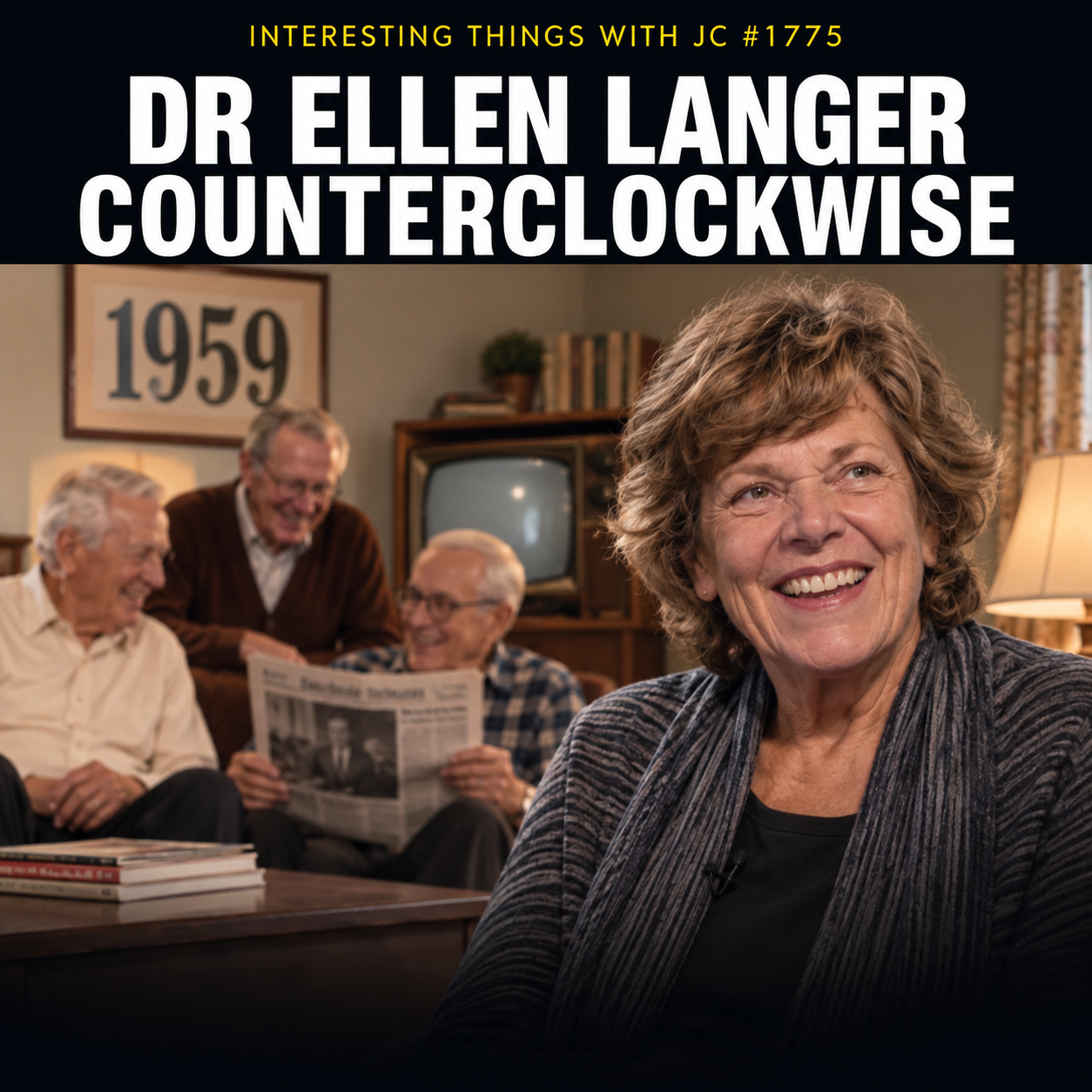
Promotional image for Interesting Things with JC #1775, titled “Dr Ellen Langer Counterclockwise.” A smiling older woman sits in the foreground of a warmly lit, 1950s-style living room. Behind her, three older men socialize, with one reading a newspaper. A vintage television, books, lamps, and a framed “1959” sign reinforce the period setting. Large white text across the top reads “DR ELLEN LANGER COUNTERCLOCKWISE,” with the series name and episode number in smaller yellow text above.
Transcript
Interesting Things with JC #1776:
"Ellen Langer - Counterclockwise"
In 1979, a group of men in their seventies and eighties arrived at a retreat that had been carefully stripped of the present. The magazines were old. The television programs, music, movies, and news came from another time. Nearly everything around them pointed to the year 1959.
The experiment was the work of Harvard psychologist Ellen Langer, who was studying the relationship between the mind and the body, and how much of what people experience as aging might be influenced by expectations and surroundings.
One group was told not simply to remember 1959, but to live for the stay as though it were 1959. They discussed the news and culture of the period in the present tense, surrounded by familiar pieces of the world they had known twenty years earlier. A comparison group experienced a similar retreat, but they were asked only to reminisce about 1959.
Before and after the stay, researchers measured aspects of physical and cognitive performance. Both groups improved, but Langer later reported that the men asked to inhabit the earlier time generally showed greater improvement across several measures of physical and cognitive functioning. Photographs taken afterward were also judged as looking younger.
The experiment has important limitations. It involved very few participants, lacked some controls Langer later said she would have preferred, and the original study was never published as a conventional peer-reviewed research paper. Much of its detailed record comes from Langer's later accounts, including her 2009 book, Counterclockwise. It isn't evidence that simply thinking young can reverse biological aging.
But something else had changed during that retreat. For several days, these men were living in a place where many of the ordinary signals telling them they were old had disappeared. Instead of continually being treated according to their age, they were surrounded by reminders of themselves twenty years earlier and expected to participate accordingly.
Langer would spend decades studying that territory: mindfulness, aging, expectations, and the relationship between mind and body. Her idea of mindfulness centers on actively noticing what is happening rather than automatically accepting familiar assumptions about what must be true.
The men in that retreat didn't actually return to 1959, and the experiment couldn't turn back time.
But for a few days in 1979, Ellen Langer changed what the clock was allowed to tell them.
These are interesting things, with JC.
Student Worksheet
Comprehension
What year did the counterclockwise experiment take place, and what earlier year did the retreat recreate?
What were participants in the experimental group instructed to do differently from participants in the comparison group?
What general types of performance did researchers measure before and after the retreat?
What results did Langer report for the two groups?
Identify three limitations of the experiment described in the episode.
Analysis
Why is the difference between “living as though” it were 1959 and reminiscing about 1959 important to the experimental design?
Identify at least two variables besides mindset that might plausibly have contributed to improvement during the retreat.
Why does a small sample make it difficult to generalize findings to all older adults?
Explain why “participants improved” does not justify the conclusion that “thinking young reverses biological aging.”
If researchers conducted the experiment again today, what additional control or design feature would strengthen the evidence?
Reflection
What expectations about age do you encounter in everyday life? Explain how one expectation might influence behavior without assuming that it changes underlying biology.
Which is more valuable scientifically: an unusual experiment that raises an important question or a less dramatic study with stronger controls? Defend your position.
Difficulty Scaling
Level 1 — Identify: Complete Questions 1–5 using evidence from the transcript.
Level 2 — Analyze: Complete Questions 1–10 and distinguish findings from interpretations.
Level 3 — Evaluate: Complete all questions and propose a stronger follow-up study with variables, controls, and measurable outcomes.
Student Output: Responses should use complete sentences. Analytical answers should identify specific evidence from the episode and explain how that evidence supports the conclusion.
Academic Integrity Guidance: Base claims on the assigned episode and teacher-approved sources. Distinguish direct evidence, reasonable inference, and personal opinion. Do not invent data, participants, measurements, or conclusions that the available evidence does not establish.
Teacher Guide
Quick Start: Play or read the episode without initially explaining whether the counterclockwise experiment was scientifically convincing. Ask students to record one finding they find interesting and one question they would ask about the research design.
Pacing Guide — Audio First
0–5 minutes: Bell ringer and prediction.
5–10 minutes: Listen to the episode without interruption.
10–18 minutes: Review experimental group, comparison group, baseline, and controls.
18–30 minutes: Students complete comprehension and analysis questions.
30–40 minutes: Conduct evidence-versus-claim discussion.
40–47 minutes: Students design one improvement to the experiment.
47–50 minutes: Complete exit ticket.
Bell Ringer: Write one statement you have heard about what people supposedly become better or worse at as they get older. What evidence would you need before treating that statement as scientifically reliable?
Audio Guidance: Students should listen once for the narrative and a second time, if time permits, for experimental design, findings, and limitations.
Audio Fallback: Read the supplied transcript aloud or assign paired reading. Preserve the distinction between the experimental and comparison conditions.
Time on Task: Approximately 50 minutes for a standard lesson; 75–90 minutes with the Level 3 research-design extension.
Materials
Episode audio or transcript
Student worksheet
Paper or digital response document
Optional research-design organizer
Board or shared display
Vocabulary Prep
Preteach experimental group, comparison group, baseline, and control before analysis.
Introduce replication, peer review, and causal inference when discussing evidentiary strength.
Contrast Langer’s use of mindfulness with everyday uses of the term.
Misconceptions
The study did not demonstrate literal reversal of time or establish reversal of biological aging.
Improvement after an intervention does not by itself identify which component caused the improvement.
A comparison group strengthens a study but does not automatically eliminate all alternative explanations.
An interesting result can deserve further investigation even when the original evidence is limited.
Critiquing methodology does not require dismissing the research question.
Discussion Prompts
What is the strongest feature of Langer’s experimental idea?
What is the most important limitation?
Why might both groups have improved?
How could increased activity, social interaction, novelty, or expectations complicate interpretation?
What distinction should journalists make between “suggests,” “shows,” and “proves”?
Formative Checkpoints
Students correctly identify the manipulated difference between the groups.
Students name at least one plausible alternative explanation.
Students distinguish measured outcomes from broad claims about aging.
Students explain why replication and stronger controls would increase confidence.
Differentiation
Additional Support: Provide a two-column organizer labeled “What Researchers Did” and “What Researchers Reported.”
Advanced Learners: Require students to design experimental, active-control, and no-treatment conditions and identify independent and dependent variables.
English Learners: Pair vocabulary with short definitions and allow oral rehearsal before written responses.
Assessment Differentiation: Students may demonstrate understanding through written analysis, structured oral response, or a research-design diagram accompanied by explanatory statements.
Time Flexibility: For a 30-minute lesson, use Questions 1–3, 6, 9, and the exit ticket. For a 90-minute block, add the experimental redesign task and peer critique.
Substitute Readiness: The lesson can be completed from the transcript alone. Have students read individually, complete Questions 1–10, and write a paragraph explaining the difference between an interesting finding and a scientifically established conclusion.
Engagement Strategy: Before revealing the methodological limitations, conduct a quick confidence rating: “How convincing is this experiment from 1–5?” Repeat the rating after students examine the limitations and ask them to justify any change.
Extensions
Design a modern replication with a larger sample and additional controls.
Create a claim-evidence-limitations chart based on the episode.
Compare popular descriptions of an experiment with scholarly descriptions of its methodology.
Investigate another study involving expectations or environmental cues and compare evidentiary strength.
Cross-Curricular Connections
Psychology: Expectations, cognition, behavior, aging, and mindfulness.
Biology/Health Science: Separating physiological measurements from claims about biological aging.
Statistics: Sample size, variability, generalizability, and replication.
English Language Arts: Evaluating claims and supporting conclusions with evidence.
Media Literacy: Examining how dramatic research findings can become simplified in popular communication.
SEL Connection: Students can examine age-related assumptions and perspective-taking while avoiding stereotypes about either younger or older people.
Skill Value Emphasis: Evidence evaluation, critical thinking, research literacy, cautious interpretation, and communication of uncertainty are transferable academic and workplace skills.
Answer Key
The experiment occurred in 1979 and recreated 1959.
The experimental group was asked to behave as though 1959 were the present; the comparison group reminisced about 1959 from the perspective of the present.
Researchers assessed aspects of physical and cognitive functioning before and after the retreat.
Both groups reportedly improved, with the experimental group generally reported as showing greater improvement across several measures.
Acceptable answers include the very small sample, missing controls, and lack of a conventional peer-reviewed publication of the original experiment.
It created the central difference being investigated: psychologically inhabiting the earlier period versus remembering it.
Acceptable examples include social interaction, novelty, increased activity, attention from researchers, environmental change, expectations, or participation in a retreat.
A small group may not adequately represent the wider population, and individual differences can have a large effect on results.
The experiment cannot establish broad reversal of biological aging; reported changes in selected measures are narrower than that claim, and alternative explanations remain.
Answers may include a larger randomized sample, additional control groups, blinded outcome assessment, standardized measurements, preregistration, longer follow-up, or independent replication.
Answers will vary but should distinguish social or behavioral influence from unsupported biological claims.
Answers will vary; strong responses evaluate both discovery value and evidentiary reliability.
Quiz
Questions
What was the central environmental feature of Langer’s 1979 experiment?
A. Participants lived without clocks for several months.
B. A retreat was arranged to evoke the world of 1959.
C. Participants received experimental anti-aging medication.
D. Researchers taught participants new physical exercises.
How did the experimental condition differ most importantly from the comparison condition?
A. Only the experimental group encountered objects from 1959.
B. Only the comparison group underwent physical testing.
C. The experimental group acted as though 1959 were the present, while the comparison group reminisced about it.
D. The comparison group consisted entirely of younger participants.
Which statement most accurately represents the reported results?
A. Neither group demonstrated measurable change.
B. Both groups improved on some measures, with broader or greater improvements reported for the experimental group.
C. Biological aging was permanently reversed.
D. Every participant became physically equivalent to his 1959 self.
Which factor most directly limits how confidently the original findings can be generalized?
A. The retreat contained magazines.
B. Participants discussed historical events.
C. The experiment involved very few participants.
D. The researchers collected measurements.
What is the most scientifically defensible conclusion from the episode?
A. Expectations have no relationship to human behavior.
B. Thinking about youth has been proven to reverse aging.
C. Age is entirely determined by environmental cues.
D. The experiment raises questions about expectations and context, but stronger evidence is required for broad causal claims.
Assessment
Open-Ended Questions
Evaluate the counterclockwise experiment as scientific evidence. Discuss its research question, experimental comparison, reported findings, and at least three limitations before reaching a conclusion about what the experiment can reasonably support.
Design a stronger modern study investigating whether age-related environmental cues or expectations influence measurable performance. Identify participants, conditions, controls, measurements, and a method for reducing researcher or participant bias.
3–2–1 Rubric
3 — Proficient: Accurately uses evidence, distinguishes findings from causal claims, identifies meaningful methodological limitations, and provides logically supported reasoning.
2 — Developing: Demonstrates basic understanding and uses some evidence but provides incomplete methodological analysis or overstates conclusions.
1 — Beginning: Provides limited evidence, confuses reported findings with established causation, or does not address major limitations.
Exit Ticket: In 2–3 sentences, complete this idea: “The counterclockwise experiment is scientifically interesting because ___, but it should not be interpreted as proof that ___ because ___.”
Standards Alignment
NGSS — Science & Engineering Practices
SEP — Analyzing and Interpreting Data — Students distinguish reported measurements from broader interpretations and identify limitations affecting what can be inferred from the data.
SEP — Engaging in Argument from Evidence — Students construct a defensible conclusion about the experiment and support it with specific evidence while acknowledging uncertainty.
CCSS Reading
CCSS.ELA-LITERACY.RST.11-12.1 — Cite specific textual evidence to support analysis of science and technical texts — Students identify transcript evidence supporting descriptions of the experimental design, findings, and limitations.
CCSS.ELA-LITERACY.RST.11-12.8 — Evaluate the hypotheses, data, analysis, and conclusions in a science or technical text — Students determine whether broad claims about aging are justified by the evidence presented.
CCSS Writing
CCSS.ELA-LITERACY.WHST.11-12.9 — Draw evidence from informational texts to support analysis, reflection, and research — Students use episode evidence to construct an evaluation of the counterclockwise experiment.
C3 Framework
D3.2.9-12 — Evaluate the credibility of a source by examining how experts value the source — Students consider sample size, controls, publication status, and replication when evaluating scientific credibility.
ISTE — Knowledge Constructor
1.3.b — Evaluate the accuracy, perspective, credibility and relevance of information, media, data or other resources — Students practice determining whether evidence supports the strength of claims made about an unusual psychological experiment.
Career Readiness Competencies
Critical Thinking: Evaluate evidence before accepting a causal conclusion.
Information Literacy: Distinguish primary findings, later accounts, interpretations, and unsupported extrapolation.
Communication: Explain scientific uncertainty precisely without presenting uncertainty as either proof or dismissal.
Research Design: Identify variables, controls, measurements, and alternative explanations.
Homeschool/Lifelong Learning
Learners practice evaluating health and psychology claims encountered in books, news, advertising, and social media.
Learners demonstrate mastery by explaining what the evidence suggests, what it does not establish, and what additional evidence would strengthen the conclusion.
Show Notes
Ellen Langer’s 1979 “counterclockwise” experiment asked older men to enter an environment modeled on 1959 and, for one group, to behave as though that earlier year were the present. Reported improvements made the experiment an enduring story about expectations, environmental cues, aging, and the relationship between mind and body. Its small sample, limited controls, and unusual publication history also make it an excellent classroom case in scientific literacy. Students can explore an intriguing psychological hypothesis while learning a crucial principle: interesting findings deserve attention, but the strength of a conclusion must remain proportional to the strength of the evidence.
References
Langer, E. J. (2009). Counterclockwise: Mindful health and the power of possibility. Ballantine Books. https://psychology.fas.harvard.edu/publications/counterclockwise-mindful-health-and-power-possibility
Harvard Gazette. (2018). Ellen Langer talks mindfulness, health. https://news.harvard.edu/gazette/story/2018/10/ellen-langer-talks-mindfulness-health/
Harvard University. (n.d.). Mindfulness & meditation. https://www.harvard.edu/in-focus/mindfulness-meditation/
Pagnini, F., Cavalera, C., Volpato, E., Comazzi, B., Vailati Riboni, F., Valota, C., Bercovitz, K., Molinari, E., & Phillips, D. (2019). Ageing as a mindset: A study protocol to rejuvenate older adults with a counterclockwise psychological intervention. BMJ Open, 9(7), e030411. https://bmjopen.bmj.com/content/9/7/e030411
Banakou, D., et al. (2026). Counterclockwise virtual reality–based embodiment of a younger self and revisit of a past iconic event in older adults: Between-groups study of cognitive and physical performance. JMIR Formative Research, 10, e88338. https://pmc.ncbi.nlm.nih.gov/articles/PMC13102333/
Harvard University Department of Psychology. (n.d.). Ellen Langer. https://psychology.fas.harvard.edu/people/ellen-langer
