Interesting Things with JC #1777: "Your Mind Controls Your Age"
Adults who viewed their own aging more positively lived an average of 7.5 years longer in a long-running Yale study. Across other studies, people who felt younger also walked faster and declined less over time, while researchers continue to examine how expectations about aging interact with behavior, health, and longevity.
Curriculum - Episode Anchor
Episode Title: Your Mind Controls Your Age
Episode Number: 1777
Host: JC
Audience: Grades 9–12, introductory college, homeschool, lifelong learners
Subject Area: Psychology, health science, human development, research literacy
Lesson Overview
Learning Objectives
Define subjective age and distinguish it from chronological age.
Explain how researchers have connected perceptions of aging with longevity, physical function, and health outcomes.
Distinguish correlation from causation when interpreting longitudinal research.
Evaluate possible behavioral and psychological pathways connecting beliefs about aging with health.
Essential Question: How might a person's perceptions and expectations about aging influence behavior, physical functioning, and health without literally controlling biological aging?
Success Criteria: Students can accurately describe subjective age, interpret the major findings discussed in the episode, identify limitations of observational evidence, and construct an evidence-based explanation of how beliefs and behavior may interact.
Student Relevance Statement: People form expectations about aging long before they become older adults. Understanding how those expectations may influence choices, confidence, activity, and health provides a practical example of how psychology and biology can interact.
Real-World Connection: Research on subjective aging is relevant to health communication, medicine, psychology, exercise science, public health, and the ways individuals make decisions about activity and social participation throughout adulthood.
Workforce Reality: Professionals in healthcare, counseling, rehabilitation, gerontology, research, fitness, and public health must distinguish evidence-supported psychological influences from exaggerated claims that thoughts alone determine health.
Key Vocabulary
Terms
Subjective age (sub-JEK-tiv ayj) — The age a person feels or experiences themselves to be, which may differ from chronological age.
Chronological age (kron-uh-LOJ-ih-kul ayj) — Age measured by elapsed time since birth.
Self-perception of aging (self per-SEP-shun uhv AY-jing) — A person's beliefs and evaluations concerning their own aging.
Longitudinal study (lon-juh-TOO-duh-nul STUH-dee) — Research that follows participants over time to examine change and relationships among variables.
Meta-analysis (met-uh-uh-NAL-uh-sis) — A statistical method that combines findings from multiple studies to estimate an overall pattern or effect.
Correlation (kor-uh-LAY-shun) — A statistical relationship between variables that does not, by itself, establish causation.
Causation (kaw-ZAY-shun) — A relationship in which a change in one factor produces a change in another.
Covariate (koh-VAIR-ee-it) — A variable statistically considered because it may also be related to an outcome.
Functional health (FUNK-shuh-nul helth) — A person's ability to perform physical activities and everyday tasks.
Bidirectional relationship (bye-dih-REK-shuh-nul ree-LAY-shun-ship) — A relationship in which each factor may influence the other.
Narrative Core
Open: The number on a birth certificate establishes chronological age, but people do not necessarily experience themselves as being that age. Researchers study this difference through concepts including subjective age and self-perceptions of aging.
Info: A well-known longitudinal study followed 660 adults who were at least 50 years old. Participants with more positive self-perceptions of aging lived an average of 7.5 years longer than those with less positive perceptions, after several relevant variables were statistically considered. An updated 2023 meta-analysis of 107 longitudinal studies found a small but robust overall association between measures of subjective aging and later health and longevity.
Details: Research has also connected younger subjective age with faster walking speed and less decline in walking speed in large longitudinal samples. Experimental studies provide additional evidence that expectations and stereotypes about aging can affect aspects of physical performance, including gait and strength. These findings do not establish that beliefs can override biological aging or guarantee longer life.
Reflection: Several mechanisms could contribute. Beliefs about aging may influence physical activity, social engagement, confidence, stress responses, and expectations about what a person can do. The relationship can also work in the opposite direction: declining health or mobility may cause someone to feel older. Distinguishing these possibilities is a central scientific challenge.
Closing: These are interesting things, with JC.
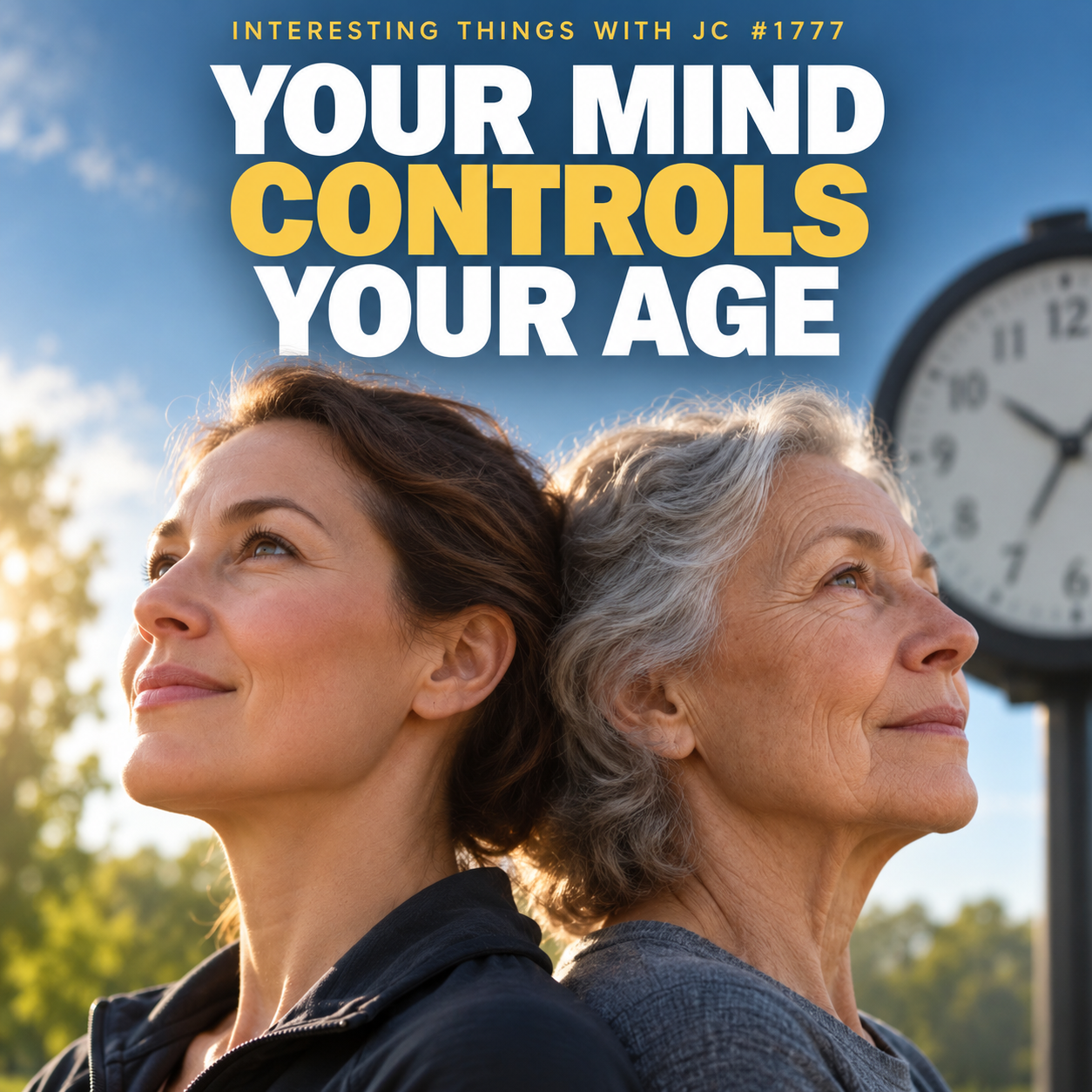
Episode #1777 artwork showing a younger and an older woman standing back-to-back beside a clock, illustrating perceptions of age and aging.
Transcript
Interesting Things with JC #1777:
"Your Mind Controls Your Age"
Your birth certificate gives you one age, but ask people how old they actually feel and you’ll often get a different number. Researchers call that subjective age, and it turns out that number can be connected to more than attitude.
In one long-running study, Yale researchers followed 660 adults who were at least 50 years old. Those who began the study with more positive perceptions of their own aging eventually lived, on average, 7.5 years longer than people with more negative perceptions, even after the researchers accounted for factors including age, sex, socioeconomic status, loneliness, and functional health.
That doesn’t mean positive thinking adds seven and a half years to your life. Aging is biological, and no belief can simply override disease, genetics, or time. But the relationship keeps appearing. A 2023 meta-analysis covering 107 longitudinal studies found that people with more positive perceptions of aging tended to have better health and longevity outcomes over time. The effects were generally small, but they were remarkably consistent.
Researchers have even seen it in movement. Across two large studies of older adults, people who felt younger than their chronological age walked faster and experienced less decline in walking speed over time. Experimental work has also shown that changing expectations about aging can temporarily affect physical performance, including walking speed and strength.
And there may be a practical reason for some of this. How you think about aging can influence what you expect from yourself. If getting older automatically means becoming frail, withdrawing, or doing less, those expectations can begin shaping behavior. Staying active and socially engaged, on the other hand, gives the body and brain something very different to work with.
The connection probably runs both ways. Feeling healthy can make you feel younger, while believing decline is inevitable may influence activity, stress, confidence, and the choices you make about your own body. Scientists are still working out exactly how those pieces interact.
So your mind doesn’t control the calendar, and it can’t stop aging. But the age you expect yourself to become may help shape the way you live while you’re getting there.
These are interesting things, with JC.
Student Worksheet
Comprehension
What is subjective age, and how does it differ from chronological age?
How many participants were included in the long-running longevity study described in the episode?
What difference in average longevity was reported between participants with more positive and more negative self-perceptions of aging?
What general conclusion did the 2023 meta-analysis of 107 longitudinal studies report?
Analysis
Why does the 7.5-year difference not prove that positive thinking causes a person to live 7.5 years longer?
Explain how physical activity could operate as a pathway between perceptions of aging and later health.
What does the statement that the relationship "probably runs both ways" mean? Provide an example in each direction.
Why does evidence from experimental research add something different from evidence obtained through longitudinal observation?
Reflection
Identify one expectation about aging that could influence a person's behavior. Explain how the expectation might eventually affect health without assuming that thoughts directly alter biological age.
Rewrite the episode title as a scientifically cautious claim that reflects the evidence presented.
Difficulty Scaling
Level 1 — Identify: Define terms and accurately summarize findings.
Level 2 — Explain: Connect beliefs, behaviors, and outcomes using evidence.
Level 3 — Evaluate: Analyze causation, alternative explanations, bidirectional effects, and limits of the evidence.
Student Output: Complete Questions 1–10 using complete sentences. Responses to Questions 5–10 should include specific evidence or reasoning from the episode.
Academic Integrity Guidance: Distinguish what the research reports from what you infer. Do not convert an association into a causal claim, and identify outside information if additional sources are used.
Teacher Guide
Quick Start: Play or read the episode once without interruption. Ask students to identify the central claim and one limitation. Replay or reread as needed before students complete the worksheet.
Pacing Guide — Audio First
0–5 minutes: Bell Ringer and introduction to chronological versus subjective age.
5–10 minutes: Listen to the complete episode.
10–18 minutes: Clarify vocabulary and identify major research findings.
18–30 minutes: Complete worksheet Questions 1–8.
30–40 minutes: Discuss correlation, causation, and bidirectionality.
40–48 minutes: Complete reflection questions.
48–55 minutes: Exit Ticket and review.
Bell Ringer: Ask students to respond privately: "Do you think feeling younger or older could influence how someone behaves? Explain one possible mechanism."
Audio Guidance: Students should listen first for the overall argument rather than attempting to record every statistic. During a second pass, identify the 660-participant study, the 107-study meta-analysis, and the walking-speed findings.
Audio Fallback: If audio is unavailable, read the supplied transcript aloud or have students read it individually before discussion.
Time on Task: Approximately 45–55 minutes for a standard lesson; 70–90 minutes with the extension activity.
Materials
Episode audio or transcript
Student Worksheet
Writing materials or digital response system
Optional research-source access for extension work
Vocabulary Prep
Contrast subjective age with chronological age.
Review longitudinal study, meta-analysis, correlation, causation, and covariate before evaluating the research.
Misconceptions
Positive thinking does not automatically add 7.5 years to an individual's life.
Subjective age is not the same as biological age.
Statistical adjustment for covariates strengthens an analysis but does not eliminate every possible confounding factor.
An association between feeling younger and better health does not establish which factor caused the other.
Small effects can still be scientifically meaningful when patterns are repeatedly observed across studies.
Discussion Prompts
Why might the title "Your Mind Controls Your Age" attract attention while requiring qualification?
What behavioral pathways could plausibly connect age beliefs with physical health?
Why is bidirectionality especially important when studying subjective age?
What additional experiment would help clarify cause and effect?
Formative Checkpoints
Students correctly distinguish subjective and chronological age.
Students describe the 7.5-year result as an observed group difference rather than a guaranteed effect.
Students identify correlation-versus-causation limitations.
Students can explain at least one plausible behavioral pathway.
Students recognize that health may also influence subjective age.
Differentiation
Additional Support: Provide a two-column organizer labeled "Research Found" and "Research Did Not Prove."
Advanced Learners: Have students identify confounding, mediation, reverse causation, and experimental evidence separately.
English Learners: Preteach the vocabulary and allow students to diagram the proposed relationship before writing responses.
Assessment Differentiation: Students needing support may demonstrate Questions 7–10 orally. Advanced students should propose a study design that could better distinguish causal pathways.
Time Flexibility: For a 30-minute lesson, complete Questions 1–8 and the Exit Ticket. For an extended period, add source evaluation and experimental-design activities.
Substitute Readiness: Provide the transcript, worksheet, and instruction to complete Questions 1–10 independently. The Answer Key below allows rapid review without additional preparation.
Engagement Strategy: Ask students to build a chain such as "belief → expectation → behavior → possible health outcome" and then identify where alternative explanations could enter.
Extensions
Compare an observational study with an experiment discussed in the episode.
Design a hypothetical study measuring subjective age, physical activity, walking speed, and health over five years.
Examine how media headlines can transform associations into causal claims.
Cross-Curricular Connections
Psychology: Self-perception, stereotypes, expectations, and behavior.
Biology/Health: Aging, physical functioning, and mobility.
Statistics: Effect size, covariates, longitudinal evidence, and meta-analysis.
English Language Arts: Evaluating claims and qualifying evidence.
SEL Connection: Students can examine how expectations about personal development influence confidence and behavior while avoiding the unsupported conclusion that individuals are responsible for biological illness or aging.
Skill Value Emphasis: Evidence evaluation, statistical literacy, causal reasoning, scientific communication, and distinguishing measured findings from interpretations are transferable academic and workforce skills.
Answer Key
Subjective age is how old a person feels or experiences themselves to be; chronological age is elapsed time since birth.
660 adults aged 50 or older.
Participants with more positive self-perceptions of aging lived an average of 7.5 years longer than those with more negative perceptions.
More positive measures of subjective aging were associated with better health and longevity outcomes over time, with an overall effect that was small but robust.
The study was observational; statistical associations and adjustment for measured variables do not establish that the perception itself caused the longevity difference.
Positive expectations could encourage continued physical activity, which may contribute to maintaining physical function and health.
Beliefs could influence behavior and health, while existing health could simultaneously influence how old someone feels.
Experiments manipulate conditions, providing stronger evidence about whether changing a psychological factor can produce a short-term performance change.
Answers will vary but must provide a plausible pathway without claiming that belief directly controls biological aging.
Accept answers such as: "How You Think About Aging May Influence How You Age."
Quiz
Questions
Subjective age refers primarily to:
A. Age calculated from biological markers
B. The age a person feels themselves to be
C. Legal age established by government records
D. Average life expectancyThe study of 660 adults reported that participants with more positive self-perceptions of aging:
A. Stopped experiencing biological aging
B. Lived exactly 7.5 additional years individually
C. Lived an average of 7.5 years longer as a group
D. Experienced no age-related diseaseWhy is the 2023 meta-analysis important to the episode's argument?
A. It combined evidence from 107 longitudinal studies
B. It proved thoughts directly determine lifespan
C. It eliminated all uncertainty about aging
D. It studied only walking speedWhat did the two large walking studies associate with younger subjective age?
A. Faster walking and less decline in walking speed
B. Complete prevention of mobility decline
C. Greater chronological age
D. Identical physical performance among all participantsWhich statement best represents the episode's scientific caution?
A. Beliefs have no relationship with physical functioning.
B. Subjective age completely determines biological aging.
C. Health determines beliefs, but beliefs never influence behavior.
D. Perceptions of aging may influence behavior and health, while health may also influence those perceptions.
Assessment
Open-Ended Questions
Construct an evidence-based explanation of how self-perceptions of aging could become associated with physical health without claiming that thoughts directly control biological aging. Include at least two possible pathways.
Evaluate the statement, "Thinking positively about aging makes you live longer." Use evidence from the episode to explain both why someone might make this claim and why the wording overstates the research.
3–2–1 Rubric
3 — Proficient: Accurately uses evidence, distinguishes association from causation, explains a plausible pathway, and recognizes bidirectionality or another limitation.
2 — Developing: Identifies relevant evidence and a possible pathway but provides incomplete causal reasoning or limited qualification.
1 — Beginning: Provides unsupported conclusions, misrepresents the findings, or treats correlation as proof of causation.
Exit Ticket: In two or three sentences, explain one thing perceptions of aging might influence and one thing the research does not demonstrate that the mind can control.
Standards Alignment
NGSS — Science & Engineering Practices
SEP 4 — Analyzing and Interpreting Data — Students interpret longitudinal and meta-analytic findings and distinguish measured associations from unsupported causal conclusions.
SEP 7 — Engaging in Argument from Evidence — Students construct and evaluate claims about subjective aging using evidence and explicit limitations.
CCSS Reading
CCSS.ELA-LITERACY.RST.11-12.1 — Cite Specific Textual Evidence — Students use episode evidence to support analysis of research findings and causal claims.
CCSS.ELA-LITERACY.RST.11-12.8 — Evaluate Hypotheses, Data, Analysis, and Conclusions — Students assess whether conclusions about aging perceptions are justified by observational and experimental evidence.
CCSS Writing
CCSS.ELA-LITERACY.WHST.11-12.1 — Write Arguments Focused on Discipline-Specific Content — Students construct qualified evidence-based arguments concerning the relationship between aging perceptions and health.
CCSS.ELA-LITERACY.WHST.11-12.9 — Draw Evidence from Informational Texts — Students incorporate specific research findings into written analysis.
C3 Framework
D2.His.10.9-12 — Detect Possible Limitations in Historical Record and Evidence — Adapted through inquiry practice, students identify evidentiary limitations and alternative explanations when interpreting claims.
D4.1.9-12 — Construct Arguments Using Precise and Knowledgeable Claims — Students develop claims that acknowledge competing explanations and evidentiary limits.
ISTE / CTE
ISTE 1.3 — Knowledge Constructor — Students evaluate the credibility and relevance of research evidence when developing conclusions about subjective aging.
CTE — Critical Thinking and Evidence Evaluation — Students differentiate observation, statistical association, experimental manipulation, and causal inference in health-related information.
Career Readiness Competencies
Critical Thinking: Evaluate whether evidence supports a stated conclusion.
Communication: Translate scientific findings into accurate language without exaggeration.
Information Literacy: Distinguish primary research, meta-analysis, and interpretation.
Problem Solving: Identify alternative explanations and propose methods for testing them.
Homeschool/Lifelong Learning
Learners can independently evaluate health claims encountered in news, social media, advertising, and everyday conversation by asking whether evidence demonstrates correlation, causation, or a plausible but unresolved relationship.
Show Notes
What if the age you feel matters alongside the age on your birth certificate? Episode #1777 examines research on subjective age and self-perceptions of aging, including a long-running longevity study, a large meta-analysis, and research connecting subjective age with physical performance. For classrooms, the episode provides an accessible case study in psychology, health science, longitudinal research, correlation versus causation, and bidirectional relationships. It matters because understanding health research requires recognizing both meaningful psychological influences and the limits of what scientific evidence allows us to claim.
References
Levy, B. R., Slade, M. D., Kunkel, S. R., & Kasl, S. V. (2002). Longevity increased by positive self-perceptions of aging. Journal of Personality and Social Psychology, 83(2), 261–270. https://pubmed.ncbi.nlm.nih.gov/12150226/
Westerhof, G. J., Nehrkorn-Bailey, A. M., Tseng, H.-Y., Brothers, A. F., Siebert, J. S., Wurm, S., Wahl, H.-W., & Diehl, M. (2023). Longitudinal effects of subjective aging on health and longevity: An updated meta-analysis. Psychology and Aging, 38(3), 147–166. https://pubmed.ncbi.nlm.nih.gov/36972091/
Stephan, Y., Sutin, A. R., & Terracciano, A. (2015). “Feeling younger, walking faster”: Subjective age and walking speed in older adults. Age, 37(5), 86. https://pubmed.ncbi.nlm.nih.gov/26296609/
Stephan, Y., Chalabaev, A., Kotter-Grühn, D., & Jaconelli, A. (2013). “Feeling younger, being stronger”: An experimental study of subjective age and physical functioning among older adults. The Journals of Gerontology: Series B, 68(1), 1–7. https://pubmed.ncbi.nlm.nih.gov/22492113/
Barber, S. J., Hamel, K., Ketcham, C., Lui, K., & Taylor-Ketcham, N. (2020). The effects of stereotype threat on older adults’ walking performance as a function of task difficulty and resource evaluations. Psychology and Aging, 35(2), 250–266. https://pmc.ncbi.nlm.nih.gov/articles/PMC7543189/