Interesting Things with JC #1778: "The Waffle House Hero"
James Shaw Jr. is trapped inside a Waffle House as a gunman fires through the restaurant, then the shooting stops. Shaw rushes the gunman, grabs the hot rifle barrel with his bare hand, wrestles the weapon away, and later turns the attention on him into more than $240,000 for the victims’ families.
Curriculum - Episode Anchor
Episode Title: The Waffle House Hero
Episode Number: 1778
Host: JC
Audience: Grades 9–12, introductory college, homeschool, lifelong learners
Subject Area: English Language Arts, social studies, psychology, civic reasoning, information literacy
Lesson Overview
Learning Objectives
Identify the sequence of events that led James Shaw Jr. to intervene during the April 22, 2018, Waffle House shooting.
Analyze how split-second decision-making, self-preservation, and courage interact under extreme circumstances.
Evaluate the difference between a person's understanding of their own actions and society's interpretation of those actions.
Explain how Shaw's actions after the attack expanded the meaning of service beyond the immediate emergency.
Essential Question: What makes an action heroic when the person responsible does not consider himself a hero?
Success Criteria: Students can accurately reconstruct the episode's events, distinguish documented facts from interpretation, support an analysis of heroism with evidence, and explain how Shaw's later fundraising contributes to the episode's central idea.
Student Relevance Statement: People regularly make decisions without complete information. Shaw's experience provides an unusually high-stakes case for examining judgment, responsibility, identity, and how actions can affect other people.
Real-World Connection: The episode connects narrative analysis to emergency decision-making, charitable action, public recognition, and the ways individuals respond after traumatic public events.
Workforce Reality: Employers across fields value situational awareness, sound judgment under pressure, initiative, communication, and the ability to act responsibly when circumstances change unexpectedly.
Key Vocabulary
Terms
Heroism (HAIR-oh-iz-um) — Courageous or selfless conduct that benefits or protects others.
Self-preservation (self prez-er-VAY-shun) — The instinct or effort to protect one's own life or safety.
Intervention (in-ter-VEN-shun) — An action taken to alter the course or outcome of a situation.
Situational awareness (sit-yoo-AY-shun-ul uh-WAIR-niss) — Perception and understanding of what is happening in one's immediate environment.
Split-second decision (split-SEK-und dih-SIZH-un) — A choice made extremely quickly with little time for deliberation.
Fundraiser (FUND-ray-zer) — An organized effort to collect money for a person, group, or cause.
Evidence (EV-ih-dens) — Information used to support or evaluate a claim.
Narrative (NAIR-uh-tiv) — An account of connected events arranged to communicate a story or idea.
Narrative Core
Open: A little after three in the morning on April 22, 2018, James Shaw Jr. entered a Waffle House in Antioch, Tennessee, with a friend. Within minutes, an ordinary late-night stop became a life-or-death situation.
Info: A gunman opened fire outside and then entered the restaurant with a semi-automatic rifle. Four people were killed and others were wounded. Shaw, then 29, moved toward the restaurant's rear area and found himself with few options for escape.
Details: After being grazed in the arm, Shaw noticed that the shooting had stopped. He could not know with certainty whether the weapon had jammed or the attacker was attempting to reload. Shaw used the brief opening to rush him, struggled for the rifle, grabbed its hot barrel, took the weapon away, and threw it over the counter. The attacker fled. Shaw later explained his decision primarily in terms of survival rather than heroism.
Reflection: Shaw's response did not end inside the restaurant. Within hours, he created a fundraiser for victims' families. Beginning with a $15,000 goal, the campaign ultimately generated more than $240,000. The sequence complicates the distinction between acting for self-preservation and producing consequences that benefit others.
Closing: These are interesting things, with JC.
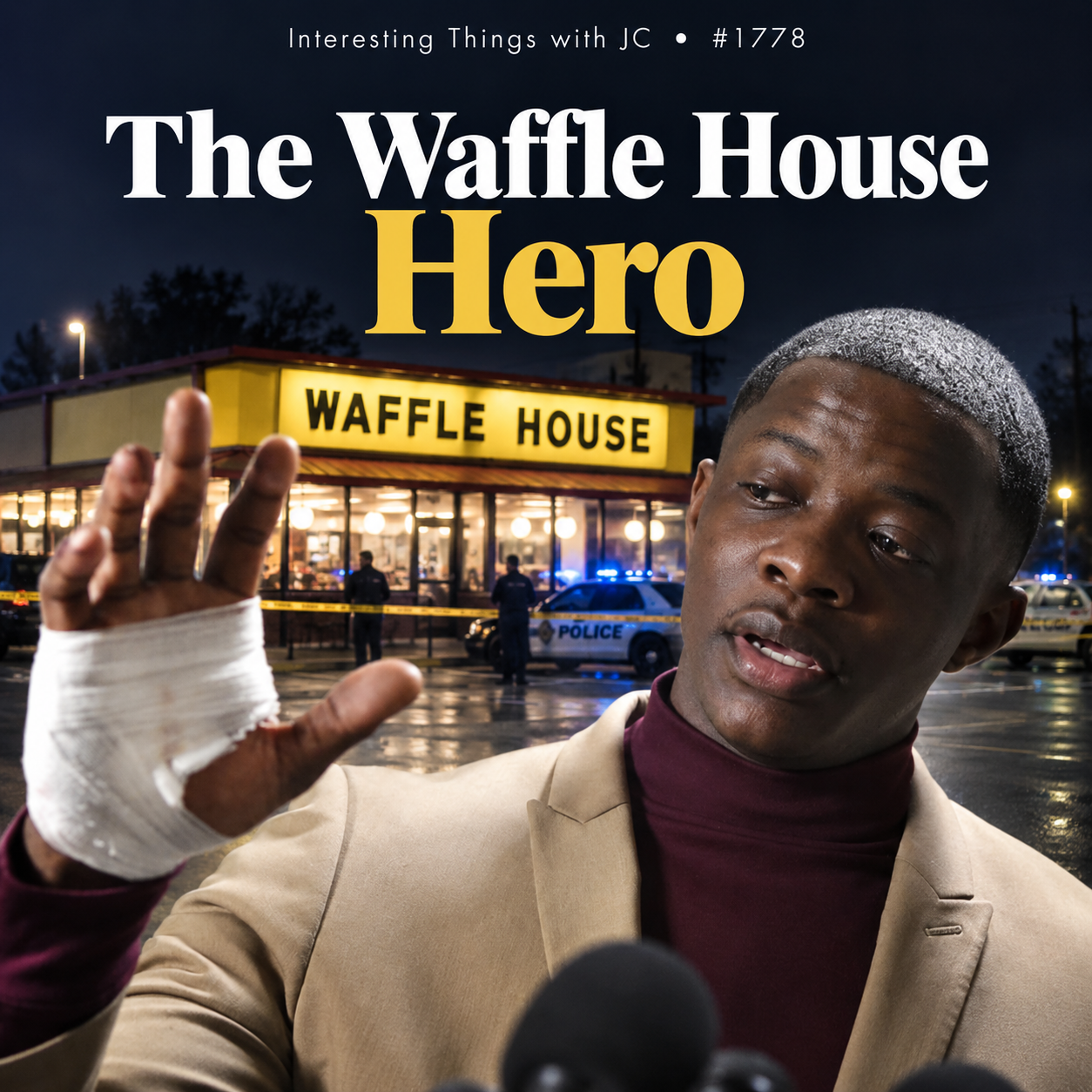
A square promotional graphic for Interesting Things with JC episode #1778, “The Waffle House Hero.” Large white and yellow title text appears over a nighttime scene outside a brightly lit Waffle House. In the foreground, a Black man wearing a tan jacket and burgundy turtleneck raises a heavily bandaged hand while speaking near a microphone. Police vehicles, officers, and yellow police tape are visible outside the restaurant in the background.
Transcript
Interesting Things with JC #1778:
"The Waffle House Hero"
A little after three in the morning on April 22, 2018, James Shaw Jr. and a friend walked into a Waffle House in Antioch, Tennessee. Shaw was 29 years old, and within minutes, he was on the floor with gunfire coming through the restaurant and nowhere left to hide.
The gunman had opened fire outside before entering with a semi-automatic rifle. Four people would die in the attack, and others were wounded. Shaw tried moving toward the back but ended up trapped near a swivel door. A bullet grazed his arm, and he later said he felt like a fish in a barrel.
Then the gunfire stopped.
Shaw didn't know why. He thought the gunman might be reloading or having trouble with the rifle, but he knew the pause might not last. With nowhere else to go, he rushed him.
Shaw grabbed the hot barrel with his bare hand and fought for the rifle. He was burned, but managed to wrench it away and throw it over the counter, then forced the attacker toward the door. The gunman fled on foot.
Almost immediately, people began calling James Shaw Jr. a hero. He resisted the word. Shaw said he'd acted to save himself and described himself as a regular person forced into a moment where he either had to react or fold.
What he did afterward made that explanation harder to leave there.
Within hours, Shaw started a fundraiser for the victims' families. His original goal was $15,000. It eventually raised more than $240,000.
Inside that Waffle House, Shaw had seconds to decide. He didn't know whether the gunman would start firing again or whether grabbing the rifle would work. He saw an opening and moved.
Later, when the attention turned toward him, he found another way to act, using it to help the families of people who hadn't made it out.
James Shaw Jr. could keep saying he wasn't a hero.
He'd already given everyone else enough evidence to decide for themselves.
These are interesting things, with JC.
Student Worksheet
Comprehension
Where and when did the events described in the episode occur?
What happened to Shaw as he moved toward the back of the restaurant?
What change in the situation gave Shaw an opportunity to act?
What did Shaw do after gaining control of the rifle?
What did Shaw establish following the attack, and whom was it intended to help?
Analysis
Why is the pause in the gunfire a turning point in the narrative?
Shaw framed his actions primarily as self-preservation. What evidence could another person use to characterize the same actions as heroic?
How does the fundraiser change or deepen the episode's examination of heroism?
Compare Shaw's knowledge during the attack with what readers know afterward. Why is that distinction important when evaluating his decision?
Reflection
Is heroism determined primarily by intention, action, outcome, or some combination of the three? Defend your position using at least two specific pieces of evidence from the episode.
Difficulty Scaling
Level 1 — Recall: Answer Questions 1–5 using complete sentences and direct episode evidence.
Level 2 — Analysis: Complete Questions 6–9 and explain how specific details support each conclusion.
Level 3 — Evaluation: Complete Question 10 with a defensible claim, counterargument, evidence, and conclusion.
Student Output: Produce written responses to Questions 1–10 or a teacher-selected subset. Analytical responses should identify evidence and explain its significance rather than merely retell events.
Academic Integrity Guidance: Use the episode as the primary source for your reasoning. Clearly distinguish details stated in the narrative from your own interpretations. Do not invent quotations, motives, or facts not established by the source.
Teacher Guide
Quick Start: Play or read the episode without giving students a definition of heroism beforehand. Ask students to record the moment they believe the central decision occurs and the evidence supporting that choice.
Pacing Guide — Audio First
0–5 minutes: Bell Ringer and prediction.
5–10 minutes: First uninterrupted listening.
10–15 minutes: Vocabulary and factual reconstruction.
15–25 minutes: Second listening or transcript review focused on decision points.
25–38 minutes: Student Worksheet analysis.
38–48 minutes: Discussion and evidence comparison.
48–55 minutes: Reflection and Exit Ticket.
Bell Ringer: Write a one-sentence working definition of heroism. Then identify whether intention, action, or outcome matters most to your definition.
Audio Guidance: On the first listen, students should focus on the story rather than taking extensive notes. During a second listen, have them identify what Shaw knew, what he did not know, and what he did.
Audio Fallback: If audio is unavailable, read the transcript aloud or have students read it silently, pausing only after the first complete reading.
Time on Task: Approximately 50–55 minutes for a full lesson; 25–30 minutes for a condensed version.
Materials
Episode audio or transcript
Student Worksheet
Writing materials or digital response platform
Optional three-column organizer labeled Known / Unknown / Action
Vocabulary Prep
Emphasize self-preservation, intervention, situational awareness, and evidence.
Ask students to distinguish heroism as an evaluative label from the observable actions on which that label may be based.
Misconceptions
Shaw did not describe himself as acting from certainty that his intervention would succeed.
Calling an outcome heroic does not establish that the actor's original motive was to become a hero.
The fundraiser was a separate, deliberate action after the immediate danger had ended.
The episode should not be treated as tactical instruction for responding to armed violence; it is a case study in decision-making and narrative interpretation.
Discussion Prompts
Can an action be heroic if self-preservation is the person's primary motivation?
Who has greater authority to define an action as heroic—the actor or the people affected by the action?
Why does the episode devote substantial attention to what Shaw did after the shooting?
How would the story's meaning change if the fundraiser were omitted?
Formative Checkpoints
Students correctly identify the pause in gunfire as the immediate opening Shaw perceived.
Students distinguish Shaw's stated motivation from the consequences of his intervention.
Students support interpretations with specific narrative evidence.
Students recognize the fundraiser as evidence relevant to the episode's broader characterization of Shaw.
Differentiation
Additional Support: Provide the Known / Unknown / Action organizer and allow students to cite paragraph numbers rather than reproduce details from memory.
Advanced Learners: Require students to distinguish motive, action, consequence, and retrospective interpretation in their definition of heroism.
English Learners: Preteach vocabulary and permit oral rehearsal before written responses.
Assessment Differentiation
Allow a structured paragraph, oral explanation, or concept map when appropriate while preserving the evidence-and-reasoning requirement.
Advanced responses should address a plausible counterargument.
Time Flexibility: For a 30-minute lesson, use one listening, Questions 3, 6, 8, and 10, followed by the Exit Ticket.
Substitute Readiness: Provide the transcript, worksheet, and answer key. The lesson can be completed without specialized background knowledge.
Engagement Strategy: Before revealing Shaw's comments about heroism, ask students privately whether they would apply the term to his actions. Revisit their answers after examining his own interpretation.
Extensions
Write a definition of heroism that accounts for both motive and outcome.
Compare the episode's narrative framing with a factual news account of the event.
Research how charitable fundraising can transform public attention after a crisis.
Cross-Curricular Connections
ELA: Narrative structure, evidence, characterization, argument.
Psychology: Decision-making under uncertainty and perception under stress.
Civics: Individual action, community response, and civic contribution.
Media Literacy: Differences between self-description and public characterization.
SEL: Discuss agency, empathy, responsible decision-making, and the difficulty of interpreting another person's choices under extreme circumstances without asking students to imagine themselves physically confronting an attacker.
Skill Emphasis: Evidence-based reasoning, source interpretation, causal analysis, and distinguishing facts from evaluative judgments.
Answer Key
The events occurred at a Waffle House in Antioch, Tennessee, early on April 22, 2018.
Shaw became trapped near a swivel door and was grazed in the arm by a bullet.
The gunfire stopped, creating a brief opening; Shaw believed the gunman might be reloading or experiencing trouble with the rifle.
Shaw took the rifle, threw it over the counter, and forced the attacker toward the exit; the attacker fled.
Shaw started a fundraiser for the victims' families.
The pause changes Shaw's position from being trapped under fire to perceiving a brief opportunity to intervene.
Strong responses may cite his decision to confront the attacker, disarm him, and thereby end the immediate attack despite substantial personal risk.
The fundraiser demonstrates deliberate assistance after Shaw was no longer acting under immediate threat, broadening the discussion from survival to service.
Shaw acted without knowing whether the weapon would fire again or whether his intervention would succeed. Retrospective knowledge of the outcome can make the decision appear more predictable than it actually was.
Answers will vary. Strong responses establish a definition, use at least two pieces of evidence, and explain why those details support the conclusion.
Quiz
Questions
What created the opening that Shaw used to confront the gunman?
A. Police entered the restaurant.
B. The gunfire temporarily stopped.
C. The restaurant lights went out.
D. Another customer took the rifle.What injury did Shaw sustain during the shooting?
A. A bullet grazed his arm.
B. He broke his leg.
C. He suffered a head injury.
D. He was struck by a vehicle.What did Shaw do with the rifle after taking it from the attacker?
A. He carried it outside.
B. He gave it to another customer.
C. He threw it over the counter.
D. He hid it near the restroom.How did Shaw characterize his own actions?
A. As a carefully planned rescue
B. As an attempt to gain recognition
C. As a response motivated by survival
D. As part of his professional responsibilitiesWhich later action most directly supports the episode's broader examination of service?
A. Shaw returned to the restaurant for dinner.
B. Shaw started a fundraiser for victims' families.
C. Shaw wrote a newspaper report.
D. Shaw became a restaurant employee.
Assessment
Open-Ended Questions
Evaluate the statement: An action does not have to begin with selfless motives to become heroic. Use Shaw's experience as evidence and address at least one reasonable counterargument.
Analyze how the episode uses the sequence of the shooting, Shaw's explanation, and the fundraiser to develop its final claim that others had "enough evidence to decide for themselves."
3–2–1 Rubric
3 — Proficient: Presents a clear claim, accurately uses multiple pieces of evidence, explains the relationship between evidence and conclusion, and distinguishes fact from interpretation.
2 — Developing: Presents a relevant claim and some accurate evidence but provides incomplete reasoning or limited explanation.
1 — Beginning: Provides a general opinion or summary with minimal accurate evidence and little explanation.
Exit Ticket: In two or three sentences, identify one detail that supports calling Shaw a hero and one detail that complicates that label. Conclude by stating which evidence you find more persuasive and why.
Standards Alignment
NGSS — Science & Engineering Practices
SEP — Engaging in Argument from Evidence — Students construct and defend a claim about heroism using documented actions as evidence while distinguishing observation from interpretation.
CCSS Reading
CCSS.ELA-LITERACY.RI.9-10.1 — Cite strong and thorough textual evidence — Students select specific details to support explicit and inferential conclusions.
CCSS.ELA-LITERACY.RI.11-12.3 — Analyze a complex set of ideas or sequence of events — Students analyze how the pause in gunfire, intervention, public response, and later fundraising develop the narrative's meaning.
CCSS Writing
CCSS.ELA-LITERACY.W.9-10.1 — Write arguments to support claims — Students construct an evidence-based definition and evaluation of heroism.
CCSS.ELA-LITERACY.W.11-12.9 — Draw evidence from informational texts — Students integrate episode details into analytical written responses.
C3 Framework
D2.Civ.10.9-12 — Analyze the impact and appropriate roles of personal interests and perspectives on the application of civic virtues — Students examine the relationship between Shaw's stated personal motivation and the wider social consequences of his actions.
ISTE / CTE
ISTE 1.3 — Knowledge Constructor — In an extension activity, students compare credible reporting with the narrative and evaluate how sources support factual claims.
CTE — Critical Thinking and Problem Solving — Students separate known information, uncertainty, action, and outcome while analyzing a real-world decision.
Career Readiness Competencies
Critical Thinking: Students evaluate competing interpretations using evidence.
Decision-Making: Students analyze choices made with incomplete information rather than assuming outcomes were predictable.
Communication: Students defend conclusions clearly while responding to alternative interpretations.
Initiative and Responsibility: Students examine how individual action can influence a broader community response.
Homeschool/Lifelong Learning
Learners practice source evaluation, ethical reasoning, narrative analysis, and evidence-based argument through a self-contained real-world case study suitable for independent or facilitated study.
Show Notes
In Episode #1778, "The Waffle House Hero," JC examines the actions of James Shaw Jr., who confronted and disarmed a gunman during the April 22, 2018, Waffle House shooting in Antioch, Tennessee, and later raised money for the victims' families. The episode gives students a focused case for examining courage, self-preservation, decision-making under uncertainty, public interpretation, and the meaning of heroism. Its classroom value lies not in asking students to imagine confronting violence themselves, but in evaluating evidence, intention, consequences, and the way later choices can reshape how an individual's actions are understood.
References
ABC News. (2018, April 29). Waffle House shooting hero raises over $185K for victims. https://abcnews.com/News/waffle-house-shooting-hero-raises-185k-victims/story?id=54803670
ABC7 San Francisco. (2018, April 23). Waffle House 'hero' says he 'felt like a fish in a barrel' before wrestling gun away. https://abc7news.com/post/waffle-house-hero-says-he-felt-like-a-fish-in-a-barrel-before-wrestling-gun-away/3379550/
CBS News. (2018, April 23). "Hero" customer wrestled rifle away from Waffle House shooter. https://www.cbsnews.com/news/waffle-house-shooting-tennessee-james-shaw-jr-hero-customer-charged-gunman-2018-04-22/
CNN. (2018, April 23). Anderson Cooper 360 Degrees: Interview with James Shaw Jr. https://transcripts.cnn.com/show/acd/date/2018-04-23/segment/01
NewsChannel 5 Nashville. (2018). James Shaw Jr. meets Waffle House families; presents them with check. https://www.newschannel5.com/news/james-shaw-jr-meets-waffle-house-families-presents-them-with-check
Tennessee State University Newsroom. (2018). TSU recognized for "Best Student Organization" and "Alumnus of the Year" at HBCU Digest Awards. https://tnstatenewsroom.com/tsu-recognized-for-best-student-organization-and-alumnus-of-the-year-at-hbcu-digest-awards/
Washington Post. (2018, April 22). James Shaw Jr. on why he rushed the Waffle House shooter: "He was going to have to work to kill me." https://www.washingtonpost.com/news/post-nation/wp/2018/04/22/james-shaw-jr-on-why-he-rushed-the-waffle-house-shooter-he-was-going-to-have-to-work-to-kill-me/